Key Cabinets Explained: Types, Sizes, Lock Options and Uses
April 27, 2026
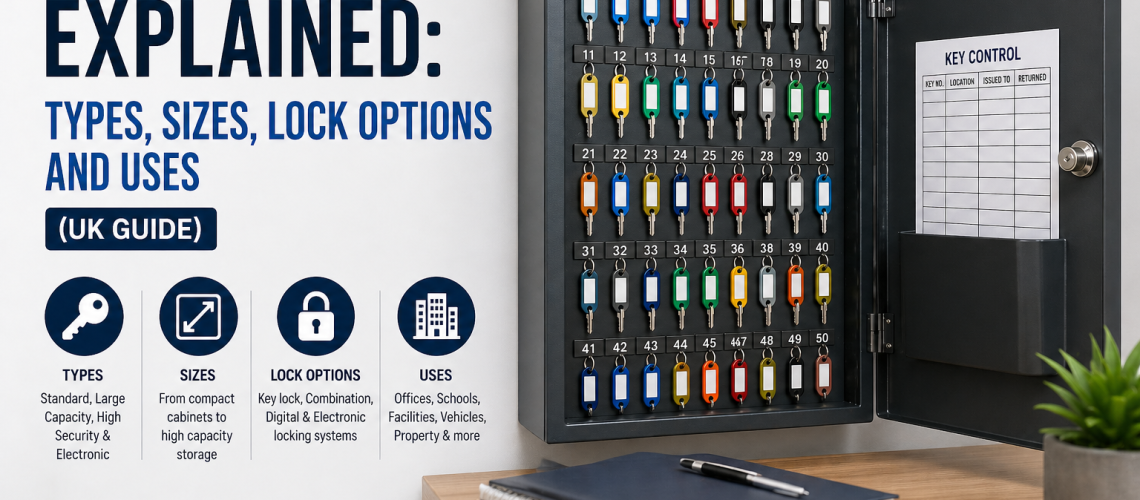
Key cabinets are secure storage units designed to organise keys, keep them in a defined location and restrict access to authorised users. They are used in offices, schools, workplaces, workshops, healthcare environments, vehicle operations, property businesses and facilities departments.
This guide explains the main types of key cabinets, what each type is designed for and the broad factors that affect cabinet choice. Detailed questions about capacity, mechanical versus digital access, tracking, compliance and day-to-day key management are covered in separate specialist guides.
What Is a Key Cabinet?
A key cabinet is a lockable cabinet designed specifically to store and organise keys. Commercial models commonly use numbered hooks, hook bars, key tags or indexing systems so that each key has a defined storage position.
Instead of leaving keys in drawers, on desks or in open cupboards, a cabinet creates a central storage point. This makes keys easier to identify, easier to return and harder to access casually.
Specification principle: choose the cabinet around the type of keys being stored, the level of risk and the access requirement, not simply the external cabinet dimensions.
Quick Answer: Which Key Cabinet Do I Need?
| Requirement | Broad cabinet type |
|---|---|
| Routine office or cupboard keys | Standard key cabinet |
| Large collection of ordinary keys | Large-capacity key cabinet |
| Vehicle fobs or bulky bunches | Deep key cabinet |
| Master keys or more sensitive keys | Higher-security key cabinet |
| Electronic access to the cabinet | Digital or electronic key cabinet |
| Complex issuing, return or user permissions | Dedicated key-control system |
The cabinet type and the key-management process are related but separate decisions. This page focuses on the cabinet itself.
Main Types of Key Cabinets
Standard Key Cabinets
Standard key cabinets are designed for everyday key storage. They normally contain numbered hooks or adjustable hook bars and use a straightforward cabinet lock.
Typical uses include:
- office room keys;
- cupboard and filing keys;
- school and college keys;
- workshop and maintenance keys;
- locker keys;
- store-room keys;
- routine spare keys.
For many smaller businesses and departments, a standard cabinet provides all the physical storage required.
Large-Capacity Key Cabinets
Large-capacity cabinets use the same basic storage principle but provide more key positions. They are useful for schools, estates teams, facilities departments, hotels, property businesses, warehouses and other organisations managing many rooms or assets.
Capacity is not simply a hook-count question. Large tags, fobs and key bunches can reduce the usable space inside a cabinet.
For detailed capacity planning, use Commercial Key Cabinet Sizes UK.
Deep Key Cabinets
Deep key cabinets provide additional clearance between the rear of the cabinet and the door. This makes them particularly useful for vehicle keys, electronic fobs, large bunches and keys carrying substantial identification tags.
A cabinet can have enough nominal hook positions and still be awkward to use if bulky fobs overlap. In those applications, depth can matter as much as hook count.
Higher-Security Key Cabinets
Higher-security key cabinets are intended for keys where unauthorised access could create a greater operational, financial or security consequence.
- master keys;
- vehicle keys;
- plant-room keys;
- restricted-area keys;
- equipment-store keys;
- keys controlling higher-value assets.
Construction and locking features vary by product. Where a site has an insurance, contractual or security requirement, check the specification and any relevant certification of the individual cabinet rather than relying on the description alone.
Digital and Electronic Key Cabinets
Digital or electronic key cabinets use electronic access instead of, or in addition to, a conventional mechanical cabinet lock.
Depending on the product, access may use a PIN, keypad, card, fob, RFID credential or another electronic method.
Electronic access does not automatically mean individual key tracking. Some products only control access to the cabinet door, while more advanced systems provide much more detailed user or key control.
For the detailed technology comparison, use Mechanical vs Digital Key Cabinets.
Key Cabinet Lock Options
At broad category level, key cabinets are available with several common access methods.
| Access method | Typical use | Main consideration |
|---|---|---|
| Key-operated lock | Simple controlled storage | The cabinet key must itself be controlled |
| Mechanical combination | Shared access without issuing cabinet keys | The code must remain restricted |
| Digital keypad | Convenient electronic access | Codes and permissions still need managing |
| Card, fob or electronic credential | Individual electronic access | Requires compatible hardware and administration |
This guide does not compare those technologies in depth. That purchasing decision belongs in Mechanical vs Digital Key Cabinets: Which Should You Choose?.
Where Are Key Cabinets Used?
Offices
Offices may use key cabinets for entrance doors, meeting rooms, filing cabinets, cupboards, storage rooms and spare keys. Smaller premises often need only a straightforward standard cabinet.
Schools and Colleges
Education sites can have large numbers of classroom, gate, storage, maintenance, office and equipment keys. Clear indexing becomes more important as the collection grows.
Facilities and Estates Teams
Facilities departments may hold keys for plant rooms, service areas, stores, roofs, maintenance spaces, lockers and other controlled locations. Larger estates may use several cabinets or separate higher-risk keys from routine keys.
Vehicle and Fleet Operations
Garages, dealerships, transport operations and vehicle fleets often need deeper cabinets because modern vehicle fobs can be bulky.
Property Management
Estate agents, landlords and property-management organisations may hold keys for many properties, making clear indexing and reliable storage positions particularly important.
Workshops and Industrial Sites
Industrial sites may use cabinets for workshop doors, stores, machinery access, gates, plant areas and vehicles. Keys controlling higher-risk equipment may justify stronger cabinet construction or tighter access.
When Is a Standard Key Cabinet Enough?
A standard cabinet can be entirely appropriate where the main requirement is organised, restricted storage rather than detailed user tracking.
- the authorised user group is small and stable;
- the keys are mainly routine;
- access requirements are straightforward;
- individual electronic credentials are unnecessary;
- the business does not need detailed key-use reporting.
There is little benefit in specifying an advanced electronic system where simple controlled storage solves the actual problem.
When Is a Standard Key Cabinet Not Enough?
A different cabinet type or a wider key-control system may be required when:
- many authorised users need cabinet access;
- permissions change frequently;
- master keys or high-value asset keys are involved;
- vehicle keys are heavily shared;
- the organisation needs stronger evidence of who accessed keys;
- ordinary cabinet construction does not meet the site’s security requirement.
If the main problem is issuing, returning and controlling who has a key, move to Key Control Systems UK. If the problem is recording key movement, use Key Tracking Methods UK.
How to Choose the Right Key Cabinet
1. Identify the Keys
List the keys you need to store and separate ordinary keys from master keys, vehicle fobs, large bunches and more sensitive keys.
2. Assess the Risk
Consider the consequence if an unauthorised person obtained one of the keys. Routine cupboard keys and building master keys should not automatically use the same storage approach.
3. Decide Who Needs Cabinet Access
A cabinet used by one office manager has a different access requirement from one serving a large facilities or shift-working team.
4. Choose the Broad Cabinet Type
Decide whether the application calls for a standard, large-capacity, deep, higher-security or electronically accessed cabinet.
5. Choose the Required Capacity
Capacity should be planned separately. Use Commercial Key Cabinet Sizes UK for hook count, fobs, bulky bunches and spare capacity.
6. Choose the Access Method
For the detailed mechanical-versus-digital purchasing decision, use Mechanical vs Digital Key Cabinets.
Common Key Cabinet Mistakes
- Choosing only by external cabinet size: internal capacity and depth matter more.
- Ignoring bulky fobs: vehicle keys may need additional depth or spacing.
- Using routine storage for high-risk keys: the cabinet should reflect the importance of the keys.
- Assuming digital access automatically means tracking: an electronic lock and a full key-management system are not the same thing.
- Over-specifying the cabinet: simple applications may not need electronic access.
- Under-specifying the cabinet: a light-duty standard unit may be inappropriate for more sensitive keys.
Key Cabinet FAQs
What is a key cabinet?
A key cabinet is a lockable storage unit designed to organise keys in defined positions and restrict access to authorised users.
What type of key cabinet do I need?
The broad type depends on the keys being stored, their physical size, the level of risk and how users need to access the cabinet. Standard, large-capacity, deep, higher-security and electronic cabinets suit different applications.
Can key cabinets store vehicle keys?
Yes. Vehicle keys are commonly stored in key cabinets, but modern fobs and large bunches may require additional internal depth or spacing.
Are digital key cabinets the same as key-control systems?
No. A digital cabinet may simply use electronic access to the cabinet door. A key-control system can also manage permissions, issuing, return and key accountability.
What size key cabinet do I need?
The required size depends on the number and physical size of the keys, bulky fobs, key bunches and future growth. Detailed sizing should be handled separately from the broad cabinet-type decision.
Related Key Cabinet Guides
| Question | Guide |
|---|---|
| How many keys should the cabinet hold? | Commercial Key Cabinet Sizes UK |
| Mechanical or digital access? | Mechanical vs Digital Key Cabinets |
| How should keys be issued and returned? | Key Control Systems UK |
| How should key movement be recorded? | Key Tracking Methods UK |
| Where should the cabinet be installed? | Where to Install Key Cabinets |
| What governance and evidence are needed? | Key Storage Compliance UK |
| What is a sensible setup for a small office? | Small Business Key Storage UK |
Summary: Key Cabinets Explained
Key cabinets provide a practical way to organise keys and restrict access to them. Standard cabinets suit routine storage, large-capacity cabinets manage bigger collections, deep cabinets accommodate bulky fobs, higher-security cabinets suit more sensitive keys and digital cabinets provide electronic access.
The broad cabinet type should be chosen first. Capacity, access technology, tracking, compliance and day-to-day key management should then be handled by their dedicated guides rather than being treated as one decision.
Discover more from Blog Total Locker Service
Subscribe to get the latest posts sent to your email.