High-Security Key Cabinets UK: Security Levels, Construction and When You Need One
July 2, 2025
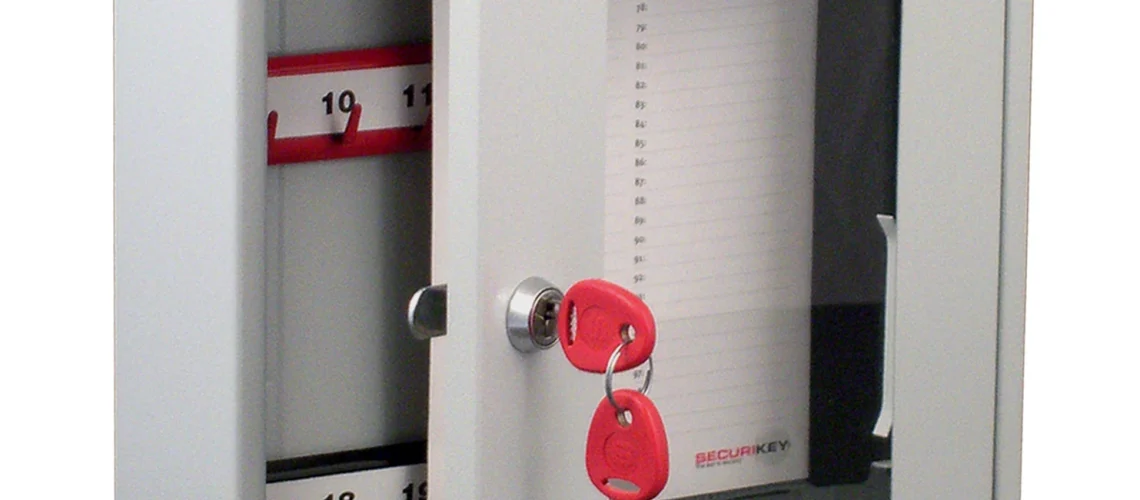
Not every workplace needs a high-security key cabinet. For routine office keys, cupboard keys and other relatively low-risk items, a standard locked key cabinet may provide perfectly adequate controlled storage. However, the security requirement changes when a cabinet contains master keys, vehicle keys, access keys, plant keys or keys that could provide entry to valuable or restricted areas.
A high-security key cabinet uses stronger physical construction and more substantial locking than a basic key box. The objective is not simply to keep keys organised. It is to make unauthorised physical access to the stored keys substantially more difficult.
This guide explains the difference between standard and high-security key cabinets, the construction features that matter, how to assess the risk associated with the keys being stored and when reinforced key storage is justified.

What is a high-security key cabinet?
A high-security key cabinet is a reinforced physical storage cabinet designed for keys where unauthorised access could create a significant security, operational or financial risk.
The important distinction is physical protection. High-security cabinets generally use heavier steel construction, stronger doors and locking at several points around the door rather than relying on the relatively simple construction used for routine key organisation.
Total Locker Service’s high-security key cabinets, for example, use a 3 mm welded steel body, 6 mm steel door and three-way locking mechanism. They are designed for controlled storage of larger or higher-risk key inventories.
A reinforced cabinet does not automatically provide electronic tracking or record who removed an individual key. Physical key security and key-management auditing are separate requirements. Where user-level records or automatic audit trails are required, see our guide to mechanical vs digital key cabinets.
Standard vs high-security key cabinets
The correct cabinet should be selected according to the consequences of somebody obtaining the keys, rather than simply choosing the strongest cabinet available.
| Requirement | Standard key cabinet | High-security key cabinet |
|---|---|---|
| Primary purpose | Organised controlled key storage | Reinforced storage for higher-risk keys |
| Typical keys | Office, cupboard and routine internal keys | Master, vehicle, plant, building and restricted-access keys |
| Construction | Lighter steel cabinet construction | Heavier reinforced cabinet and door construction |
| Door locking | Usually a conventional cabinet lock | May use multi-point or three-way locking |
| Physical attack resistance | Suitable for routine controlled environments | Greater resistance to forced physical access |
| Best suited to | Low to moderate consequences if compromised | Keys where compromise could create substantial risk |
A standard key cabinet is therefore not an inferior product when used for the right application. Security should be proportionate to the risk.
Start with the risk created by the keys
The value of a key is not determined by the piece of metal itself. Its importance comes from what that key can access.
A small cupboard key may present very little risk. A master key capable of opening large parts of a building can have considerably greater consequences if stolen. The same applies to keys for vehicles, plant, secure stores and restricted areas.
- What can the key open?
- What could somebody access if the key were stolen?
- Does one key provide access to several doors or areas?
- Could the key allow a vehicle or piece of equipment to be used?
- Would loss require locks or cylinders to be replaced?
- Could loss disrupt normal business operation?
- Are replacement locks or keys expensive?
- Would unauthorised access create a safety or security problem?
The greater the consequence of compromise, the stronger the case for reinforced physical storage.
Why master keys need particular consideration
Master keys deserve particular attention because one physical key may provide access to numerous locks within a site.
Storing a master key in the same way as a low-risk cupboard key can therefore underestimate its importance. Loss of a master key may affect a much larger part of the organisation and, depending on the locking system, could lead to significant replacement work.
Sites managing master and sub-master keys should consider whether those keys require a separate restricted cabinet or reinforced storage rather than placing every site key in one general-access cabinet.
Key cabinet construction: why steel thickness matters
The construction of the cabinet body and door affects its resistance to physical attack.
Routine key cabinets can use relatively light steel because their primary purpose is controlled storage and organisation. As the security requirement increases, heavier fabricated or welded steel construction becomes more appropriate.
Within the Total Locker Service range, standard System Key Cabinets use 1.5 mm steel, while our high-security filing cabinets use a 3 mm welded steel body and 6 mm steel door.
Steel thickness should not, however, be considered in isolation. Cabinet construction, door design, hinges, locking points, mounting and the surrounding installation all contribute to physical security.
The door is as important as the cabinet body
A reinforced cabinet body provides limited benefit if the door or locking arrangement remains the weakest point.
High-security designs therefore commonly combine a heavier door with reinforced locking arrangements. A substantial door is more resistant to distortion and gives the locking mechanism a stronger structure against which to operate.
When comparing cabinets, look beyond the overall cabinet dimensions and examine:
- cabinet body construction;
- door construction and thickness;
- how the door overlaps or closes against the cabinet body;
- the number and position of locking points;
- hinge protection;
- lock protection;
- and the method used to secure the complete cabinet to the building.
What is three-way locking?
A conventional cabinet may rely primarily on one locking point. A three-way locking system secures the door at several points, helping distribute resistance around the door rather than concentrating it at one location.
Total Locker Service’s high-security key filing cabinets use three-way locking as part of their reinforced physical-security design.
Three-way or multi-point locking should not be confused with electronic access control. It describes how the cabinet door is physically secured. A cabinet can therefore have substantial multi-point physical locking while still using either a key-operated or keypad lock to authorise opening.
Key lock or keypad lock?
Lock choice and cabinet construction are related but separate decisions.
A strong cabinet can use a conventional key-operated lock or an appropriate keypad locking option. The choice should be based on who needs cabinet access and how access credentials will be managed.
A keypad can remove the need to manage a separate cabinet key, but that does not turn a physical cabinet into an electronic key-management system. Systems that identify individual users, control access to individual key positions or automatically record key removal and return belong to a different product category.
For that decision, see Mechanical vs Digital Key Cabinets UK.
Physical attack resistance
The reason for specifying a high-security cabinet is to increase the amount of physical protection around the key inventory.
No cabinet should be described as impossible to attack. Instead, consider how its construction improves resistance compared with a lightweight storage cabinet.
Important characteristics can include:
- heavier steel cabinet construction;
- a substantially reinforced door;
- multiple locking points;
- protected hinges and vulnerable areas;
- a strong internal frame around the door;
- and secure fixing to a suitable structural surface.
The complete installation matters. An expensive reinforced cabinet mounted poorly to an unsuitable wall may provide less security than its construction suggests.
Secure installation matters
A key cabinet protects the keys only while the cabinet itself remains securely installed.
Higher-security cabinets should normally be installed within a controlled or supervised area and securely fixed to a structure capable of supporting the cabinet and resisting removal.
The appropriate fixing method depends on the cabinet, its weight, the wall construction and the security requirement. Installation should therefore be considered part of the security specification rather than an afterthought.
Where should a high-security key cabinet be located?
Putting a reinforced cabinet in an unrestricted public area unnecessarily exposes it to interference. Wherever practical, locate high-risk key storage within an area already subject to some level of access control or supervision.
- security offices;
- facilities or estates offices;
- controlled back-office areas;
- supervised workshops;
- vehicle or fleet offices;
- restricted plant or maintenance areas.
Location should also allow authorised staff to use the cabinet practically. Security that makes everyday operation unnecessarily difficult can encourage poor working practices.
When is a standard key cabinet enough?
High-security construction should not automatically be specified for every set of keys.
A normal commercial key cabinet may be entirely suitable where:
- the keys provide access only to routine internal areas;
- the cabinet is already located inside a secure staff-only room;
- the consequences of individual key loss are limited;
- the primary requirement is organised storage;
- and there is no identified requirement for reinforced physical protection.
Do not confuse higher specification with better specification. The best cabinet is the one proportionate to the actual risk.
When should you consider a high-security key cabinet?
Reinforced storage becomes more relevant when the keys themselves provide access to valuable, sensitive or operationally important assets.
- Master and sub-master keys: one key may provide access to numerous doors.
- Vehicle keys: unauthorised access may provide immediate access to cars, vans or specialist vehicles.
- Plant and equipment keys: access may allow machinery or specialist equipment to be operated.
- Building access keys: loss can affect physical security across a site.
- Restricted-area keys: laboratories, plant rooms, secure stores and other controlled areas may justify greater physical protection.
- Large estates: a central cabinet may contain keys controlling substantial parts of a building or site.
Commercial and facilities-management applications
Facilities and estates teams often control a much more consequential collection of keys than a typical small office.
A single cabinet may contain building entrance keys, maintenance keys, plant-room keys, vehicle keys, master keys and keys for areas normally unavailable to general staff.
In these environments it can make sense to separate routine keys from higher-risk keys. A standard cabinet can continue to handle everyday internal keys while a reinforced cabinet provides stronger physical protection for the smaller number of particularly sensitive keys.
Schools and education sites
Schools, colleges and larger education estates can hold substantial key inventories covering classrooms, gates, stores, offices, maintenance areas and external buildings.
Not every key requires high-security storage. The more important question is whether particular master, external-access or restricted-area keys create a higher consequence if compromised.
Separating those keys from routine departmental keys can produce a more proportionate security arrangement than treating the complete inventory identically.
Vehicle, fleet and depot keys
Vehicle keys deserve separate consideration because access to the key can effectively provide access to the asset itself.
Depots, fleet operators, workshops and facilities departments may therefore choose stronger cabinet construction for vehicle and plant keys, particularly where many vehicles are controlled from one location.
Remember that vehicle fobs and large key bunches also take more physical space than individual door keys. Capacity and physical security are separate decisions. For cabinet sizing, see our Key Cabinet Sizes and Capacity UK guide.
Insurance and security requirements
Do not assume that a particular key cabinet automatically satisfies an insurer, accreditation scheme or site-security requirement.
If an insurer, customer, security consultant or internal policy specifies a particular security standard, lock approval or construction requirement, obtain the exact requirement before ordering.
Security terminology can vary between products, and phrases such as “high security” should not be treated as a substitute for a specified certification or approval.
Where a particular model or lock carries an independently recognised certification, check the current manufacturer specification for that exact model and locking option rather than assuming the approval applies across an entire product range.
High-security cabinet vs electronic key management
These solve different problems and should not be treated as interchangeable.
| Requirement | High-security physical cabinet | Electronic key-management system |
|---|---|---|
| Reinforced physical storage | Primary function | Varies by system |
| Individual user identification | Normally no | Often available |
| Automatic issue/return records | No | Often available |
| Individual key-position control | No | Available on suitable systems |
| Physical attack resistance | Major specification consideration | Depends on cabinet construction |
If your problem is primarily that keys need stronger physical protection, consider a reinforced cabinet. If your main problem is determining who took a key and when it was returned, the requirement is closer to electronic key management and key tracking.
Do not use cabinet capacity as a security measure
A cabinet holding 300 keys is not automatically more secure than one holding 50. Capacity tells you how much the cabinet can organise; it does not tell you how resistant the cabinet is to unauthorised physical access.
Likewise, a small collection of five master keys may justify stronger protection than several hundred low-risk internal keys.
Determine the security requirement first, then choose sufficient capacity within the appropriate cabinet type.
High-security key cabinet selection checklist
- Identify what every higher-risk key can access.
- Separate master, vehicle, plant and restricted-area keys from routine keys where appropriate.
- Assess the consequences if the complete cabinet were compromised.
- Compare cabinet body and door construction.
- Check the locking arrangement and number of locking points.
- Choose a suitable lock type for authorised cabinet users.
- Check that the installation surface can support secure fixing.
- Install the cabinet within a controlled area where practical.
- Check any insurer or customer security requirement before purchase.
- Verify certifications against the exact product and locking option where a specific approval is required.
- Choose capacity separately according to the number and physical size of the keys being stored.
High-security key cabinet FAQs
What makes a key cabinet high security?
A high-security key cabinet generally uses stronger cabinet and door construction together with a more substantial locking arrangement than a routine key cabinet. The exact construction varies by product, so compare the specification rather than relying solely on the product description.
Do I need a high-security key cabinet?
Not necessarily. Standard cabinets are appropriate for many routine workplace keys. Consider reinforced storage where loss or theft of the keys could provide access to valuable assets, vehicles, large parts of a building or restricted areas.
Should master keys be stored in a high-security cabinet?
It can be appropriate because one master key may provide access to many locks. Assess the extent of access provided by the key and the consequences if it were lost or stolen.
Is a digital key cabinet more secure?
Not automatically. Digital access can improve user control and audit capability, while physical security depends on the construction and locking of the cabinet itself. The two requirements should be assessed separately.
What is three-way locking on a key cabinet?
Three-way locking secures the cabinet door at multiple points rather than relying on a single central locking point. Check the exact locking arrangement on the selected model.
Does a high-security key cabinet provide an audit trail?
Not simply because it is described as high security. A reinforced mechanical cabinet primarily provides physical protection. Automatic user and key-movement records require an electronic key-management or tracking system designed to provide that functionality.
Do insurers require high-security key cabinets?
Requirements vary. If key storage forms part of an insurance condition, obtain the insurer’s exact specification before purchasing. Do not assume that a general high-security description meets a particular insurance requirement.
Choosing the right level of key security
The correct approach is not to put every key into the strongest cabinet available. It is to match the physical protection to the consequence of losing control of the keys.
Routine office and internal keys can often be managed effectively in a standard commercial key cabinet. Master keys, vehicle keys, plant keys and keys controlling valuable or restricted areas may justify stronger construction and multi-point locking.
For reinforced physical key storage, view our high-security key cabinet range. For the wider selection of standard, deep, high-capacity and electronic products, see our commercial key cabinets.
Discover more from Blog Total Locker Service
Subscribe to get the latest posts sent to your email.