Blog Total Locker Service

Blog storage solutions

Fire Safe Buying Guide UK: How to Choose the Right Protection (2026)

Fire safe

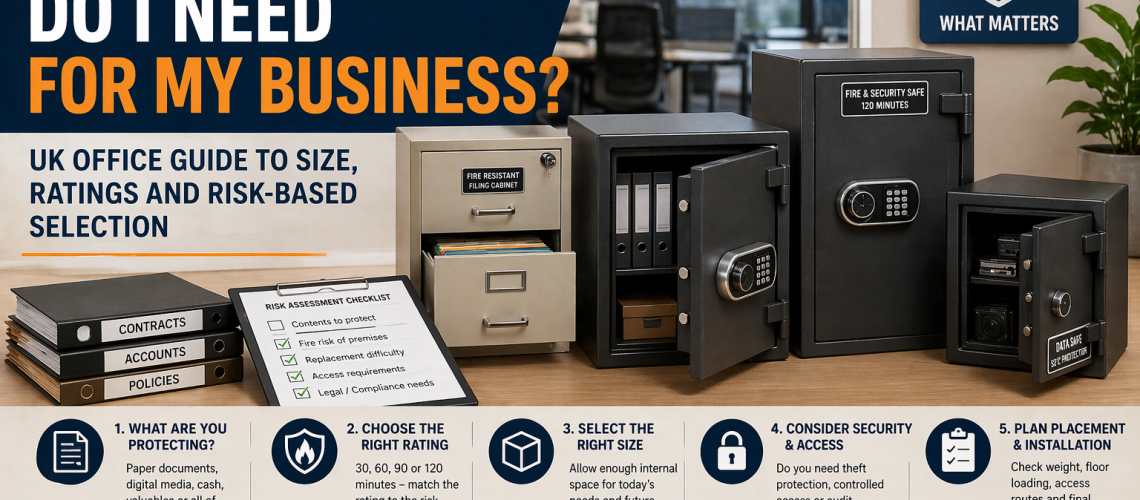
Choosing the right fire safe means matching the safe to the contents you need to protect, the required fire resistance, any theft risk, available space and the practicalities of delivery and installation.

Not every fire-resistant safe provides the same protection. A safe designed for paper documents may not be appropriate for USB drives or other digital media, and a long fire-resistance time does not automatically mean the safe has a high burglary or cash rating.

This guide explains fire ratings, paper vs data protection, fire-only vs dual-rated safes, safe sizes, lock types, installation, positioning and common buying mistakes.

If you are ready to compare products, view the Total Locker Service fireproof safes and cabinets range.

Quick Guide: How to Choose a Fire Safe

QuestionWhat to check
What are you protecting?Paper documents, cash, valuables, digital media or a mixture
How long does it need fire protection?Check the tested fire-resistance rating of the specific model
Is theft protection also important?Check burglary/security or cash rating separately from fire resistance
How much space is required?Measure the actual contents and allow sensible future capacity
Which lock is suitable?Key, electronic, combination or another option available on the model
Where will the safe go?Check floor space, access, weight, fixing and environmental conditions
Can it be delivered to the final position?Measure doors, corridors, stairs and lifts before ordering

What Is a Fire Safe?

A fire safe is a specially constructed secure storage unit designed to slow heat transfer and keep the internal temperature below a defined threshold for a tested period during fire exposure.

Fire-resistant safes typically use an insulated body and door construction designed to reduce the rate at which heat reaches the contents.

Depending on the individual model, a fire safe may also provide:

  • Burglary or security protection
  • Key or electronic locking
  • Adjustable shelves
  • Internal drawers or compartments
  • Anchoring or fixing points
  • Document or filing storage

Always check the specification of the individual safe rather than assuming all fire safes have the same features.

Fire Resistance Ratings Explained

Fire safes are commonly available with tested protection periods such as:

  • 30 minutes
  • 60 minutes
  • 90 minutes
  • 120 minutes

The stated period describes the tested fire-resistance performance of that product under defined test conditions. It does not mean that every real fire will develop in the same way.

A longer tested duration means the safe has demonstrated protection for a longer period under the relevant test. It does not automatically mean that the safe has:

  • A higher burglary rating
  • A higher cash rating
  • A stronger lock
  • Better protection for digital media
  • Water resistance

Those characteristics need to be checked separately.

For a more detailed explanation, read our Fire Safe Ratings UK guide.

30 vs 60 vs 90 vs 120 Minute Fire Safes

RatingWhat it meansSelection consideration
30 minutesTested protection for the specified periodCan suit lower-duration document protection requirements
60 minutesLonger tested fire protectionCommon option for business and document storage
90 minutesExtended tested fire resistanceConsider where longer protection is required
120 minutesLong-duration tested protectionConsider for higher-duration requirements where an appropriate model is available

The best rating is not simply the largest number available. The correct choice depends on the contents, business continuity needs, building risk, budget and any insurer or organisational requirements.

Paper Documents vs Digital Media

This is one of the most important distinctions when buying fire-resistant storage.

Paper and digital media do not necessarily require the same internal temperature conditions.

A fire safe designed for documents may be suitable for:

  • Contracts
  • Certificates
  • Passports
  • Deeds
  • Business records
  • Paper files

Digital media such as:

  • USB drives
  • Hard drives
  • Backup tapes
  • Discs
  • Other sensitive electronic media

can require storage designed to maintain lower internal temperatures than many standard document fire safes.

If digital media is the main concern, compare a purpose-designed data safe rather than assuming a standard document safe will provide the required protection.

See also Data Safes vs Fire Safes.

Fire Safe vs Security Safe

Fire protection and burglary protection are different functions.

FeatureFire SafeSecurity Safe
Main purposeLimit heat reaching contents during a fireResist theft and forced entry
Main performance measureFire test and protection durationSecurity, burglary or cash rating
Typical contentsDocuments, certificates and recordsCash and higher-value items
Fire protectionYes, according to modelNot necessarily
Burglary protectionNot necessarilyPrimary function

Some safes combine both types of protection. If you need protection against fire and theft, choose a product with appropriate ratings for both rather than assuming a fire-resistant safe automatically provides high burglary resistance.

Read Fire Safe vs Standard Safe for a fuller comparison.

What Should You Store in a Fire Safe?

A document fire safe may be appropriate for items such as:

  • Passports
  • Birth and marriage certificates
  • Property documents
  • Contracts
  • Insurance records
  • Company records
  • Certificates
  • Selected cash and valuables where the safe also provides suitable security

The exact contents should always be checked against the manufacturer’s stated protection and internal conditions.

Fireproof Safe or Fireproof Filing Cabinet?

A compact fire safe is often practical for a relatively small quantity of important documents and valuables.

A fire-resistant filing cabinet may be more efficient where the main requirement is to protect a larger quantity of organised paper files.

RequirementOption to consider
Passports, certificates and a small number of filesCompact fire safe
Office documents and foldersMedium or large fire safe
Large quantities of organised filesFire-resistant filing cabinet
USB drives or backup mediaData safe
Cash plus fire protectionDual-rated fire and security safe

The Total Locker Service fireproof range includes compact safes, larger safes, fire-resistant cupboards and fire-resistant filing products.

How to Choose the Right Fire Safe Size

Safe size should be based on the usable internal dimensions, not just the external dimensions.

Before ordering:

  1. List everything that needs to go inside.
  2. Measure the largest items.
  3. Check whether documents need to lie flat or stand upright.
  4. Consider folders, boxes and document wallets.
  5. Allow sensible future capacity.
  6. Check shelf positions and internal fittings.

Fire-resistant construction can make the external dimensions of a safe considerably larger than its usable internal space, so always compare both sets of dimensions.

For more detail, see Fire Safe Sizes Explained.

Do Not Buy a Safe With No Spare Capacity

Fire safes are relatively long-lived products, while document and records storage often grows over time.

If the safe is completely full on installation day, it may become inadequate quickly.

Allow reasonable capacity for:

  • Additional certificates
  • Business records
  • New contracts
  • Insurance documents
  • Additional valuables

However, avoid buying a much larger safe than the building, floor or delivery route can practically accommodate.

Fire Safe Lock Types

Lock options vary by safe model and manufacturer.

Key Locks

Key locks are straightforward and do not rely on batteries.

  • Advantages: simple operation and no code to remember
  • Considerations: keys need secure storage and replacement procedures

Electronic Keypad Locks

Electronic locks allow authorised users to open the safe using a code rather than carrying a normal user key.

  • Advantages: convenient code-based access
  • Considerations: batteries and code control need managing

Mechanical Combination Locks

Mechanical combination locks remove the need for both an electronic power supply and a normal user key.

  • Advantages: no batteries or physical user key
  • Considerations: authorised users need to know and protect the combination

Biometric Locks

Some safe ranges use biometric access such as fingerprint recognition. Availability and features vary considerably between products.

Do not assume that the lock technology alone determines the overall security level. The complete safe construction and tested rating are more important than whether the lock is key, electronic or biometric.

Which Lock Type Is Best?

RequirementOption to consider
Simple access for one or two usersKey lock
Several authorised usersElectronic keypad where available
No batteries or normal user keyMechanical combination where available
Credential-free rapid accessBiometric model where suitable

The best option depends on the individual product, number of users and how the organisation manages access.

Internal Shelves and Organisation

The internal layout can make a substantial difference to how much usable storage a fire safe provides.

Depending on the model, useful features may include:

  • Adjustable shelves
  • Removable shelves
  • Internal drawers
  • Document compartments
  • Filing arrangements

Check whether the largest documents will fit with the shelves in their required position before ordering.

Do Fire Safes Protect Against Water?

Do not assume that a fire-resistant safe is automatically waterproof or water resistant.

Water protection varies between models. Some products may include tested or stated water-resistance features, while others are designed primarily for protection against heat and fire.

If protection from sprinklers, fire-fighting water or flooding is important, check the exact specification of the individual safe.

See Do Fire Safes Protect Against Water Damage?

Home vs Business Fire Safes

The underlying fire-protection principles are similar, but the contents and capacity can differ substantially.

ApplicationTypical contentsImportant considerations
HomePassports, certificates, property records and valuablesCompact size, fire protection and suitable security
OfficeContracts, company records, certificates and cashCapacity, access control and business continuity
Industrial siteRecords, certificates and operating documentationEnvironment, document volume and access
Healthcare or schoolImportant records and organisational documentsAccess control, location and document volume

See Fire Safe for Home vs Business.

Fire Safe Installation and Positioning

Where the safe is positioned matters for security, usability and delivery.

Before ordering, check:

  • Floor construction
  • Safe weight
  • Available floor area
  • Door-opening clearance
  • Access for users
  • Potential damp or moisture
  • Delivery route
  • Stairs and lifts
  • Door and corridor widths
  • Fixing requirements

Large fire safes and filing cabinets can be extremely heavy, so the final position and delivery route should be established before purchase.

Does a Fire Safe Need to Be Bolted Down?

Fixing requirements vary by product, security rating, insurer requirement and installation location.

Many security safes are designed to be anchored using the manufacturer’s fixing points, but it is better to check the instructions and any relevant security or insurance requirement for the specific safe rather than applying one rule to every fire-resistant product.

Before installation, confirm:

  • Whether anchoring is specified
  • Available fixing points
  • Floor or wall construction
  • Safe weight
  • Whether professional installation is appropriate

Delivery Access for Heavy Fire Safes

One of the easiest mistakes to avoid is ordering a safe that cannot reach its intended position.

Measure:

  • External safe dimensions
  • Building entrance
  • Internal doors
  • Corridors
  • Stairs
  • Lift dimensions and capacity
  • Tight corners
  • Any steps or thresholds

Also consider the safe’s weight, not just its size.

If access is restricted, provide the supplier with details before the delivery is arranged.

Advantages of Fire-Resistant Safes

  • Tested protection against heat and fire according to the individual model
  • Secure storage for important paper records
  • Compact options for passports and certificates
  • Larger options for business documents
  • Different lock choices across product ranges
  • Combined fire and burglary protection available on selected models

Limitations of Fire Safes

A fire safe also has practical limitations that should be understood before buying.

  • Weight: insulation and construction can make fire safes very heavy.
  • Internal capacity: thick insulated walls can reduce usable internal volume.
  • Price: higher levels of tested protection and larger capacities generally increase cost.
  • Delivery: heavy products may require specialist handling.
  • Digital media: document fire safes may not be suitable for temperature-sensitive media.
  • Security: fire resistance alone does not establish burglary resistance.
  • Water: water protection should not be assumed unless specified.

Fire Safe Certification and Ratings

Where verified fire performance is important, check the test standard and certification stated for the individual model.

Likewise, if theft protection is required, check any separate security classification or cash rating.

Do not rely solely on terms such as:

  • Fireproof
  • Heavy duty
  • High security
  • Insurance safe
  • Commercial safe

Instead, check what the specific model has actually been designed and tested to provide.

Common Fire Safe Buying Mistakes

1. Assuming Every Fire Safe Protects Digital Media

Paper and digital media can have different temperature requirements. Use a suitable data safe where required.

2. Choosing Only by Fire Duration

A 120-minute fire rating does not automatically mean better burglary protection than a 60-minute model.

3. Ignoring Theft Risk

If cash or valuable items are being stored, check the safe’s security performance as well as fire resistance.

4. Buying Too Small

Measure the usable internal dimensions and allow sensible future capacity.

5. Choosing by External Dimensions Alone

Fire insulation can substantially reduce the internal storage volume.

6. Assuming Fire Resistance Means Water Resistance

Check whether water protection is actually specified for the chosen safe.

7. Ignoring Safe Weight

Heavy fire safes can create delivery, stair and floor-loading considerations.

8. Forgetting the Delivery Route

A safe can fit perfectly in the intended room but still be impossible to move through a narrow doorway or staircase.

9. Assuming Every Safe Needs the Same Fixing

Follow the installation requirements of the particular safe and any applicable security or insurance requirements.

10. Choosing the Lock Before Choosing the Safe

Select the required fire and security performance first, then compare the available lock options within suitable safe models.

Fire Safe Buying Checklist

  • List exactly what will be stored.
  • Separate paper documents from digital media requirements.
  • Determine the required fire-resistance duration.
  • Check the actual fire certification of the model.
  • Decide whether burglary protection is also required.
  • Check any security or cash rating separately.
  • Measure the largest items being stored.
  • Compare usable internal dimensions.
  • Allow sensible future capacity.
  • Choose the appropriate lock type.
  • Check external dimensions.
  • Check safe weight.
  • Measure the complete delivery route.
  • Check stairs, lifts and narrow doors.
  • Confirm the installation position.
  • Check fixing or anchoring requirements.
  • Check whether water resistance is required and actually provided.
  • Confirm whether professional delivery or installation is needed.

Fireproof Safes and Cabinets from Total Locker Service

Total Locker Service supplies fire-resistant safes, fireproof document cabinets and fire-resistant filing storage for UK homes, offices, schools, healthcare organisations and commercial premises.

The current range includes options with 30, 60, 90 and 120 minute fire protection, depending on the model, together with key and electronic locking options across selected ranges.

Products include:

  • Compact fireproof safes
  • Fireproof document safes
  • Fire and security safes
  • Fire-resistant filing cabinets
  • Large fire-resistant cupboards
  • Data safes for temperature-sensitive media

Browse fireproof safes and fire-resistant cabinets or view the complete safe range.

For advice, call 01284 749211 or email sales@totallocker.co.uk.

Related Fire Safe Guides

Fire Safe FAQs

What is a fire safe?

A fire safe is a secure storage unit designed to slow heat transfer and protect suitable contents for a tested period during fire exposure. The protection level depends on the individual model and its tested fire rating.

What fire safe rating should I choose?

The correct rating depends on the contents, building risk, required protection period and any organisational or insurer requirements. Common options include 30, 60, 90 and 120 minutes, depending on the safe model.

Is a 120-minute fire safe more secure than a 60-minute safe?

Not necessarily. A longer fire rating means longer tested fire protection. Burglary resistance and cash ratings are separate characteristics and must be checked independently.

Can I store USB drives in a normal fire safe?

Not automatically. Many document fire safes are designed for paper, while USB drives and other digital media can require lower internal temperatures. A purpose-designed data safe may be more appropriate.

Do fire safes also protect against theft?

Some do, but fire resistance and burglary protection are separate. If theft protection is important, choose a safe with both the required fire protection and an appropriate security or cash rating.

Are fireproof safes waterproof?

Not necessarily. Water protection varies by product. Check whether the individual safe provides tested or stated water resistance if protection from sprinklers, fire-fighting water or flooding is important.

What size fire safe should I buy?

Measure the items you need to store and compare them with the safe’s usable internal dimensions. Allow sensible future capacity and remember that thick fire-resistant construction can make external dimensions much larger than the usable interior.

Which lock is best for a fire safe?

The best lock depends on the number of users and how access will be managed. Key, electronic, mechanical combination and biometric options are available on different safe models. The complete safe rating matters more than the lock technology alone.

Does a fire safe need to be bolted down?

Fixing requirements vary by safe model, security rating and installation. Check the manufacturer’s fixing instructions and any insurer requirements before installation rather than assuming every fire safe uses the same anchoring method.

What is the difference between a fire safe and a fireproof filing cabinet?

A compact fire safe is generally better suited to smaller quantities of documents and valuables, while a fire-resistant filing cabinet can provide more practical organised storage for larger quantities of paper files and business records.

What should I measure before ordering a fire safe?

Measure the contents, safe position and full delivery route. Check internal and external safe dimensions, doorways, corridors, stairs, lifts, door-opening clearance and any fixing space required.

Are fire safes heavy?

They can be. Fire-resistant insulation and secure construction often make fire safes substantially heavier than ordinary cabinets of similar external dimensions. Check the product weight and delivery route before ordering.


Discover more from Blog Total Locker Service

Subscribe to get the latest posts sent to your email.