Engraved Tags for Cupboards and Cabinets: Clear Storage Labelling for Workplaces
April 9, 2026
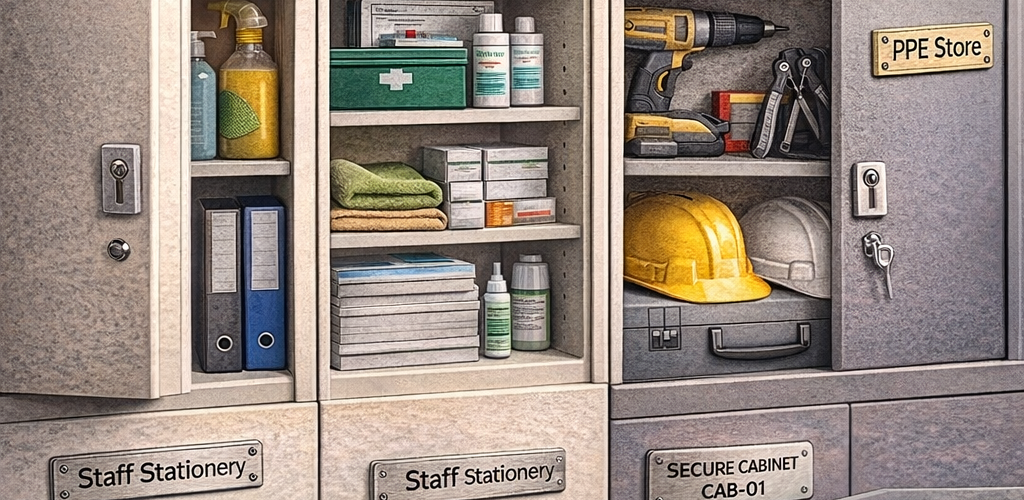
Cupboards and cabinets are often where workplace organisation starts to break down. Items get moved, extra stock is pushed into the nearest empty space and labels become inconsistent over time. One cupboard may be clearly marked, while the one next to it has no identification at all. As soon as that happens, staff begin relying on memory instead of structure.
Engraved tags and nameplates help prevent that problem. They create clear, durable storage labels that stay readable over time and make it easier for staff to understand where items belong. In busy workplaces, that can save time every day. It also helps new staff, contractors and temporary users find what they need without asking for directions or opening multiple cupboards to check the contents.
At Total Locker Service, we supply engraved tags and nameplates for a wide range of workplace identification needs. In this guide, we look at how engraved tags can be used on cupboards and cabinets, what makes a good storage labelling system and how to choose the right format for different environments.
Why cupboard and cabinet labelling matters
Storage works best when it is obvious. A well-labelled cupboard tells users what belongs inside before the door is opened. That makes the workplace easier to use and easier to manage.
Clear cupboard and cabinet labels help with:
- faster item retrieval
- better stock organisation
- fewer misplaced items
- easier handover between staff
- cleaner presentation
- stronger consistency across a site
- simpler audits and checks
Without labels, storage systems often become dependent on habit. That works only until staff change, rooms are reorganised or several people start using the same area in different ways.
Where engraved cupboard labels are most useful
Engraved cupboard and cabinet labels are suitable for many types of workplace storage. Some uses are straightforward and administrative. Others are more operational or controlled.
Common applications include:
- stationery cupboards
- cleaning cupboards
- first aid cabinets
- PPE storage
- maintenance cupboards
- staff room storage
- medical and healthcare cupboards
- key cabinets
- IT storage cupboards
- secure storage cabinets
The exact wording and format will vary, but the aim is always the same: clear identification that supports better organisation.
Why engraved labels work better than temporary signs
Temporary labels can help during short-term changes, but they often become long-term solutions by accident. Paper signs curl at the edges. Printed stickers fade or peel. Handwritten notes look inconsistent and can quickly make a storage area feel untidy.
Engraved labels offer a more durable solution because they are:
- longer lasting
- more professional in appearance
- easier to standardise
- less likely to peel or wear away
- better suited to permanent storage systems
That makes them a sensible option when the cupboard or cabinet has an ongoing purpose rather than a short-term use.
Start with the function of the cupboard
Before ordering engraved labels, it helps to define exactly what the cupboard or cabinet is for. A clear storage system is easier to create when each area has a specific function.
For example, labels might identify:
- what is stored there
- who should use it
- whether access is restricted
- whether it belongs to a department
- whether the cupboard is part of a numbered system
That may lead to simple labels such as:
- Cleaning Supplies
- First Aid
- PPE Store
- Staff Stationery
- Maintenance Tools
- Medical Storage
Where a cupboard needs to be identified as part of a wider management system, a short code can also be used.
Keep wording short and practical
One of the biggest mistakes in storage labelling is trying to include too much detail on the plate. A cupboard label should be clear at a glance. If users need to stop and read a long description, the wording is probably too heavy.
Short wording usually works best. In most cases, two or three words are enough.
For example:
- Cleaning Cupboard
- Medical Supplies
- Secure Store
- Spare Parts
- PPE Cabinet
- Staff Room Stock
Longer descriptions may be better placed in an inventory sheet or internal record rather than on the label itself.
Choose names that people actually use
A storage label should reflect how staff refer to the cupboard in daily use. If the engraved label says one thing but everybody informally calls it something else, confusion can follow.
The best labels usually use wording that is:
- familiar
- practical
- consistent with internal terminology
- easy to understand for new users
For example, if the team already refers to a cupboard as “Cleaning Cupboard”, it is usually better to keep that label rather than changing it to something more formal but less familiar.
Use numbering where needed
Not every cupboard needs a name-only system. In some environments, numbering or coded storage references work better, especially where there are many similar cabinets or where the site uses an asset or room plan.
For example:
- CUP-01
- CAB-12
- MED-04
- ST-07
This can be useful where:
- multiple cupboards serve the same function
- the site has several similar storage rooms
- maintenance teams need short references
- a cupboard is part of an audit or inspection system
In many workplaces, the strongest solution is a short name on the front and a coded reference in the internal records.
Match the label size to the cupboard
The size of the label needs to suit the surface and the viewing distance. A small cupboard in a staff room may only need a modest plate with one short line of text. A larger storage cabinet in a warehouse corridor may need a wider and more visible label.
When choosing size, think about:
- the width of the cupboard door
- how far away the label will be read from
- the amount of wording required
- whether the cabinet sits among several similar units
- whether the label needs to stand out quickly
If the text only fits by being reduced too much, the label is probably too small.
Think about reading distance
Cupboard labels are often viewed from a short distance, but not always. In larger storage areas, workshops or corridors, staff may need to identify a cabinet while walking past or standing several steps away.
That means readability still matters. Good practice usually includes:
- clear type
- strong contrast
- short wording
- enough space around the text
- a plate size suited to the location
A neat small label can still work well, but only if it remains easy to read in normal use.
Consistency makes storage easier to understand
A single engraved label improves one cupboard. A consistent storage labelling system improves the whole workplace.
Consistency helps users understand the logic of the storage area more quickly. It also gives the site a more organised appearance.
Consistency should apply to:
- wording style
- plate sizes
- materials
- alignment
- naming structure
- numbering format where used
For example, if all cleaning-related storage uses the word “Cleaning”, that should be repeated across similar cupboards rather than switching between “Janitor”, “Cleaning Supplies” and “Hygiene Store” without a clear reason.
Plastic or metal for cupboard labels?
For many cupboard and cabinet labels, plastic engraved plates are the most practical choice. They are lightweight, cost-effective and easy to standardise across larger sites.
Plastic engraved labels are often ideal for:
- offices
- schools
- staff rooms
- cupboards and internal cabinets
- general workplace storage
- healthcare and support areas
Metal engraved labels may be suitable where:
- a more premium finish is wanted
- the cabinet is in a harder-wearing environment
- the site specification calls for a stronger material
- the overall fit-out uses more robust signage
In most cases, the environment and appearance requirements will determine the best option.
Choosing the right fixing method
Cupboard and cabinet labels are usually fixed directly to the door or front panel, so the fixing method needs to match the surface.
Common options include:
- self-adhesive backing
- screw fixing
- other permanent mounting methods where appropriate
Adhesive fixing often works well for smooth cupboard doors and indoor cabinet fronts. It gives a clean finish and is usually suitable for many office, school and healthcare storage applications.
Mechanical fixing may be better where:
- the environment is heavier-duty
- the surface is less suitable for adhesive
- the cabinet is in a high-impact area
- a more permanent attachment is preferred
Different storage areas need different label styles
Not all cupboards should be labelled in exactly the same way. The best format depends on the use.
General workplace cupboards
These usually work best with simple function labels such as:
- Stationery
- Supplies
- Staff Stock
- Printing Paper
Cleaning cupboards
These should usually be clearly identified and easy to distinguish from general storage.
First aid and medical cupboards
These benefit from precise wording and a clean, professional appearance.
Maintenance cupboards
These may benefit from a short code alongside the function, especially on larger sites.
Secure cabinets
These often need concise labels that balance clarity with the right level of discretion, depending on the environment.
The wider system should still feel connected, but the wording can adapt to the type of storage.
Support audits and internal organisation
A well-labelled cupboard does more than help people find items. It also supports stock control, internal checks and better housekeeping.
This is especially useful where teams need to:
- check contents regularly
- confirm that storage is being used properly
- control access to certain items
- keep stock in defined locations
- identify empty or underused storage quickly
A labelled storage system is easier to monitor because the structure is visible.
Avoid labels that go out of date too easily
Some cupboard labels become outdated because they are too specific. If the function of the cupboard changes, the sign becomes wrong almost immediately.
This can be avoided by choosing wording that is clear but not unnecessarily narrow.
For example:
- Staff Supplies may stay relevant longer than Printer Paper Only
- PPE Store may be more flexible than Gloves and Masks
- Medical Stock may outlast a label naming one exact item type
This depends on how fixed the storage function is. Where the cupboard will always serve a specific role, a direct label is usually best. Where the contents may evolve, a slightly broader term can be more practical.
Common mistakes to avoid
Several problems come up repeatedly when workplaces label cupboards and cabinets:
- using labels that are too small
- including too much wording
- mixing naming styles across the site
- relying on temporary stickers for long-term use
- failing to match the label to the cupboard’s actual use
- using inconsistent materials and sizes
- not updating labels when storage functions change
Most of these issues are easy to avoid if the storage system is planned before the plates are ordered.
Storage labels should make the workplace easier to use
The best cupboard labels are often the ones people barely think about. They work because they are obvious. Staff know where to look. New users understand the system quickly. Items go back into the right place more often because the destination is clear.
That is what makes engraved cupboard and cabinet labels so useful. They do not just identify storage. They help the storage system function properly.
Better cupboard labels create better storage systems
Engraved tags and nameplates are a simple way to improve workplace storage. They help cupboards and cabinets stay organised, easier to manage and easier to understand over time.
For offices, schools, healthcare sites, warehouses and general workplaces, the strongest results usually come from keeping the system clear, consistent and practical. Short wording, suitable sizing and standardised formats all help create a storage labelling system that supports daily use rather than adding confusion.
When cupboard and cabinet labels are planned properly, storage becomes easier to navigate, easier to maintain and easier to scale as the workplace changes.
Discover more from Blog Total Locker Service
Subscribe to get the latest posts sent to your email.