What Size Should Engraved Tags Be? Locker, Key and Equipment Tag Sizing Guide
April 9, 2026
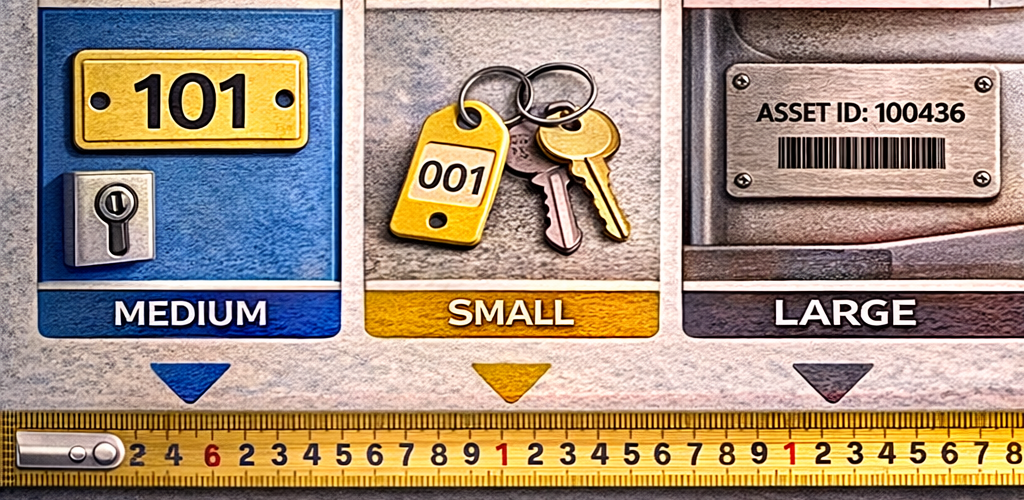
Choosing the correct engraved tag size is mainly a question of readability, available space and the amount of information that needs to be displayed. This page is the sizing owner for the engraved-identification cluster: it covers viewing distance, character height, text quantity, available mounting area, overall dimensions and tag proportions. A tag should be large enough to read comfortably without being unnecessarily bulky for the surface or item it identifies.
The best size depends on how far away the tag will normally be viewed, the required character height, the amount of text, the available mounting area and whether the tag is being used on a locker, key or piece of equipment. Product type should already have been chosen before sizing begins.
If you still need to decide whether the identification should be a locker tag, key tag, equipment plate or nameplate, use Engraved Tags for Lockers vs Key Tags vs Equipment first. For numbering structure, use the Locker Numbering & Labelling Guide UK. For attachment methods, use the Engraved Tag Fixing Guide. For cleaning, replacement and lifecycle decisions, use Maintain & Replace Engraved Tags.
How do you choose the right engraved tag size?
Start with the way the tag will actually be read. A locker number viewed while walking along a changing room needs different proportions from a compact key tag read in the hand or an equipment plate carrying several lines of information. This page determines the size requirements created by those use cases; it does not decide which identification product should be used.
- How far away will the reader normally be?
- How many characters or lines must be engraved?
- How large do the characters need to be?
- How much mounting space is available?
- Does the tag need to be read quickly or inspected close up?
- Would reducing the wording produce a clearer result?
Viewing distance is the first sizing consideration
A tag intended to be read from further away normally needs larger characters and therefore more surface area. A tag that is handled or inspected close up can usually be considerably smaller.
This is particularly important with locker identification. Users may need to locate a locker while standing several steps away, whereas a key reference is normally read with the tag directly in front of the user.
| Typical use | Usual viewing situation | Size implication |
|---|---|---|
| Locker number | Read from a short distance | Allow enough area for prominent characters |
| Key tag | Read close up or in the hand | Compact format is normally sufficient |
| Equipment plate | Read close up during inspection or maintenance | Size depends heavily on the amount of information |
| Location or bay marker | May be viewed from further away | Larger characters and plate size may be justified |
Character height determines how much space is required
The size of the engraved characters is often more important than the overall dimensions of the tag. Making a plate physically larger has little benefit if the text remains too small to read comfortably.
Short references such as 24, A17 or LOCKER 52 can normally use relatively large characters within a modest plate. Longer descriptions need either a wider tag, additional lines or smaller lettering.
When readability matters, it is normally better to give the important reference more space rather than filling the available area with unnecessary wording.
Allow for the amount of text
The amount of engraved information has a direct effect on the required tag dimensions. A two-digit locker number needs very little horizontal space. An equipment description, department name or multi-line asset reference needs considerably more.
| Information | Likely requirement |
|---|---|
| Single number | Small or medium tag with prominent characters |
| Short alphanumeric code | Compact rectangular tag |
| Number plus short description | Wider tag or two-line layout |
| Several lines of information | Larger equipment-style plate |
| Long sentence or excessive wording | Reduce the text before increasing the tag size |
When reducing the text is better than increasing the tag size
A larger tag is not always the best solution. If the plate is becoming oversized simply because too much wording has been included, shortening the information can produce a clearer result.
For example, a plate reading MAINTENANCE EQUIPMENT STORAGE CABINET 04 may be unnecessarily long if MAINTENANCE 04 provides all the identification the user actually needs.
- remove repeated wording that is already obvious from the location;
- use a short reference where staff already understand the system;
- separate essential identification from supplementary information;
- avoid reducing character height merely to force excessive text onto a small plate.
Available mounting space sets the maximum practical size
The surface where the tag will sit places a physical limit on its dimensions. Before specifying a plate, measure the usable flat area rather than the overall size of the locker door, cabinet or equipment panel.
Allow enough surrounding space for the tag to look deliberate rather than squeezed between door edges, handles, controls, hinges or other features.
A slightly smaller tag with well-proportioned text is usually preferable to a plate that technically fits but appears cramped within the available area.
Tag proportions matter as well as overall dimensions
Width and height should reflect the information being engraved. Two tags with the same surface area can perform very differently if their proportions do not suit the text.
- A short number often suits a compact horizontal plate.
- A long code normally benefits from additional width.
- Two or three lines of information require more height.
- Very wide, shallow tags can make multi-line information difficult to arrange.
- Very tall tags can waste space when only a single short reference is needed.
Choosing locker tag sizes
Locker identification normally needs to be read quickly while the user approaches a bank of lockers. This usually justifies larger characters than would be necessary on a key tag.
A simple locker number can therefore use a relatively compact plate while still providing excellent visibility because very little text needs to be accommodated.
- prioritise character size over unnecessary wording;
- check that numbers remain clear at the expected viewing distance;
- keep the plate proportionate to the locker door;
- allow enough width for the longest locker number in the installation.
For example, a locker bank numbered 1–40 requires little text space, while references such as GROUND FLOOR 001–120 need either a wider format or a shorter approved reference. The numbering structure itself should be decided in the dedicated locker-numbering guide rather than on this sizing page.
Choosing key tag sizes
Key tags are normally viewed at close range, so they do not need the same character height as locker plates. Their dimensions are instead constrained by the need to remain compact while still providing enough engraving area for the required reference.
A short key number or room code may fit comfortably onto a small tag. If several lines of information are required, increasing the tag slightly can improve readability, but it is worth checking whether all of that wording genuinely needs to travel with the key.
Choosing equipment plate sizes
Equipment plates often need more information than locker or key tags. They may contain an asset reference, equipment name, location code or other operational identification.
This generally makes rectangular formats useful because additional width can accommodate longer codes while additional height allows information to be divided into readable lines.
The correct size should still be determined by the available mounting area and the minimum amount of information required to identify the equipment clearly. Asset-register structure and operational workflow belong elsewhere; this page only determines how much physical engraving area is needed.
Locker tags, key tags and equipment plates need different proportions
| Application | Main sizing priority | Typical approach |
|---|---|---|
| Locker tag | Fast recognition at short viewing distance | Prominent number with moderate plate size |
| Key tag | Compact handling and close-up readability | Small plate with concise reference |
| Equipment plate | Accommodating structured information | Wider or taller plate according to text quantity |
When is a larger engraved tag justified?
Increasing the physical size of the tag is justified when doing so solves a genuine readability or layout problem.
- the tag must be recognised from a greater distance;
- larger characters are required;
- the reference contains more characters than a smaller plate can accommodate comfortably;
- several essential lines of information are required;
- the available mounting surface is large and a small plate would be difficult to locate visually.
Simply making every tag larger does not automatically improve an identification system. The increase should have a clear purpose.
When should you keep the tag smaller?
A smaller format is normally preferable where the tag is read close up, the information is short or the available mounting area is limited.
- single locker or key numbers;
- short asset references;
- close-up identification;
- small equipment surfaces;
- applications where a larger plate would be disproportionately bulky.
Practical engraved tag size-selection examples
Example 1: simple locker numbers
A changing room contains lockers numbered 1 to 80. Only the locker number needs to appear on each plate.
Because the information is extremely short, the plate does not need to be large. The priority is providing enough space for a bold number that can be recognised while approaching the locker.
Example 2: key tags with short references
A facilities team uses references such as P12, OFF04 and ST17 on individual keys.
These codes are read close up and contain few characters, so a compact tag is appropriate. Making the tags substantially larger would provide little additional benefit.
Example 3: equipment identification
An equipment plate needs to show:
- PUMP 04
- PLANT ROOM B
- ASSET 1847
A larger rectangular plate is justified because three separate pieces of essential information need to remain clear. A very small plate would force the character height down and make the information unnecessarily difficult to read.
Example 4: too much text on a locker tag
A proposed locker plate reads EMPLOYEE PERSONAL STORAGE LOCKER NUMBER 126.
Increasing the plate size enough to accommodate the full wording would be unnecessary. If the context already makes the purpose clear, engraving 126 or LOCKER 126 provides better readability without creating an oversized tag.
Example 5: restricted mounting space
An equipment panel provides only a narrow flat area for identification. Rather than specifying a large square plate, a wider and shallower format can use the available space more efficiently while preserving suitable character height.
A simple way to select an engraved tag size
- Measure the usable mounting area.
- Write down only the information that genuinely needs to appear.
- Estimate the normal viewing distance.
- Choose a character height that remains comfortable to read.
- Allow sufficient width and height around the text.
- Check that the resulting proportions suit the item being labelled.
- If the tag becomes excessively large, reconsider whether the wording can be shortened.
Test the size at full scale before ordering
Dimensions can be difficult to judge on a computer screen. A useful final check is to reproduce the proposed tag dimensions at full size on paper and place the mock-up against the locker, cabinet or equipment.
This makes it easier to judge the proportions, available space and approximate readability before committing to a larger quantity.
The best tag size is the smallest size that remains comfortably readable
There is no single engraved tag dimension that suits every application. Locker tags usually prioritise visibility, key tags prioritise compactness and equipment plates often need additional area for structured information.
The most effective approach is to work backwards from viewing distance, character height, text quantity and available mounting space. Make the tag larger when readability genuinely requires it, but reduce unnecessary wording rather than allowing the plate to become oversized. Once the size is settled, move to the relevant fixing, numbering, maintenance or product-specific guide rather than expanding those topics here.
Discover more from Blog Total Locker Service
Subscribe to get the latest posts sent to your email.