Medical Cabinets: The Complete UK Guide to Secure Clinical Storage
March 24, 2026
Medical cabinets are one of the most important parts of secure healthcare storage. They help practices, clinics, care settings and treatment rooms keep medicines, dressings and clinical supplies organised, protected and easy to access by authorised staff. A well-chosen cabinet does far more than hold stock. It supports safer routines, clearer segregation, easier cleaning and better day-to-day control of essential items.
Many buyers start by searching for medical cabinets, but the real decision is broader than the product name alone. You need to think about where the cabinet will be used, what it will store, who needs access, how often it will be opened and how the contents need to be separated. A compact wall-mounted unit may suit a treatment room perfectly, while a larger floor-standing cupboard may be the better choice for a busy clinical area handling a wider range of items.
This guide explains what medical cabinets are, where they are used, the main types available, which lock options to consider and how to choose a layout that supports secure clinical storage. If you are already comparing products, you can also view our medical cabinet range here.
What are medical cabinets?
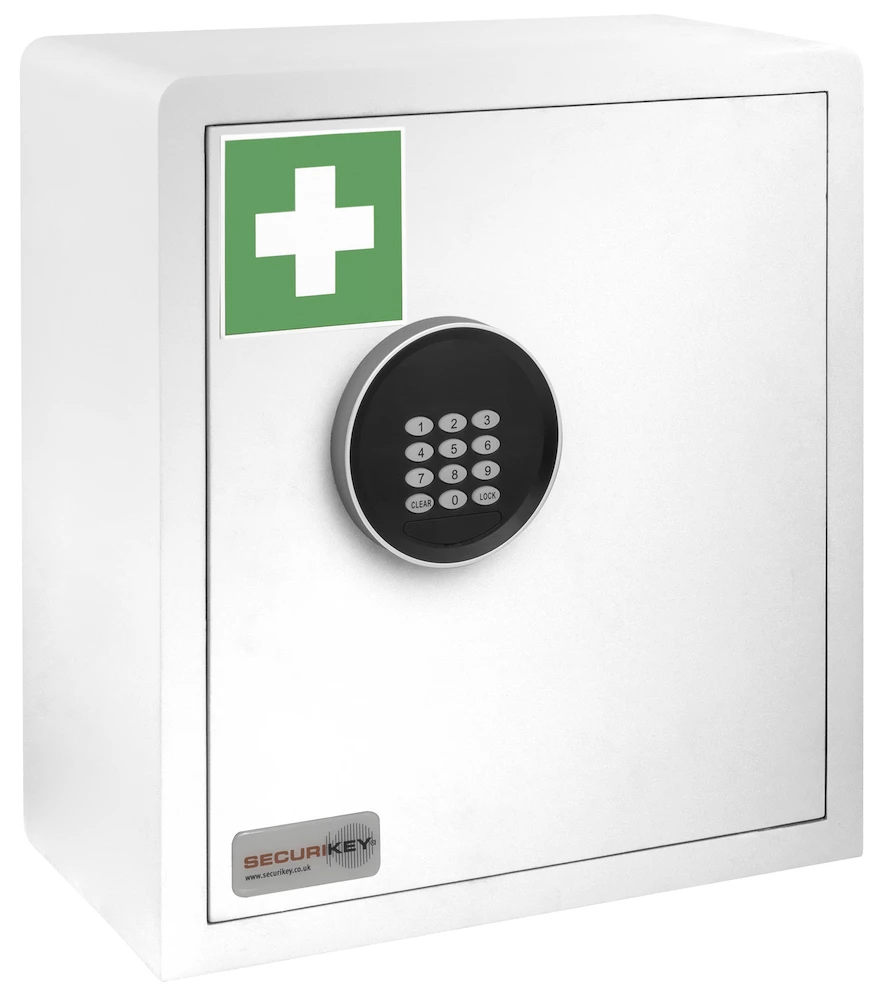
Medical cabinets are secure storage units designed for healthcare and care-related environments. In practical terms, the term covers a broad range of cupboards and cabinets used to store medicines, treatment room supplies, dressings, first aid stock and selected clinical items. Some are small wall-mounted cupboards for compact rooms. Others are taller and designed to provide a larger storage capacity with more shelves and clearer separation between product types.
The phrase medical cabinets is often used loosely, which is why buyers sometimes order the wrong product. A lockable steel cupboard may look suitable at first glance, but medical storage needs vary widely between environments. A GP surgery has different pressures from a hospital department. A care home medication room works differently from a dental treatment room. A first aid point in a workplace is not the same as a medicines cupboard in a clinical setting.
Good medical cabinets are chosen around function. They should help staff keep stock organised, restrict access where needed and make routine checks easier. They should also be easy to clean, durable in daily use and appropriate for the room available. In many cases the best answer is not simply the largest cabinet. It is the cabinet that fits the workflow and supports good habits every day.
Why secure medical storage matters
Secure medical storage matters because healthcare teams need reliable access to the right items at the right time, without creating unnecessary risk. When storage is poor, problems build quietly. Shelves become crowded. Packaging gets mixed. Similar items are placed too close together. Staff rely on memory instead of structure. Keys circulate informally. Stock is hidden behind other stock. Cleaning becomes harder. Regular checks take longer.
By contrast, well-planned medical cabinets support a calmer and safer environment. Items are easier to find. Stock can be grouped more clearly. Expiry checks are more manageable. The right people can access what they need without leaving everything open to everyone. In smaller clinical spaces this is especially important because poor storage design creates clutter quickly.
Secure medical cabinets also help present the right professional standard. Whether the cabinet is in a treatment room, a consulting room, a dispensary area or a care setting, the storage should look deliberate and controlled. A tidy, well-organised cabinet reassures staff and supports a stronger internal process. It also reduces the temptation to improvise with unsuitable cupboards or mixed-use storage.
In simple terms, secure clinical storage is not just about stopping unauthorised access. It is also about improving visibility, supporting organisation and making everyday work easier to manage.
Where medical cabinets are used
Medical cabinets are used across a wide range of healthcare and care environments. The correct cabinet depends on the setting as much as the stock being stored.
- GP surgeries and health centres: often need compact, secure cabinets that fit treatment rooms and consulting areas while keeping common items easy to access.
- Hospitals and clinics: may need larger cabinets with clearer internal segregation, especially in treatment and ward areas.
- Care homes and assisted living settings: usually need practical, secure storage that supports routine medicines handling and organised stock control.
- Dental practices: often benefit from compact, easy-clean storage in treatment and back-room areas.
- Private clinics: may want a combination of security, neat presentation and efficient use of limited room space.
- First aid rooms and workplace settings: usually need first aid cabinets rather than full clinical medicines cupboards, but the same principles of visibility and access control still apply.
The point is simple. Medical cabinets are not one-size-fits-all. The setting shapes the best cabinet format, the right lock option and the amount of shelf space needed.
Main types of medical cabinets
When buyers search for medical cabinets, they are often looking at several different cabinet types without realising it. Breaking the category down makes selection much easier.
Wall-mounted medical cabinets
Wall-mounted medical cabinets are ideal where floor space is limited. They are often used in treatment rooms, consulting rooms and smaller clinical spaces where a neat footprint matters. Because they sit above floor level, they can also make cleaning easier and help keep the room looking less crowded.
The main advantage is efficiency. A wall-mounted cabinet uses vertical space well and can place commonly used items at a practical working height. The main limitation is capacity. If the site needs to hold a wide product range or larger containers, a small wall unit may become too cramped.
Floor-standing medical cupboards
Floor-standing cupboards are a strong choice where capacity matters more than compactness. These are often used in busier treatment areas, larger clinical rooms and back-of-house healthcare storage spaces. They provide more shelf positions, more internal volume and greater flexibility for segregation.
A taller medical cupboard can also work well where a site wants to separate products by category rather than stacking too much into a smaller unit. In many settings this creates a tidier and safer storage arrangement over time.
Medicine cupboards
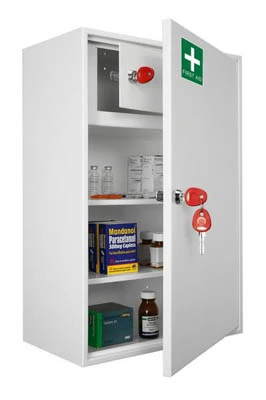
Medicine cupboards are designed for routine secure storage of medicines and related clinical items. They often use adjustable shelves, steel construction and a lockable door or doors. They are a practical option for surgeries, clinics and healthcare rooms that need dependable day-to-day medicine storage without moving into specialist safe-custody solutions.
First aid cabinets
First aid cabinets are usually smaller and more straightforward. They are often used in schools, workplaces, sports facilities and public buildings. They may look similar to some medical cabinets, but the use case is different. A first aid cabinet should not automatically be treated as a substitute for properly planned medicines storage in a clinical environment.
Consumables and treatment room cabinets
Some healthcare cupboards are mainly used for dressings, gloves, disposables and routine treatment stock. These can sit alongside medicines storage rather than replacing it. In many environments, this is the better approach. Separate storage for medicines and general clinical consumables helps maintain order and reduces mixed-use clutter.
Medical cabinets versus domestic medicine cabinets
It is worth making a clear distinction between medical cabinets used in healthcare environments and domestic medicine cabinets designed for home use. Domestic cabinets are usually small and light-duty. They may be fine for basic household storage, but they are not intended for the demands of busy healthcare settings.
Medical cabinets for clinics, surgeries and care settings are built around a very different requirement. They need to be stronger, more secure and easier to clean. They also need to handle repeated daily use and provide clearer internal organisation. In a professional environment, the cabinet is part of a working system. It is opened often, checked regularly and relied upon by multiple authorised users. That is why proper medical cabinets are the right choice for healthcare applications.
Wall-mounted versus floor-standing medical cabinets
This is one of the most useful buying decisions to make early. Both styles can work well, but each suits a different room profile.
Choose wall-mounted medical cabinets when:
- floor space is restricted
- the room is small and needs a cleaner visual layout
- stored items are moderate in quantity
- you want the cabinet positioned at a convenient working height
- cleaning under the cabinet matters
Choose floor-standing medical cabinets when:
- you need more storage capacity
- you want more shelf levels or wider compartments
- the room can accommodate a taller cupboard
- stock needs stronger separation by category
- the site handles a broader range of products
Neither format is automatically better. The best choice depends on the room, the wall available, the stock profile and how the cabinet will be used. A small treatment room can work beautifully with a wall-mounted cabinet. A high-volume clinical area may work far better with a larger floor-standing unit. The right answer is the one that reduces clutter and supports organised storage in that specific space.
Lock options for medical cabinets
The lock is one of the most important parts of any medical cabinet, but the best option depends on the access pattern rather than fashion or price alone.
Key locks
Traditional key locks remain a popular choice because they are simple, familiar and cost-effective. For smaller teams or rooms with limited authorised access, they can work very well. The main issue is key control. If too many people need access, keys can drift, be shared informally or end up stored in the wrong place.
Cam locks
Cam locks are widely used in steel medical cabinets and are often perfectly suitable for routine secure storage. They are straightforward, practical and easy for staff to use. Cabinet construction still matters, though. A decent lock needs a decent cabinet around it.
Digital locks
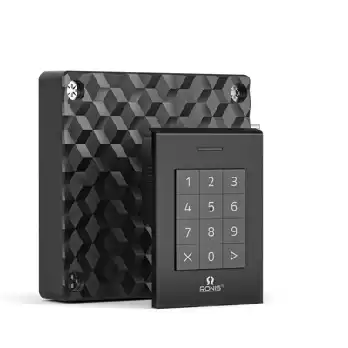
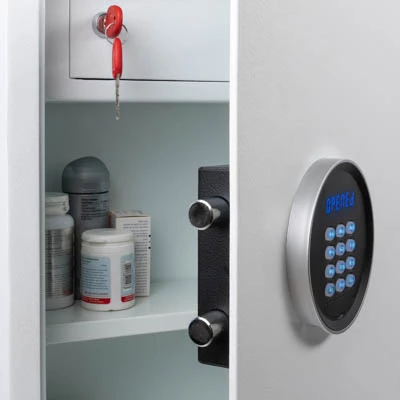
Digital or keypad locks can be useful where several authorised users need frequent access. They remove the need to pass physical keys between staff and can simplify access control in busier settings. They still require disciplined code management, however. A digital lock is only as good as the way codes are controlled and changed.
Mechanical combination locks
Mechanical combination locks offer code access without electronic components. They can suit organisations that want keyless access but prefer a simpler solution. Again, the main question is whether the lock format matches the way the room actually works.
When comparing medical cabinets, think beyond the lock face alone. Door strength, hinge quality, cabinet body rigidity and fixing all affect real-world security. A strong lock on a weak cabinet is not a strong storage solution.
If you are reviewing lockable medical cabinets for your site, our medical cabinet options include practical formats for secure healthcare storage.
How to choose cabinet size and internal layout
Choosing the right size is about more than external dimensions. Many buyers focus on whether a cabinet fits the available wall or floor area, but the real question is whether the internal layout fits the stock.
Start with the contents. List what the cabinet will actually hold. Separate boxed items, liquids, packs, dressings, topicals and higher-use products. Think about how often each category is used and whether anything needs to be kept apart from other stock.
Adjustable shelves are especially useful because they give the cabinet more long-term flexibility. Product sizes change. Stock profiles change. What works well today may not work well next year. A cabinet that allows shelf positions to be altered is usually a better long-term investment than a rigid fixed layout.
Practical visibility also matters. If the cabinet becomes overcrowded, staff start stacking products in front of other products. That makes checks harder and increases the chance of confusion. It is often better to leave a modest amount of spare room than to buy the absolute minimum size.
Think about door opening space too. A cabinet may look ideal on paper, but if the doors cannot open fully or the location forces awkward access, the room will never feel properly organised. Storage works best when the area around the cabinet has been considered as carefully as the cabinet itself.
Medical cabinets for GP surgeries and treatment rooms
GP surgeries and treatment rooms often need secure storage in relatively compact spaces. In these environments, the cabinet should support quick, controlled access without dominating the room. Wall-mounted medical cabinets are often a good fit because they keep the floor clear and use vertical space efficiently.
In a typical treatment room, high-use items should be easy to reach and simple to separate from less frequently used stock. A tidy cabinet with adjustable shelving can make a real difference to daily routines. If the practice handles a wider range of products, a larger cupboard or a two-cabinet arrangement may be better than trying to force everything into one small unit.
For surgeries, the best medical cabinets tend to be those that reduce clutter, make stock checks faster and support a consistent internal layout that all authorised staff understand.
Medical cabinets for care homes and assisted living
Care homes and assisted living settings need secure medical storage that supports routine medicines handling and organised stock control. In these environments, ease of use matters alongside security. Cabinets should help staff work efficiently during busy rounds without becoming overloaded or confusing to manage.
Depending on the setting, separate storage for medicines and general care consumables can be very helpful. It keeps the cabinet focused and avoids the slow build-up of mixed-use clutter. Lockable medical cabinets with practical shelving are often a strong fit because they help staff keep categories clear and maintain a tidier workflow.
Where room allows, a larger floor-standing cupboard can support better organisation than an undersized wall unit. Where space is tighter, a carefully positioned wall-mounted cabinet may still work well. The main goal is a secure, visible and manageable storage layout.
Medical cabinets for private clinics, dental practices and specialist rooms
Private clinics and dental practices often place a high value on neat presentation as well as function. That is sensible, but the cabinet still needs to work hard behind the scenes. Easy-clean surfaces, a professional finish and a logical shelf layout are more valuable than purely decorative features.
These settings often have limited room space, so compact wall-mounted cabinets can be a strong choice. At the same time, stock needs to stay well organised. If the cabinet becomes cramped, the room loses efficiency quickly. The best option is usually a unit that looks tidy, supports segregation and fits naturally into the working layout of the room.
How to organise medicines and clinical consumables safely
A good medical cabinet is only half the job. The internal arrangement matters just as much. Cabinets should support clear separation between categories, not simply act as lockable boxes.
In practice, that may mean separating high-use items from reserve stock, liquids from boxed products, or medicines from general clinical consumables. It may also mean giving each shelf a clear purpose so that staff know exactly where products belong. The simpler the system looks at a glance, the more likely it is to remain tidy under pressure.
It is also wise to avoid overloading the cabinet. When products are packed too tightly, visibility suffers and routine checks become slower. Labelling helps, but physical space matters more than labels alone. A crowded shelf with excellent labels is still a crowded shelf.
For sites with a broader stock profile, two smaller cabinets with distinct roles may work better than one overloaded cupboard. One can hold routine medicines. Another can hold dressings or treatment room supplies. This often produces a cleaner, safer and more sustainable layout.
If you are reworking a storage area rather than buying for a new room, start by reviewing what should and should not be in the cabinet. Many storage problems are caused not by the cabinet itself, but by the slow accumulation of unrelated items.
Cleaning and housekeeping
Medical cabinets should be easy to clean inside and out. Smooth finishes, durable surfaces and uncomplicated construction all help. This is one reason steel cabinets remain a popular option for healthcare environments. They are robust, practical and generally easier to maintain over time than lighter-duty alternatives.
Cleaning should also influence placement. Wall-mounted cabinets can make floor cleaning easier, while floor-standing cupboards need sensible positioning so that the surrounding area does not become neglected. Internally, clear shelf organisation helps reduce dust traps and makes routine wipe-downs simpler.
Housekeeping is closely linked to storage quality. Cabinets that are too large can become dumping spaces. Cabinets that are too small become crowded. The best storage arrangements create enough room to stay organised without inviting unrelated items to accumulate.
Standards, guidance and policy context
When choosing medical cabinets, buyers often want reassurance that the storage approach is aligned with current healthcare expectations. The safest approach is to treat the cabinet as part of a wider storage system shaped by setting, local medicines management procedures and current guidance relevant to the service.
In practical terms, this means the cabinet should support secure storage, sensible segregation, safe handling, appropriate access control and an organised room layout. Buyers should also distinguish between general medicines storage and any specialist requirement that sits outside the scope of an ordinary medical cabinet.
For NHS and clinical readers, it is helpful to review the current healthcare storage guidance relevant to medicines storage in clinical areas, then compare that with the room, workflow and categories of items being stored. Care providers should also ensure the cabinet choice fits the broader systems they use to manage medicines safely in their service.
If you want more detail on NHS-related storage context, you can also read our article on HTM 71, HTM 63 and NHS medical cabinets.
Medical cabinets versus controlled drug cupboards
This is an important distinction. General medical cabinets are designed for secure healthcare storage, but they should not automatically be treated as controlled drug cupboards. Controlled drug storage sits within a more specific safe-custody requirement and should be considered separately.
That matters because some buyers search for one product to do every job. In reality, many sites need one cupboard for routine medicines or clinical supplies and a separate, more specific storage solution for controlled drugs where applicable. Trying to combine everything into a single cabinet can create confusion and weaken the clarity of the storage plan.
For most buyers, the practical takeaway is simple. Use medical cabinets for the broader category of secure clinical storage, and treat controlled drug storage as a separate specification decision where relevant to the service.
Common mistakes when buying medical cabinets
Several buying mistakes come up repeatedly. Avoiding them early makes the project far easier.
- Buying by appearance alone: a cabinet can look neat online but still be too small or badly configured inside.
- Using one cabinet for too many functions: mixing medicines, dressings, consumables and unrelated items creates clutter.
- Choosing the lock before understanding the access pattern: the right lock depends on who needs access and how often.
- Underestimating internal space: external dimensions do not tell you how usable the inside really is.
- Ignoring the room layout: door clearance, wall position and working space all affect how usable the cabinet will be.
- Failing to separate routine medicines from specialist storage needs: not every secure cupboard should be expected to do every job.
- Leaving no room for growth: cabinets that are full from day one rarely stay organised for long.
A good cabinet purchase starts with the workflow. What is being stored, who uses it, how often it is accessed and how it should be separated are the questions that matter most.
How to choose the right medical cabinets for your setting
If you are narrowing down your options, start with five practical questions.
- What exactly will the cabinet store?
- Who needs access, and how many authorised users are there?
- Is a wall-mounted or floor-standing format better for the room?
- How much shelf flexibility is needed?
- Does the site need one cabinet or a small, planned storage arrangement?
Once those points are clear, the choice becomes much easier. You can focus on cabinet size, lock format, shelf arrangement and placement with far more confidence. This usually leads to a better result than browsing only by price or by headline dimensions.
Our secure medical cabinets are designed to support healthcare environments that need organised, lockable storage. Whether you need a compact wall-mounted unit or a larger cupboard for a busier clinical space, choosing the right format at the start makes daily use much easier.
Why medical cabinets are a long-term investment
A well-chosen medical cabinet can support a room for years. That is why build quality matters. Strong steel construction, durable shelves, a reliable lock and a layout that remains useful as stock changes all contribute to better long-term value.
Cheap storage can become expensive if it creates frustration, clutter or early replacement. In contrast, a cabinet that fits the room properly and supports the way staff actually work can improve daily efficiency from the moment it is installed. It can also reduce the time spent reorganising stock and dealing with the knock-on effects of poor layout.
That is why buyers should think of medical cabinets not just as cupboards, but as working storage equipment. They form part of the environment in which care is delivered. When they are selected well, the whole room tends to function better.
Frequently asked questions about medical cabinets
What is the best material for medical cabinets?
Steel is often one of the best choices for medical cabinets because it is durable, secure and easy to maintain. It also works well for lockable cupboards used in busy healthcare environments.
Are wall-mounted medical cabinets better than floor-standing cupboards?
Not always. Wall-mounted medical cabinets are excellent where space is limited, while floor-standing cupboards are often better where more capacity and stronger internal segregation are needed.
Can one medical cabinet store everything in a treatment room?
Sometimes, but not always. If the room handles a broad range of items, two cabinets with separate roles can create a better and more manageable storage system than one overloaded cupboard.
Do medical cabinets need locks?
For professional healthcare and care environments, lockable medical cabinets are usually the sensible choice because they help control access and support more secure storage.
What should not be mixed inside medical cabinets?
Items that should be separated by category, use or level of control should not simply be mixed together. Medicines, dressings, consumables and specialist stock are often easier to manage when they are clearly segregated.
Are medical cabinets the same as controlled drug cupboards?
No. Medical cabinets are for broader secure clinical storage. Controlled drug cupboards should be treated as a separate storage requirement where applicable.
Final thoughts
The best medical cabinets support order, visibility and controlled access. They help healthcare teams work more efficiently and make day-to-day stock management easier. Whether you are fitting out a surgery, reviewing a treatment room or improving storage in a care setting, the right cabinet should match the room, the users and the items being stored.
If you are ready to compare products, browse our medical cabinet range to find secure, practical storage for healthcare environments.
Discover more from Blog Total Locker Service
Subscribe to get the latest posts sent to your email.