Healthcare Staff Lockers UK: NHS Changing Rooms, Uniform Storage and Staff Security
September 15, 2026
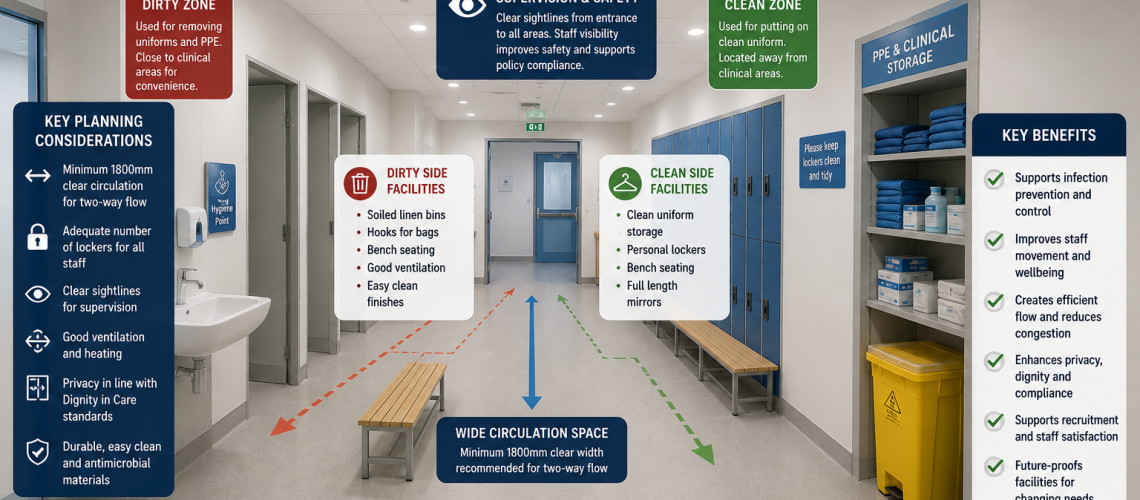
Healthcare staff lockers need to support a working environment that operates around shifts, uniforms, staff-only areas, personal security and frequent changes of personnel. A hospital changing room, theatre department, community healthcare facility or NHS staff welfare area may look similar to an ordinary workplace locker room, but the operational demands can be very different.
Clinical and support staff may arrive in personal clothing, change into uniforms or theatre clothing, store bags and valuables, change footwear, work across several departments and return at different times of day or night. Agency workers, students, visitors and temporary staff may add further demand. The locker system therefore needs to work as part of the healthcare staff-changing process rather than simply provide rows of secure cupboards.
This guide explains how to plan healthcare staff lockers in the UK, with particular attention to NHS changing rooms, staff uniform storage, shift-based locker provision, personal belongings, staff security, controlled access and the practical operation of healthcare changing facilities.
For the wider workplace-storage canister, start with our Workplace Lockers UK guide. For product options, browse our workplace lockers.
Quick Answer: What Do Healthcare Staff Lockers Need to Provide?
Healthcare staff lockers should provide secure, practical storage for clothing and personal belongings while fitting into the staff-changing process used by the organisation.
- Full-height lockable storage for clothing and personal belongings.
- Clean uniform and workwear storage.
- Footwear storage where required.
- Space for coats and wet outerwear.
- Secure access to staff changing areas.
- Locker provision for permanent, temporary and visiting staff.
- Capacity for shift changes and peak simultaneous use.
- Personal privacy and accessible changing provision.
- Key, combination, RFID or electronic locker access.
- Controlled management access for authorised staff.
- Cleaning and maintenance access around locker banks.
- Clear numbering and allocation across larger healthcare estates.
The exact arrangement should follow the healthcare organisation’s estate strategy, staff policy, uniform policy and local operational requirements.
Healthcare Staff Lockers Are Not the Same as Clinical Storage
This distinction is important. Healthcare staff lockers are primarily intended for staff clothing, personal belongings, uniforms, footwear and other items associated with changing and staff welfare.
They should not automatically be treated as suitable storage for medicines, controlled drugs, sterile clinical supplies, confidential clinical records or specialist medical equipment. Those applications can have different security, construction, management and regulatory requirements.
If the requirement is clinical or medical storage rather than staff changing, use the relevant healthcare-storage specification instead. Our existing NHS HTM and Healthcare Storage Requirements guide covers the broader healthcare-storage subject.
NHS Staff Changing Room Planning
NHS healthcare planning guidance treats staff changing as a defined support function rather than simply an area containing lockers. Typical activities include changing into clean uniforms, storing personal clothing and belongings, holding coats and wet clothes, storing clean footwear and, where required, returning used uniforms.
Healthcare changing facilities can therefore require:
- full-height lockable lockers;
- dedicated changing space;
- secure coat and wet-clothing storage;
- clean footwear storage;
- uniform issue or storage;
- used-uniform return;
- controlled staff access.
The staff-changing process should be established before the final locker configuration is chosen.
Calculate Locker Numbers Around Shift Patterns
Healthcare staff locker demand should not be calculated from total employee headcount alone. Hospitals and other healthcare facilities commonly operate around overlapping shifts, temporary staff and visiting personnel.
NHS healthcare planning guidance uses a shift-based planning approach that allows for both the outgoing and incoming staff groups during changeover, together with visiting staff.
This highlights an important principle: total workforce is not the same as peak locker demand.
- Establish the maximum number of staff on duty.
- Identify shift overlap.
- Include agency and bank staff.
- Include students and visiting clinicians.
- Decide whether lockers are permanently assigned or shared.
- Allow reasonable spare capacity.
For general locker-capacity calculations outside the healthcare-specific context, use our How Many Lockers Do You Need? Capacity Planning Guide.
Changing Capacity Matters as Much as Locker Quantity
Providing enough locker doors does not automatically create an effective NHS changing room. Incoming and outgoing staff may need to use the facility at the same time.
During shift change:
- incoming staff may be opening lockers;
- outgoing staff may be removing uniforms;
- benches may be occupied;
- bags and footwear may temporarily occupy floor space;
- several locker doors may be open together;
- staff may be travelling in opposite directions.
The room should therefore be assessed as a working changing facility rather than a static locker layout.
For detailed aisle and door-clearance calculations, use our Locker Aisle Width Guide UK.
Healthcare Staff Changing Workflow
The most effective healthcare changing-room design follows the sequence staff actually use.
- Enter the controlled staff changing area.
- Store coats, bags and personal belongings.
- Remove personal clothing where required.
- Collect or access a clean uniform.
- Change footwear where required.
- Complete the appropriate hygiene routine.
- Move into the clinical or support environment.
- Return to the changing area after the shift.
- Remove or return the uniform according to local policy.
- Retrieve personal clothing and belongings.
- Leave without obstructing incoming staff.
The locker installation should support this process without creating unnecessary crossing between personal storage, uniform storage and used-workwear return.
Uniform Storage in NHS and Healthcare Changing Rooms
Healthcare uniform storage should follow the organisation’s workwear and uniform policy rather than relying on one universal locker arrangement.
Possible arrangements include:
- clean uniforms stored in individually assigned lockers;
- personal clothing stored in lockers while uniforms are issued separately;
- clean workwear supplied through garment dispensers;
- used uniforms returned directly to laundry collection;
- department-specific uniform storage;
- spare clean uniforms stored separately for replacement during a shift.
Where clean garments are centrally distributed and used garments centrally collected, see our garment dispenser and laundry lockers.
Full-Height Healthcare Staff Lockers
Full-height lockers can be particularly useful where healthcare staff need to store personal clothing, coats and other garments without compressing them into small compartments.
Before choosing the locker configuration, establish whether it needs to hold:
- coats or jackets;
- personal clothing;
- uniforms;
- bags or backpacks;
- footwear;
- wet outerwear;
- small personal belongings.
Multi-tier lockers can increase user capacity, but smaller compartments should only be used where they genuinely suit the contents.
Theatre Staff Lockers and Changing Facilities
Theatre changing can require a more controlled process than a general staff locker room. Staff may change into dedicated theatre clothing and footwear close to the department.
A theatre locker project should establish:
- whether personal clothing remains in a full-height locker;
- where clean theatre clothing is issued;
- where clean theatre footwear is stored;
- where used garments are returned;
- whether sessional lockers are required;
- how changing-room access is controlled;
- how visiting clinicians, students and temporary staff are accommodated.
The personal locker should be treated as one part of the changing process rather than the entire uniform-management system.
Assigned vs Sessional Healthcare Staff Lockers
Healthcare organisations should decide whether lockers are permanently assigned, shared on a sessional basis or managed using a mixture of both systems.
Assigned lockers suit permanent staff who regularly work in the same department and need consistent personal storage.
Sessional lockers may suit rotating staff, visiting clinicians, temporary workers and other users who only require storage while they are on site.
A mixed model can include:
- assigned lockers for permanent staff;
- sessional lockers for visiting clinicians;
- temporary lockers for agency staff;
- short-term lockers for students;
- visitor lockers for authorised users.
For the wider allocation subject, see our Locker Allocation Systems UK guide.
Agency Staff, Bank Staff, Students and Visiting Clinicians
Healthcare facilities often have a more fluid workforce than conventional workplaces. Locker planning therefore needs to include more than permanent payroll staff.
- Bank staff.
- Agency workers.
- Students and trainees.
- Locums.
- Visiting clinicians.
- Contract staff.
- Temporary project teams.
- Staff temporarily moved between departments.
Temporary users may not need permanent allocation, but they still require secure storage while on site.
For temporary-permission systems, see our Temporary Locker Access Systems UK guide.
Staff Security Starts With the Changing Room
A secure locker does not compensate for an uncontrolled changing area. Healthcare staff may leave phones, wallets, keys, travel cards, clothing and other personal possessions in the room throughout a shift.
A layered security approach can include:
- controlled access to the staff changing room;
- individually secure lockers;
- defined lost-key and forgotten-code procedures;
- controlled management overrides;
- credential recovery when staff leave;
- prompt repair of damaged locks;
- accurate locker-allocation records.
The entrance-control system and the individual locker-lock system do not have to use the same technology, but they should form one coherent security process.
Choosing Locker Locks for Healthcare Staff
| Lock type | Typical healthcare use | Main management consideration |
|---|---|---|
| Key lock | Assigned staff lockers | Key issue, replacement and master-key control |
| Mechanical combination | Assigned or some shared-use systems | Code reset and forgotten-code procedures |
| Digital keypad | Assigned or sessional lockers | Battery maintenance, override and operating mode |
| RFID / proximity | Managed healthcare facilities | Credential compatibility and administration |
| Padlock fitting | Simple individually controlled storage | Policy for abandoned locks and padlocks |
Do not assume that an electronic locker lock is automatically compatible with existing hospital staff ID cards. Compatibility needs to be confirmed before specification.
Compare available options on our locker locks page.
Master-Key Control in Healthcare Locker Estates
Large healthcare sites can contain hundreds or thousands of lockers. Where keyed systems are used, authorised estates or facilities staff may require management access for lost keys, repairs, abandoned lockers and controlled administrative purposes.
Define:
- who may hold master keys;
- where master keys are stored;
- whether departments use different sub-master groups;
- how management access is recorded;
- what happens when a user key is lost;
- what happens when an employee leaves.
For detailed key governance, see our Master Key Locker Systems UK guide.
RFID and Electronic Locker Access in Healthcare
Healthcare sites often already use electronic credentials for building and department access, making RFID or electronically managed lockers attractive where staff allocation changes frequently.
Potential benefits include:
- reduced physical key issue;
- temporary locker assignment;
- faster credential revocation;
- central administration;
- support for changing staff populations.
Mechanical locks remain appropriate for many healthcare installations, so electronic access should be chosen for operational reasons rather than simply because it is available.
For networked and software-managed locker systems, use our Smart Locker Systems UK guide.
Department-Based Healthcare Locker Zoning
Large hospitals can become difficult to manage when locker allocation develops piecemeal over many years. Department-based zoning can help facilities teams identify:
- which staff group uses each locker bank;
- which manager owns the allocation process;
- which master or override access applies;
- where temporary lockers are located;
- which banks serve clinical or support teams;
- where spare capacity remains.
Clear zoning also improves maintenance reporting and asset control.
For general room-zoning principles, see our Locker Room Zoning Guide UK.
Healthcare Locker Numbering and Asset Identification
A healthcare locker estate is easier to manage when every locker can be identified consistently.
- Staff allocation.
- Key records.
- Department identification.
- Repair requests.
- Condition audits.
- Replacement planning.
- Temporary assignment.
- Staff offboarding.
On large sites, structured references can combine building, department, changing room, bank and locker number, making the locker an identifiable facilities asset rather than anonymous furniture.
24-Hour Healthcare Sites Need 24-Hour Locker Planning
Hospitals do not operate like nine-to-five offices. Night teams, early shifts, late finishes and emergency staffing mean the changing facilities may be used continuously.
- Cleaning cannot always rely on long empty periods.
- Maintenance may need to be phased.
- Changing-room access must remain reliable outside office hours.
- Lost-key or access problems can happen overnight.
- Shift handovers create concentrated demand.
- Temporary staff may require access outside facilities-office hours.
The selected locker and management system should therefore remain workable throughout the healthcare site’s operating hours.
Personal Belongings and Staff Welfare
Healthcare locker planning can become overly focused on uniforms and overlook ordinary personal belongings.
- Coats.
- Bags and backpacks.
- Personal clothing.
- Phones.
- Wallets or purses.
- Keys.
- Travel items.
- Footwear.
If the locker is sized only around workwear, personal possessions can end up on locker tops, benches and floors. The locker therefore needs to support the complete staff-changing routine.
Coats, Wet Clothing and Staff Footwear
Healthcare facilities also need to account for staff arriving in poor weather, particularly where employees walk, cycle or use public transport.
Wet outer clothing can be difficult to manage if every item is placed inside an enclosed personal locker for a full shift. A separate secure hanging arrangement, appropriate ventilation or another drying strategy may be more useful than simply increasing every locker size.
Specialist departments may also need defined clean-footwear storage rather than relying entirely on the bottom of individual lockers.
Cleaning and Infection Prevention
A staff locker can support a clean, manageable healthcare changing area, but the locker itself does not create infection-control compliance.
Healthcare infection prevention depends on the organisation’s wider procedures, environmental cleaning, hand hygiene, workwear management and local controls.
Locker-related considerations include:
- surfaces that can be cleaned using the agreed method;
- access to surrounding floors;
- avoiding unnecessary dirt traps;
- repairing damaged doors and components;
- maintaining working locks and hinges;
- keeping locker tops appropriately managed;
- preventing abandoned belongings from accumulating.
Steel Lockers in Healthcare Staff Areas
Steel lockers are widely used for staff storage because they provide durable commercial construction, a broad range of configurations and compatibility with many lock types.
They can be suitable for dry healthcare staff-changing and welfare areas where the specification matches the actual environment.
- Check room humidity.
- Check cleaning methods.
- Consider frequency of use.
- Consider lock and door durability.
- Check ventilation needs.
- Confirm replacement parts are available.
- Consider expected service life.
Privacy and Accessible Staff Changing
Healthcare changing facilities need to work for a diverse workforce. Privacy and accessibility should be considered before the locker positions are fixed.
- Can the user approach the locker?
- Is the lock and handle reachable?
- Can the locker door open without restricting movement?
- Do benches obstruct the approach?
- Are useful compartment heights available?
- Does the accessible route remain usable during shift change?
For the detailed locker-accessibility layer, use our Locker Accessibility and DDA Planning UK guide.
Refurbishing Existing NHS and Hospital Locker Rooms
Many healthcare projects involve existing changing facilities. Replacing every locker is not always the first or best step.
- Are there genuinely too few lockers?
- Are unused lockers still assigned to former staff?
- Are broken locks making usable compartments unavailable?
- Are allocation records inaccurate?
- Are compartments too small for current needs?
- Has the department changed its shift pattern?
- Are temporary staff occupying permanent lockers?
- Are locker bodies sound but doors or locks worn?
- Has the changing-room workflow changed?
An audit can reveal whether the project needs repair, reallocation, partial replacement, lock upgrades or full redesign.
For estate-wide condition assessment, use our Locker Estate Audit UK guide. Total Locker Service also provides locker servicing, repairs and refurbishment.
Healthcare Locker Maintenance
Hospitals and healthcare facilities benefit from locker systems that can be maintained without lengthy disruption.
- Locks.
- Cams and latches.
- Keys.
- Hinges.
- Doors.
- Number plates.
- Electronic-lock batteries or components where applicable.
A locker estate that can be repaired selectively may remain useful considerably longer than one treated as disposable when individual parts fail.
Healthcare Locker Project Example: Ward Staff Changing
Consider a healthcare department with 30 staff on the establishment but a smaller number present at one time.
- Establish the maximum number on duty.
- Identify shift overlap.
- Determine whether lockers are permanently assigned.
- Include bank, agency and visiting staff.
- Establish where clean uniforms are stored.
- Check footwear requirements.
- Calculate simultaneous changing demand.
- Decide how access to the changing room is controlled.
The correct locker quantity may therefore differ from the simple employee headcount.
Healthcare Locker Project Example: Theatre Department
A theatre department may combine:
- secure full-height personal lockers;
- clean theatre clothing storage or distribution;
- clean footwear storage;
- dedicated changing space;
- controlled entrance access;
- used theatre-clothing collection;
- temporary storage for visiting staff.
The personal locker is therefore one element of the wider changing system.
Healthcare Locker Project Example: Large Hospital Estate
A large hospital may have locker banks across numerous departments, floors and buildings. Standardisation can improve estate management.
- Standard locker numbering.
- Approved lock families.
- Master-key groups.
- Replacement components.
- Allocation records.
- Temporary staff procedures.
- Department ownership.
- Maintenance reporting.
For wider estate governance, see our Multi-Site Locker Estate Management UK guide.
Common Healthcare Staff Locker Mistakes
- Using total staff headcount as the only capacity calculation.
- Providing enough lockers but too little changing space.
- Ignoring security at the changing-room entrance.
- Choosing lockers before defining the uniform process.
- Forgetting agency, bank and visiting staff.
- Using compartments too small for realistic belongings.
- Assuming every healthcare locker needs electronic access.
- Assuming staff ID cards automatically work with RFID locker locks.
- Leaving master-key control informal.
- Treating staff lockers as clinical storage.
- Ignoring wet coats and footwear.
- Failing to plan accessible changing from the start.
- Replacing entire locker estates without auditing existing stock.
- Using unsupported claims such as “NHS compliant locker”.
Healthcare Staff Locker Specification Checklist
- Which department will use the lockers?
- How many permanent staff are assigned?
- What is the maximum number on duty?
- How much shift overlap occurs?
- How many visiting or temporary staff require storage?
- Are lockers assigned, sessional or mixed use?
- What personal belongings need to fit?
- Are uniforms stored inside personal lockers?
- Are clean uniforms issued separately?
- Where are used uniforms returned?
- Is clean-footwear storage required?
- How are coats and wet outerwear handled?
- Does the changing area require controlled access?
- Which individual locker lock type is appropriate?
- Who requires management override access?
- How will lost keys or forgotten codes be handled?
- How will temporary users receive access?
- How will lockers be numbered and allocated?
- Is there sufficient space for shift-change occupancy?
- Are privacy requirements addressed?
- Is accessible changing integrated?
- Can surrounding floors and lockers be cleaned?
- Can locks, doors and parts be repaired later?
- Does the specification match the actual healthcare environment?
Relevant Healthcare and Workplace Locker Guides
- Workplace Lockers UK
- Workplace Changing Rooms
- PPE and Uniform Lockers for Workplaces
- Locker Room Zoning Guide UK
- Locker Accessibility and DDA Planning UK
- Locker Allocation Systems UK
- Temporary Locker Access Systems UK
- Smart Locker Systems UK
- Locker Estate Audit UK
- NHS HTM and Healthcare Storage Requirements
- Workplace and Staff Lockers
- Garment Dispenser and Laundry Lockers
- Locker Locks
- Locker Servicing and Repairs
- Request a Commercial Locker Quote
Healthcare Staff Lockers UK FAQs
What lockers are suitable for NHS staff changing rooms?
Healthcare staff lockers should provide secure storage for clothing and personal belongings and suit the changing process used by the organisation. Full-height lockable lockers are commonly appropriate where staff need to store personal clothing and coats.
How many lockers should an NHS staff changing room have?
Locker quantity should be based on maximum staffing, shift overlap, visiting staff and the chosen allocation system rather than total headcount alone.
Why do shift changes affect healthcare locker planning?
Incoming and outgoing healthcare staff can use the changing room simultaneously, increasing temporary demand for lockers, changing space, benches and circulation.
Can NHS staff use shared or sessional lockers?
Yes, where the organisation’s operational model supports it. Sessional lockers can be useful for visiting clinicians, agency workers, students and other temporary users, while permanent staff may use assigned lockers.
How should NHS uniforms be stored?
The arrangement depends on local uniform policy. Clean uniforms may be stored in assigned lockers, issued separately or distributed through a managed garment system. Used uniforms may have a separate laundry-return process.
Are RFID locker locks suitable for hospitals?
RFID locker locks can suit healthcare sites where electronically managed access is useful, but compatibility with existing staff credentials must be confirmed.
Can hospital staff ID cards open lockers?
Potentially, but not automatically. The locker system must support the relevant credential technology and configuration.
Do theatre staff need different locker arrangements?
Theatre departments may need personal lockers alongside clean theatre clothing, footwear storage, controlled access and used-garment collection, so the changing system should be planned around theatre workflow.
Are steel lockers suitable for healthcare staff changing rooms?
Steel lockers can be suitable for many dry internal healthcare staff areas where the material, finish and lock system match the environment and cleaning requirements.
Should healthcare lockers be audited?
Periodic audits can identify unused allocations, damaged lockers, broken locks, inaccurate records and areas where existing locker capacity no longer matches staffing.
Plan Healthcare Staff Lockers Around Staff Operations
The strongest healthcare locker projects begin with the workforce rather than the locker catalogue. Establish how many staff are present, how shifts overlap, which people need permanent storage, how temporary staff are accommodated and how uniforms move through the department.
Then design the storage around that process. Provide appropriate locker capacity, enough changing space, suitable security, controlled access and a practical method for managing keys, credentials and staff allocation.
In healthcare, the locker is part of a larger staff-support system. It needs to work alongside changing, uniforms, footwear, access control, privacy, cleaning and facilities management without being confused with clinical storage.
Total Locker Service supplies workplace and staff lockers, garment dispenser and laundry lockers, locker locks, replacement keys, parts and locker servicing and refurbishment for healthcare, workplace and commercial facilities throughout the UK.
For a healthcare locker project, use our commercial locker quote form and provide the staff numbers, shift pattern, available room dimensions, storage requirements and preferred access method where known.
Discover more from Blog Total Locker Service
Subscribe to get the latest posts sent to your email.