Healthcare Storage Systems UK: NHS Lockers, PPE & Cabinets
December 8, 2025
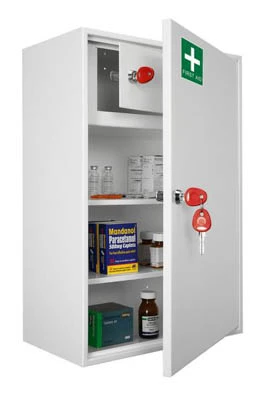
Healthcare storage systems should be specified from the storage function, the users, the room and the way the area is cleaned and managed. In an NHS hospital, clinic or other healthcare setting, staff lockers, PPE cabinets, medicine storage, clinical-supply cabinets, key storage and hazardous-substance storage solve different problems. There is no single generic “HTM-compliant locker” or cabinet that is automatically correct for every healthcare location.
This guide explains how to build a practical healthcare storage brief for NHS lockers, PPE storage, clinical supplies and secure cabinets. It uses current NHS estates, cleanliness and infection-prevention guidance as planning context, but it does not replace project-specific advice from estates, fire safety, infection prevention and control (IPC), pharmacy, health and safety or clinical teams.
Planning staff changing rooms or personal lockers? Use our NHS & Healthcare Changing Room Planning UK guide. That is the main guide for healthcare staff lockers, uniforms, shift changes, benches, changing-room flow and staff-only access. This page stays focused on the wider question: what type of storage is appropriate for each healthcare function?
If you are still deciding between lockers, cabinets, safes, shelving, key storage or other secure-storage formats, also see Types of Storage Systems UK: Lockers, Cabinets and Safes.
Quick Answer: How Should Healthcare Storage Be Specified?
Start with the stored item and operating process, not a product label. Define what is being stored, who needs access, whether the contents are clean, used, clinical, hazardous or security-sensitive, where the unit will be installed and how it will be cleaned, inspected and maintained.
- Staff coats, bags, footwear and personal clothing: start with healthcare staff lockers and changing-room planning.
- Clean PPE or department-issued protective equipment: define the PPE type, replenishment process, point of use and required access.
- Medicines: use suitable medical or specialist medicines storage and follow the organisation’s medicines-management requirements.
- Controlled drugs: use specialist storage specified against current legal, pharmacy and local governance requirements.
- Clinical consumables: define cleanliness, stock control, access and location requirements.
- Cleaning chemicals and hazardous products: follow the safety data, COSHH assessment and local segregation requirements.
- Keys and access credentials: define authorised users, issue and return procedures, emergency access and audit requirements.
The correct healthcare storage system is the one that supports the room, the stored item and the operating procedure. “Healthcare”, “clinical” or “HTM compliant” on a product description does not establish suitability by itself.
Healthcare Lockers, PPE Cabinets and Medical Cabinets: Which Route Do You Need?
| Storage requirement | Typical starting point | Primary decision |
|---|---|---|
| Staff coats, bags and personal clothing | Healthcare staff lockers | Staff numbers, allocation, shift overlap, clothing volume and changing sequence |
| Uniforms and workwear | Staff lockers, clean/used clothing lockers or garment-management storage | How clean garments are issued and how used garments leave the changing area |
| Clean PPE | PPE cabinet, cupboard or allocated storage | Point of use, replenishment, contamination risk and authorised access |
| General medicines | Medical or medicine cabinet | Medicine type, authorised users, monitoring and local procedure |
| Controlled drugs | Specialist controlled-drug storage | Current statutory, pharmacy and local governance requirements |
| Clinical consumables | Suitable organised or secure cabinet storage | Stock rotation, cleanliness, access frequency and location |
| Cleaning chemicals | Appropriate hazardous-substance storage | Safety data, COSHH assessment, segregation and quantity |
| Keys, access cards and credentials | Key cabinet or controlled key-management system | Authorised users, accountability, issue/return and emergency access |
Where several of these functions exist in the same department, do not solve them by buying one generic cabinet type in several sizes. The storage brief should separate the functions first, then select the product and lock method for each one.
Which NHS Guidance Is Relevant to Storage Planning?
NHS storage requirements are spread across different guidance because “healthcare storage” is not one single regulated product category. The relevant source depends on the room, the stored item and the risk being controlled.
| Guidance | Why it matters | What not to assume |
|---|---|---|
| HBN 00-09: Infection control in the built environment | Supports designed-in infection prevention, cleanability, maintainability and IPC involvement in healthcare building design. | It does not provide one universal approved material list for every healthcare locker or cabinet. |
| National Standards of Healthcare Cleanliness 2025 | Provides the current cleanliness framework, including cleaning responsibilities, frequencies, performance expectations and functional risk. | It does not mean every healthcare storage product requires the same finish or cleaning method. |
| National Infection Prevention and Control Manual for England | Provides the current national IPC framework and supports local procedures for PPE, equipment and contamination risks. | It does not make an ordinary cabinet or locker “IPC compliant” simply because it is installed in a healthcare building. |
| HBN 00-02: Sanitary spaces | Can be relevant where changing, washing and associated sanitary facilities form part of the project. | It should not be treated as a generic cabinet specification for every clinical room. |
| Current Health Technical Memoranda | Individual HTMs cover specialist engineering and safety subjects, including fire and other healthcare-estates requirements. | There is no single current HTM that defines every NHS locker, cabinet and storage system. |
The practical rule is simple: build the specification from the specific room, specific contents and specific risk. Avoid statements such as “HTM requires this locker material” or “NHS rules require digital locks” unless a current document and the project context actually support that claim.
NHS Staff Lockers Belong in the Changing-Room Plan
Staff lockers are primarily for personal belongings, clothing, footwear and appropriate work-related items. They should not be specified as if they were medicine cabinets or clinical-supply cupboards.
The locker requirement depends on staff numbers, peak shift overlap, permanent versus bank or agency staff, uniform policy, locker allocation, compartment size, changing sequence, cleaning access and lock management. A healthcare changing room may also need to account for benches, clean workwear, used garments, footwear and staff-only access.
- NHS & Healthcare Changing Room Planning UK — main healthcare locker and changing-room guide.
- NHS Locker Access Systems UK — key, combination, RFID and managed locker access for healthcare staff.
- Accessible Locker Planning UK — reach, circulation, lock usability and inclusive provision.
- Locker Estate Audit UK — condition, allocation, usage, access and replacement priorities.
- Locker Refurbishment UK — repair, repainting, replacement components and lock upgrades.
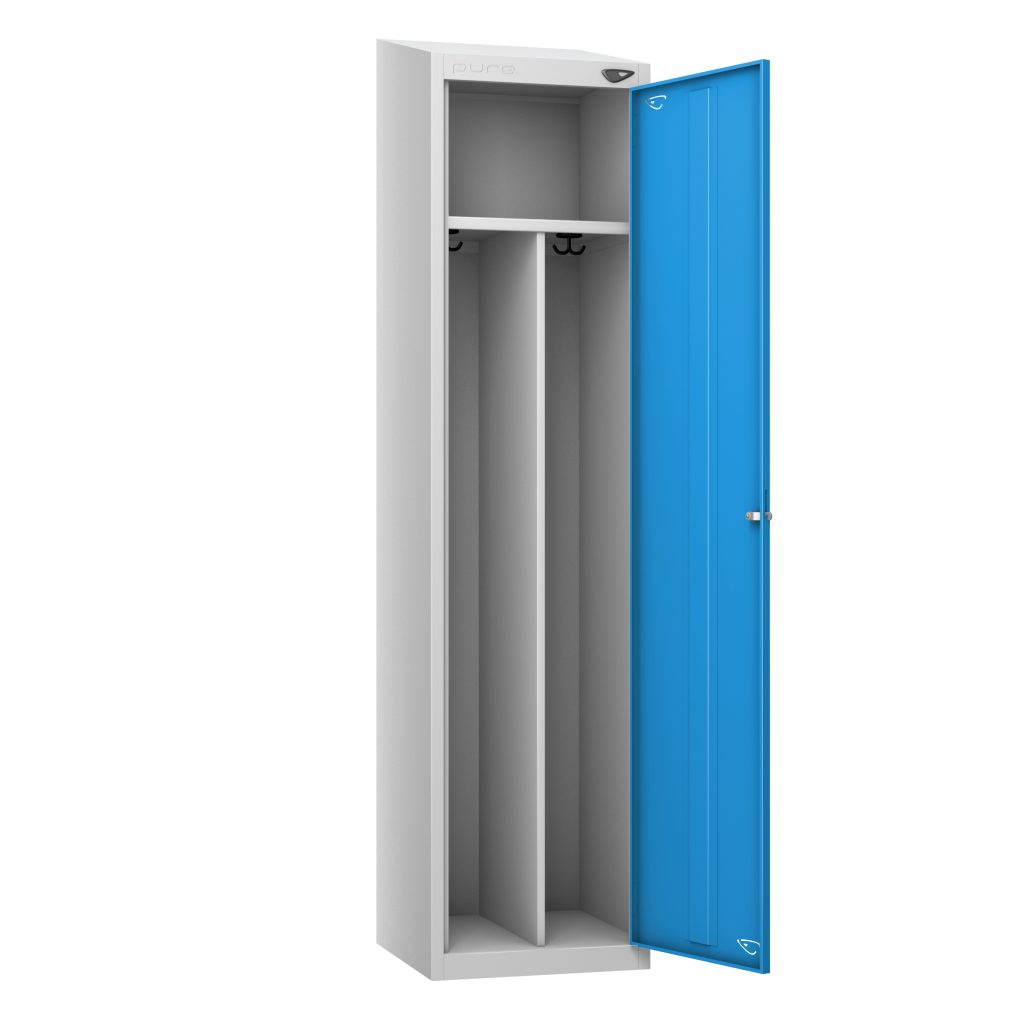
PPE Storage: Define the PPE and Workflow Before Choosing a Cabinet
PPE is not one uniform storage category. Some items are disposable, some reusable, some individually issued and some shared. Some PPE is kept close to the point of use; other protective clothing is managed through staff changing or departmental storage.
- What type of PPE is being stored?
- Is it clean, used or awaiting disposal?
- Is it single-use or reusable?
- Is it allocated to one person or shared?
- Where is it put on and removed?
- Does it need protection from dust, moisture or general handling?
- Who replenishes and checks the stock?
- Does access need to be open, staff-only or restricted?
- What does the local IPC procedure require?
The National Infection Prevention and Control Manual for England should inform local practice. Select storage that supports the organisation’s actual PPE procedure rather than assuming that all PPE needs sterile storage, a digital lock or the same cabinet format.

For current product options, see the PPE cabinet range. Check the cabinet against the actual PPE dimensions, location, cleaning process, replenishment method and required access level before ordering.
Medicines and Clinical Supplies Need a Separate Storage Route
Medicines should not be treated as an extension of the staff-locker specification. Medicine storage has its own access, monitoring and governance requirements, while controlled drugs can require specialist storage beyond a standard medical cabinet.
Use Medical Cabinets UK: Medicines Storage, Compliance and Security Guide as the parent guide for medicines storage. For current products, see lockable medical cabinets. Always check suitability against the medicine type and the organisation’s current medicines-management requirements.
General clinical consumables are a different problem again. The main questions are whether stock must remain clean and protected, whether access needs restriction, how stock is rotated and how close the storage needs to be to the point of use.
Cleaning Chemicals and Hazardous Substances Are Not General Healthcare Cabinet Storage
Cleaning chemicals, acids and other hazardous substances should be specified from the product safety information, quantity, hazard, segregation requirements and the organisation’s COSHH assessment. Do not use ordinary staff lockers or general medical cabinets as substitutes for dedicated hazardous-substance storage where the risk assessment requires a specialist solution.
Cleanability and Maintenance: Design the Installation, Not Just the Cabinet
HBN 00-09 makes infection prevention, cleanability and maintainability important design considerations. For storage systems, that means looking beyond the door finish and considering the complete installation.
- Can exposed surfaces be cleaned using the site’s approved method?
- Can the floor beneath or around the unit be reached?
- Are there unnecessary gaps, voids or horizontal surfaces that are difficult to inspect?
- Would a plinth, stand or sloping top improve the installation for this location?
- Is the environment dry, humid, wet-adjacent or subject to more intensive cleaning?
- Are locks, hinges, doors and other service parts replaceable?
- Is ventilation useful or necessary for the stored contents?
- Who is responsible for routine inspection and defect reporting?
The National Standards of Healthcare Cleanliness 2025 use functional risk, cleaning responsibilities and defined cleaning frequencies. The storage installation therefore needs to work with the organisation’s cleaning specification rather than rely on a generic “antibacterial” marketing claim.
Storage Location, Circulation and Fire Strategy
An empty wall in a healthcare corridor is not automatically a suitable storage location. Lockers and cabinets can affect clear width, door swing, visibility, access to fire-safety equipment and the use of circulation or escape routes.
- Keep required circulation and escape routes clear.
- Allow for locker, cabinet and drawer projection when open.
- Check that the installation does not obstruct fire-safety equipment or service access.
- Confirm fixing and stability requirements.
- Check the project fire strategy before placing storage in circulation areas.
- Do not apply one generic material or reaction-to-fire rule to every healthcare corridor without checking the actual project requirements.
Current NHS fire guidance sits within the Health Technical Memoranda, including the Firecode series. Project-specific fire requirements should therefore be checked rather than inferred from the word “NHS”.
For general room layout, door clearance and circulation planning, see Locker Room Design UK.
Healthcare Storage Access Control: Match the Lock to the Function
A digital lock can be useful in a healthcare environment, but electronic access does not create HTM compliance. Key locks, mechanical combination locks, keypads, RFID systems and managed electronic locks can all be appropriate where they solve the actual access problem.
| Use pattern | Access question |
|---|---|
| Assigned staff locker | Is a simple key, combination or individual electronic credential adequate? |
| Shared or temporary staff locker | How is the locker released, reset and made ready for the next user? |
| Restricted cabinet | Who is authorised and how are keys, codes or credentials controlled? |
| Higher-governance storage | Is an access record genuinely required, and who will review it? |
| Emergency access | What override method is available and who controls it? |
| Electronic system | Who administers users, batteries, credentials, faults and replacement parts? |
For healthcare locker-specific access options, use NHS Locker Access Systems UK. For the wider subject, see Storage Access Control Guide UK.
Healthcare Storage Procurement Checklist
- What exactly will be stored?
- Is it personal, clinical, medicinal, hazardous or security-sensitive?
- Is it clean, used or subject to a defined contamination-control process?
- Who needs access?
- Is use assigned, shared or restricted?
- Does access need to be recorded?
- Where will the storage be installed?
- What room conditions apply?
- What cleaning products and cleaning frequencies apply?
- Does the IPC team need to review the location or specification?
- Does the project fire strategy restrict the proposed position?
- Will open doors or drawers affect circulation?
- Can the unit and surrounding floor and wall areas be cleaned?
- Are the compartments large enough for the actual stored items?
- Is ventilation required?
- Can locks, hinges, doors and other parts be replaced?
- Who owns inspection, maintenance and defect reporting?
- Has the final brief been checked by the relevant healthcare, estates or specialist team?
Common Healthcare Storage Specification Mistakes
- Starting with a product rather than the stored item. This often produces the wrong compartment size, access method or cabinet type.
- Using “HTM compliant” as a generic product claim. Identify the actual guidance, room and requirement instead.
- Treating every healthcare room as the same environment. A dry staff changing room and a specialist clinical area can have very different requirements.
- Mixing staff belongings with medicines or controlled clinical storage. Keep these functions separate.
- Assuming all PPE needs the same storage. Storage depends on the PPE, point of use and local IPC procedure.
- Specifying electronic locks purely for “compliance”. Use them where they solve a defined access or management problem.
- Ignoring the installation around the storage. Tops, bases, floor access, voids and door swing all affect day-to-day use and cleaning.
- Placing storage in circulation space without checking the fire strategy.
- Relying on an “antibacterial” description instead of the site’s cleaning specification.
- Using old guidance without checking the current NHS England estates collections.
Where to Go Next
- NHS staff lockers, uniforms, benches and shift flow: NHS & Healthcare Changing Room Planning UK
- Healthcare locker locks and staff access: NHS Locker Access Systems UK
- Accessible healthcare locker provision: Accessible Locker Planning UK
- Existing locker condition and usage: Locker Estate Audit UK
- Repairing or upgrading existing lockers: Locker Refurbishment UK
- Medicines storage: Medical Cabinets UK
- General locker quantities and room planning: Locker Planning UK
- Choosing between lockers, cabinets, safes and other systems: Types of Storage Systems UK
- Current products: commercial lockers, PPE cabinets and medical cabinets
Frequently Asked Questions
Is there one NHS HTM that defines all healthcare storage requirements?
No. Healthcare storage requirements depend on the room, the stored item and the risk. Relevant NHS guidance is spread across HBNs, HTMs, cleanliness standards, IPC guidance and specialist procedures rather than one universal locker or cabinet specification.
Are healthcare lockers required to be made from one specific material?
Not as a universal rule. Material and construction should be assessed against the location, cleaning process, moisture exposure, use pattern, maintenance needs and project specification.
Are digital locks required for NHS lockers?
No. Digital locks can be useful for shared use, credential management or access records, but the correct lock depends on the users, operating method, security requirement and management process.
Can medicines be stored in ordinary staff lockers?
Staff lockers are primarily for personal belongings, clothing and appropriate work-related items. Medicines should follow the organisation’s medicines-storage procedures and use suitable medical or specialist storage where required.
How should PPE storage be chosen in a healthcare setting?
Define the PPE type, whether it is clean or used, whether it is individual or shared, where it is put on and removed, who replenishes it and what the local IPC procedure requires. Then select storage that supports that workflow.
Can lockers or cabinets be installed in NHS corridors?
Storage in corridors, circulation spaces or escape routes should be checked against the project layout, required clear routes and fire strategy. An unused wall is not automatically an acceptable storage location.
What NHS guidance is relevant to healthcare storage cleanability?
HBN 00-09 addresses infection control in the built environment, while the National Standards of Healthcare Cleanliness 2025 provide the current cleanliness framework. Local cleaning specifications and IPC procedures still need to be applied to the actual room and storage installation.
Need help selecting healthcare storage?
For staff changing and personal lockers, start with the NHS & Healthcare Changing Room Planning guide. If the storage type itself is not yet decided, use the Storage Systems guide. When you are ready to compare products, view our commercial lockers, PPE cabinets and medical cabinets.
Discover more from Blog Total Locker Service
Subscribe to get the latest posts sent to your email.