AquaStore Swimming Pool Leisure Lockers
January 28, 2020
AquaStore leisure lockers are designed for wet and humid changing-room environments where conventional steel locker construction may be less suitable. The range combines aluminium locker bodies with solid-grade laminate doors and polymer shelving to provide a durable, low-maintenance storage system for swimming pools, leisure centres and other demanding changing areas.
This guide focuses specifically on the AquaStore locker range: how it is constructed, where it is best used, the main configuration options and what should be checked before specification.
For wider advice on choosing access methods such as coin, PIN, RFID or padlock systems, use our Leisure Locker Access Systems UK guide.
What are AquaStore leisure lockers?
AquaStore is a specialist leisure-locker system developed for environments where moisture, cleaning and heavy daily use are major considerations. The construction is different from a conventional powder-coated steel locker because the main body uses aluminium, while the doors use solid-grade laminate.
This makes the range particularly relevant to swimming pools, wet changing rooms, leisure centres and sports facilities where corrosion resistance and easy cleaning are important parts of the specification.
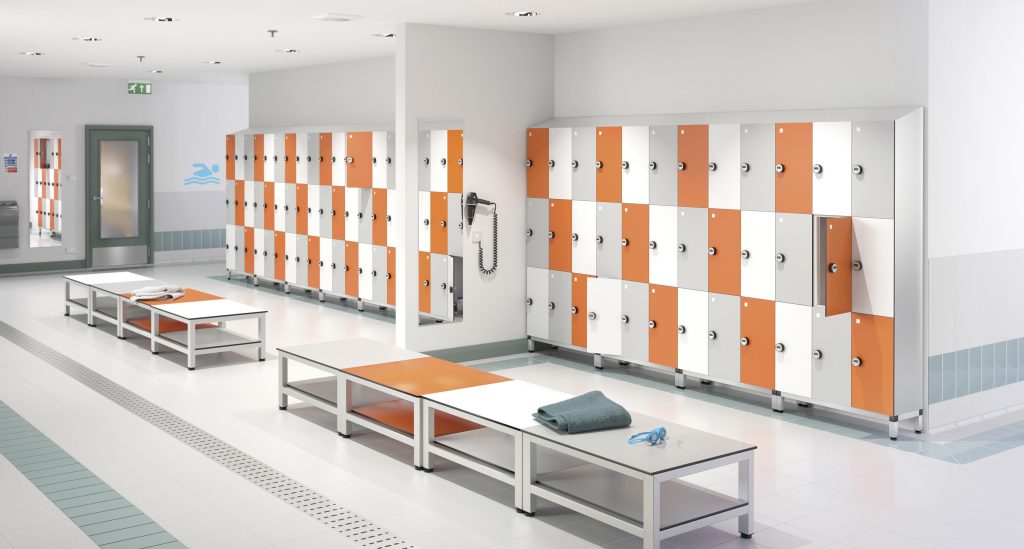
AquaStore construction
The AquaStore format is designed around materials that suit leisure and changing-room environments.
- Aluminium locker body.
- Solid-grade laminate doors.
- Polymer internal shelving on suitable configurations.
- Robust door fixing and hinge arrangement.
- Replaceable door and hardware components where applicable.
- Laminate end panels for finishing exposed locker-bank ends.
The exact construction and component specification should be checked against the current AquaStore product information before ordering, particularly where the project includes specialist locks, end panels or seat-stand arrangements.
Wet and humid changing-room use
AquaStore is best suited to environments where moisture is expected as part of normal use. This includes pool changing rooms, leisure centres, sports facilities and other wet or humid areas.
The material combination helps reduce the corrosion concerns associated with unsuitable locker construction in damp environments. That does not remove the need for good ventilation, cleaning access and appropriate room design, but it gives the locker system a construction better matched to wet-area use.
AquaStore door and shelf design
Solid-grade laminate doors are used because they are durable, moisture-resistant and available in a wide range of decorative finishes. This makes them suitable for leisure environments where appearance and cleaning performance are both important.
Internal polymer shelving can provide a practical alternative to materials that are more vulnerable to moisture. The shelf and compartment arrangement depends on the selected locker format.
AquaStore compartment configurations
AquaStore lockers are available in multiple compartment layouts so the same construction can support different storage requirements.
| Configuration | Typical use |
|---|---|
| Single-door | Full-height personal storage, coats and larger bags |
| Two-door | General changing-room storage with improved capacity |
| Three-door | Compact personal storage for higher user numbers |
| Four to six-door | Smaller-item storage where compartment density is more important than hanging space |
| Half-height units | Locations where reduced-height storage or specific room layouts are required |
Exact widths, depths, heights and compartment sizes should be confirmed from the current product specification rather than relying on legacy dimensions.
Builders’ plinths, stands and island runs
AquaStore lockers can be incorporated into different changing-room layouts, including wall runs and back-to-back island arrangements.
- Builders’ plinth installation.
- Dedicated locker stands.
- Back-to-back island runs.
- Single exposed-end laminate panels.
- Double end panels for island configurations.
End panels are important where the aluminium locker body would otherwise remain visible at the end of a run. They improve appearance and help protect exposed locker-bank ends.
Seat-stand options for AquaStore lockers
Where changing-room space is limited, lockers can be combined with seat stands so storage and seating occupy the same overall footprint.
This can be useful in leisure and sports changing rooms where separate benches would otherwise reduce aisle space. The combined arrangement still needs to be checked carefully against locker-door opening space and circulation.
For detailed bench dimensions, see Changing Room Bench Sizes UK. For small-room planning, use Small Locker Room Design UK.
AquaStore locking options
AquaStore lockers can be supplied with different lock types depending on whether the facility uses public, shared or assigned storage.
| Lock type | Typical use |
|---|---|
| Coin lock | Public and leisure changing rooms where temporary use is required |
| Hasp and padlock fitting | Facilities where users supply their own padlocks |
| Electronic PIN lock | Keyless operation for managed or shared changing rooms |
| RFID lock | Facilities using cards, wristbands or managed electronic credentials |
This page does not attempt to own the detailed access-control decision. For coin, RFID, electronic PIN and public-use locker operation, use Leisure Locker Access Systems UK.
Colour and laminate finish options
Solid-grade laminate doors allow AquaStore lockers to be specified in a wide range of finishes. Different door colours can be used to create zones, identify areas or support a wider changing-room design scheme.
Current laminate ranges and colour availability should be checked at quotation stage because manufacturer collections and finishes can change over time.
Where AquaStore lockers are used
| Environment | Why AquaStore can suit it |
|---|---|
| Swimming pools | Wet-area materials and public-use lock options |
| Leisure centres | Durable construction, multiple compartment formats and broad access options |
| Sports clubs | Robust changing-room storage with flexible door configurations |
| Gyms | High user turnover and multiple lock choices |
| Health clubs | Laminate finishes, wet-area suitability and premium appearance |
How to specify AquaStore lockers
- Confirm the number of users and required compartments.
- Decide whether full-height or smaller compartments are needed.
- Measure the available room width and depth.
- Decide between wall runs, stands, builders’ plinths or island arrangements.
- Choose the door laminate finish.
- Select the operating lock type.
- Check whether end panels are required.
- Decide whether seat stands are needed.
- Confirm the final room layout and clearances before ordering.
For the wider project brief, use Locker Specification Planning UK. For practical setting out, fixing and installation, see Locker Installation Planning UK.
AquaStore vs standard steel lockers
AquaStore should not be treated as a direct replacement for every conventional steel locker. The two constructions suit different environments and budgets.
| Factor | AquaStore | Standard steel locker |
|---|---|---|
| Wet-area suitability | Designed for wet and humid changing-room use | Depends on coating, environment and manufacturer specification |
| Door material | Solid-grade laminate | Usually powder-coated steel |
| Body material | Aluminium | Steel |
| Appearance | Broad laminate finish options | Powder-coated colour range |
| Typical use | Pools, leisure and premium changing rooms | Schools, workplaces, general changing rooms and dry environments |
Related AquaStore and leisure locker guides
- Leisure Locker Access Systems UK – coin, PIN, RFID and public-use locking methods.
- Changing Room Bench Sizes UK – bench planning and dimensions.
- Small Locker Room Design UK – planning constrained leisure and changing spaces.
- Locker Room Layout Mistakes UK – avoiding blocked aisles, door clashes and poor bench placement.
- Locker Specification Planning UK – defining the project brief.
- Locker Installation Planning UK – delivery, positioning and fixing.
AquaStore Leisure Locker FAQs
What are AquaStore lockers made from?
AquaStore lockers use aluminium body construction with solid-grade laminate doors and polymer shelving on suitable configurations. The exact specification should be checked against the current product information.
Are AquaStore lockers suitable for swimming pools?
Yes. AquaStore is designed for wet and humid leisure environments, making it suitable for swimming pools, leisure centres and similar changing areas.
Can AquaStore lockers use coin locks?
Coin locks are one of the access options that can be used on leisure lockers, alongside hasp, electronic PIN and RFID systems. The available lock choices should be confirmed for the selected AquaStore configuration.
Can AquaStore lockers be installed back to back?
Yes. Back-to-back island arrangements can be used where the room layout allows it, with suitable end panels and installation support included in the specification.
Can AquaStore lockers be combined with bench seating?
Yes. Seat-stand arrangements can combine locker storage and seating where changing-room space is limited, subject to the selected configuration and room-clearance requirements.
Summary: AquaStore leisure lockers
AquaStore is a specialist leisure-locker system for wet and humid changing-room environments. Its aluminium body, solid-grade laminate doors and polymer components make it a strong option for swimming pools, leisure centres, gyms and sports facilities.
The key specification decisions are the compartment layout, lock type, installation format, laminate finish, end panels and whether seat stands are required. These should be confirmed against the current AquaStore range and the actual room layout before ordering.
Discover more from Blog Total Locker Service
Subscribe to get the latest posts sent to your email.