Medical Cabinets for Care Homes and Assisted Living: How to Choose the Right Storage
March 24, 2026
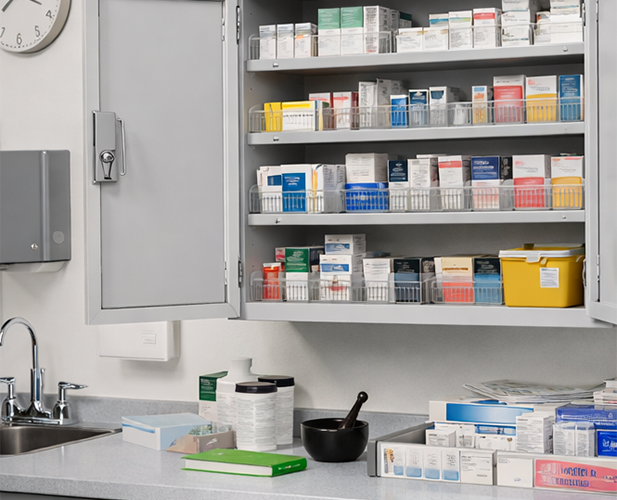
Medical cabinets for care homes and assisted living settings need to do more than provide a lock. They need to support safe daily routines, keep medicines and related items organised, and fit the way the service actually works. In many care environments, storage is under constant pressure. Different residents have different medicines, teams work across shifts, and staff need quick but controlled access to items throughout the day. If the cupboard is poorly chosen, that pressure shows up quickly in the form of clutter, awkward access, mixed categories and weak day-to-day organisation.
That is why choosing the right medical cabinet should begin with the setting rather than the catalogue. A care home medicines room does not operate in the same way as a GP treatment room or a hospital clinical area. Storage needs to reflect the residents, the medicines system in use, the amount of stock being held and the way staff support administration, checking and reordering.
This guide explains what to look for when choosing medical cabinets for care homes and assisted living, including cabinet format, shelf layout, lock options, room placement and practical organisation. For the broader topic, see our complete guide to medical cabinets. If you are ready to compare products, you can also browse our medical cabinet range.
Why storage matters in care homes
In care homes, storage affects much more than neatness. It shapes how easy it is for staff to find the correct item, keep medicines separated appropriately and maintain a consistent routine across shifts. When cupboards are overcrowded or badly arranged, the whole process becomes harder. Staff spend more time looking for items, products are more likely to end up in the wrong place and regular checks become slower and less reliable.
Good storage supports safer working because it makes the right process easier to follow. Items are visible. Shelves have a clear purpose. Access is controlled. The cupboard is easier to clean and easier to review. That does not make the cupboard the whole medicines system, but it does make it an important part of the system.
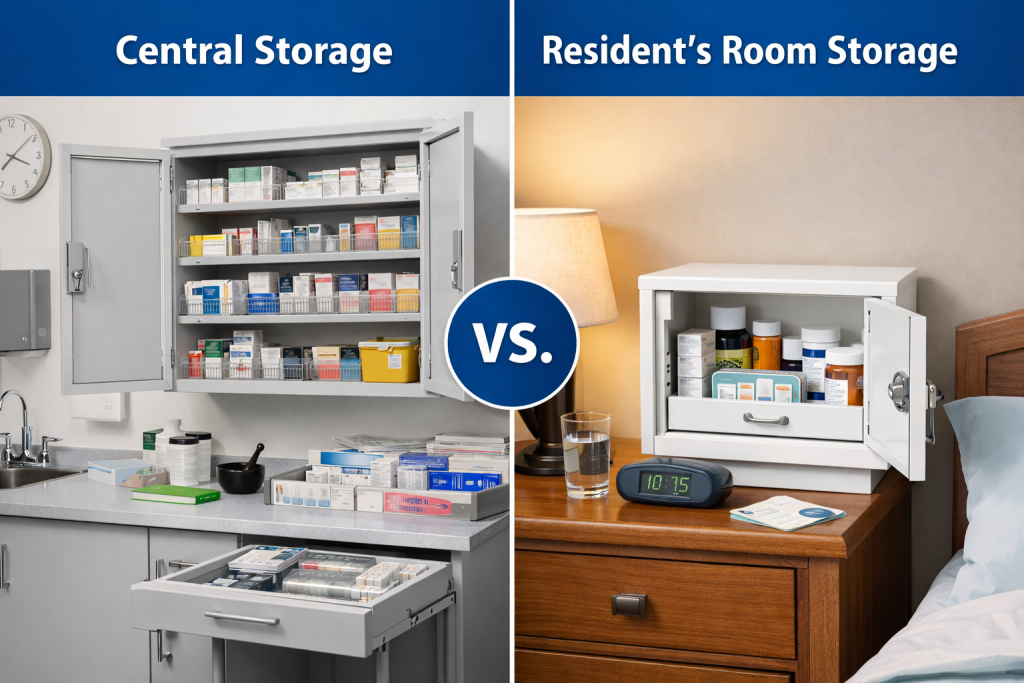
Care homes also need storage that fits the reality of resident care. Some residents may self-administer or keep medicines in their own room, while other medicines are stored centrally. That means the storage setup may need more than one type of cabinet or a more deliberate layout than buyers first expect.
What care homes usually need from a medical cabinet
Most care homes need medical cabinets that combine secure access with practical organisation. The cupboard should be easy for authorised staff to use, but it should not become a general dumping space for unrelated items. In most settings, the best cabinets do several jobs well at the same time.
- They provide secure storage for medicines or clinical items that should not be freely accessible.
- They offer enough internal shelf space to keep categories clearly separated.
- They support easier checks, restocking and day-to-day housekeeping.
- They suit the room without making it feel crowded or awkward.
- They use a lock system that matches the staff access pattern.
- They help keep the storage area manageable over time rather than only on installation day.
The exact balance will differ between homes. A smaller assisted living setting may need a compact and simple cupboard arrangement, while a larger care home may need a more substantial central storage setup with a clearer division between routine medicines, disposables and other care-related stock.
Central storage versus storage in residents’ rooms
One of the key differences in care settings is that medicines may be stored centrally or, in some cases, in a resident’s room. This makes care home storage more varied than some other healthcare settings. The right arrangement depends on the resident’s needs, the level of support required and the overall medicines system used by the home.
Central storage often works well for medicines that staff manage routinely because it keeps the storage controlled, visible and easier to oversee. It can support a more structured process across shifts and can make stock checks more straightforward.
At the same time, some residents may need their own storage arrangements depending on how their medicines are managed. This is why care homes should think in terms of a storage plan rather than assuming one central cupboard automatically solves every requirement. A well-run home may use a combination of central cupboards and resident-specific storage where appropriate.
Wall-mounted or floor-standing cabinets for care homes?
Both wall-mounted and floor-standing medical cabinets can work well in care homes, but they suit different spaces.
Wall-mounted cabinets are often useful where floor space is limited, where the room needs to feel open and easy to clean, or where the amount of stock is moderate. They can keep the area visually tidy and place commonly used items at a practical height. This can work well in smaller treatment areas, medicines rooms or assisted living environments where the stock profile is controlled.
Floor-standing cupboards are often the better choice where the home holds a wider range of stock or needs stronger shelf separation. The extra capacity helps prevent overcrowding and gives staff more room to organise medicines in a clear and manageable way. In busier care homes, this additional capacity can make a real difference to daily usability.
If you are weighing up these two formats, our guide to wall-mounted vs floor-standing medical cabinets compares them in more detail.
Why internal layout matters so much in care settings
In care homes, internal organisation is often more important than buyers expect. A cupboard with the right outer dimensions can still work badly if the shelf layout does not support clear separation. This is especially true where several residents’ medicines, monitored systems, creams, liquids or high-use items need to be stored in an orderly way.
Adjustable shelving is particularly useful because it allows the cupboard to be configured around the actual stock being held. Some products are small and boxed. Others are taller. Some categories are used frequently and need to sit at easier reach height. A rigid fixed-shelf layout may force staff into awkward stacking or mixed storage, which then makes routine handling harder.
Good layout is not only about fitting everything in. It is about making the cupboard workable when the home is busy. Staff should be able to see what is there, return items to the correct place and maintain order without constant rearranging.
Lock options for care homes
The best lock for a care home cabinet depends on who needs access and how often. In some homes, a keyed lock may be perfectly suitable if access is limited and key control is clear. In others, particularly where several staff across different shifts need routine access, a keypad or combination format may be more practical.
The important thing is that the lock supports the way the home actually works. If the lock creates friction, staff may start working around it. If access is too loose, accountability becomes weaker. A simple solution used consistently is usually better than a more advanced solution used badly.
For a fuller comparison of the main lock formats, see our guide to medical cabinet lock options for clinics and care homes.
Separating medicines from general care supplies
One of the easiest ways to lose control of a cupboard is to let it become mixed-use storage. If a cabinet is meant for medicines, it should not gradually fill with dressings, gloves, paperwork, cleaning products or unrelated care supplies. That makes the cupboard harder to check, harder to clean and harder to keep organised.
Many care homes work better when medicines are stored separately from broader consumables. This does not always require a large room. Sometimes it simply means using one cupboard for routine medicines and another for general care items. The result is usually a cleaner, more manageable storage system.
It also helps to separate general routine medicines storage from more specific controlled-drug storage decisions. Those two requirements should not be blurred together. Our guide to medicine cupboards vs controlled drug cupboards explains that distinction in more detail.
How much capacity does a care home cabinet need?
The answer depends on the number of residents supported, the medicines system used by the home and how much stock is held centrally. This is why buying by outer dimensions alone is risky. A cupboard can look large enough on paper and still be too cramped once the real contents are placed inside.
Start with the actual storage need. Consider what the cabinet will hold every day, not just in theory. Think about resident-specific medicines, reserve stock, creams, liquids, monitored dosage systems and any other items that belong in that storage area. Then ask whether the cabinet will still feel organised when it is fully in use on a busy day.
It is usually better to allow a modest amount of spare room than to fill the cabinet to capacity from the start. A cupboard that begins overcrowded rarely becomes easier to manage later.
Placement, cleaning and room flow
Medical cabinets should fit the room as well as the stock. In care homes, that means thinking carefully about where the cupboard sits, how the doors open and how easily the surrounding area can be cleaned. A cupboard that blocks movement or makes the room feel crowded will never work as well as one that fits naturally into the space.
Wall-mounted cabinets often help with floor cleaning and can reduce visual heaviness in smaller rooms. Floor-standing cupboards can be excellent where more capacity is needed, but they still need sensible positioning. If the cabinet is pushed into a difficult corner or blocks part of the room when opened, staff will feel that drawback every day.
Good placement also helps the storage stay tidy. When a cupboard is easy to reach and easy to use, staff are more likely to keep it organised. When it is awkward, the room slowly adapts around the inconvenience instead.
Assisted living settings need the same clarity
Assisted living environments may be smaller or more domestic in feel than a traditional care home, but the same storage logic still applies. The cabinet should suit the residents being supported, the medicines arrangements in place and the amount of staff access required. A smaller setting does not remove the need for deliberate storage planning. In fact, limited space often makes good planning even more important.
Compact wall-mounted cabinets can work well in some assisted living settings, especially where the central stock is modest. In other cases, a taller cupboard may still be the better fit if it allows clearer separation and avoids crowding. The right answer depends on the room and the system, not the label of the service alone.
Common mistakes when buying medical cabinets for care homes
Several mistakes come up repeatedly when care providers choose cabinets.
- Choosing by appearance alone: the cupboard may look tidy but still be too small or badly laid out internally.
- Underestimating the amount of stock: this quickly leads to overcrowded shelves.
- Using one cupboard for too many different functions: mixed-use storage becomes harder to manage over time.
- Ignoring shift-based access: the lock should match the real staff access pattern.
- Forgetting about resident-specific storage needs: not all medicines are managed in exactly the same way.
- Placing the cupboard wherever space happens to remain: poor placement creates daily friction.
Most of these problems can be avoided by planning the cupboard role before comparing products. Once the role is clear, the right size, format and lock type become much easier to identify.
How to choose the right cabinet for your care setting
A simple way to narrow the choice is to ask five practical questions.
- What exactly will this cabinet store?
- Will the storage be central, resident-specific or a mixture of both?
- How many staff need access, and how often?
- Would a wall-mounted or floor-standing format suit the room better?
- Would one cupboard be enough, or would separate storage roles work better?
Those answers usually point clearly towards the right option. A smaller setting with moderate central storage might suit a compact cabinet. A larger care home with broader stockholding may need a larger cupboard with stronger shelf separation. In some cases, the best setup is a combination rather than a single cupboard expected to do everything.
Choosing the right medical cabinet from Total Locker Service
The right medical cabinet for a care home or assisted living setting should support secure storage, sensible organisation and manageable daily use. It should fit the room, suit the staff access pattern and stay practical once it is fully in service. Whether that means a compact wall-mounted cupboard or a larger floor-standing unit depends on the setting and the stock profile.
If you are reviewing storage options, browse our medical cabinet range for secure healthcare storage designed to support organised working environments.
Final thoughts
Medical cabinets for care homes and assisted living settings should make storage easier to control, not harder. The best cupboards support secure access, clear organisation and daily routines that remain workable under pressure. They help staff keep the storage area tidy and reduce the drift towards clutter and mixed-use shelving.
When the cupboard matches the setting, the room works better. Staff can find what they need more quickly, shelves stay more manageable and the storage becomes part of a reliable daily process rather than a source of friction.
Discover more from Blog Total Locker Service
Subscribe to get the latest posts sent to your email.