Wall-Mounted vs Floor-Standing Medical Cabinets: Which Is Best?
March 24, 2026
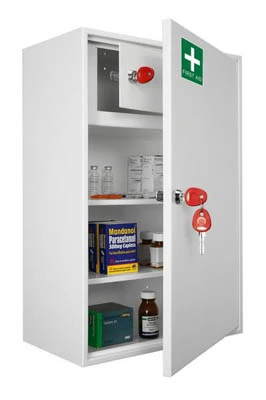
Wall-mounted and floor-standing medical cabinets solve different storage problems. Wall-mounted cabinets save floor space and can place stock at a practical working height, while floor-standing cabinets usually provide greater capacity and more room for larger stock volumes.
This guide compares wall-mounted and floor-standing medical cabinets, including room size, available wall and floor space, capacity, access height, cleaning around the cabinet, installation implications and the settings where each format is better suited.
For broad medical-cabinet selection, use the Medical Cabinets UK guide. For clinic-room workflow, use Medical Cabinets for Clinics UK.
Quick Answer: Wall-Mounted or Floor-Standing Medical Cabinet?
Choose a wall-mounted medical cabinet when floor space is limited, stock volume is moderate and a practical working height matters. Choose a floor-standing cabinet when greater capacity is needed and the room can comfortably accommodate the larger footprint.
| Factor | Wall-mounted | Floor-standing |
|---|---|---|
| Floor space | Preserves it | Uses it |
| Capacity | Usually lower | Usually higher |
| Access height | Can be positioned at a chosen working height | Fixed by cabinet dimensions |
| Cleaning around cabinet | Clear floor beneath can be easier to access | Requires cleaning around the cabinet base |
| Installation | Requires suitable wall and secure fixing | Requires suitable floor position and door clearance |
| Typical use | Treatment rooms and compact spaces | Storage rooms and higher-volume areas |
What Is a Wall-Mounted Medical Cabinet?
A wall-mounted medical cabinet is fixed above floor level and uses vertical wall space rather than floor area.
- well suited to compact rooms;
- can help preserve clear floor space;
- can be installed at a practical working height;
- is usually better suited to moderate stock volumes than bulk storage.
What Is a Floor-Standing Medical Cabinet?
A floor-standing medical cabinet sits on the floor and usually offers more usable storage space than a compact wall-mounted unit.
- better suited to larger stock volumes;
- can provide greater usable storage capacity;
- works well in storage rooms and larger clinical areas;
- requires enough floor area and door-opening clearance.
How Room Size Affects the Decision
Room size is often the first practical filter. A cabinet can have the right capacity and still be the wrong format if it dominates the room or obstructs movement.
- small treatment or consultation room: wall-mounted often fits more naturally;
- larger treatment area: either format may work;
- dedicated clinical storage room: floor-standing usually makes better use of the available area;
- very constrained room: check whether there is actually enough usable wall space before assuming wall-mounted is possible.
Available Wall Space vs Available Floor Space
The right format depends on which part of the room is genuinely available.
- Is there a clear wall area wide and strong enough for a mounted cabinet?
- Would a wall cabinet conflict with sinks, shelving, monitors or other equipment?
- Would a floor-standing unit narrow a walkway or treatment area?
- Can the doors open fully without hitting furniture or equipment?
Capacity: How Much Stock Needs to Be Stored?
Capacity is one of the clearest differences between the two formats.
Wall-mounted cabinets are usually better where the stock requirement is modest. Floor-standing cabinets generally make more sense where larger quantities or a broader range of items need to be accommodated.
The important point is not to force a compact cabinet to handle a volume of stock that will make it permanently overcrowded.
Access Height and Reach
Wall-mounted cabinets give more control over installation height, but that also creates a responsibility to choose the position carefully.
- avoid installing the cabinet so high that routine access becomes awkward;
- avoid placing it where open doors interfere with other fittings;
- consider the normal user group rather than one individual installer;
- for floor-standing cabinets, check whether frequently used shelves will remain practical to reach.
Treatment Room vs Storage Room
| Setting | Typical better fit | Why |
|---|---|---|
| Small treatment room | Wall-mounted | Preserves floor space and keeps storage close to the working area |
| Consultation room | Wall-mounted or compact floor-standing | Depends on stock volume and room layout |
| Large treatment room | Either | Capacity and placement become the deciding factors |
| Dedicated clinical storage room | Floor-standing | Greater capacity and better use of larger storage areas |
For the wider clinic-room use case, see Medical Cabinets for Clinics UK.
Cleaning Around the Cabinet
Cabinet format affects how easy it is to clean the surrounding area.
- Wall-mounted: the floor beneath remains accessible.
- Floor-standing: the cabinet base creates a fixed floor contact point and requires cleaning around the unit.
- either format should be positioned so adjacent surfaces remain practical to reach.
Installation Implications
The installation requirements are different enough that they should be checked before purchase.
Wall-Mounted Installation
- confirm that the wall is suitable for the cabinet and expected load;
- choose the mounting height before finalising the position;
- check for clashes with other fittings;
- confirm door clearance.
Floor-Standing Installation
- confirm the cabinet fits without restricting movement;
- allow enough clearance for doors to open fully;
- check the final position before loading the cabinet;
- consider any fixing or securing requirements for the chosen cabinet and setting.
When a Wall-Mounted Medical Cabinet Is Usually Better Suited
- the room is compact;
- floor space is limited;
- stock volume is moderate;
- a chosen working height is useful;
- keeping the floor clear for cleaning or movement is important;
- the wall is suitable for secure mounting.
When a Floor-Standing Medical Cabinet Is Usually Better Suited
- greater capacity is required;
- the room has enough usable floor space;
- the storage is located in a dedicated stock or clinical storage room;
- a wall-mounted unit would become overcrowded too quickly;
- more shelf area is needed.
Can You Use Both Formats?
Yes. A department may use wall-mounted cabinets in treatment rooms and floor-standing cabinets in a separate storage room.
The important point is that each cabinet has a clear role. Using both should solve two different space or capacity needs rather than simply adding more cupboards.
Common Format-Selection Mistakes
- Choosing by appearance alone.
- Ignoring available wall or floor space.
- Buying a wall cabinet that is too small for the stock volume.
- Buying a floor-standing cabinet that makes the room awkward to use.
- Forgetting door clearance.
- Installing a wall-mounted cabinet at an impractical height.
- Failing to check installation conditions before purchase.
Wall-Mounted vs Floor-Standing Decision Checklist
- How much stock will the cabinet hold?
- Is usable wall space available?
- Is usable floor space available?
- Would a floor-standing cabinet obstruct movement?
- Will the wall-mounted height be practical for normal users?
- Can the cabinet doors open fully?
- Will the surrounding area remain easy to clean?
- Is the wall suitable for the mounted load?
- Would a separate floor-standing storage cabinet be better for reserve stock?
Related Medical Storage Guides
- Medical Cabinets UK – broad cabinet selection and buying guide.
- Medical Cabinets for Clinics UK – treatment-room and clinic use case.
- Medical Cabinet Locks & Access Control UK – access governance.
- Medicine Cabinet Audit Checklist UK – stock, expiry and recurring checks.
- Medical Cabinet Layout & Organisation UK – shelving, segregation and practical stock organisation.
Medical Cabinets from Total Locker Service
Total Locker Service supplies wall-mounted and floor-standing medical cabinets for clinics, care settings, schools and workplaces across the UK.
Wall-Mounted vs Floor-Standing Medical Cabinet FAQs
Are wall-mounted medical cabinets better for small rooms?
They often work well in small rooms because they preserve floor space, provided the available wall is suitable and the stock volume fits the cabinet.
Do floor-standing medical cabinets hold more stock?
Floor-standing models usually provide more overall capacity than compact wall-mounted cabinets, although the exact capacity depends on the individual product.
Are wall-mounted medical cabinets easier to clean around?
They can be, because the floor beneath remains clear and accessible. The final result still depends on cabinet position and the surrounding room layout.
What should be checked before installing a wall-mounted medical cabinet?
Check that the wall is suitable for the cabinet and expected load, choose a practical mounting height and confirm that doors and nearby fittings will not clash.
Can a clinic use both wall-mounted and floor-standing medical cabinets?
Yes. Wall-mounted cabinets can suit treatment rooms while floor-standing cabinets can provide higher-capacity storage in a separate clinical storage room.
Conclusion: Match the Format to the Room and Capacity
Wall-mounted medical cabinets are usually better where floor space is limited and stock volume is moderate. Floor-standing cabinets are usually better where greater capacity is needed and the room can accommodate the larger footprint.
Use this guide for the wall-mounted vs floor-standing decision. Use the specialist guides for broad cabinet selection, access governance, controlled-drug storage, compliance, stock audits and detailed cabinet organisation.
Discover more from Blog Total Locker Service
Subscribe to get the latest posts sent to your email.