How to Carry Out a Medicines Storage Risk Assessment in a Care Home
March 24, 2026
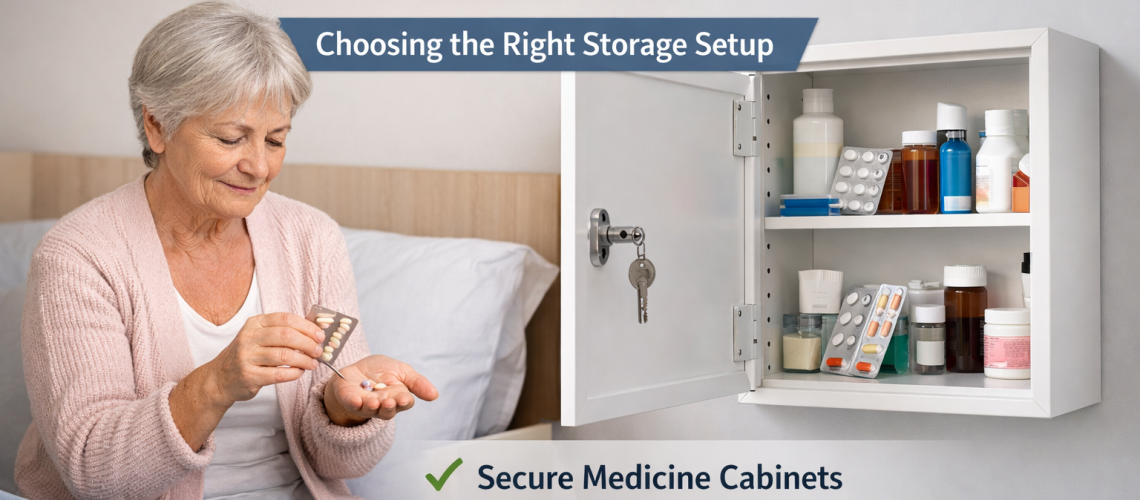
Medicines storage in a care home should never be an afterthought. A cupboard, cabinet or drawer may look secure, but if it does not match the resident’s needs, the medicine type and the way care is actually delivered, the system can quickly become weak. A proper medicines storage risk assessment helps care providers make practical decisions that support safety, accountability and independence.
In simple terms, the purpose of a medicines storage risk assessment is to decide where medicines should be kept, who should have access, what level of security is needed and how the arrangement will be reviewed over time. That might mean central storage in a treatment room, a lockable cupboard in a resident’s room, a small dedicated medical cabinet, refrigerated storage for cold-chain items, or a hybrid arrangement that combines more than one option.
The strongest systems are not always the most restrictive ones. Good storage planning balances control with dignity. Some residents can safely self-administer part or all of their medicines. Others need closer support. Some medicines carry higher risks than others. A care home medicines storage risk assessment helps turn those differences into a clear, workable storage plan.
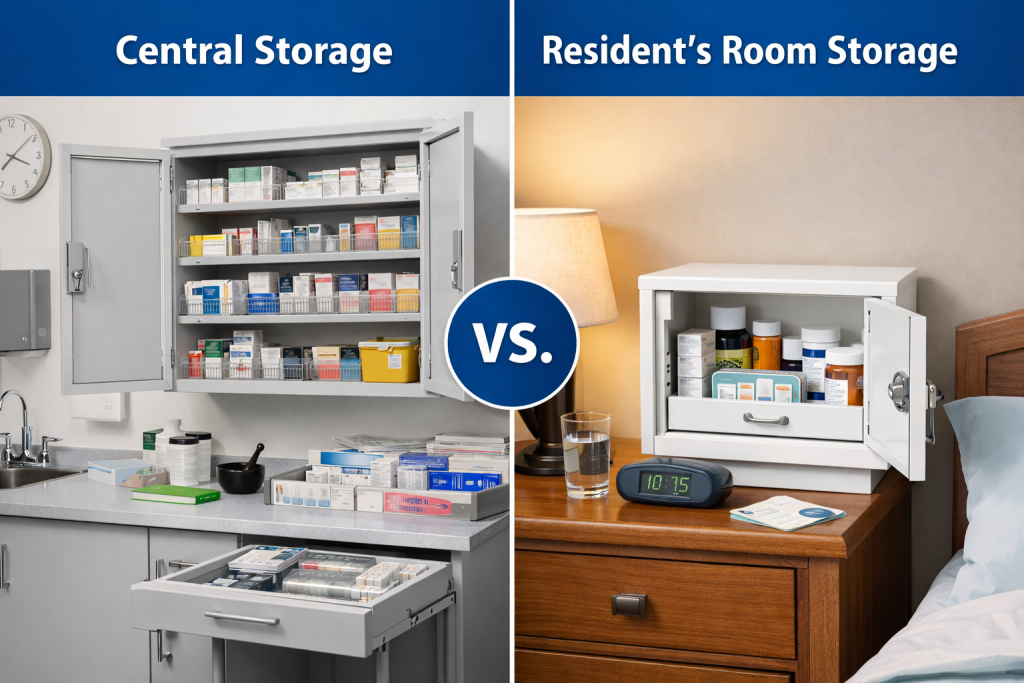
If you are reviewing your wider storage setup, see our comprehensive guide to medical cabinets. You may also want to read Central Storage vs Storage in Residents’ Rooms and Self-Administration of Medicines in Care Homes: Choosing the Right Storage Setup for related planning guidance.
What Is a Medicines Storage Risk Assessment?
A medicines storage risk assessment is a structured review of how medicines should be stored for a particular resident or within a particular care setting. It looks at the practical risks linked to the person, the medicines, the environment and the level of staff support.
It is not only about theft or misuse. It also covers access at the right time, the risk of missed doses, accidental access by other people, product mix-ups, temperature issues, packaging difficulties, room layout and how well the storage arrangement fits daily workflow.
In many homes, the most useful way to think about storage risk is this: the right system is the one that keeps medicines safe while still allowing the resident to receive or use them in the way that best matches their needs. That may sound obvious, but many storage problems begin when a home uses one standard arrangement for every resident regardless of individual circumstances.
Why Risk Assessment Matters in Practice
Without a proper assessment, medicine storage decisions are often made for convenience alone. A cabinet may be installed because it fits the wall space. A lock may be chosen because it is cheap. Medicines may be kept centrally because that feels easier for staff. In some cases, those choices will work. In others, they create unnecessary risk.
A resident who can safely self-administer may lose independence if all medicines are kept out of reach in a staff-only room. On the other hand, a resident whose memory or judgement fluctuates may be placed at risk if medicines are stored in an unsecured drawer by the bed. A bulky cabinet may encourage clutter. A poor room layout may mean a lockable cupboard is technically secure but awkward to use in real life.
A risk assessment brings order to these decisions. It helps care homes justify why a medicine is stored in a certain place, why a certain lock type is used, why staff have or do not have routine access, and what checks are needed to make the arrangement safe.
When a Medicines Storage Risk Assessment Should Be Carried Out
A medicines storage risk assessment should not be seen as a one-off paperwork exercise. It should be completed when a resident first moves into the home or first begins receiving medicines support, and it should also be reviewed whenever circumstances change.
- On admission to the care home.
- When a resident starts self-administering medicines.
- When there is a significant change in health, cognition or mobility.
- When the medicine regime changes.
- When higher-risk medicines are introduced.
- When room allocation or furniture layout changes.
- After an incident, near miss or medication error linked to storage or access.
- During regular care plan and medicines management reviews.
The review point is important. A storage setup that worked well three months ago may not be right now. Capacity may change. A resident may become more independent or less independent. A medicine that was once taken once a day may now be needed at variable times. Risk assessment should move with reality.
The Four Main Areas to Assess
A strong care home medicines storage risk assessment usually looks at four broad areas: the resident, the medicine, the environment and the process. Considering all four helps avoid the mistake of focusing only on the cabinet itself.
1. The Resident
Start with the person. Can they understand what each medicine is for? Can they recognise when to take it? Can they open the packaging? Can they manage a key or other method of access? Are they likely to forget doses, take extra doses or confuse one medicine with another? Does their capacity fluctuate?
You should also consider choice and dignity. Some residents want to remain involved in their medicines and can do so safely. Others may prefer full staff support. A good assessment does not assume that every resident wants the same level of independence.
2. The Medicines
Different medicines carry different storage demands. Tablets, creams, inhalers, liquids and cold-chain products do not all fit neatly into the same solution. Some medicines are needed quickly and must remain accessible at the right time. Some are more vulnerable to misuse. Some require more careful stock control. Some are supplied in awkward packaging that affects how and where they can be kept.
The assessment should consider how often the medicine is used, how critical timing is, whether it needs refrigeration, whether there are any safe custody requirements, and whether mixing it with other items in the same location could increase the chance of error.
3. The Environment
The room or storage area matters more than many people expect. Is there enough space for a proper cabinet? Is the location discreet but practical? Can other residents, visitors or contractors access the space? Is the room humid, hot or otherwise unsuitable for general medicine storage? Is there a clear place for the key or a controlled access process if staff support is involved?
In residents’ rooms, it is also worth thinking about daily life. A cupboard may be secure on paper but poorly positioned for the resident to use safely. A bedside drawer may be easy to reach but too easy for others to access. The assessment should match the room layout to the actual routine of the resident and staff.
4. The Process
Finally, look at the care process around the storage arrangement. Who checks stock? Who records administration or self-administration support? Who notices if items are running low? How are medicines separated when some are self-administered and others remain staff-controlled? What happens if a resident loses access to the cupboard key or their ability to self-manage changes?
Storage is only one part of medicines management. If the process around it is weak, even a high-quality cabinet will not make the system safe.
Key Questions to Include in the Assessment
When building or reviewing a medicines storage risk assessment form, it helps to ask clear practical questions rather than relying on vague tick boxes. The following points usually provide a strong starting framework.
- Does the resident want to self-administer any or all medicines?
- Can the resident identify the correct medicine and the right dose?
- Can the resident take the medicine at the right time?
- Can the resident open packaging safely and reliably?
- Would room-based storage increase risk to the resident or to others?
- Would central storage create delays or reduce independence unnecessarily?
- Does the medicine need refrigeration or other special storage conditions?
- Does the medicine require a higher level of security or separate control?
- Is the proposed storage location easy to keep clean, organised and secure?
- Who will monitor stock levels, expiry dates and safe use?
- How often will the arrangement be reviewed?
The best assessment forms do not ask these questions in isolation. They lead to a clear conclusion about the storage arrangement and who is responsible for each part of the process.
How to Decide Between Central Storage and Room-Based Storage
One of the most common outcomes of a medicines storage risk assessment is a decision about location. Should medicines be kept centrally, in the resident’s room, or in a combination of both?
Central storage is often suitable where medicines are staff-administered, where tighter stock control is needed or where a resident is not able to manage access safely. It can make routines more consistent and reduce the chance of medicines being left in unsuitable or unsecured places.
Room-based storage can be appropriate where a resident self-administers, where quick access is important, or where keeping medicines close by supports dignity and independence. In these cases, the storage should still be secure and should prevent access by other residents or visitors.
A hybrid arrangement is often the most realistic answer. A resident may keep some regularly used items in a lockable cupboard or drawer in their room while other medicines remain under staff control in a central cabinet. This can be an excellent solution when the resident has partial independence or where some medicines require closer supervision than others.
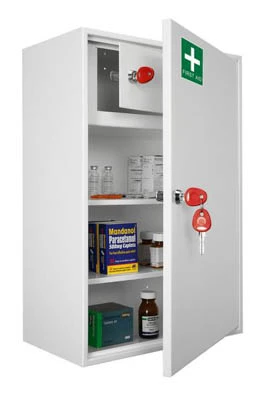
What Type of Storage May Be Suitable?
Once the assessment points to a storage location, the next step is choosing the right physical solution. That does not always mean a large wall-mounted cabinet. The best option is the one that matches the level of risk and daily use.
Lockable Cupboards and Drawers
These can be suitable in a resident’s room for self-administered medicines where the risk assessment supports room-based storage. They offer a discreet and practical way to keep medicines secure without making the room feel clinical.
Dedicated Medical Cabinets
Dedicated cabinets are often easier to standardise across a care home. They provide a clear medicines-only space, which can improve organisation and make staff checks simpler. They are often the better choice where a home wants consistency across several rooms or treatment areas.
Treatment Room or Central Cabinets
These are useful where medicines are administered by staff, where stock holding is larger or where the home wants a more controlled central process. The cabinet should still be sized properly for the actual volume of medicines being stored, as overcrowding can lead to poor organisation and mistakes.
Specialist Refrigerated Storage
Some medicines need refrigeration and should not simply be placed into an ordinary domestic routine without careful control. Where cold-chain storage is required, the assessment should record how medicines will be received, stored, monitored and accessed safely.
Common Risks the Assessment Should Pick Up
A care home medicines storage risk assessment should be practical enough to identify common real-world problems before they become incidents. These often include:
- Medicines stored in an unlocked or poorly controlled location.
- Room-based storage that is accessible to other residents or visitors.
- A resident unable to open packaging or use the storage safely.
- Medicines mixed with unrelated personal items, increasing confusion.
- Cabinets that are too small, cluttered or poorly organised.
- No clear separation between self-administered and staff-administered items.
- Inadequate monitoring where a resident’s ability to self-manage is changing.
- Special-storage items kept without suitable controls.
- Keys or access methods handled inconsistently.
- Storage plans not updated after a change in care needs.
These risks are not rare. They often appear gradually as services grow, staff change or routines become informal. Regular assessment helps stop that drift.
Turning the Assessment Into an Action Plan
The assessment should end with more than a score or a general comment. It should produce a clear action plan. That plan should state where the medicines will be stored, what type of cabinet or compartment will be used, who can access it, what support staff will provide and when the arrangement will be reviewed.
For example, the outcome may be that the resident will self-administer morning tablets from a lockable cupboard in their room, staff will check stock weekly, higher-risk medicines will remain in central storage, and the arrangement will be reviewed monthly or after any change in health. A clear result like that is far more useful than a vague line saying the resident is low risk.
Where the current setup is not suitable, the action plan should also identify what must change. That might mean fitting a dedicated medical cabinet, moving storage to a more secure area, changing the lock arrangement, improving shelf organisation or updating staff guidance.
How Often Should the Risk Assessment Be Reviewed?
There is no value in a risk assessment that sits in a file while real life moves on. Reviews should be built into routine medicines management. Many homes tie this to care plan reviews, but medicines storage may also need extra review after specific triggers.
- After a medication incident or near miss.
- After a hospital discharge or major prescription change.
- When a resident starts or stops self-administration.
- When staff identify repeated access or timing problems.
- When the resident’s cognition, dexterity or mobility changes.
- When new furniture or refurbishment changes the room layout.
The more changeable the situation, the more important regular review becomes. A fixed yearly review may be enough for one resident and nowhere near enough for another.
Common Mistakes to Avoid
Some of the weakest storage systems are built on good intentions but poor assumptions. There are a few mistakes that appear again and again.
- Using the same storage setup for every resident without considering individual needs.
- Assessing the cabinet but not the full care process around it.
- Assuming a resident is either fully independent or fully dependent, with no middle ground.
- Ignoring changes in condition that affect safe access or safe use.
- Choosing furniture first and then trying to fit the risk assessment around it.
- Failing to record who is responsible for checks, stock monitoring or review.
- Treating room-based storage as informal and central storage as the only “real” system.
The safest and most efficient homes tend to avoid these mistakes by making medicines storage part of wider care planning rather than a separate maintenance issue.
Final Thoughts
A care home medicines storage risk assessment is one of the simplest ways to improve both safety and day-to-day workflow. It helps providers choose storage that fits the resident, the medicines and the environment rather than relying on habit or convenience. In some cases, that will support greater independence. In others, it will lead to stronger central control. Very often, it will point to a balanced hybrid approach.
The main goal is not to create more paperwork. It is to create a storage system that works. When medicines are kept in the right place, under the right level of control, with the right review process behind them, the whole service becomes easier to manage.
If you are reviewing your current setup, explore our Medical Cabinet Security range and return to our comprehensive guide to medical cabinets for broader planning advice across healthcare and care environments.
Discover more from Blog Total Locker Service
Subscribe to get the latest posts sent to your email.