Controlled Drug Cabinet Requirements UK (2026 Guide)
March 4, 2026
Controlled drugs in the UK must be stored securely, with restricted access and appropriate physical protection. Storage arrangements are subject to legal duties and regulatory scrutiny, particularly during inspection.
This guide explains what is generally expected when specifying and installing controlled drug cabinets in healthcare environments.
When Is a Controlled Drug Cabinet Required?
Controlled drug cabinets are typically required where Schedule 2 (and certain Schedule 3) medicines are stored. The exact requirement depends on legislation, local governance and risk assessment.
- GP surgeries
- Hospital wards
- Dental practices
- Community pharmacies
- Private clinics
- Care homes (where medicines are administered)
Storage must reflect both legal classification and the operational risk profile of the service.
Core Physical Requirements
While wording varies across guidance, controlled drug cabinets are generally expected to:
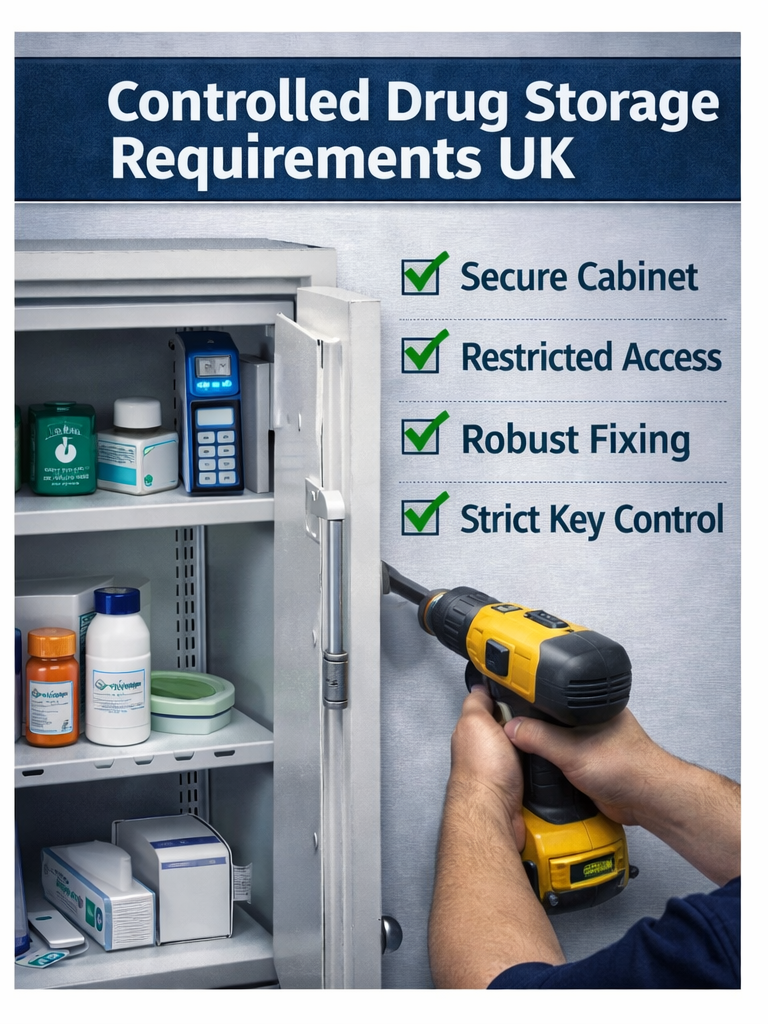
- Be constructed from robust steel
- Have a secure locking mechanism
- Be securely fixed to a solid wall or structure
- Restrict access to authorised individuals only
- Be used solely for controlled drugs
The objective is to reduce the risk of diversion, theft or tampering.
For compliant cabinet options, see:
Medical Cabinet Security Solutions
Secure Fixing Expectations
A controlled drug cabinet is normally expected to be:
- Fixed to a solid wall (not lightweight partitioning without reinforcement)
- Installed using appropriate heavy-duty fixings
- Positioned away from public access areas
Inspectors may check that cabinets are firmly secured and not easily removable.
Locking & Key Control
Cabinet security depends not only on the lock but also on how keys are controlled.
- Restricted key issue
- Named key holders
- Key registers
- Secure key storage when not in use
If digital locks are used, procedures should define:
- Who can access codes
- How codes are changed
- Emergency override arrangements
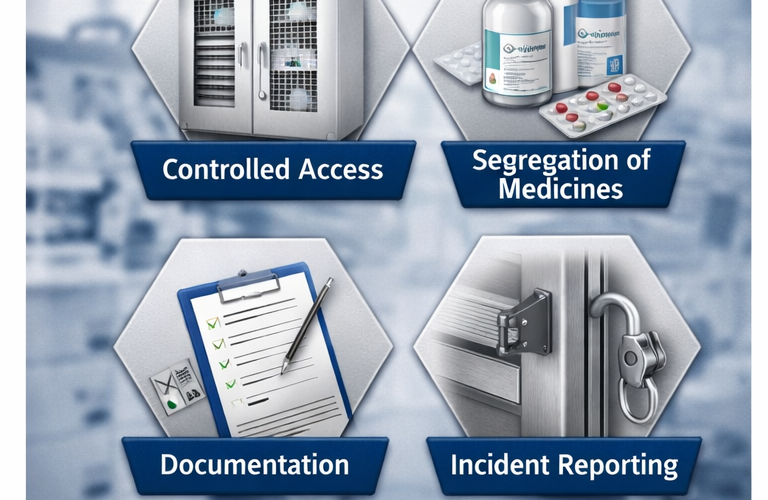
Segregation of Medicines
Controlled drugs should not be stored with general medicines unless policy and risk assessment explicitly allow for controlled separation.
- Dedicated controlled drug cabinet
- Clear internal labelling
- Separate stock reconciliation
- Controlled documentation procedures
Documentation & Audit
Physical cabinet security must align with documented governance procedures.
- Controlled drug storage policy
- Access control procedure
- Stock check and reconciliation records
- Incident reporting system
Regular internal audits help demonstrate ongoing compliance.
Common Inspection Failures
- Cabinet not securely fixed
- Uncontrolled shared key access
- Damaged or poorly maintained lock
- Mixed storage without clear policy
- Incomplete documentation
Selecting the Right Controlled Drug Cabinet
When specifying a cabinet, confirm:
- Steel gauge and build quality
- Lock specification and access control model
- Secure fixing suitability
- Capacity for expected stock levels
- Environment suitability
View secure cabinet options here:
Medical Cabinet Security UK
Frequently Asked Questions
Do all controlled drugs require a locked cabinet?
Higher-risk schedules typically require enhanced secure storage. Always align with current legislation and professional guidance.
Can a general lockable cupboard be used?
For controlled drugs, cabinets are expected to meet stronger security expectations than standard cupboards.
Do inspectors check cabinet fixing?
Yes. Secure fixing and physical stability are commonly reviewed during inspection.
Discover more from Blog Total Locker Service
Subscribe to get the latest posts sent to your email.