Where Should Office Lockers Go in a Reception-to-Desk Journey?
April 7, 2026
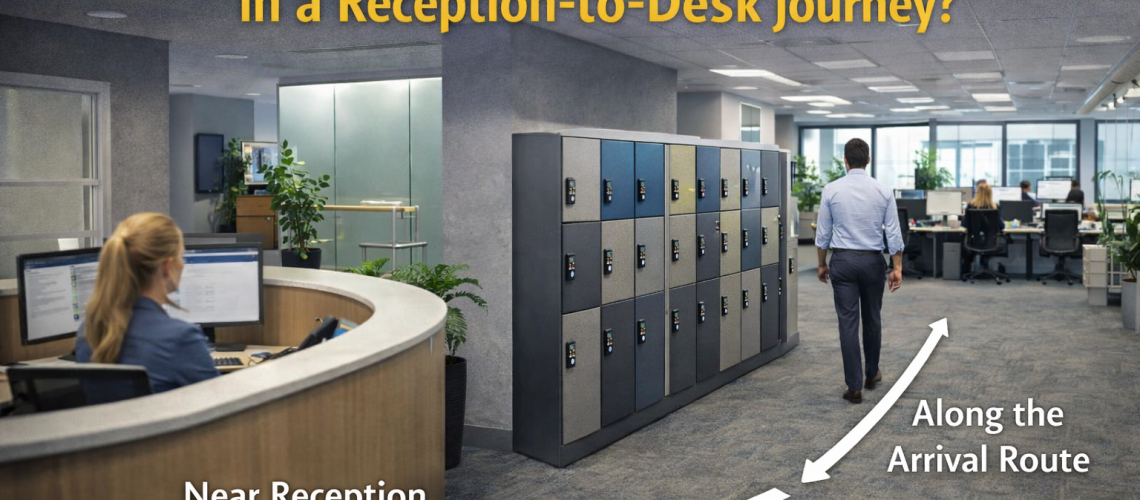
Office lockers do more than provide storage. They also shape how people move through the workplace. In a well-planned office, the route from reception to desk should feel natural, tidy and easy to follow. Lockers can support that flow, but only when they are placed in the right part of the journey.
Put the lockers in the wrong place and they can create clutter, block circulation or become an awkward stop that people try to avoid. Position them well and they become part of a smoother arrival routine. Staff can come in, put away coats, bags and devices, then move into the workspace without dragging personal storage into the main office floor.
This guide looks at where office lockers should sit between reception and desk, and how placement affects staff behaviour, hybrid working, visual order and workplace planning. For the main workplace lockers guide, visit the hub page. For wider office planning, see how to choose workplace lockers for a new office fit-out. If you are comparing placement models, visit should staff lockers be in open plan areas or separate storage zones. When you are ready to compare products, see our workplace lockers page for staff lockers and commercial staff storage.
Why the reception-to-desk journey matters
The arrival sequence helps define how the office feels from the moment someone walks in. Staff, visitors and contractors all read the space through movement before they think about furniture or finishes. That is why the journey from reception to desk matters. It sets the tone for order, control and ease of use.
Office lockers sit directly inside that experience because they deal with the first practical question many staff have each day: where do I put my things? A coat, a laptop bag, lunch, headphones or commuting items all need somewhere to go. If there is no clear answer, those items often travel too far into the workspace and start to appear on chairs, desks and shared surfaces.
Good locker placement helps stop that from happening. It creates a handover point between arrival and work. That can make the office feel more intentional and easier to use.
Lockers should usually support the transition, not interrupt it
One of the most useful ways to think about office lockers is as transition furniture rather than as background storage. Their role is to support the move from entering the building to starting work. They should help staff settle into the day, not become an obstacle in the middle of the journey.
That usually means the lockers should sit after reception but before the main desk area becomes fully active. In practical terms, they often work best just beyond the point of entry, near the arrival route or on the edge of the work floor rather than deep inside the office or directly in front of reception itself.
The exact location depends on the layout, but the principle stays the same. The storage should feel like part of the arrival sequence, not like a detour and not like an afterthought.
Why lockers should not usually sit inside reception itself
In most offices, reception needs to stay clear, calm and easy to read. It is the point where visitors orient themselves, staff pass through and the business makes its first impression. Filling that zone with active personal storage can weaken the effect.
If lockers are too close to the reception desk, the area can become crowded with coats, bags, door openings and people stopping to unpack. That may be fine in a very small informal workplace, but in many offices it makes the entrance feel busier and less composed than it should.
A better answer is often to place the lockers just beyond reception, where they remain easy to find but do not dominate the first visual field of the office. That keeps the arrival sequence clear while still making storage convenient.
Why lockers should not usually sit too deep in the workspace
Lockers placed too far into the office can create a different problem. Staff may carry personal belongings through the whole floor before storing them, which means the arrival routine happens inside the main working area instead of before it. Bags end up placed down temporarily, coats may be slung over chairs and the office feels more cluttered than it needs to.
That layout also weakens one of the key benefits of office lockers, which is helping the workplace separate personal storage from work settings. If the lockers are buried too far from the point of arrival, they lose some of that value.
In many offices, the strongest result comes from placing lockers near enough to the entry route that people use them early, but not so close that they overwhelm reception.
The best position is often just beyond reception
For many offices, the ideal location is an arrival-adjacent zone just beyond reception. This could be along the route to the main desk area, beside a shared touchdown point or on the edge of the work floor where staff naturally slow down and organise themselves before moving further in.
That arrangement works well because it gives the lockers purpose. Staff come in, store what they need to store, then continue into the office with fewer items in hand and less clutter around the desk area. The storage feels convenient, but it does not dominate the front-of-house space.
It also supports hybrid working particularly well. Employees who are not in the office every day often arrive carrying more, not less. A well-placed locker bank near the arrival sequence makes it easier for them to settle in quickly.
Edge-of-floor placement often works well
Another effective approach is edge-of-floor placement. In this setup, the lockers sit just inside the wider office zone but remain along its perimeter rather than in the centre of the shared workspace. That keeps them visible and accessible while reducing their visual impact.
Edge placement can be a strong solution in hybrid offices because it connects naturally to the desk area without turning personal storage into a central feature of the room. Staff can access their locker easily, but the storage still feels secondary to the main work environment.
This is often the middle ground between putting lockers in open plan areas and moving them to a completely separate storage zone. In many office fit-outs, that balance is exactly what works best.
Separate storage zones can improve the journey
Some workplaces benefit from a more defined storage zone rather than from integrating lockers near the work floor. This tends to suit larger offices, design-led interiors and spaces where the business wants a stronger distinction between arrival, storage and work.
In a separate-zone approach, staff move from reception into a dedicated locker area, then continue into the main office. That can make the journey feel more structured and can reduce visual noise on the work floor. It is especially useful where the workplace wants desks and collaboration areas to stay as clear as possible.
The zone still needs to sit on the natural route. If it feels hidden, disconnected or too far away from the point where storage is needed, it can become less effective.
Hybrid offices need a clear drop point
Hybrid working strengthens the case for a defined drop point between arrival and desk. Staff coming in for the day often carry a fuller set of belongings than they would in a traditional fixed-desk office. Laptop bags, coats, lunch, chargers and personal items all arrive together, so the office benefits from a clear place to absorb that load early in the journey.
Without that drop point, the office tends to inherit the whole commuting bundle across its desks and shared furniture. That creates a messier visual feel and weakens the benefit of flexible working design.
Well-placed lockers help create a rhythm. Staff arrive, store, move and then work. That simple sequence is one of the strongest reasons to think carefully about locker location in hybrid workplaces.
What staff are storing affects where lockers should go
The right placement also depends on what the lockers are expected to hold. If the main items are coats, backpacks and lunch containers, the lockers often make sense nearer the arrival route. If the office expects staff to access their lockers repeatedly through the day for devices or working materials, a location a little closer to the work floor may be better.
This is why office locker planning always benefits from starting with user behaviour. A locker used mainly once in the morning and once in the evening can sit differently from one used several times a day. The route from reception to desk should reflect that pattern rather than assume all storage is the same.
For more on sizing and what staff actually store, see what should office staff lockers be big enough to hold.
Day-use lockers depend on a natural route
Shared day-use lockers are especially sensitive to placement. If they are not on the natural arrival route, staff may ignore them or use them inconsistently. A day-use system works best when the locker bank feels easy to reach before someone settles at a desk.
That is one reason why shared storage often performs well near the entrance sequence or along the edge of the office floor. Staff pass the lockers as part of their normal movement, so using them becomes habit rather than effort.
For the shared model itself, visit day-use office lockers.
Charging lockers may need slightly different placement
If the office is using lockers with charging points, the placement question becomes a little more specific. The lockers still need to fit the reception-to-desk journey, but they also need to feel like a natural place for secure device storage rather than an isolated technology feature.
In many cases, charging lockers work well in the same arrival-adjacent or edge-of-floor positions as standard lockers. The difference is that staff may expect to use them for powered device storage, not just for coats and bags. That can make proximity and visibility slightly more important.
For that comparison, see should office lockers include charging points or just secure storage.
Visitor flow still needs protecting
Even when the blog is focused on staff storage, visitor flow matters. A reception area must still work clearly for guests, clients and contractors. If staff locker use spills too visibly into that zone, the front of house can feel less organised.
The office should therefore think about what a visitor sees and what a staff member does at the same point. The two flows should sit alongside each other without interfering. That is another reason why lockers often work best just after reception rather than inside it.
Where temporary storage is also needed, it often helps to separate staff lockers from visitor and contractor lockers so each route remains clear.
Visual calm matters
The journey from reception to desk is not only functional. It is visual. Staff and visitors both read the office through sightlines, density and how much activity is visible. Lockers placed well can support a sense of order. Lockers placed badly can make the office feel busier and more storage-led than intended.
That is why visible locker banks need to be considered as part of the fit-out, not simply as storage equipment. Their finish, scale and location all affect how the office feels during the arrival sequence. In some workplaces, a quieter separate zone is the stronger answer. In others, an elegant edge-of-floor bank is enough.
The decision should always balance movement, usability and appearance together.
Common mistakes in the reception-to-desk journey
- placing lockers directly in reception and crowding the entrance
- hiding lockers so far into the office that staff carry everything to their desks first
- using spare wall space as the only placement rule
- ignoring how visitors and staff move through the same area
- putting day-use lockers outside the natural arrival route
- treating locker placement as separate from the wider office fit-out
- forgetting that the arrival sequence should feel calm and readable
Most of these issues come from seeing lockers as a late add-on rather than as part of the office journey.
How to choose the right location
The best starting point is to map the real staff journey. Where do people enter? Where do they pause? At what point do they stop carrying coats and bags? Which route feels natural before they reach their working area? Once those questions are answered, the right locker location often becomes much clearer.
In many offices, the best answer will be just beyond reception or along the edge of the work floor. In others, a dedicated storage zone between reception and desk will feel more appropriate. The strongest result is the one that supports the transition into work without making storage dominate the front of house.
Good planning starts with movement, then fits the lockers into that flow.
Conclusion
Office lockers work best when they sit naturally within the journey from reception to desk. They should support the handover from arrival to work, reduce the amount of personal storage carried into the main office and help the workplace feel tidier and more intentional.
For many offices, that means placing lockers just beyond reception or along the edge of the work floor rather than directly in front of reception or buried deep inside the workspace. For the wider cluster, return to the workplace lockers guide. Office-wide planning is covered in how to choose workplace lockers for a new office fit-out. Product-led next steps can be found on our commercial staff storage page.
Frequently asked questions
Where should office lockers go?
They often work best just beyond reception, along the arrival route or on the edge of the main office floor where staff can store belongings before settling at a desk.
Should office lockers be in reception?
Usually not directly in reception. In many offices, that makes the entrance feel busier and more cluttered. A nearby arrival-adjacent zone is often a better answer.
Why should lockers be near the arrival route?
Because staff are more likely to use them properly if storage happens naturally between entering the building and reaching the workspace.
Do hybrid offices need a different locker location?
Often yes. Hybrid staff tend to arrive with more belongings, so a clear drop point between reception and desk usually becomes more important.
What is the biggest placement mistake?
A common mistake is putting lockers wherever wall space is left over without checking whether the location actually fits the way staff arrive and settle into work.
“`
Discover more from Blog Total Locker Service
Subscribe to get the latest posts sent to your email.