How to Stop Office Lockers Becoming Permanent Dumping Space in Hybrid Workplaces
April 7, 2026
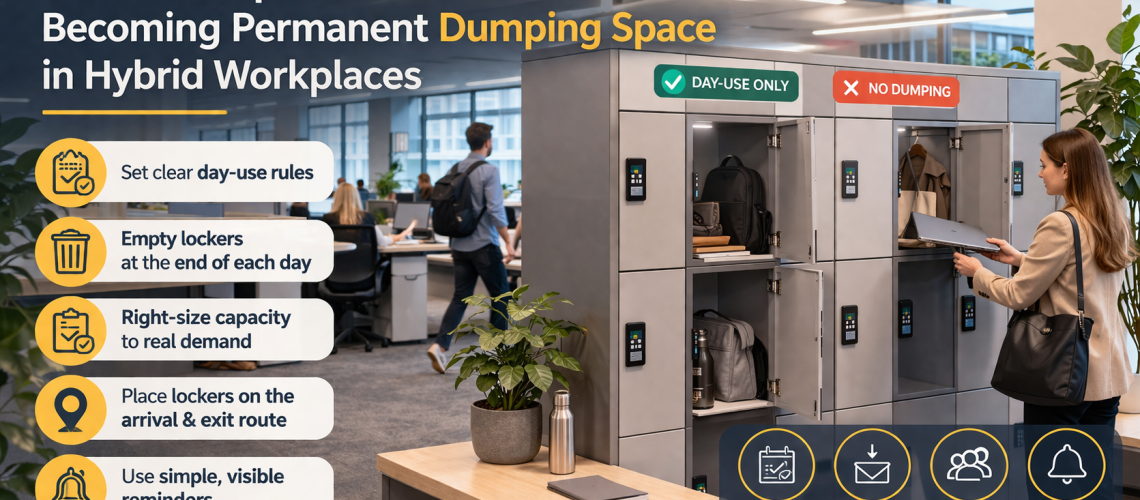
Shared office lockers can work extremely well in hybrid workplaces, but only when they stay true to their purpose. They are meant to support day-use storage, reduce desk clutter and help staff move through the office with fewer personal items in hand. Once they start being used as semi-permanent dumping spaces, those benefits quickly begin to fade.
This problem is common in hybrid offices because shared storage sits in a grey area between personal convenience and workplace discipline. Staff may leave a charger behind, then a coat, then a bag, and over time the locker starts to feel privately owned even when it is supposed to be shared. If that happens across the office, availability drops, trust in the system falls and shared storage stops working properly.
This guide explains how to stop office lockers becoming long-term dumping space and how to keep shared storage clear, fair and usable. For the main workplace lockers guide, visit the hub page. If you are looking at the shared model itself, see day-use office lockers and should office lockers be bookable or first come, first served. For the policy side, visit staff locker policies for UK workplaces. When you are ready to compare products, see our workplace lockers page for staff lockers and commercial staff storage.
Why this becomes a problem in hybrid offices
Hybrid working changes how people relate to storage. Staff are not always in the office, so when they do come in they often arrive with more belongings. That makes lockers more useful, but it also creates a temptation to leave things behind so the next office day feels easier.
At first, that behaviour can seem harmless. One or two forgotten items do not look like a major issue. Over time, though, shared locker banks can become partly occupied by things nobody urgently needs but nobody has removed either. The result is reduced capacity, uncertainty over which lockers are genuinely free and a growing sense that the system is unfair.
That is why shared storage needs more than the right product. It also needs a clear routine and clear expectations.
What “dumping space” looks like in practice
Permanent dumping space does not usually start with obvious misuse. It tends to grow through small habits. A staff member leaves a cable inside because they will need it next time. Someone else keeps spare shoes there between visits. Another person leaves a coat because they do not want to carry it home. None of those choices feels major on its own, but together they change the purpose of the shared locker bank.
Once a shared locker starts being treated as semi-private, availability drops for everyone else. Staff begin arriving unsure whether they will find a usable compartment, and the office gradually loses confidence in the shared model.
The key point is that dumping space is often created by drift rather than by deliberate abuse. That means the solution needs to address habits, not only bad behaviour.
Shared lockers only work when the purpose is clear
The first protection against dumping-space behaviour is clarity. Staff need to understand whether the lockers are day-use only, whether any overnight storage is allowed and what must be removed at the end of the day. If the office leaves that vague, people will naturally create their own assumptions.
A shared locker bank should have a simple identity. It is either for daily use, for bookable short-term use or for a clearly defined mixed model. The more sharply that purpose is explained, the easier it is for staff to follow it and the easier it is for managers to enforce it fairly.
Clarity sounds basic, but it is often the difference between a locker bank that stays usable and one that gradually fills with forgotten belongings.
Day-use means end-of-day emptying must be normal
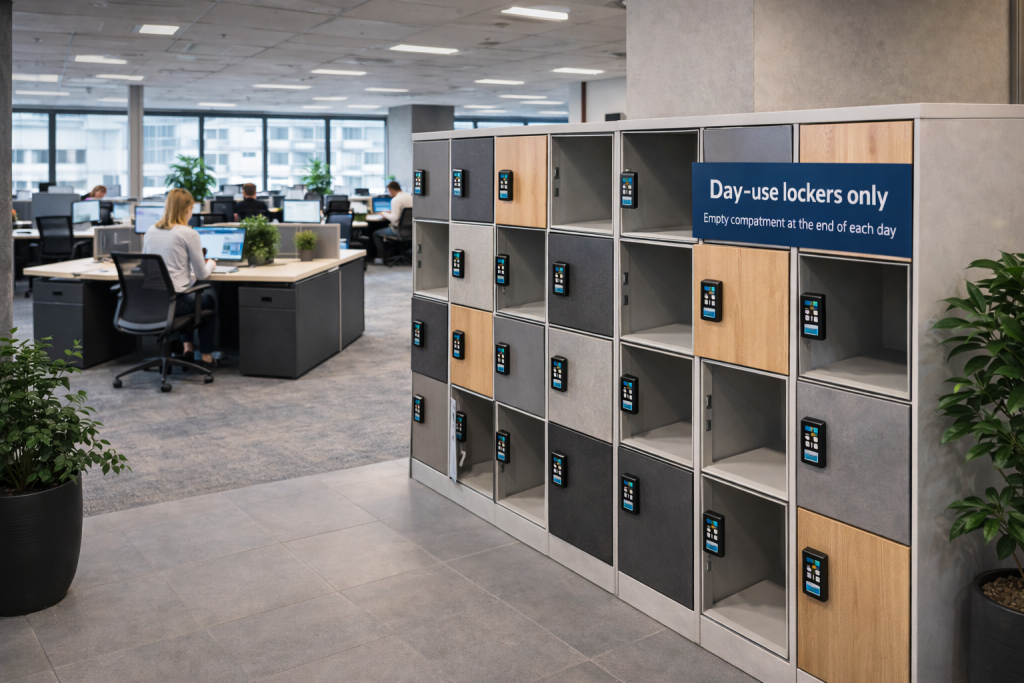
If the lockers are meant for day use, that rule needs to be more than a line in a handbook. It has to feel like the normal expected rhythm of the office. Staff arrive, use a locker, empty it and leave. That cycle should be obvious, easy to understand and easy to repeat.
Where that routine is weak, semi-permanent use starts to creep in. People begin to treat the locker as a convenience buffer between office days rather than as shared daily storage. Once that happens, the system becomes harder to recover unless the office resets expectations clearly.
That is why shared office storage works best when the end-of-day emptying rule is visible, consistent and supported in practice.
Good capacity reduces the temptation to hoard space
People are more likely to hold onto a locker when they fear they will not get one next time. That means some dumping-space behaviour is actually a signal that staff do not fully trust the capacity of the shared system. If the office regularly runs short on storage during busy periods, users may start informally reserving space by leaving items behind.
In that sense, availability problems and dumping-space problems are often linked. A locker bank that is too small encourages protective behaviour. A locker bank planned around realistic peak demand is more likely to support a relaxed shared culture.
For the wider capacity question, see how many workplace lockers do you need.
Location affects behaviour too
Placement influences whether lockers feel like part of a daily routine or like hidden storage where items can be left indefinitely. Lockers on the natural arrival and departure route are easier to use properly because staff pass them at the start and end of the day. That makes emptying them feel more natural.
If the locker bank is tucked away in a remote corner, people may be less likely to clear it before leaving. Out of sight storage can drift into semi-permanent storage more easily, especially in hybrid offices where not everyone returns the next day.
For that reason, good shared storage is not only about rules. It is also about placing the lockers where correct use feels like the easy option.
For more on placement, see where should office lockers go in a reception-to-desk journey.
Simple signage can do more than overcomplicated policy
In many offices, short visible reminders work better than heavy policy language. A shared locker bank benefits from clear local messaging such as day-use only, empty by end of day or remove all belongings before leaving. That kind of wording reinforces the routine at the exact point where people make the decision to leave something behind.
This does not replace formal policy. It supports it. Staff are much more likely to follow the intended model when the expectation is visible in the storage area itself rather than buried in a document they read months earlier.
The goal is to make correct use feel obvious, not bureaucratic.
What should happen when items are left behind?
A shared locker system needs a clear process for belongings left overnight or left beyond the permitted period. Without that, staff learn that nothing really happens when they ignore the day-use rule, and the dumping-space pattern becomes harder to stop.
A practical process usually includes a defined cut-off point, authorised access by the right person or team, a short record of what was removed and a clear way for the owner to recover their items. The tone does not need to be harsh. It does need to be consistent.
Once staff see that the office treats shared lockers as genuinely shared, the system becomes easier to trust and easier to maintain.
Some workplaces need a mixed model instead
If staff regularly try to keep items in shared lockers, the office should ask whether the storage model fits the real need. Sometimes the problem is not discipline. It is that some teams genuinely need more stable storage than a pure day-use system allows.
In that case, a mixed model can work better. A smaller number of assigned lockers can support regular users or teams carrying more equipment, while the rest of the office uses shared day-use lockers. This can reduce pressure on the shared bank and make dumping-space behaviour less likely.
For that comparison, visit assigned vs shared staff lockers.
Bookable lockers can help, but only sometimes
A bookable system can reduce uncertainty and make staff less likely to claim a locker informally by leaving items behind. If users know they can reserve storage properly, they may feel less pressure to hold space in unofficial ways.
However, booking is not a complete solution. If the office still lacks enough capacity or if users still want semi-permanent personal storage, the behaviour may simply reappear in a different form. Booking helps most when the real issue is confidence in access rather than a deeper mismatch between staff needs and the locker model.
For that topic, see should office lockers be bookable or first come, first served.
Manager behaviour sets the tone
Shared locker culture depends heavily on consistency. If some staff are allowed to leave items indefinitely while others are asked to clear lockers promptly, the system will quickly feel unfair. That makes compliance weaker and encourages more informal claiming of space.
Managers and facilities teams need to apply the same standard across the office. The rule does not have to be inflexible in every edge case, but it does need to be visible and credible. Staff are far more likely to follow a storage routine that feels fair than one that feels selective.
In practice, the office culture around storage often matters as much as the locker hardware itself.
Common mistakes that encourage dumping-space behaviour
- calling lockers shared but allowing indefinite overnight use
- providing too little capacity for real peak demand
- keeping the rules vague or invisible
- placing lockers away from the natural end-of-day route
- having no clear process for items left behind
- treating repeated locker hoarding as harmless when it is reducing shared availability
- ignoring signs that some teams may need assigned storage instead
Most of these problems come from failing to decide what the shared locker bank is actually for and then supporting that purpose properly.
How to keep shared office lockers usable
The best approach is usually straightforward. Set a clear purpose for the lockers. Match the capacity to real demand. Place the storage where correct use feels natural. Make the day-use expectation visible. Apply the same standard consistently. Then create a simple process for any items left behind.
Where those basics are in place, shared lockers are much less likely to drift into permanent dumping space. If the office still struggles, it may be a sign that the storage model needs adjusting rather than that staff are simply not cooperating.
Good shared storage works because the routine is clear and realistic, not because the office hopes people will interpret it correctly on their own.
Conclusion
Office lockers become dumping space when the shared model loses clarity, confidence or consistency. In hybrid workplaces, that usually happens through small habits rather than through one major failure. The best prevention is a system that makes day-use storage simple, visible and fair.
Shared lockers should support the office day, not become semi-private overflow cupboards. For the wider cluster, return to the workplace lockers guide. Shared storage is covered in day-use office lockers. Product-led next steps can be found on our commercial staff storage page.
Frequently asked questions
Why do shared office lockers become dumping space?
This usually happens when the day-use purpose is unclear, capacity feels tight or there is no consistent process for removing items left behind.
How do you stop staff leaving items in shared lockers?
Use clear day-use rules, visible reminders, enough capacity and a consistent process for dealing with belongings left beyond the permitted period.
Should shared office lockers be emptied every day?
If they are designed as day-use lockers, yes. Daily emptying is usually essential if the office wants the shared system to stay available and fair.
Can bookable lockers prevent dumping-space behaviour?
Sometimes, especially when the real issue is lack of confidence in access. They do not solve the problem on their own if the storage model is wrong for the office.
What is the biggest mistake with shared locker banks?
A common mistake is calling the lockers shared while quietly allowing semi-permanent use, which gradually reduces availability for everyone else.
Discover more from Blog Total Locker Service
Subscribe to get the latest posts sent to your email.