How to Label and Number Lockers Properly for Schools, Workplaces and Changing Rooms
April 10, 2026
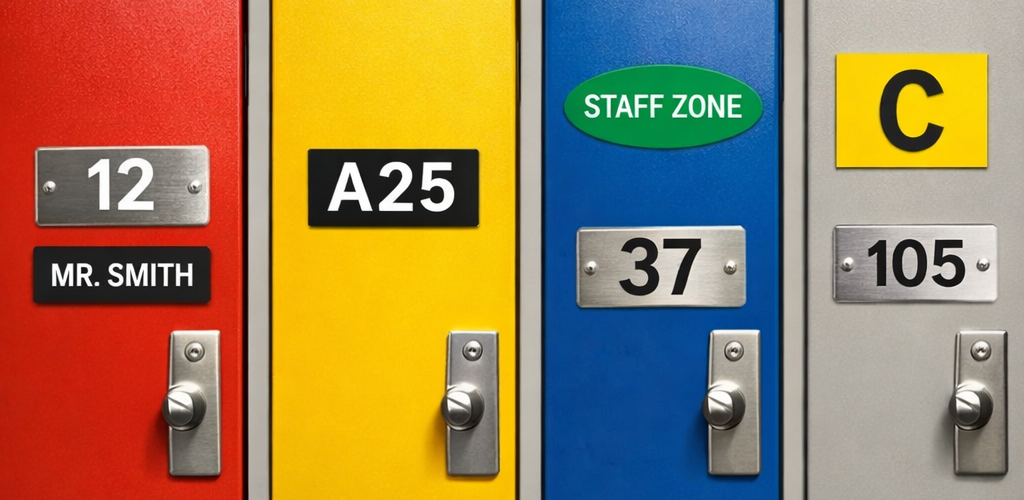
A clear locker numbering and labelling system makes lockers easier to find, allocate, maintain and manage. Whether the installation is in a school, workplace, office, leisure centre or industrial changing room, every locker should have a stable reference that users and facilities teams can understand.
This guide explains how to design a locker numbering and labelling system, including numbering sequences, leading zeros, numeric and alphanumeric references, prefixes, suffixes, locker banks, buildings, floors, departments, zones, duplicate prevention, future expansion and renumbering existing installations.
The focus here is the numbering system itself. This page owns how locker references are structured, kept unique, extended and changed over time. For physical engraved number plates, materials, dimensions, colours, fixing and replacement matching, use our Engraved Locker Number Plates guide. For operational allocation, maintenance and estate-record use of those references, use Engraved Locker Identification UK.
Quick Answer: What Is the Best Way to Number Lockers?
The best locker numbering system is simple, unique and consistent. Small installations can often use a straightforward sequence such as 1–40 or 001–120. Larger sites may need prefixes for buildings, floors, rooms, departments or locker banks, such as A001, GF-027 or WH-A014.
Every physical locker should have one stable identity that remains valid even when the person using it changes.
Why Locker Numbering Matters
Locker numbering is more than a visual finishing detail. The numbering system creates the stable reference that other operational processes can use throughout the life of the installation. This page defines that reference structure; it does not own the wider allocation or maintenance workflow built around it.
- users can find the correct locker quickly;
- lockers can be allocated accurately;
- shared lockers can be identified consistently;
- faults can be reported against a specific compartment;
- replacement keys can be linked to records;
- maintenance history can refer to the correct locker;
- extensions and refurbishments can retain an organised structure;
- asset registers can use the same physical locker reference.
Locker Numbering vs Locker Labelling
Numbering and labelling are related but not identical.
| Method | Purpose | Example |
|---|---|---|
| Locker number | Permanent identity of the physical locker | 027 |
| Alphanumeric reference | Identifies locker and location or bank | A027 |
| Zone label | Identifies a wider locker area | Visitor Lockers |
| Temporary user label | Shows current assignment | Current employee name |
The permanent locker number should normally remain stable. Names, departments or short-term assignments can be managed separately where they are likely to change, so the numbering structure does not have to be rewritten whenever users move.
Start with a Numbering Logic Before Applying Any Labels
Do not number lockers one door at a time without first deciding how the complete installation will work. The sequence should make sense across the whole locker bank and, where necessary, across the wider building or site.
Before finalising the numbers, decide:
- how many lockers are being numbered;
- how many separate locker banks exist;
- whether there are several rooms or floors;
- whether different buildings need distinct references;
- whether lockers are assigned, shared or bookable;
- whether more lockers may be added later;
- whether existing maintenance or allocation records already use locker references.
Simple Sequential Locker Numbering
For a small installation, simple sequential numbering is usually the easiest system to understand.
Examples include:
- 1, 2, 3, 4…
- 01, 02, 03, 04…
- 001, 002, 003, 004…
This works particularly well where there is only one locker room or where all lockers can be managed as a single sequence.
Should Locker Numbers Use Leading Zeros?
Leading zeros are not essential, but they can make a larger numbering system look more consistent and can make digital records easier to sort visually.
| Number of lockers | Possible format |
|---|---|
| Up to 9 | 1–9 or 01–09 |
| Up to 99 | 01–99 |
| 100 or more | 001–120, 001–250, etc. |
If the installation may eventually exceed 99 lockers, starting with a three-digit structure such as 001 can avoid changing the visual format later.
Using Letters and Numbers Together
Letters and numbers are useful when a site contains several banks, rooms or operational areas.
For example:
- A001–A040 for Locker Bank A;
- B001–B040 for Locker Bank B;
- V01–V10 for visitor lockers;
- C01–C20 for contractor lockers;
- S001–S120 for staff lockers.
The prefix should have a clear operational meaning. Avoid adding letters simply to make the numbering look more sophisticated.
Using Prefixes and Suffixes Without Overcomplicating the System
Prefixes are usually the clearest way to add location or group context, but suffixes can also be useful where they distinguish a genuine operational difference without forcing the whole numbering system to change.
- A001 or GF-027 can identify a bank, floor or zone before the locker number;
- 042-A and 042-B may distinguish paired or related compartments where that relationship is useful;
- avoid adding both prefixes and suffixes unless each element has a clear meaning;
- document the convention in the master numbering schedule so future extensions follow the same pattern.
Numbering Lockers Across Several Banks
A room containing several locker banks can either use one continuous sequence or a separate prefix for each bank.
Continuous Sequence
Bank 1 might contain lockers 001–040, Bank 2 lockers 041–080 and Bank 3 lockers 081–120.
This is simple where all banks form one obvious installation.
Bank-Based References
Alternatively:
- A01–A40
- B01–B40
- C01–C40
This can make the physical location easier to understand in larger changing rooms or office storage areas.
Numbering Across Floors, Rooms and Buildings
Large estates need enough information to prevent duplicate locker references from becoming ambiguous.
For example, simply having a Locker 027 in three separate buildings can create problems in maintenance records and key management.
A structured reference could use:
- GF-027 for Ground Floor Locker 027;
- F1-027 for First Floor Locker 027;
- BLDG-A-027 for Building A Locker 027;
- WH-A027 for Warehouse A Locker 027.
The reference should remain as short as practical while still being unique within the organisation’s management system.
Avoid Duplicate Locker Numbers
Duplicate locker references are one of the most avoidable causes of confusion in larger installations.
Before issuing numbers:
- prepare a complete numbering schedule;
- check existing lockers and records;
- confirm whether the same sequence is used elsewhere;
- reserve future numbers where appropriate;
- keep the master numbering schedule after installation.
Horizontal vs Vertical Locker Numbering
Locker numbers can follow either a horizontal or vertical sequence, but the direction should match the physical arrangement and remain consistent.
Horizontal Numbering
Numbers progress left to right across a row before continuing to the next row or bank. This is often intuitive where lockers are arranged as individual full-height doors or clearly separated compartments.
Vertical Numbering
Numbers progress from top to bottom within a column before moving to the next column. This can make sense for multi-tier locker configurations where compartments are visually grouped vertically.
Neither approach is universally correct. The important point is that the sequence is predictable and applied consistently.
Where Should Locker Numbers Be Positioned?
The locker reference should be easy to see when the door is closed. Consistent placement helps users scan a complete locker bank quickly.
- avoid positions hidden by handles or locks;
- avoid door edges where the plate may be less visible;
- use the same relative position across equivalent doors;
- avoid placing identification where routine handling may obscure it;
- keep the number visible from a natural standing position where practical.
This guide owns the numbering logic and the decision about where the reference should sit conceptually within the locker system, but not the detailed physical plate specification or general fixing method. For tag dimensions and character height, use our Engraved Tag Size Guide. For locker-specific plate placement, dimensions, materials and fixing details, use the Engraved Locker Number Plates guide.
Permanent Numbers vs User Names
For most commercial locker installations, the permanent locker identity should belong to the physical locker rather than the person currently using it.
For example:
Permanent locker reference: A027
Current user: held separately in the allocation record
This allows the user to change without changing the identity of the locker itself.
Names can still be useful as removable or temporary identification where assigned storage needs a visible personal reference, but they should not normally replace the underlying locker number.
Numbering Assigned Lockers
Assigned lockers still benefit from a permanent locker number even when one person uses the same compartment for a long period.
- the locker retains a permanent identity;
- the user can be recorded separately;
- maintenance can refer to the locker number;
- the locker can be reallocated without replacing its permanent identification.
Numbering Shared and Day-Use Lockers
Shared, day-use and bookable lockers need especially clear numbering because different people may use the same locker throughout the week.
The number may need to correspond with:
- a booking system;
- a temporary allocation record;
- a key or token;
- a PIN or electronic access record;
- a facilities or maintenance system.
The physical locker reference should remain stable even as users change. Booking, allocation, PIN and access records can then refer back to that stable locker identity without becoming part of the numbering scheme itself.
Locker Numbering in Offices and Hybrid Workplaces
Office lockers are easier to manage when their numbering system is planned alongside the wider workplace layout rather than added as a final decorative detail.
Hybrid workplaces may contain:
- assigned staff lockers;
- shared day-use lockers;
- visitor storage;
- contractor lockers;
- departmental locker banks;
- bookable storage.
A simple prefix or zone structure can distinguish these groups without creating an unnecessarily complicated code.
Examples might include:
- S001–S100 for general staff;
- V01–V10 for visitors;
- C01–C20 for contractors.
For broader workplace storage planning, see our Workplace Lockers UK guide.
Locker Numbering in Schools
School locker numbering should be simple enough for pupils and staff to understand quickly while remaining useful for administration and maintenance.
Examples include:
- 001–300 for one large installation;
- A01–A40 for Corridor A;
- B01–B40 for Corridor B;
- Y7-001–Y7-100 where a year-group reference is genuinely useful.
Avoid unnecessarily complicated references simply because several classifications are available. The system still needs to be easy for pupils to recognise.
For wider school locker planning, see our School Lockers UK guide.
Locker Numbering in Leisure and Changing Rooms
Leisure environments often benefit from particularly clear numbers because users need to recognise the correct locker after spending time away from the changing area.
- keep individual numbers prominent;
- avoid unnecessarily long codes;
- use logical bank or zone references where the room is large;
- make sure the locker number corresponds with keys or tokens where relevant.
For broader leisure locker planning, see our Gym, Leisure & Changing-Room Lockers guide.
Locker Numbering in Industrial and Warehouse Environments
Industrial sites may need references that distinguish personal lockers, garment lockers, PPE storage and separate operational areas.
Examples might include:
- P001–P080 for personal lockers;
- G001–G040 for garment lockers;
- PPE-01–PPE-30 for PPE storage;
- WH-A001–WH-A040 for Warehouse A.
The identifiers should reflect real management needs rather than trying to encode every characteristic of the locker into the number itself.
Using Locker Zones and Wayfinding
Individual locker numbers identify compartments. Zone and bank labels help users reach the right part of a larger storage area before looking for the exact locker.
A large office might use:
- Zone A: Staff Lockers 001–080;
- Zone B: Staff Lockers 081–160;
- Visitor Lockers V01–V20;
- Contractor Lockers C01–C20.
Zone identification should support the locker numbering rather than replace it.
Colour Coding and Locker Numbering
Colour can support a numbering system, but it should not be the only way individual lockers are distinguished.
Colour coding may help separate:
- departments;
- locker banks;
- staff and visitor storage;
- school areas;
- changing-room zones.
Each locker should still retain a clear written or numeric reference.
Reserve Capacity Where Future Locker Banks Are Likely
Where expansion is reasonably likely, reserve enough numbering capacity to extend the system without renumbering existing lockers. The reserved range does not need to be physically used on day one; it only needs to be documented so later additions do not create duplicates or force a new format.
For example, a first bank of 40 lockers could use A001–A040 while the schedule reserves A041–A080 for a planned second bank. If another room will always be managed separately, a new prefix may be cleaner than reserving a very large unused range.
Plan Locker Numbering for Future Expansion
A numbering system that works today should not become difficult to maintain simply because another locker bank is added later.
Before installation, consider:
- whether more lockers may be added;
- whether new rooms could use the same sequence;
- whether spare ranges should be reserved;
- whether the existing digit format allows growth;
- whether new buildings will need distinct prefixes.
For example, numbering an initial 80 lockers as 001–080 leaves a cleaner route to 081–120 than starting with mixed formats such as 1–80 and later changing to 081.
Keep a Locker Numbering Schedule
Once the numbering system is agreed, retain a simple master numbering schedule showing which references exist and where they are located. This schedule belongs here because it prevents duplication and preserves the numbering structure; broader allocation, condition and maintenance records belong in their dedicated operational guides.
| Locker reference | Location | Bank | Status |
|---|---|---|---|
| A001 | Ground-floor changing room | Bank A | Active |
| A002 | Ground-floor changing room | Bank A | Active |
| B001 | First-floor changing room | Bank B | Active |
The schedule helps prevent duplicates, preserves the agreed structure and provides a reference when new lockers or locker banks are added. It can also support later replacement work without turning this page into an asset-register or allocation guide.
How Locker Numbering Supports Maintenance
A clear locker number allows a fault to be reported against the exact compartment instead of an approximate physical position.
Instead of:
third locker from the left near the door
the report can state:
Locker A027 – lock sticking
This page stops at creating and preserving the locker reference. For the wider operational use of those identifiers in allocation, maintenance and estate records, use our Engraved Locker Identification UK guide.
Locker Number vs Key Number
The number displayed on a locker door is not automatically the same as the manufacturer’s key number or lock code.
| Reference | Purpose |
|---|---|
| Locker number | Identifies the physical locker or compartment |
| Key number / lock code | Identifies the physical key or compatible lock series |
Only treat those references as interchangeable where reliable site records specifically link them.
For locker key identification, visit our locker keys hub.
Renumbering Existing Lockers
Renumbering should normally be undertaken only when the existing system has a genuine structural problem.
Reasons might include:
- duplicate locker numbers;
- several unrelated numbering formats;
- a major site reorganisation;
- locker banks being relocated;
- the old structure no longer matching records;
- large-scale refurbishment creating a practical opportunity to standardise the system.
Do not renumber lockers purely because the old physical number plates are worn. If the underlying references still work, replacing the plates while retaining the same numbers is usually simpler.
How to Renumber Lockers Without Losing Control
- Record every existing locker reference.
- Record the physical location of each locker.
- Check allocation, key and maintenance records.
- Design the new numbering structure.
- Create an old-reference to new-reference conversion schedule.
- Check for duplicates or missing numbers.
- Update records before or alongside physical relabelling.
- Replace the physical identification consistently.
- Retain the conversion schedule for future reference.
Do Not Renumber Lockers During Routine Tag Replacement
Physical plate replacement and numbering-system redesign are separate jobs.
If Locker A027 has a damaged number plate but A027 remains a valid reference in allocation, maintenance and key records, the simplest solution is normally to replace the physical plate with another A027 plate.
For maintenance and replacement planning, use our Maintain & Replace Engraved Tags guide.
Choosing the Physical Locker Label
Once the numbering system is agreed, the reference needs to be displayed physically on the locker.
Possible methods include:
- engraved locker number plates;
- engraved tags;
- printed or adhesive labels;
- insert labels;
- numbered escutcheon products where appropriate.
This page does not own the detailed physical specification. For plate dimensions, materials, colours and matching replacement plates, use our Engraved Locker Number Plates guide.
Common Locker Numbering Mistakes
- numbering lockers without planning the complete sequence;
- using duplicate numbers in different areas without location context;
- mixing formats such as 1, 02 and 003 in the same system;
- using unnecessarily complex prefixes;
- changing permanent locker numbers when users change;
- failing to plan for future expansion;
- placing numbers inconsistently across locker doors;
- using small or difficult-to-read identification;
- failing to retain a master numbering schedule;
- confusing the locker number with the manufacturer’s key code;
- renumbering during routine plate replacement without a genuine need.
A Simple Locker Numbering Planning Process
- Count the lockers and locker banks.
- Map the buildings, rooms or zones involved.
- Decide whether one continuous sequence is sufficient.
- Introduce prefixes only where they provide useful context.
- Choose a consistent digit format.
- Allow for likely expansion.
- Check for duplicate references.
- Create the master numbering schedule.
- Decide the consistent physical placement.
- Choose the appropriate physical identification product.
- Retain the numbering schedule for future maintenance and extensions.
When This Guide Is Not the Right One
This article owns the locker numbering-system design: sequences, leading zeros, numeric and alphanumeric references, prefixes and suffixes, buildings, floors, departments, zones, duplicate prevention, future expansion, master numbering schedules and renumbering decisions. It should not take over physical plate specification, tag sizing, fixing, operational allocation and maintenance workflow, key-control workflow, maintenance lifecycle or broad engraved-product selection.
- Locker number-plate dimensions, materials and physical specification: use the Engraved Locker Number Plates guide.
- Size and character-height decisions: use What Size Should Engraved Tags Be?
- Adhesive, screws and rivets: use the Engraved Tag Fixing Guide.
- Allocation, maintenance and operational use of locker IDs: use Engraved Locker Identification UK.
- Maintaining and replacing old tags: use Maintain & Replace Engraved Tags.
- Key tags and key-cabinet records: use Engraved Key Tags for Key Cabinets.
- General engraved identification products: use the Engraved Products UK guide.
Locker Number Plates and Identification from Total Locker Service
Total Locker Service supplies locker identification products for commercial locker installations, including engraved locker number plates and related identification products.
Once the locker numbering schedule is agreed, the physical identification can be produced to match the required locker references.
Related Locker Numbering and Identification Guides
- Engraved Locker Number Plates — physical plate shapes, dimensions, materials and replacement matching.
- Engraved Locker Identification UK — using locker references for allocation, maintenance and records.
- What Size Should Engraved Tags Be? — viewing distance, character height and physical tag size.
- How to Fix Engraved Tags & Nameplates — adhesive, screw and rivet fixing.
- Maintain & Replace Engraved Tags — cleaning, damage, replacement matching and refurbishment.
- Locker Asset Register UK — linking physical lockers to estate records.
- Engraved Products UK — broad engraved-identification guide.
- Locker Number Plates — commercial locker identification products.
Locker Numbering & Labelling FAQs
What is the best way to number lockers?
The best system is simple, unique and consistent. Small installations may use a straightforward numeric sequence, while larger sites can use short prefixes for locker banks, floors, buildings or zones.
Should locker numbers use leading zeros?
They are not essential, but formats such as 001, 002 and 003 can improve consistency in larger installations and make future expansion easier to manage.
Should office lockers use names or numbers?
Numbers are usually better as the permanent locker identity because they remain stable when users change. Names can be added separately where a temporary or personal assignment needs to be shown.
How should locker banks be numbered?
Locker banks can use one continuous sequence or separate bank prefixes such as A01–A40 and B01–B40. The most suitable approach depends on how users identify the physical location.
Should shared lockers still have permanent numbers?
Yes. The permanent number identifies the physical locker even when its user changes. Temporary allocation can then be handled separately through records, keys, codes or booking systems.
Should locker numbers match key numbers?
Not necessarily. The locker number identifies the physical compartment, while the key number or lock code may identify the key or lock series. Only treat them as the same where reliable records link the references.
When should existing lockers be renumbered?
Renumbering is normally justified when duplicate, inconsistent or structurally unsuitable references cause genuine management problems. Worn number plates alone do not require the underlying locker references to change.
How should locker numbering allow for future expansion?
Use a consistent digit format, avoid unnecessary duplication and consider how additional locker banks, rooms or buildings can be incorporated before the initial numbers are produced.
Discover more from Blog Total Locker Service
Subscribe to get the latest posts sent to your email.