Self-Administration of Medicines in Care Homes: Choosing the Right Storage Setup
March 24, 2026
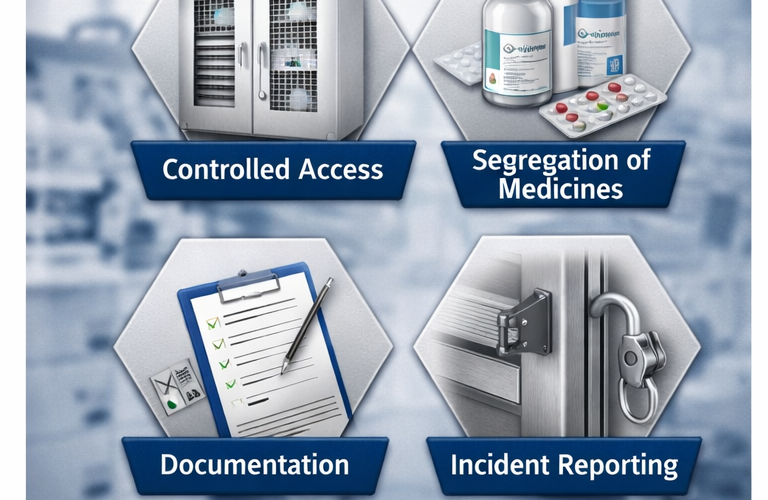
Supporting residents to stay as independent as possible is a key part of good care. That includes medicines. In some care settings, a resident may be fully able to manage their own tablets, inhalers, creams or other prescribed items. In others, they may need partial support, regular checks or full administration by staff. The right storage setup plays a major part in making that work safely.
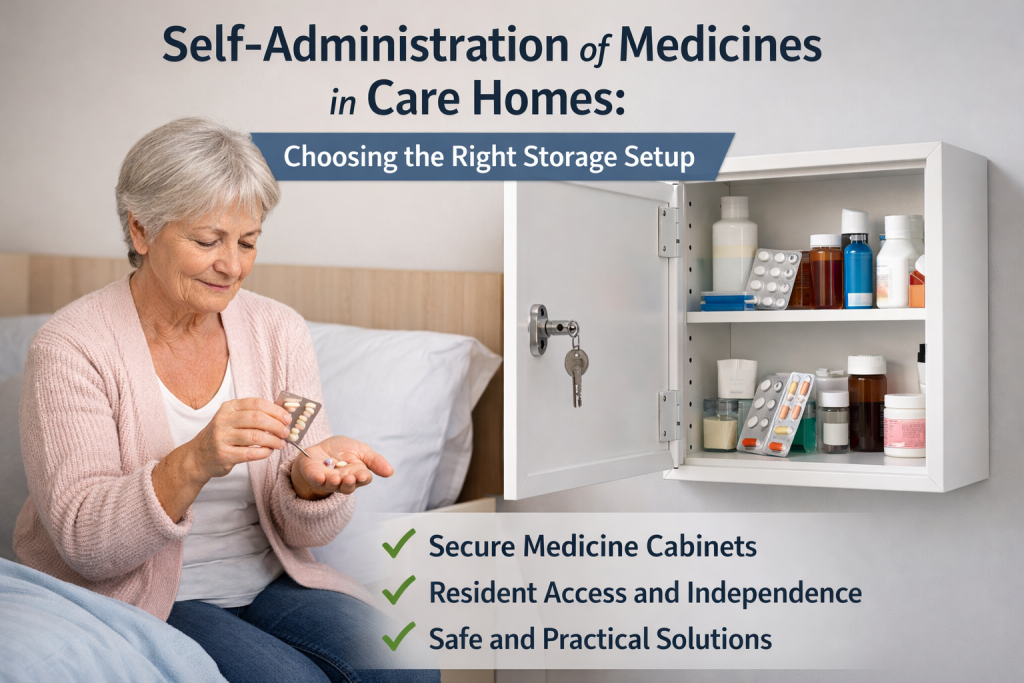
Medicine storage in care homes is not only about locking products away. It is about balancing access, dignity, safety, accountability and workflow. If storage is too restrictive, it can take independence away from people who are able to manage their own medicines. If storage is too loose, the risk of error, loss or unauthorised access increases. A well-planned medical cabinet strategy helps care homes find the right middle ground.
This guide explains what self-administration means in practice, when it may be appropriate, what type of storage is usually suitable, and how care homes can choose between room-based storage and more centralised arrangements. For a broader overview, see our comprehensive guide to medical cabinets. You may also want to read Central Storage vs Storage in Residents’ Rooms for a wider comparison of storage models.
What Self-Administration Means in a Care Home
Self-administration means a resident takes responsibility for some or all of their own medicines. That does not always mean they are completely unsupported. In practice, there can be several levels of independence.
- A resident may manage all medicines without staff help.
- A resident may manage their own medicines but need reminders.
- A resident may need support opening packaging or accessing a locked compartment.
- A resident may keep some medicines in their room while others remain under staff control.
- A resident may move between levels of support over time.
This matters because the storage solution should match the real level of independence, not an assumption. A resident who can safely use an inhaler when needed may require quick access in their room. A resident who can manage a morning tablet box but struggles with more complex medicines may need a mixed arrangement. A resident whose condition changes may need a different setup next month than they need today.
That is why a single cabinet model does not suit every care environment. The aim is to choose a storage arrangement that supports the person while maintaining a clear and safe system for staff.
Why Storage Setup Matters
When care homes talk about medicine storage, the conversation often starts with security. Security is important, but it is only one part of the picture. The storage setup also affects daily workflow, staff time, medication rounds, resident privacy and the overall feel of the care environment.
A poor setup can create delays and confusion. Staff may have to walk back and forth to retrieve items. Records may become harder to maintain if medicines move between locations without a clear process. Residents may feel they have lost control over part of their daily life. In shared settings, poor storage planning can also increase the risk of accidental access by other residents or visitors.
A good setup does the opposite. It supports the person, protects medicines, helps staff work efficiently and makes accountability easier. In simple terms, the cabinet arrangement should fit the care model rather than forcing the care model to fit the cabinet.
When Self-Administration May Be Appropriate
Self-administration can work well for residents who are willing and able to manage their own medicines safely. This may be particularly relevant in residential care, step-down settings, short-term stays, rehabilitation pathways or supported living-style environments within a wider care framework. It can also be suitable in some nursing settings for residents who remain capable and want to retain that control.
There are clear benefits when it is appropriate. Residents may feel more independent. They may keep familiar routines. Their confidence can improve. In some cases, it can reduce delays around medicines that are needed at a specific time or on an as-required basis.
However, it is not suitable for everyone. Some residents may be at risk of missed doses, double dosing, confusion between medicines, unsafe storage or reduced ability to recognise when something is wrong. Others may have fluctuating needs. The answer is not to assume either total independence or total dependence. It is to build a proportionate system.
That proportionate approach should shape the storage choice. The more independent the resident, the more important it becomes that they can access their medicines easily while still keeping them secure from others. The more staff-managed the process, the more important central control and recording may become.
Common Storage Options for Self-Administered Medicines
There is no single cabinet style that works in every room. The best option depends on the type of medicines, the volume being stored, the resident’s level of independence and the layout of the building. That said, most room-based medicine storage for self-administration falls into a few broad categories.
Lockable Cupboards or Lockable Internal Compartments
A lockable cupboard or a lockable internal section within a larger wardrobe or bedside unit can be a practical option for residents who self-administer. It keeps medicines in the resident’s room, supports privacy and avoids unnecessary trips to a central treatment room.
This type of storage can work well for regular tablets, creams, inhalers and similar items where room storage is appropriate. It is often a good choice when a resident needs independence but the care home still needs a defined and secure location for medicines.
Small Dedicated Medical Cabinets
A compact medical cabinet can provide a more structured solution than adapting general furniture. This can be especially useful where the care home wants consistent standards across multiple rooms. Dedicated cabinets can be easier to inspect, easier to clean and easier to integrate into medicines policies.
They also help create a clear distinction between everyday belongings and medication storage. That can make staff checks simpler and reduce the chance of medicines becoming mixed with unrelated personal items.
Hybrid Storage
Some residents may keep selected medicines in their room while higher-risk or staff-administered items remain in central storage. This hybrid model can be very effective. For example, a resident might keep an inhaler or simple oral medicines in a room cabinet while more tightly controlled medicines are stored separately under staff procedures.
Hybrid arrangements can reflect real life better than a single all-or-nothing policy. They allow a care home to support independence where it is appropriate without losing control of medicines that require closer oversight.
Where Central Storage Still Has an Important Role
Even in care settings that support self-administration, central storage still matters. Not every medicine should sit in a resident’s room. Not every resident wants that responsibility. Not every item is suitable for the same level of access.
Central storage can remain the best option where medicines are staff-administered, where closer supervision is needed, where stock control is especially important or where the home wants a more controlled process for ordering, checking and disposal. It can also be the better option for care homes with high staff turnover or mixed dependency levels, where a standardised workflow reduces the chance of mistakes.
This is why the real question is not whether central storage or room storage is always best. The better question is how much independence the resident has, what the medicines are, what risks are present and how the building layout supports safe access and supervision.
What a Good Risk Assessment Should Consider
Choosing the right storage arrangement starts with a practical risk assessment. This should look beyond a basic yes-or-no decision and focus on how medicines are actually used day to day.
- Can the resident understand what each medicine is for?
- Can they identify the correct medicine and the correct time to take it?
- Can they open packaging safely?
- Can they keep medicines secure from visitors or other residents?
- Are any medicines more vulnerable to misuse, confusion or accidental harm?
- Does the resident’s capacity or physical ability fluctuate?
- Does the room layout allow safe and discreet storage?
- Will staff need to monitor stock, prompt doses or provide partial support?
The answers help define the cabinet requirement. A resident who is fully independent may need a lockable cupboard that they can access themselves. A resident who needs prompting may need a cabinet that remains secure but is easy for staff to supervise. A resident with changing needs may require a setup that can be adapted quickly without replacing the full room layout.
Choosing the Right Medical Cabinet Features
When selecting room-based cabinets or central medical cupboards for a care home, the best products are usually the ones that make safe routines easier. Practical features matter more than flashy design.
Reliable Locking
A cabinet used for medicines should have a dependable lock suited to the care setting. The right lock type depends on who needs access. In some situations, a simple keyed lock may be enough. In others, particularly where staff access and accountability matter, a more controlled locking approach may be preferable.
The lock should support the policy, not undermine it. If the process relies on limited authorised access, the locking system needs to make that manageable in day-to-day use.
Clear Internal Organisation
A medicine cabinet should not become a cluttered box. Shelving, internal separation and adequate space all help prevent mix-ups. That is especially important in settings where a resident keeps more than one medicine in the same location or where staff may need to carry out checks.
Easy Cleaning and Durable Construction
In care settings, surfaces should be easy to wipe down and maintain. A durable cabinet also holds up better to repeated access and ongoing daily use. That matters in both central treatment rooms and residents’ rooms.
Size That Matches Actual Need
Oversized cabinets can encourage poor organisation. Undersized cabinets lead to overflow and awkward storage habits. The best fit is one that matches the real medicine profile of the resident or the service, with some room for change but not so much space that control is lost.
Documentation, Checks and Review
Even the best cabinet will not fix a weak process. Self-administration needs good documentation and regular review. The care home should be clear about who is responsible for what, what level of support is being provided, where medicines are stored and what staff need to monitor.
That does not mean creating unnecessary paperwork. It means having a system that reflects reality. If a resident self-administers from a room cabinet, staff should know what checks are required. If a hybrid arrangement is used, the split between room-based and central storage should be clear. If the resident’s ability changes, the storage plan should change with it.
Review is particularly important after a change in health, cognition, mobility, medication type or care level. A setup that was safe six months ago may no longer be the right one today. Good storage planning is not static. It is part of ongoing medicines management.
Common Mistakes to Avoid
Care homes can run into problems when storage decisions are made for convenience alone. The most common mistakes are usually practical rather than technical.
- Using general furniture with no clear medicines policy behind it.
- Giving a resident too little access when they could safely self-administer.
- Giving a resident too much responsibility without adequate assessment.
- Mixing staff-administered and self-administered medicines without a clear system.
- Choosing cabinet sizes that do not suit the volume and type of medicines stored.
- Failing to review the arrangement when the resident’s needs change.
- Focusing only on the cabinet and not on workflow, checks and records.
These mistakes can usually be avoided by linking the storage choice to the resident assessment, the medicines policy and the practical realities of staff routines.
How This Fits Into Wider Medical Cabinet Planning
Self-administration is one part of a bigger storage strategy. Most care providers need a mix of solutions across the building. That may include central medical cupboards, treatment-room storage, room-based cabinets, refrigerated medicine storage where appropriate and separate arrangements for specific medicine categories under the organisation’s policy.
The strongest approach is usually a joined-up one. Rather than choosing cabinets room by room with no wider plan, it is better to map the service as a whole. Identify which residents may self-administer, which medicines require closer staff control, which areas need quick access, and which zones need stronger segregation. This leads to a cleaner, safer and more scalable setup.
If you are reviewing your current arrangement, it can help to audit where medicines are stored now, how often staff need to move between locations, where delays happen, and whether cabinet provision matches actual use. In many homes, the issue is not that storage is completely wrong. It is that the system has grown over time without a clear design plan.
Choosing a Practical Approach for Your Care Setting
A practical approach usually starts with three questions.
- Which residents can safely self-administer, in full or in part?
- Which medicines are suitable for room-based storage and which are better kept under tighter staff control?
- What type of cabinet or lockable compartment supports that arrangement without creating extra risk or inefficiency?
Once those points are clear, the cabinet choice becomes much easier. Some homes benefit from a standard room medicine cupboard in selected rooms. Others need only a few dedicated self-administration cabinets supported by a larger central storage system. In some settings, upgrading the internal lockable sections of existing furniture may be enough. In others, a dedicated medical cabinet programme is the better long-term solution.
The key is to avoid treating medicine storage as an afterthought. When the storage system reflects the care model, the service tends to run more smoothly. Staff know what to do. Residents feel better supported. Audits become easier. The environment feels more organised and more professional.
Final Thoughts
Supporting self-administration in a care home can be a positive step when it is safe and well planned. The storage setup is central to making that work. A resident needs access, but not uncontrolled access. Staff need oversight, but not a system so rigid that independence is lost. The best answer is usually a thoughtful balance supported by suitable cabinets, clear routines and regular review.
If you are planning or upgrading medicine storage in a care environment, start with the resident’s needs and build outwards. That will help you choose between room-based storage, central storage or a hybrid of both. For more on secure products and planning options, visit our Medical Cabinet Security page or return to our comprehensive guide to medical cabinets.
Discover more from Blog Total Locker Service
Subscribe to get the latest posts sent to your email.