How to Plan Office Locker Capacity Around Peak Attendance Days
April 7, 2026
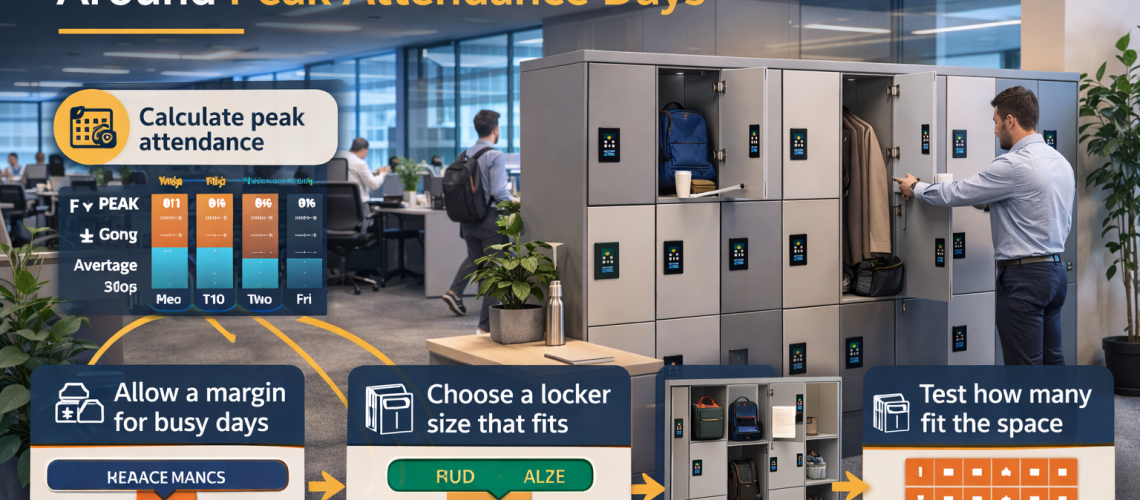
Office locker planning often goes wrong when businesses focus on total headcount instead of real attendance patterns. In a hybrid workplace, not everyone is in the office every day, but that does not mean storage demand is low. In many cases, demand is concentrated into the busiest days of the week, which is why locker capacity should be planned around peak attendance rather than average use.
Get that calculation wrong and the office can quickly run into problems. Too few lockers create frustration, desk clutter and a sense that the shared storage system cannot be relied on. Too many lockers can waste valuable floor space and make the fit-out heavier than it needs to be. The best answer usually sits somewhere between full headcount and casual guesswork.
This guide explains how to plan office locker capacity around busy attendance days and how to size a locker bank in a way that reflects real office behaviour. For the main workplace lockers guide, visit the hub page. For broader capacity thinking, see how many workplace lockers do you need. If your office uses shared storage, visit day-use office lockers. When you are ready to compare products, see our workplace lockers page for staff lockers and commercial staff storage.
Why average attendance is not enough
Average attendance can make a locker plan look more efficient than it really is. If an office averages 55% occupancy across the week, it may be tempting to size the locker bank for that level. In practice, though, staff often favour the same days. A Tuesday or Wednesday may feel far busier than the weekly average, and that is the moment when the locker system is tested properly.
Storage pressure appears at peak use, not at average use. Staff arrive on a busy day and need somewhere for coats, bags, laptops and personal items. If capacity has been planned around a calmer overall number, the shortage becomes obvious very quickly.
That is why a locker bank should be judged against the busiest realistic day rather than against the mathematical middle of the week.
Peak attendance is about real behaviour, not theory
Peak attendance means the highest realistic number of people who will need storage on the same day, or in some cases at the same time. In hybrid offices, this is often shaped by team patterns, anchor days, collaboration habits and how the business expects people to use the workspace.
Some organisations have fairly even attendance through the week. Others have strong surges on particular days because teams prefer to come in together. That difference matters far more than broad assumptions such as “we are hybrid now, so we need fewer lockers”.
The locker plan should be built around what staff actually do, not around what the office hoped hybrid working would spread evenly.
Start by understanding who actually needs a locker
Not every person in the building will always need the same level of storage. Some staff may use lockers every office day. Others may only need storage occasionally. Visitors and contractors may rely on separate storage zones altogether. Before calculating the number of lockers, it helps to define which user group the bank is really for.
In many offices, the main locker bank is designed for staff day use rather than for every possible person on site. That distinction helps avoid overestimating or underestimating the real demand. The clearer the user group is, the more accurate the capacity plan becomes.
For mixed-user environments, see hybrid office locker zones for teams, visitors and contractors.
What staff store affects capacity planning too
Locker numbers cannot be separated from locker size. If each person only needs a compact compartment for a bag and a few personal items, the office may be able to fit more lockers into the same area. If staff need room for coats, laptop bags, lunch items and commuting extras, each unit may need more space and the total number that fits may fall.
This means capacity planning is not only about counting people. It is also about understanding the storage brief. A very small locker bank of realistic size may be more useful than a larger bank of compartments that are too cramped to solve the actual problem.
For that side of the topic, see what should office staff lockers be big enough to hold.
Shared lockers usually mean planning below full headcount
Where the office uses day-use or shared lockers, the total number usually does not need to match total staff headcount. The point of shared storage is that not everyone needs a permanent locker. However, this only works when the number of shared lockers still covers realistic busy-day demand.
That is why the planning question becomes: how many staff are likely to need a locker on the busiest day, and how many of those will be on site at the same time? In most hybrid offices, that number is lower than full headcount but higher than average attendance.
The office should be careful not to treat “shared” as a reason to undersupply storage. Shared systems still need enough capacity to feel dependable.
Assigned lockers change the calculation
If the office uses assigned lockers instead of shared storage, the planning logic changes. Assigned lockers are tied to specific employees, so the number is often much closer to the number of users who are entitled to them. In that model, peak attendance matters slightly less than the allocation decision itself.
Even so, some hybrid offices use a mixed model. Certain teams may have assigned lockers, while the rest of the office relies on shared day-use units. In those cases, the office needs to calculate the assigned and shared parts separately rather than trying to apply one rule across the whole storage system.
For the wider comparison, visit assigned vs shared staff lockers.
Capacity planning should include a small margin
Peak-day planning should not be so tight that the whole system fails the first time attendance rises slightly above expectation. A modest margin can help absorb small fluctuations, occasional overlap and the normal unpredictability of real office life.
This does not mean oversupplying the office with unused lockers. It means allowing enough breathing room that the shared system still feels reliable when the busiest day runs a little busier than normal. The exact margin will vary by office, but planning right on the absolute edge often creates avoidable frustration.
In practice, staff trust storage more when it feels comfortably available rather than barely sufficient.
Busy days are not only about numbers
Peak attendance is one part of the issue, but arrival timing matters as well. Some offices may have enough lockers overall and still feel pressured if too many staff arrive at the same time and the storage area is cramped or slow to use. Capacity planning therefore needs to consider both the number of users and how they flow through the space.
A locker bank that works well at 10:30 in the morning may feel very different at 08:45 if a large share of the office arrives together. This is one reason why placement, circulation space and locker zoning should be considered alongside locker numbers.
For more on flow, see where should office lockers go in a reception-to-desk journey.
Desk booking data can help, but only if it reflects reality
If the office uses desk booking, that data can be useful for understanding peak attendance patterns. It can show which days are busiest, which teams overlap and whether demand is concentrated around certain routines. However, this only helps if staff genuinely use the desk booking system properly and consistently.
Where booking data is incomplete or only loosely followed, the office should be careful about relying on it too heavily. Observed office behaviour and actual attendance patterns may still be more trustworthy than nominal system data. Good locker planning uses the best available evidence rather than assuming one source tells the full story.
If the office is also considering reserved storage, see should office lockers be bookable or first come, first served.
Common mistakes in peak-day capacity planning
- using average attendance instead of peak attendance
- assuming hybrid offices always need far fewer lockers
- counting headcount without defining which staff actually use lockers
- ignoring the effect of locker size on total capacity
- providing no margin for busy days or small attendance changes
- focusing on total lockers without checking arrival timing and flow
- relying on booking data that does not reflect real behaviour
Most of these problems come from treating locker planning as a pure numbers exercise instead of a workplace behaviour question.
How to plan the right locker capacity
The best approach is usually simple. First, identify who the locker bank is really for. Then look at the busiest realistic attendance days rather than average use. After that, check what staff actually need to store, choose a locker size that fits that brief and test how many lockers can be provided without damaging the surrounding office layout.
Once those steps are clear, the office can add a modest margin for comfort and growth. That usually produces a far more reliable answer than sizing the locker bank from headcount alone or from rough guesswork about hybrid use.
Good planning starts with real office pressure points, then builds the storage offer around them.
Conclusion
Office locker capacity should usually be planned around peak attendance days, not around average occupancy and not around full headcount by default. In hybrid workplaces, the busiest days reveal whether the locker system is truly dependable.
The strongest result comes from combining realistic attendance patterns, realistic storage needs and enough layout space for the storage to work properly. For the wider cluster, return to the workplace lockers guide. Broader capacity thinking is covered in how many workplace lockers do you need. Product-led next steps can be found on our commercial staff storage page.
Frequently asked questions
Should office lockers be planned around average attendance?
Usually no. Peak attendance is the better guide because that is when the storage system is tested properly.
Do hybrid offices need fewer lockers?
Often fewer than full headcount, yes, but the number should still reflect busy days rather than a simple average.
Should locker planning include a margin?
Yes. A modest margin can help the office cope with attendance fluctuations and maintain trust in the shared system.
Does locker size affect capacity planning?
Yes. Larger lockers improve usability but reduce the number of units that fit in the available space, so size and quantity should always be planned together.
What is the biggest mistake in office locker capacity planning?
A common mistake is using average attendance as the main measure, which can leave the office short of lockers on the days that matter most.
“`
Discover more from Blog Total Locker Service
Subscribe to get the latest posts sent to your email.