Common Office Locker Mistakes and How to Avoid Them
April 7, 2026
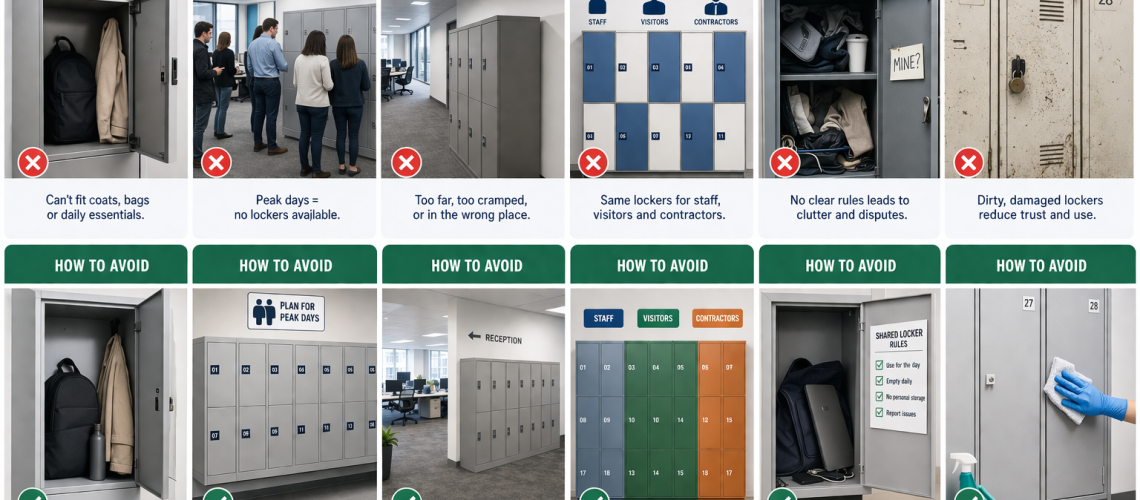
Office lockers can improve storage, reduce desk clutter and help a workplace feel more organised. However, they only work well when the planning is right. A poor locker decision can create just as many problems as it solves, especially in hybrid offices where storage has to support shared desks, variable attendance and a more flexible daily routine.
Most office locker problems do not come from the idea of lockers itself. They come from avoidable mistakes in sizing, layout, capacity, access or policy. A locker bank may look fine on a drawing and still fail in real daily use if the office has not thought clearly about what staff need to store, how they move through the building and how the storage will be managed over time.
This guide explains the most common office locker mistakes and how to avoid them. For the main workplace lockers guide, visit the hub page. For wider office planning, see how to choose workplace lockers for a new office fit-out. If your office uses shared storage, visit day-use office lockers. When you are ready to compare products, see our workplace lockers page for staff lockers and commercial staff storage.
Why office locker mistakes happen so often
Lockers are sometimes treated as a late-stage fit-out item. The office design is mostly fixed, the desks are chosen and then storage is added into whatever space remains. That approach often causes problems because lockers are not just static furniture. They shape the arrival routine, influence desk clutter, affect the visual feel of the office and create an ongoing management process around access, allocation and upkeep.
Another reason mistakes happen is that offices often plan from assumptions instead of behaviour. A team may assume staff only need room for a bag, when in practice they arrive with coats, laptops, lunch and commuting items. An office may assume hybrid working means low storage demand, when in reality most people come in on the same two or three days each week. These small misunderstandings can affect the whole storage scheme.
Mistake 1: Choosing lockers that are too small
This is one of the most common errors. A compact locker bank can look efficient on a plan, but if staff cannot fit in a coat, a laptop bag or normal daily belongings, the system quickly feels inadequate. Bags go back under desks, coats end up on chairs and the office loses the tidy storage benefit it was trying to create.
The best way to avoid this is to start with real office belongings rather than with the smallest possible compartment. Staff often need room for outerwear, work bags, personal items, chargers and lunch. If the locker cannot handle that normal load, it is too small in practical terms even if it looks efficient on paper.
For more on this, see what should office staff lockers be big enough to hold.
Mistake 2: Planning capacity around average attendance instead of peak days
Hybrid offices often underestimate storage demand because they use average occupancy instead of peak attendance. A workplace might look half full across the week overall, yet still feel extremely busy on Tuesdays and Wednesdays when most staff choose to come in together. Lockers are tested on those busy days, not on the calm ones.
If the locker bank is planned too tightly, staff arrive and find no space available, or the best compartments disappear early. That weakens confidence in shared storage and encourages people to leave belongings at desks instead. Capacity should normally be planned around the busiest realistic days, with a little margin for comfort.
For that topic, see how to plan office locker capacity around peak attendance days.
Mistake 3: Putting lockers in the wrong place
Placement is often treated as a simple space question, but it is really a behaviour question. Lockers placed too deep in the office encourage people to carry bags and coats through the whole workspace before storing them. Lockers placed directly in front of reception can make the entrance feel crowded. Lockers placed too close to desk clusters can create movement and visual clutter where people are trying to work.
The strongest locations are usually on the arrival route, just beyond reception or along the edge of the main work floor. They should feel natural to use without dominating the office. Good placement supports the handover from arrival to work instead of interrupting it.
For more on this, see where should office lockers go in a reception-to-desk journey.
Mistake 4: Using one storage model for every user
Not every office user needs the same locker experience. Permanent staff, hybrid workers, visitors and contractors often have different storage patterns, different routes through the building and different expectations. A single undifferentiated locker bank can quickly become confusing or overloaded when it is expected to serve everyone in the same way.
Many offices work better when they think in terms of locker zones or at least different storage rules for different user groups. Staff lockers may belong on the route to the desk area, while visitor lockers may be more useful near reception. Contractor storage may need to sit closer to a security point or service route.
For that, see do hybrid offices need different locker zones for teams, visitors and contractors.
Mistake 5: Making shared lockers too informal
Shared lockers can work extremely well, but they need rules. If the office assumes that staff will naturally empty them, avoid leaving items behind and manage access fairly without any guidance, the system often drifts into inconsistency. A charger gets left in one locker, then a coat in another, and gradually the bank becomes part shared, part unofficially claimed.
That is why day-use systems need clear expectations about who can use the lockers, when they should be emptied and what happens to items left behind. Shared storage works best when the purpose is obvious and the turnover routine is normal.
For more on this, see how to stop office lockers becoming permanent dumping space.
Mistake 6: Overcomplicating the access system
It can be tempting to add a more advanced locking or booking system because it looks modern or sounds efficient. Sometimes that is the right answer. In other offices, it adds a layer of process that the storage bank does not actually need. If a simple mechanical or shared-use system would work, over-engineering the access model can create unnecessary friction.
The best storage systems usually use the simplest approach that still supports the office routine well. If staff need certainty and demand is variable, booking may help. If demand is steady and the arrival pattern is straightforward, first come, first served may feel much better in practice.
For that comparison, see should office lockers be bookable or first come, first served.
Mistake 7: Ignoring maintenance and cleaning
Office lockers are often meant to support a tidy, professional workplace, yet some offices give little thought to how the locker bank will be cleaned, checked and kept in good condition. Over time, smudges, scuffs, sticking locks and worn numbering can make the storage area feel neglected even when the rest of the office looks well managed.
A simple upkeep routine usually goes a long way. Clean surfaces regularly, check locks and hinges, keep the surrounding floor area tidy and make sure faults can be reported clearly. The more visible the locker bank is, the more this matters to the overall feel of the office.
For more on this, see locker maintenance and cleaning in offices.
Mistake 8: Choosing materials only on price
Budget matters, but it should not be the only factor. A locker bank near reception or along a highly visible hybrid arrival route may need a more durable or more refined finish than a quieter back-of-house staff area. Choosing purely on upfront price can leave the office with storage that looks worn too quickly or feels too utilitarian for the surrounding fit-out.
The right material depends on visibility, wear and the design standard the office is trying to maintain. Some projects are best served by metal, others by laminate or MFC. The better question is what the material needs to do in that specific location.
For this, see what materials are best for office lockers.
Mistake 9: Weak numbering and labelling
Numbering looks like a small detail until the storage area is in daily use. If locker labels are too small, inconsistent or badly placed, staff waste time finding the right compartment and facilities teams waste time identifying the unit that needs attention. Shared and bookable systems especially depend on clear locker identity.
A simple numbering logic, readable labels and consistent placement usually make a bigger difference than people expect. Good labelling reduces small but repeated friction across the whole office storage routine.
For this, see how to label and number office lockers properly.
Mistake 10: Leaving lockers outside the policy framework
Lockers may look like a storage item, but they also raise questions about access, lost keys, overrides, left-behind items, searches and shared-use rules. When offices install lockers without linking them to a clear policy, those questions are often answered inconsistently by different managers or only when a problem appears.
A better approach is to define the purpose of the lockers, decide who can use them, explain how access is managed and set out what happens when the system is misused or something needs to be recovered. Lockers work better when they are part of the workplace rules, not outside them.
For that, see how office lockers fit into workplace security policies.
Mistake 11: Assuming one office solution fits every workplace
Some offices are compact, some are spread across large floorplates, some are highly design-led and some are more practical in style. Some workplaces have predictable attendance, while others swing sharply through the week. A locker solution that works beautifully in one office may feel completely wrong in another.
This is why the strongest locker plans are usually specific rather than generic. The storage should reflect the actual building, the actual staff routine and the actual level of demand. The moment an office starts copying a model without testing it against its own behaviour, mistakes become much more likely.
How to avoid most locker mistakes
The best way to avoid office locker mistakes is to start with behaviour and then build the storage around it. Look at what staff carry, when they arrive, how attendance peaks, whether the lockers are shared or assigned, who else uses the building and where the storage belongs in the journey from reception to desk. Once those points are clear, the right size, quantity, location and management model become much easier to define.
Good locker planning is usually less about cleverness and more about realism. Offices get better results when they plan for how the workplace actually functions rather than how they hope it will function.
Conclusion
Most common office locker mistakes are avoidable. They tend to come from underestimating how much lockers affect the daily experience of the workplace. Size, capacity, placement, access, materials, policy and upkeep all matter because lockers are not passive objects. They are part of the office routine.
The strongest offices usually avoid these mistakes by treating storage as part of the wider workplace plan from the beginning. For the wider cluster, return to the workplace lockers guide. Office-wide planning is covered in how to choose workplace lockers for a new office fit-out. Product-led next steps can be found on our commercial staff storage page.
Frequently asked questions
What is the most common office locker mistake?
One of the most common mistakes is choosing lockers that are too small for the belongings staff actually bring into the office each day.
Why do shared office lockers fail?
They often fail when the office provides too little capacity, places them poorly or leaves the shared-use rules too vague.
Should locker planning be linked to office layout?
Yes. Locker placement affects arrival flow, desk clutter, visual calm and how naturally staff use the storage.
Do hybrid offices make locker planning harder?
Often yes, because attendance varies, demand peaks on certain days and shared storage needs clearer rules and stronger capacity planning.
How do you avoid office locker mistakes?
Start with real staff behaviour, then plan the locker size, number, location, access model and policy around how the office actually works.
Discover more from Blog Total Locker Service
Subscribe to get the latest posts sent to your email.