Best Lock Options for Workplace Lockers
April 1, 2026
The right lock can make a big difference to how workplace lockers perform in daily use. It affects convenience, security, staff experience and the amount of administration a site has to manage. A locker bank may look ideal on paper, but if the locking method is awkward, unreliable or difficult to control, the installation can quickly become frustrating for both staff and managers.
That is why lock choice should be treated as part of the workplace planning process rather than a small add-on at the end. Offices, warehouses, factories and staff changing rooms do not always need the same answer. Some environments suit a simple key system. Others benefit from padlocks, mechanical combinations or digital access. The best option depends on how the lockers are used, whether they are assigned or shared, and how much key control the employer wants to handle.
This guide explains the main staff locker lock types and how they fit different workplace settings. For the wider workplace lockers guide, visit the main hub. If you are reviewing broader locker security systems across different sectors, that guide provides a wider comparison. For hybrid use cases, see smart lockers for hybrid workplaces. If you are already comparing products, visit our workplace lockers page for staff lockers and commercial staff storage.
Why lock choice matters in workplace locker planning
Lock choice shapes more than security. It also affects how fast staff can access their locker, how often managers deal with access problems and how easy the system is to operate over time. A poor locking method can lead to lost keys, forgotten codes, damaged doors, unused lockers or frequent requests for help.
Good workplace planning starts by asking a few practical questions. Are the lockers assigned or shared? Do staff use them every day or only occasionally? Will users need fast access at shift change? Does the site want to minimise key handling? Is there a need for management override or auditability? These questions usually point towards the most suitable lock type far more clearly than product labels alone.
That is why a proper staff locker planning guide should always include lock choice alongside size, layout and policy.
Main lock options for workplace lockers
Most workplace locker schemes are built around a few core lock types. Each one has strengths and drawbacks depending on the site.
1. Standard key locks
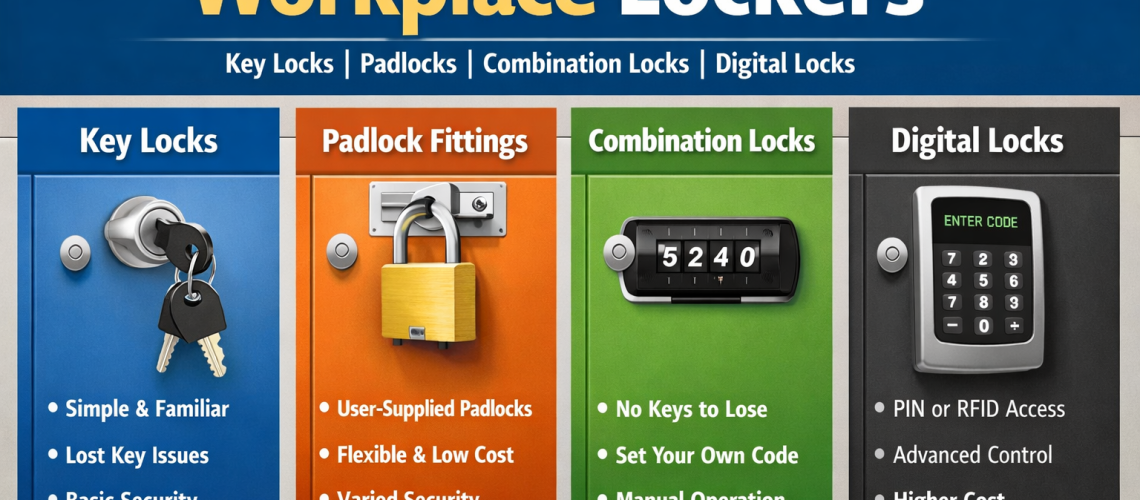
Key locks are one of the most familiar locker options. They are simple, easy for users to understand and often suit assigned staff lockers where each employee keeps the same unit over time. In many traditional workplaces, this remains a practical starting point.
The main weakness is administration. Keys get lost, spares have to be managed and replacement requests can build up. Where a site has a large workforce or a lot of turnover, that can become a regular burden. Key locks are therefore often best where staff are stable, lockers are assigned and the employer is comfortable managing key control.
2. Padlock fittings
Padlock fittings allow the user to secure the locker with a separate padlock. This can reduce the need for built-in key control, especially if staff supply their own lock. It can also be a useful option where businesses want flexibility and a simple, low-cost locking method.
However, there are trade-offs. If staff bring their own padlocks, quality and security standards may vary. Some users may forget them or choose very basic locks. Employers may prefer to issue standard padlocks instead, but that brings key management back into the picture. Padlock fittings can work well in practical staff environments, although they are usually less tidy and less consistent than an integrated lock system.
3. Mechanical combination locks
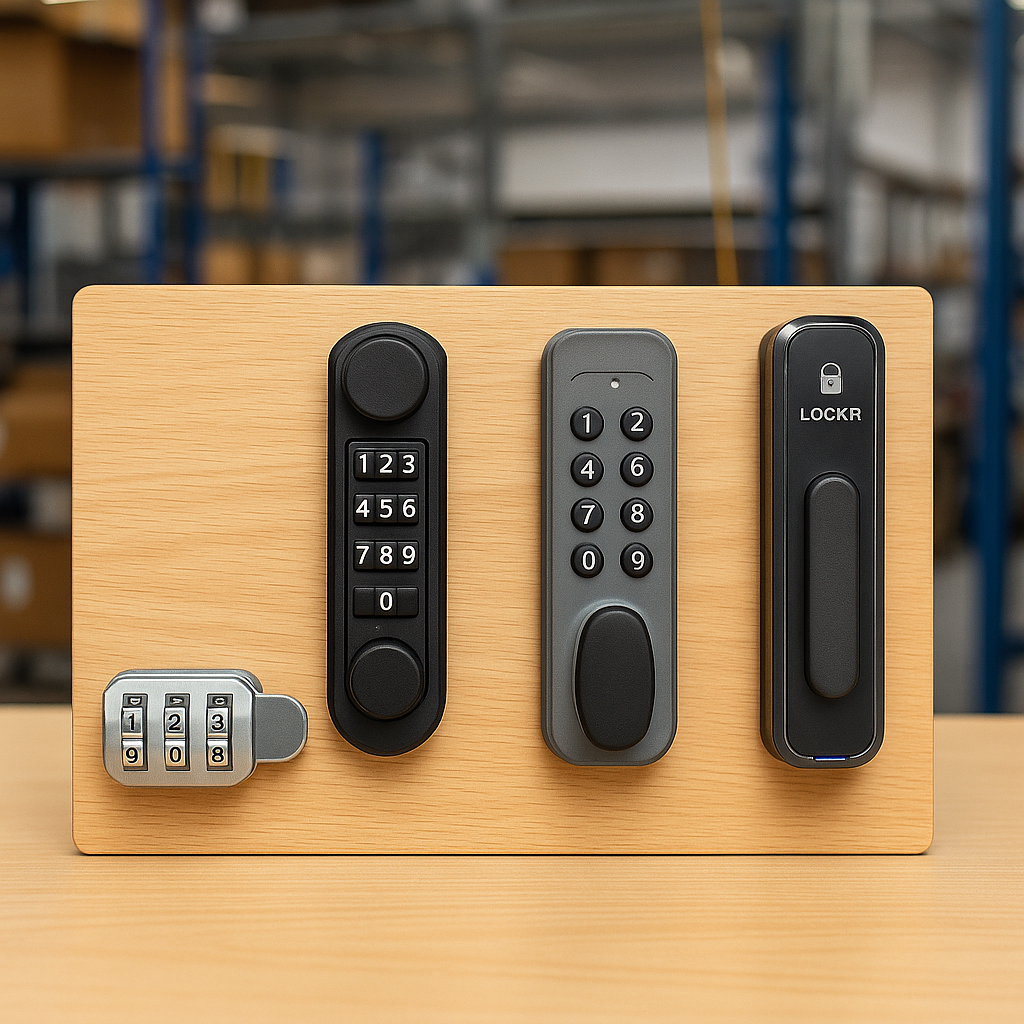
Mechanical combination locks remove the need for physical keys. That makes them attractive in workplaces that want fewer lost-key problems and simpler day-to-day control. They can suit both assigned and shared-use lockers, depending on the model and setup.
These locks are often a strong option for staff areas because they strike a balance between convenience and simplicity. There are no batteries to manage, and users do not need to carry a key. The main challenge is that people can forget codes, especially if they do not use the locker every day. Even so, combination locks are often a very practical answer for workplaces that want to reduce admin without moving fully into digital systems.
4. Digital locker locks
Digital locks can offer a more flexible and more controlled approach to workplace storage. Depending on the system, users may gain access through a PIN, RFID credential, smart card or another electronic method. Some systems also support temporary assignment, management override and wider integration with workplace access routines.
This type of solution can be particularly useful in larger offices, hybrid workspaces and mixed-use sites where shared lockers need to be managed efficiently. The extra flexibility is valuable, but it usually comes with higher cost and more complexity than a basic mechanical option. As a result, digital locker locks for staff are usually worth considering where the workplace genuinely benefits from flexible allocation or tighter control.
5. Coin return or retained systems
Coin-operated locking is more common in leisure and visitor settings than in workplace staff storage, but it can appear in certain shared-use environments. In most standard workplace schemes, it is less common because staff lockers are usually assigned, policy-led or linked to internal access arrangements. Even so, it can still be relevant in some temporary-use areas.
Which lock type is best for assigned staff lockers?
Assigned lockers are normally used by the same employee every day or over a long period. In these cases, simple and dependable access tends to matter most. Key locks often work well here, particularly in stable workplaces where users keep responsibility for their own locker. Mechanical combination locks can also be a strong option if the aim is to avoid lost keys while keeping the system straightforward.
The right choice usually depends on how much admin the site wants to handle. A smaller workplace with steady staffing may be perfectly happy with keys. A larger site with regular access issues may prefer combinations. Digital locks can still work for assigned users, but they are often most useful where there is a wider reason for electronic control rather than simply because the technology is available.
Which lock type is best for shared or flexible workplace lockers?
Shared-use lockers place more importance on easy reassignment and smooth turnover between users. In those environments, a fixed key system is usually less attractive because it creates extra handling and more chance of keys going missing between users.
Mechanical combinations often work well for flexible staff storage because users can secure the locker without carrying a key. Digital systems may be even better where the business wants temporary assignment, hybrid office support or stronger management control. In those situations, electronic locking can justify itself more clearly because the flexibility becomes a real operational advantage rather than a nice extra.
Where the main concern is hybrid office storage, our guide to smart lockers for hybrid workplaces looks more closely at when that technology is worth the extra investment.
How workplace type changes the right answer
The best lock for workplace lockers depends heavily on the setting.
Office environments
Offices often favour clean, tidy and easy-to-use locking methods. Where staff attend on fixed patterns, key or combination locks may be enough. In hybrid settings, digital access and temporary allocation may become more attractive. Appearance also tends to matter more in office spaces, so an integrated lock often feels more suitable than a visible padlock arrangement.
Factories and production sites
Production environments usually value reliability, durability and practical access at busy shift times. Staff may need to open lockers quickly while carrying clothing or equipment, so convenience matters. Combination locks can be useful where lost keys would create too much disruption. Key locks can still work if the workforce is stable and policy is well managed.
Warehouses and welfare areas
Warehouse staff areas often need lock types that are straightforward, robust and easy to manage day after day. Overly complicated systems can become more of a burden than a benefit. In many cases, the right choice is the one that balances dependability with low admin rather than the most advanced option on the market.
This is why workplace locker lock options should always be reviewed in context, not chosen from a generic list without reference to the site.
Security, convenience and admin: the three-way balance
Most locker lock decisions come down to balancing three factors: security, convenience and administration. Increase one too far without thinking about the others and the system may become harder to use in practice.
A highly controlled digital system may offer strong oversight, but it may be more than a small staff area actually needs. A very simple key arrangement may be familiar and cheap, but it can create repeated admin if users lose keys often. A padlock fitting may reduce employer involvement, but it can introduce inconsistency if users are left to choose their own locks.
The most successful workplace schemes usually choose the lock that fits the site rather than chasing maximum security or minimum cost in isolation.
Do workplace lockers need management override?
In many cases, yes. Employers often need a clear way to access lockers when staff lose keys, forget codes, leave the business or fail to clear belongings after repeated reminders. That does not mean management should open lockers casually, but it does mean the access method should be compatible with workplace policy.
Override arrangements should be linked to clear procedures. The more important point is not only whether override exists, but how it is governed. For the policy side of the topic, see our guide to employee locker rights UK. That article covers the legal and policy angle, while this page stays focused on lock choice for staff storage.
How lock choice connects to theft prevention
No lock solves theft risk on its own. The physical lock is only one part of the wider setup. Lighting, room layout, staff awareness, management processes and the handling of overrides all influence how secure the locker area feels and how well it performs in practice.
Even so, the lock should still suit the risk level of the site. Weak or inconsistent locking undermines confidence, especially if staff store phones, wallets, keys or work items inside the units. For the wider risk-management angle, see our guide to workplace locker security and how to prevent locker theft.
Common mistakes when choosing staff locker lock types
- Choosing keys without planning for replacements and spares
- Using staff-supplied padlocks without setting a clear standard
- Picking digital systems where the workplace does not really need them
- Ignoring how shared-use lockers change access needs
- Forgetting to align lock choice with locker policy
- Overlooking management override and end-of-employment procedures
- Choosing the cheapest lock without thinking about daily convenience
Most of these issues come from treating locks as a small hardware choice rather than as part of the wider workplace storage system.
How to choose the best lock option for workplace lockers
The most reliable approach is to start with the workplace pattern. Define whether the lockers are assigned or shared, list the likely user behaviour, review how often access problems are likely to occur and decide how much admin the site can manage. Then choose the simplest lock that still supports the required level of control.
In many traditional staff areas, that may point towards keys or mechanical combinations. In hybrid offices and flexible workplaces, digital locker locks for staff may make more sense. Padlocks can still work in practical environments where a simple, user-led arrangement is acceptable.
Good lock selection is not about chasing technology. It is about matching access method to the people, the environment and the management style of the site.
Conclusion
The best locks for workplace lockers are the ones that fit the way the staff area actually works. Key locks remain useful for many assigned lockers. Padlocks can offer simple flexibility. Mechanical combinations often reduce admin while staying practical. Digital systems can add value where shared use, hybrid working or tighter control justify the extra complexity.
Offices, warehouses and factories do not always need the same answer. That is why staff locker lock types should always be judged in context. For the wider cluster, return to the workplace lockers guide. For broader comparisons of locker security systems, visit that supporting guide. When you are ready to move from planning to products, see our workplace lockers page.
Frequently asked questions
What are the best locks for workplace lockers?
The best option depends on whether the lockers are assigned or shared, how much admin the site can manage and how the workplace operates day to day. Common choices include key locks, padlocks, mechanical combinations and digital access systems.
Are key locks still good for staff lockers?
Yes. They can work very well for assigned staff lockers in stable workplaces. The main downside is the ongoing need to manage lost keys and replacements.
Are digital locker locks worth it for offices?
They can be, especially in hybrid workplaces where shared or temporary locker use is common. In more traditional office setups, a simpler lock may be enough.
Do padlocks work well for workplace lockers?
They can work in practical staff areas, but the result is usually better if the employer sets a clear standard rather than leaving every user to choose their own lock.
Should lock choice be linked to locker policy?
Yes. Access, overrides, lost keys, forgotten codes and end-of-employment procedures should all be considered when choosing the locking method.
Discover more from Blog Total Locker Service
Subscribe to get the latest posts sent to your email.