How to Train Care Home Staff in Safe Medicines Handling
March 30, 2026
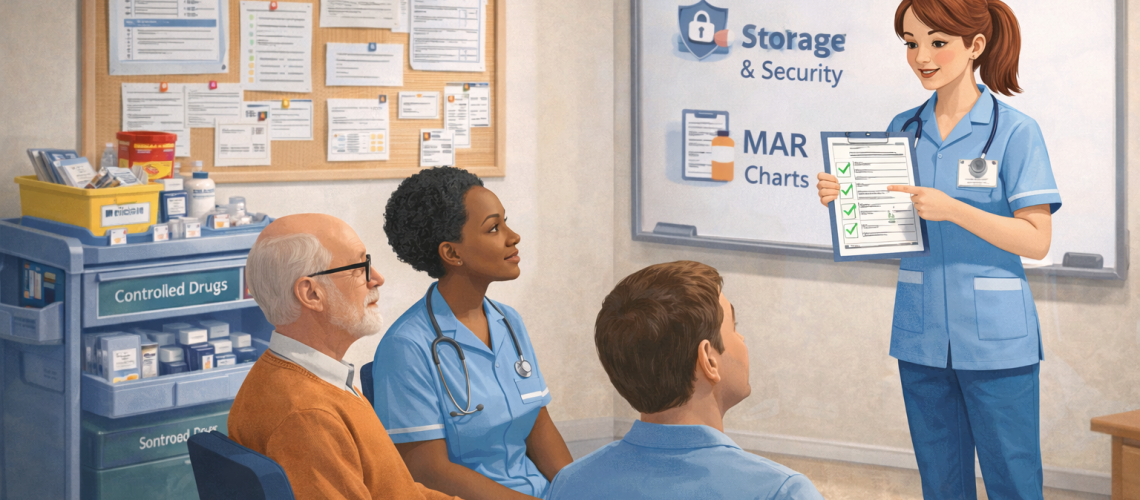
Safe medicines handling in a care home depends on people as much as process. Cabinets, trolleys, MAR charts and policies all matter, but none of them work properly without staff who understand what to do, why it matters and how to respond when something is not right. Training is therefore not a one-off box to tick. It is an ongoing safety system.
This matters because medicines handling in care homes is practical, fast-moving and detailed. Staff may receive stock, store medicines, complete MAR entries, support self-administration, manage returns, monitor fridge temperatures and report incidents, all within the same service. If knowledge is uneven, or confidence is weak, the risk of error rises quickly.
A strong training programme helps reduce those risks. It supports safer administration, more accurate records, better storage practice and stronger decision-making. It also gives managers clearer evidence that staff are competent for the responsibilities they hold.
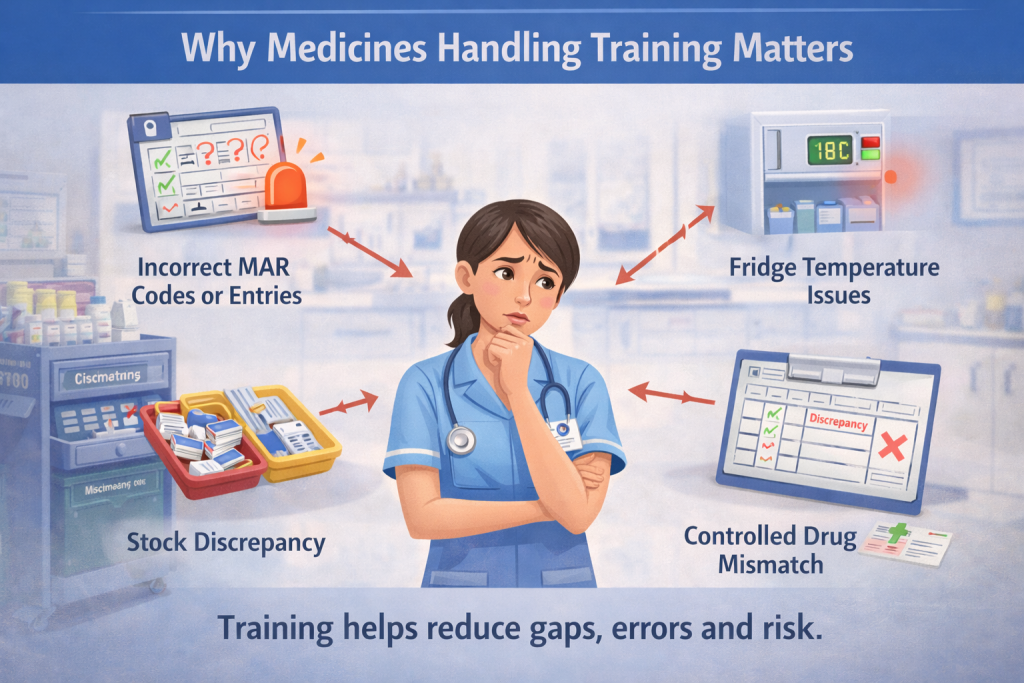
Why medicines handling training matters
Medicines errors rarely come from one cause alone. They often happen when several small weaknesses overlap. A member of staff may not fully understand the MAR code being used. A medicine may be stored in the wrong place. A stock discrepancy may not be escalated quickly enough. A refusal may be recorded unclearly. A fridge reading may be written down but not acted on.
Training helps close those gaps. It gives staff the practical knowledge to follow the system properly and the confidence to speak up when something seems wrong. It also creates consistency across the home, which matters because medicines rounds and stock checks may involve different staff on different shifts.
Good training also protects residents in a more direct way. Medicines handling affects dignity, timing, safety, communication and trust. When staff are trained well, residents are more likely to receive the right support in the right way.
What safe medicines handling includes
Medicines handling in a care home covers more than giving tablets at a set time. It usually includes:
- receiving medicines into the home
- checking and storing stock correctly
- keeping medicines secure
- administering medicines safely
- recording administration accurately
- supporting refusals and omissions correctly
- monitoring fridge storage where needed
- handling controlled drugs properly
- supporting self-administration safely
- separating medicines awaiting disposal
- reporting incidents and near misses
Training should reflect that full pathway. If it only focuses on administration, important gaps remain elsewhere in the system.
Start with clear role boundaries
Not every member of staff in a care home will have the same medicines responsibilities. Staff roles in a care home can vary widely. One team member may administer medicines. Another may witness controlled drug checks. Others may support residents in limited ways without handling medicines directly. Senior staff may instead hold management or audit responsibilities.
Training should therefore begin by defining who does what. Staff need to know:
- what medicines tasks they are authorised to perform
- which tasks they must not perform
- when to escalate to a senior colleague, nurse, pharmacy or prescriber
- what local policy says about delegation and competence
Clear role boundaries reduce confusion. They also make competency assessment much more meaningful, because managers can judge staff against the duties they are actually expected to carry out.
Build training around real care home practice
Medicines training is most effective when it matches the way care homes actually work. Staff need more than general theory. They need practical guidance linked to the situations they face every day.
That means training should cover:
Receiving medicines
Staff should know how to check deliveries, confirm the right resident, identify missing or incorrect items, and place medicines into the correct storage without delay.
Storage
Staff should understand cupboard security, fridge monitoring, controlled drugs storage, stock organisation and safe separation of medicines awaiting disposal.
Administration
Training should cover the rights of administration, checking identity, following the MAR, supporting the resident appropriately, and avoiding interruption-related mistakes.
Record keeping
Staff should know how to complete MAR charts clearly, use codes consistently, record refusals and omissions correctly, and avoid retrospective or unclear entries.
Controlled drugs
Where relevant, staff should understand witness requirements, register use, running balances and escalation of discrepancies.
Disposal and returns
Staff should know how to separate unwanted, expired or discontinued medicines from active stock and follow the home’s returns process.
Incident reporting
Staff need to know what counts as an error, near miss or concern, and how to report it promptly and accurately.
Training that stays close to real workflow is easier to retain and easier to apply.
Include competence, not just attendance
Attendance at training is not the same as competence. A member of staff may sit through a session and still be unclear on key steps. Safe medicines handling depends on what people can do in practice, not only what training they were present for.
Competency checks should therefore sit alongside teaching. These may include:
- supervised medicines rounds
- observed stock checks
- MAR documentation review
- scenario questions
- return demonstrations
- follow-up spot checks after training
This matters because a staff member may appear confident but still make repeated documentation errors or miss storage controls. Practical assessment helps identify that early.
Train staff to think, not only follow steps
Procedures matter, but medicines handling is not purely mechanical. Staff also need to understand risk. They need to notice when something does not fit the usual pattern and know what to do next.
Training should help staff think through questions such as:
- Does this medicine match the MAR and the label?
- Has this item been stored correctly?
- Is this resident refusing in a way that needs escalation?
- Does this handwritten amendment need checking?
- Does this stock balance make sense?
- Is this medicine still current, or should it be awaiting disposal?
- Is this fridge reading acceptable, and what action is needed if it is not?
That kind of judgement reduces the chance that staff follow a flawed process without questioning it.
Cover communication with residents properly
Medicines handling is also about communication. Residents should not feel rushed, confused or ignored during medicines support. Staff need to explain clearly, listen properly and record what happened accurately.
Training should include:
- offering medicines respectfully
- explaining what is being given, where appropriate
- responding calmly to refusal
- recognising when a resident may need extra reassurance
- understanding the link between communication and consent
- escalating concerns where a resident’s usual pattern changes
This improves safety and also supports dignity. In a care home, those two things should not be separated.
Refresh training regularly
Medicines training should not end after induction. Staff forget details, habits drift and procedures change. New risk areas also emerge over time, especially after incidents, changes in resident need or updates to local systems.
Refresher training helps maintain consistency. It is especially useful when:
- incidents or near misses have occurred
- audits show repeated documentation gaps
- controlled drug discrepancies are found
- fridge monitoring is weak
- new medicines systems are introduced
- agency or temporary staff are being used more often
- policies are updated
Short targeted refreshers can be as valuable as formal sessions, particularly when they are tied to a real issue in the home.
Use audits and incidents to shape training
Training should be driven by evidence, not guesswork. Where audits show gaps on MAR charts, record-keeping needs more focus. Poor separation of returns points to a need for better disposal training. Repeated stock mismatches suggest that staff may need stronger checking routines.
Incident reports, near misses and audit findings all provide useful signals. They show where the system is under strain and where training should be strengthened.
This makes training more precise. It also helps staff see that learning is linked to real practice rather than abstract policy.
Make induction strong from the start
New staff should never be left to pick up medicines handling informally from whoever happens to be on shift. Induction needs structure. It should explain the home’s policy, storage arrangements, documentation standards, escalation routes and competency expectations before the person takes on medicines duties.
A good induction should include:
- local medicines policy
- layout of medicines storage areas
- use of MAR charts
- key and access control
- fridge and controlled drugs procedures
- returns and disposal systems
- incident reporting
- supervised practice
- competency sign-off
This gives new starters a safer foundation and reduces reliance on inconsistent verbal handover.
Support senior staff and managers too
Medicines training is not only for frontline handling. Senior staff and managers also need to understand the system well enough to supervise, audit and intervene. They should be able to spot weak practice, interpret audit findings, respond to incidents and support improvement.
Manager-level training may therefore need to include:
- competency assessment methods
- audit techniques
- reviewing MAR quality
- investigating errors
- trend analysis
- policy review
- leading reflective learning after incidents
A strong medicines culture depends on leadership as well as frontline skill.
Common training gaps to watch for
Several gaps appear repeatedly in care settings. These include:
- staff signing MAR charts incorrectly
- poor understanding of omission and refusal codes
- weak knowledge of controlled drugs procedures
- uncertainty around medicines awaiting disposal
- limited understanding of fridge escalation
- over-reliance on habit rather than policy
- staff not knowing when to seek advice
- insufficient observation before sign-off
These gaps often remain hidden until an audit or incident brings them to light. That is why training should be reviewed as a live part of governance rather than a static requirement.
Practical ways to strengthen medicines handling training
Care homes can improve training by keeping it practical and continuous. Useful approaches include:
- observed practice rather than classroom-only teaching
- brief refresher sessions linked to audit findings
- competency rechecks at set intervals
- case-based discussions after incidents
- shadowing with experienced competent staff
- short written guides kept near medicines areas
- clear escalation contacts for urgent questions
Final thoughts
Training care home staff in safe medicines handling is one of the most important ways to protect residents and improve consistency. The best training is clear, practical and linked to competence. It should cover the full medicines pathway, reflect the real routines of the home and be refreshed over time.
When staff know what to do, understand why it matters and feel able to escalate concerns, the whole medicines system becomes safer. Storage improves. Records become more reliable. Errors are easier to prevent. Residents receive better support. That is the real value of good medicines handling training.
“`
Discover more from Blog Total Locker Service
Subscribe to get the latest posts sent to your email.