Medical Cabinets UK: Medicines Storage, Compliance and Security Guide
May 5, 2026
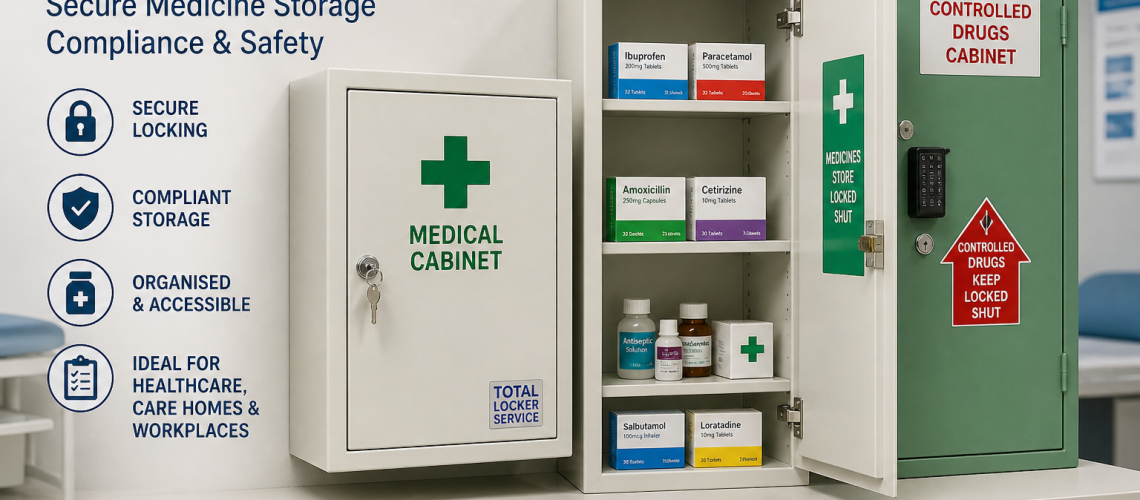
Medical cabinets provide secure, organised storage for medicines, first aid supplies, dressings and clinical consumables in care homes, clinics, schools, workplaces, treatment rooms and other staff-managed environments.
The right cabinet depends on more than external size. Start with what will be stored, who needs access, how much stock must be held, whether the cabinet should be wall-mounted or floor-standing, how the stock needs to be separated and whether any contents require specialist storage.
This is the main starting point for choosing a medical cabinet. It explains the principal cabinet types and first buying decisions, then links to more detailed guidance on controlled drugs, compliance, access control, medicine-storage systems, audits and cabinet organisation.
Quick Guide: Which Medical Cabinet Do You Need?
| Storage requirement | Cabinet type to consider | Next question |
|---|---|---|
| General medicines | Lockable medical or medicine cabinet | Capacity, shelving and access |
| Small treatment room | Wall-mounted medical cabinet | Wall space, fixing and working height |
| Larger medicine stock | Floor-standing medical cabinet | Capacity, shelf layout and segregation |
| Controlled drugs | Purpose-designed controlled drug cabinet where required | Use the specialist controlled-drug guide |
| First aid supplies | First aid or suitable medical cabinet | Visibility and accessible emergency stock |
| Personal medication | Suitable individually controlled storage | Separation by person and access |
| Clinical consumables | Medical supply cabinet | Organisation, cleanliness and stock visibility |
| Refrigerated medicines | Suitable medicine refrigeration | Temperature and monitoring requirements |
What Is a Medical Cabinet?
A medical cabinet is a secure storage unit used for medicines, first aid supplies, dressings, clinical consumables or other healthcare-related items.
Depending on the product and application, it may provide:
- lockable storage;
- adjustable shelving;
- wall-mounted or floor-standing installation;
- key or electronic access options;
- internal separation;
- durable, easy-to-clean surfaces.
The term is broader than medicine storage alone. Some products are used primarily for first aid stock or clinical consumables, while others are intended principally for medicines.
Medical Cabinet vs Medicine Cabinet
| Term | Typical use |
|---|---|
| Medical cabinet | Broader healthcare storage including medicines, dressings, first aid items and clinical consumables |
| Medicine cabinet | Storage intended principally for medicines |
| Controlled drug cabinet | Specialist storage where controlled-drug safe-custody requirements apply |
| First aid cabinet | Bandages, dressings, gloves and workplace first aid supplies |
The product name alone does not establish suitability. Match the cabinet specification to the actual contents and use.
A Medical Cabinet Is Part of a Wider Storage System
The cabinet is only the physical storage unit. A complete medicine-storage system can also include access control, monitoring, stock management, working procedures and specialist storage for higher-risk contents.
- Storage units: medical cabinets, controlled-drug cupboards, medicine fridges and trolleys.
- Access control: keys, codes and authorised users.
- Segregation: keeping different stock categories clearly separated.
- Monitoring: stock, expiry and temperature checks where applicable.
- Workflow: how stock is received, stored, accessed and replenished.
For the wider system rather than cabinet selection alone, use Medicine Storage Systems UK.
Main Types of Medical Cabinet
Wall-Mounted Medical Cabinets
Wall-mounted cabinets suit smaller rooms and moderate stock levels where saving floor space is important.
- small treatment rooms;
- schools;
- staff welfare rooms;
- clinics;
- care settings.
Confirm that the wall construction and proposed fixing arrangement are suitable for the loaded cabinet.
Floor-Standing Medical Cabinets
Floor-standing cabinets provide greater capacity and more scope for shelf organisation where the stock range is larger.
- care homes;
- larger clinics;
- school medical rooms;
- healthcare departments;
- larger workplaces.
If the main question is cabinet format, use the Wall-Mounted vs Floor-Standing Medical Cabinets guide.
General Lockable Medicine Cabinets
General medicine cabinets provide controlled storage where specialist controlled-drug storage is not required.
Check:
- cabinet construction;
- internal dimensions;
- shelf quantity and adjustment;
- access method;
- authorised users;
- fixing method;
- the exact contents to be stored.
Controlled-Drug Cabinets
Do not assume a standard lockable medical cabinet is suitable for controlled drugs.
Where controlled-drug safe-custody requirements apply, a purpose-designed cabinet may be required with a more specific construction, fixing and restricted-access specification.
For specialist requirements, use the Controlled-Drug Cabinet UK guide.
First Aid Cabinets
First aid cabinets are normally used for dressings, bandages, plasters, gloves, wipes and other emergency supplies.
They are common in workplaces, schools, gyms, warehouses, factories and workshops. First aid storage and medicine storage may need different access arrangements, so they should not automatically be treated as the same requirement.
For the direct comparison, use Medical Cabinets vs First Aid Cabinets UK.
Personal Medication Storage
Some settings need secure storage for medicines belonging to an individual rather than general stock.
- care homes;
- supported living;
- schools;
- workplace welfare arrangements.
Where several people’s medicines are stored, the arrangement should make it easy to distinguish one person’s medication from another’s.
Clinical Supply Cabinets
Medical cabinets can also be used for dressings, gloves, clinical consumables, small instruments, treatment supplies and protective equipment.
Adjustable shelving is particularly useful where pack sizes vary or the stock profile changes over time.
Where Medical Cabinets Are Used
| Setting | Typical requirement |
|---|---|
| Care homes and supported living | Routine medicines, personal medication, controlled-drug storage where applicable and refrigerated items |
| Schools and colleges | Pupil medication, emergency medication and first aid supplies |
| Workplaces and offices | First aid supplies and staff-managed medical items |
| Clinics and treatment rooms | Medicines, treatment supplies and clinical consumables |
| Factories and warehouses | Durable first aid and medical storage near welfare or first aid areas |
For clinic-specific workflow and treatment-room planning, use Medical Cabinets for Clinics UK.
Choose the Cabinet Around What Is Being Stored
List the actual contents before choosing the cabinet.
- general medicines;
- prescribed medicines;
- first aid supplies;
- personal medication;
- dressings and consumables;
- controlled drugs;
- items requiring refrigeration;
- medical devices.
Different categories may need different storage arrangements. Do not assume one cabinet should hold everything.
Access Control
The cabinet access method should suit the number of authorised users and the way the organisation manages access.
- Who needs access?
- Who controls spare keys or codes?
- What happens when staff leave or change role?
- Does the organisation need a formal access record?
For detailed lock choice and access procedures, use Medical Cabinet Locks & Access Control UK.
Capacity and Internal Layout
A cabinet needs enough capacity for normal stock, internal separation and routine checks without becoming overcrowded.
- current stock levels;
- normal restocking quantities;
- pack sizes and shelf heights;
- separation between stock groups;
- reasonable future growth.
For detailed shelf roles, segregation and practical organisation, use the dedicated medical cabinet layout and organisation guide.
Placement and Fixing
Position the cabinet where authorised users can reach it efficiently while limiting unnecessary access by other people.
- check who uses the room;
- check wall construction for wall-mounted cabinets;
- allow door-opening clearance;
- avoid unsuitable heat, damp or obstruction;
- follow the manufacturer’s fixing instructions.
Cleaning and Maintenance
Medical storage should remain practical to clean and secure to use.
Routine checks of stock, expiry dates, cabinet condition and replenishment are covered in the Medicine Cabinet Audit Checklist UK.
- keep internal surfaces accessible;
- check hinges and door alignment;
- check lock operation;
- inspect fixings;
- remove damaged or leaking stock;
- address corrosion or structural damage promptly.
Medicine Storage and Temperature
Some medicines have specific storage-temperature requirements. A normal medical cabinet should not be assumed suitable where refrigeration or defined temperature control is required.
Check the storage requirements for the actual medicine and use suitable refrigeration where necessary.
Which Medical Storage Guide Should You Read Next?
| Your question | Use this guide |
|---|---|
| How should the whole medicine-storage system work? | Medicine Storage Systems UK |
| What storage is needed for controlled drugs? | Controlled-Drug Cabinet UK |
| What are the compliance and inspection-readiness considerations? | Medical Storage Compliance UK |
| How should locks and authorised access be managed? | Medical Cabinet Locks & Access Control UK |
| How should routine stock, expiry and restocking checks be structured? | Medicine Cabinet Audit Checklist UK |
| How should medical cabinets work in clinics and treatment rooms? | Medical Cabinets for Clinics UK |
| What is the difference between medical and first aid cabinets? | Medical Cabinets vs First Aid Cabinets UK |
| Should I choose wall-mounted or floor-standing? | Wall-Mounted vs Floor-Standing Medical Cabinets |
Medical Cabinet Buying Checklist
- What will be stored?
- Do any items require specialist storage?
- Are controlled drugs involved?
- Does anything require refrigeration?
- How much stock is normally held?
- Who needs authorised access?
- Is wall-mounted or floor-standing storage more practical?
- Are adjustable shelves required?
- Does stock need separation by person or category?
- Is the proposed location secure and practical?
- Can the cabinet be fixed correctly?
- Can it be cleaned and maintained easily?
Medical Cabinets from Total Locker Service
Total Locker Service supplies lockable medical cabinets for medicines, first aid supplies and clinical storage across UK care homes, clinics, schools, workplaces and healthcare environments.
- compact wall-mounted medical cabinets;
- key-locking medical cabinets;
- electronic-locking medical cabinets;
- larger medical storage cabinets;
- specialist medical storage products.
Medical Cabinet FAQs
What are medical cabinets used for?
Medical cabinets provide secure, organised storage for medicines, first aid supplies, dressings and clinical consumables in staff-managed healthcare and care environments.
What is the difference between a medical cabinet and a medicine cabinet?
Medical cabinet is a broader term that can include medicines, first aid stock and clinical consumables. A medicine cabinet is intended principally for medicine storage.
Should I choose a wall-mounted or floor-standing medical cabinet?
Wall-mounted cabinets suit smaller rooms and modest stock levels, while floor-standing cabinets normally provide more capacity and shelf organisation for larger requirements.
Can a standard medical cabinet store controlled drugs?
Not automatically. Where controlled-drug safe-custody requirements apply, a purpose-designed controlled-drug cabinet may be required.
How large should a medical cabinet be?
Choose enough capacity for normal stock, internal separation and routine checking without overcrowding. Allow for shelf spacing and reasonable future growth.
Where should a medical cabinet be installed?
Install it where authorised users can reach it efficiently while limiting unnecessary access. Check wall or floor construction, fixing, clearance, heat, moisture and the manufacturer’s installation instructions.
Conclusion: Use This Page as the Medical Cabinet Starting Point
The main medical-cabinet decision starts with the contents, stock volume, users and room. From there, choose the likely cabinet format and use the specialist guides for controlled drugs, compliance, access control, organisation and audit procedures.
Use this guide for the broad buying decision, then move to the relevant specialist guide when you need detail on access, compliance, audits, controlled drugs, clinic use or cabinet format.
Discover more from Blog Total Locker Service
Subscribe to get the latest posts sent to your email.