Medicines Disposal in Care Homes: Returns, Waste and Record Keeping
March 26, 2026
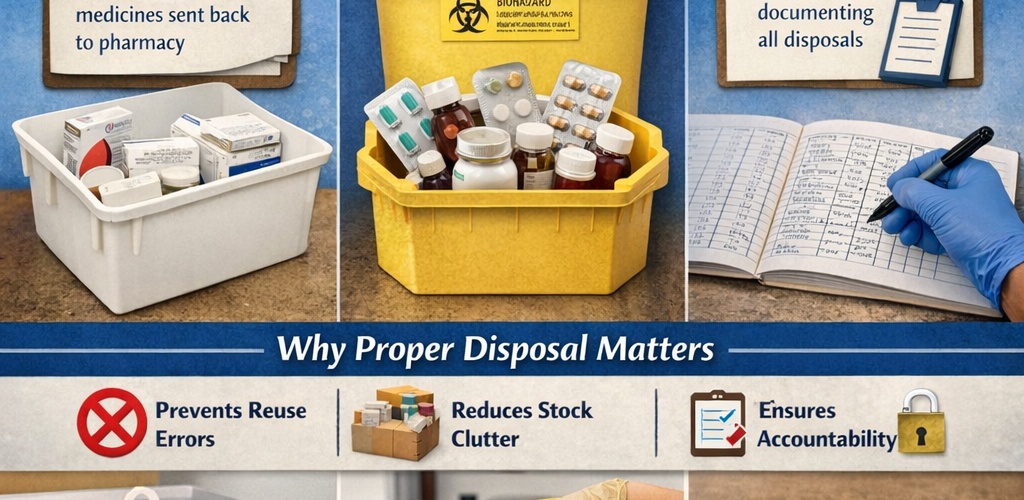
Medicines disposal in a care home is not just an end-of-line housekeeping task. It is part of safe medicines management from start to finish. Once a medicine is no longer suitable for use, is expired, has been discontinued, has been damaged or is no longer needed for a resident, it should be removed from active stock and handled through a clear disposal process.
A strong disposal system helps prevent unsuitable medicines drifting back into use, reduces clutter in storage areas, supports accurate stock control and creates a reliable record of what has left the system. It also helps care homes show that medicines are being managed responsibly, securely and consistently.
This guide explains how care homes can manage medicines disposal safely, with a focus on returns, waste handling and record keeping.
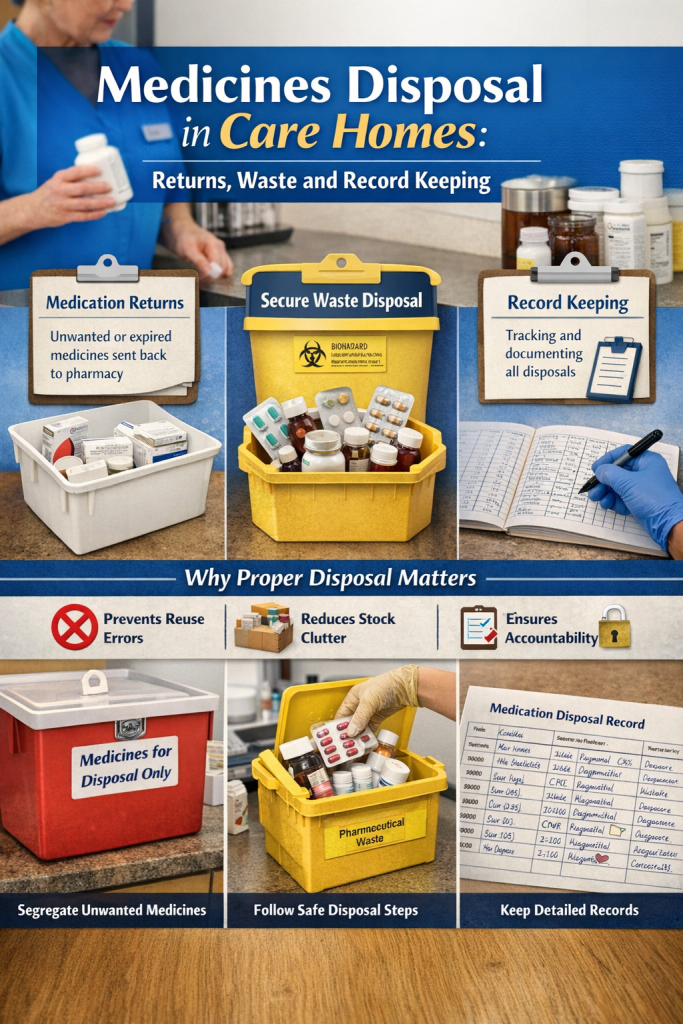
Why medicines disposal matters
A medicine that is no longer suitable for use should not remain in active storage. If it stays in the cupboard, trolley or fridge, staff may assume it is still available for administration or count it as usable stock.
Poor disposal control can lead to problems such as:
- expired medicines remaining mixed with current stock
- discontinued medicines being selected by mistake
- stock balances becoming inaccurate
- cluttered medicines rooms and cupboards
- unclear responsibility for removed items
- difficulty showing what happened to medicines that left use
- weak audit trails
- avoidable confusion between shifts
Disposal is therefore not separate from medicines safety. It is one of the steps that keeps the whole system clear and controlled.
Which medicines may need disposal or return
Medicines may need to be removed from active use for a range of reasons. Common examples include:
- medicines that have expired
- medicines that have passed an in-use limit after opening
- discontinued medicines
- stock no longer required after a resident’s prescription changes
- medicines remaining after a resident dies, moves or is discharged
- damaged or contaminated medicines
- part-used items that are no longer suitable
- unwanted stock from over-ordering
- medicines affected by incorrect storage or temperature excursion
The key point is that once an item is no longer suitable for active use, it should enter the home’s disposal or returns process rather than sitting in routine storage.
Disposal and return are related but not identical
In practice, care homes often use the words “disposal” and “return” closely together, but they are not always exactly the same thing.
- Return usually means the medicine is transferred out of the home through the agreed route, often back to a supplying pharmacy or approved collection arrangement.
- Disposal refers more broadly to the safe removal of medicines from use and the process that leads to their final destruction or authorised handling.
For the care home, the important point is to follow the correct local route. Staff should know what gets segregated, where it is held, who collects it and what record must be made.
Why unsuitable medicines must be removed promptly
Once a medicine has been identified as unsuitable, it should not remain available for administration while staff wait for a convenient time to deal with it. Delay increases the risk of confusion and accidental selection.
Prompt removal helps:
- reduce the chance of administration error
- keep stock balances accurate
- improve storage organisation
- make later collection easier
- support clean handover between shifts
- show that the home recognised the item as unsuitable and acted on it
This applies whether the medicine is expired, discontinued, damaged or simply no longer needed.
Clear segregation is the first step
Segregation is what stops unwanted medicines drifting back into use. A medicine awaiting disposal should be clearly separated from active stock and stored in a secure designated area according to the home’s procedure.
Good segregation helps staff distinguish between:
- current medicines still in use
- medicines awaiting clarification
- expired medicines
- discontinued medicines
- medicines awaiting return or disposal
If these categories are all mixed together, the risk of error rises quickly.
Where medicines awaiting disposal should be kept
The storage area for medicines awaiting return or disposal should be secure and clearly distinct from active medicines storage. It should not be just another shelf in the main cupboard unless the system is designed so clearly that confusion is impossible.
A disposal holding area should support:
- clear separation from active stock
- secure access
- easy identification of items awaiting collection
- orderly record keeping
- reduced chance of accidental reuse
The exact setup will vary between homes, but the principle remains the same: medicines awaiting disposal should not remain mixed with usable stock.
Why medicines should not simply be thrown away
Medicines should not be disposed of casually through ordinary waste routes. They require controlled handling because they may still carry clinical, safety or legal significance.
Improper disposal can create risks such as:
- medicines being retrieved or misused
- incomplete audit trail
- unsafe handling by staff
- inaccurate stock reconciliation
- poor inspection outcomes
- failure to meet policy or contractual requirements
The home’s disposal route should therefore be deliberate, documented and secure.
Expired medicines and disposal
Expired medicines are one of the most common categories entering the disposal system. Once identified, they should be removed from active stock promptly and placed into the designated segregated area pending collection or the next authorised disposal step.
Expired items should not be:
- left in the cupboard “until the next sort-out”
- counted as available stock
- mixed in loosely with other removed items without identification
- returned to the shelf after checking
This links directly to expiry checking and stock control. Disposal completes the process once the item has been identified as unsuitable.
Discontinued medicines and disposal
A medicine can be discontinued while still within date. Even so, it should be removed from active stock once it is no longer current for that resident.
Discontinued medicines create risk because:
- the label may still look valid
- staff may recognise the resident name and assume it is current
- stock balances may be distorted
- older supplies may remain unnoticed behind newer items
Once discontinued, the medicine should be segregated and handled through the home’s returns or disposal system unless there is a specific current reason for retaining it under procedure.
Medicines left after death, discharge or transfer
When a resident dies, moves or is discharged, medicines that were specific to that person often remain in the home unless there is a clear process for identifying and removing them.
These medicines should not simply remain in place because:
- they are no longer active for the current resident list
- they may later confuse staff during stock checks
- they increase clutter in storage
- they can be mistaken for current stock if left in trays or cupboards
A good system ensures that these medicines are identified quickly, separated securely and processed through the returns or disposal route with the right records.
Damaged or contaminated medicines
Some medicines need removal because their physical condition is no longer acceptable. This may include:
- cracked bottles
- leaking liquids
- crushed blister packs
- broken seals
- water-damaged packaging
- unclear or detached labels
- items affected by contamination or storage failure
These medicines should not be kept in active use while staff debate whether they are probably fine. If their integrity is in doubt, they should be segregated and handled according to procedure.
Opened medicines with expired in-use limits
Many care homes focus on printed expiry dates but overlook medicines that have passed their usable life after opening. This commonly affects:
- eye drops
- liquids
- creams and ointments
- refrigerated medicines in use
- products with short use periods after reconstitution or first opening
Once an in-use limit has passed, the medicine should be removed from active stock and handled in the same disciplined way as other unsuitable items.
Controlled drugs and stronger disposal controls
Controlled drugs require tighter arrangements than general medicines because they combine medication risk, security concerns and additional procedural expectations.
For controlled drugs, disposal usually involves:
- secure segregation
- specific record requirements
- authorised witnessing or confirmation according to local procedure
- a more tightly managed destruction or return process
The home’s controlled drugs procedure should set out exactly how this happens. The important point is that controlled drugs should never be blended into the ordinary disposal stream without the correct controls.
Refrigerated medicines and disposal
Medicines in the medication fridge are still part of the disposal system when they expire, are discontinued or are no longer needed. Their separate storage location can sometimes mean they are overlooked.
Staff should ensure that fridge stock awaiting disposal is:
- identified promptly
- removed from the fridge if appropriate under the home’s process
- clearly recorded
- placed into the correct secure disposal holding route
Fridge records and stock balances may also need updating once the item leaves active use.
Disposal records support accountability
Once medicines leave active stock, there should be a record of what was removed and why. This is one of the simplest ways to reduce later confusion.
Useful disposal or return records may include:
- resident name
- medicine name and strength
- quantity removed
- reason for removal
- date removed from active stock
- name or initials of staff handling it
- where it has been placed pending return or collection
- collection or transfer details where relevant
The exact format depends on the home’s process, but there should be enough information to explain what happened to the medicine.
Why record keeping matters
Record keeping does more than satisfy audits. It helps the home answer practical questions later, such as:
- Was this medicine removed from stock already?
- Why was it taken out of use?
- How much was removed?
- Is it awaiting collection, or has it already left the home?
- Does the current stock balance need adjusting?
- Was the resident’s medicine changed, discontinued or completed?
Without records, homes can end up repeating checks, re-ordering unnecessarily or failing to explain discrepancies.
Updating stock balances after disposal
If medicines are removed from active use, stock records may need adjusting so that unusable items are not still counted as available. This is particularly important where the home uses balance tracking for:
- regular medicines
- controlled drugs
- refrigerated stock
- high-risk items
- medicines already running low
A balance that includes unsuitable stock is misleading. Disposal and stock control need to work together.
Returns collection and handover
Where medicines are returned through pharmacy or an approved collection route, the handover should be controlled clearly. Staff should know:
- which items are ready for return
- how they have been recorded
- who is collecting them
- whether anything requires separate handling
- whether follow-up records need completion after collection
Loose or informal handover makes it harder to prove that the medicine has left the home’s control.
Communication between shifts
If medicines have been removed from active stock and placed into the disposal route, the next shift may need to know. This is especially important when:
- a current medicine has been discontinued
- a replacement is needed
- the removed item affects stock balance
- a controlled drug is involved
- fridge stock has been removed
- collection is pending
- a resident transfer, death or prescription change has triggered a larger stock clear-down
Good handover prevents staff searching for items that are no longer in active use or putting segregated stock back by mistake.
Common disposal mistakes in care homes
Several practical mistakes appear repeatedly:
- leaving unsuitable medicines in active cupboards or trolleys
- mixing expired, discontinued and queried items without clear identification
- failing to record what has been removed
- forgetting to adjust stock balances
- storing disposal stock insecurely
- overlooking fridge medicines
- not following the higher-control route for controlled drugs
- poor handover between staff
- allowing the segregated area to become disorganised
- relying on memory instead of a written record
These are system weaknesses more than one-off errors. Clear routines reduce them.
Auditing the disposal process
A care home should review its disposal system as part of wider medicines governance. Useful audit questions include:
- Are unsuitable medicines removed promptly from active stock?
- Is there a clearly defined segregated holding area?
- Are disposal records complete and legible?
- Are stock balances adjusted where required?
- Are fridge medicines included in disposal reviews?
- Are controlled drugs handled through the correct separate route?
- Is collection or handover documented clearly?
- Are staff following the same process?
- Is the disposal area secure and organised?
- Are repeated problems occurring in the same part of the system?
Staff training and procedural clarity
Staff handling medicines should understand:
- what types of medicines need entering into the disposal route
- where segregated stock should be placed
- what records must be completed
- when stock balances need updating
- how returns collection works
- how controlled drugs differ from general medicines
- how to communicate disposal actions during handover
A short practical procedure is usually more useful than relying on general assumptions.
Why physical storage design matters
The layout of the medicines room affects how easy it is to manage returns and waste safely. Disposal control is stronger when staff have:
- a clearly defined active storage area
- a separate secure area for medicines awaiting return
- room to keep items orderly rather than piled together
- good lighting for reading labels and quantities
- access to stock records and disposal logs nearby
- a logical route from cupboard or fridge to segregated storage
Poor layout encourages shortcuts. Good layout supports consistency.
Why disposal supports resident safety
A disciplined disposal system helps protect residents because it reduces the chance that unsuitable medicines remain in circulation. It also supports the wider medicines process by keeping active storage clearer and more accurate.
That means:
- fewer expired or discontinued medicines available for selection
- better stock visibility
- more accurate reordering
- cleaner storage areas
- stronger accountability over what has left use
- greater confidence during administration and audit
In practice, safe disposal is one of the quieter safeguards that keeps medicines management reliable.
Final thoughts
Medicines disposal in care homes should be controlled, secure and well recorded. Once medicines are no longer suitable or needed, they should be removed from active stock promptly, segregated clearly and handled through the agreed return or disposal route.
The essentials are straightforward:
- identify unsuitable medicines promptly
- remove them from active storage
- segregate them securely
- record what has been removed and why
- update stock balances where needed
- follow the correct route for returns and controlled drugs
- communicate clearly between shifts
When those elements are in place, the medicines system becomes clearer, safer and easier to manage.
Discover more from Blog Total Locker Service
Subscribe to get the latest posts sent to your email.