How to Investigate a Medicines Incident in a Care Home
March 30, 2026
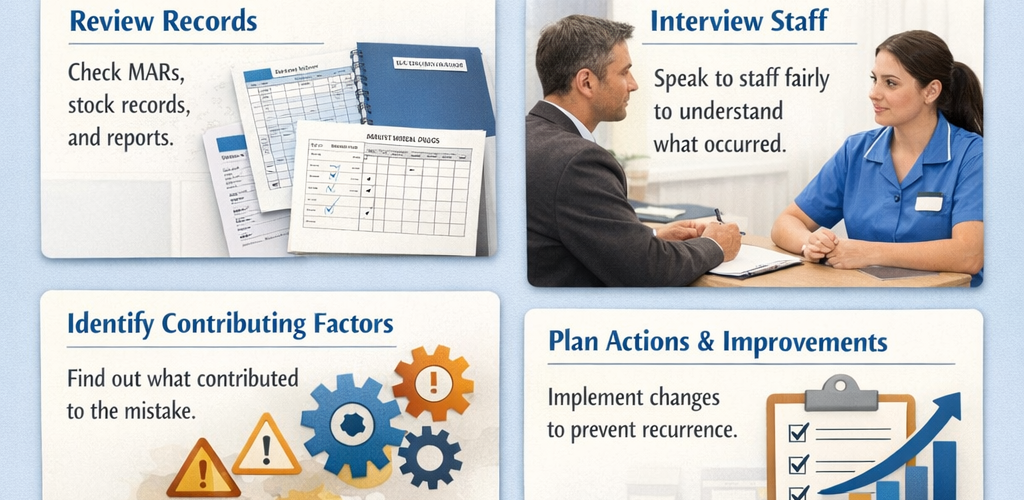
A medicines incident in a care home should never be treated as a simple mistake to file away and forget. Even when no harm has occurred, the incident still tells you something important about the system. It may show a gap in storage, a weakness in record keeping, a problem with communication or a training issue that has not yet been addressed properly. Good investigation turns that evidence into action.
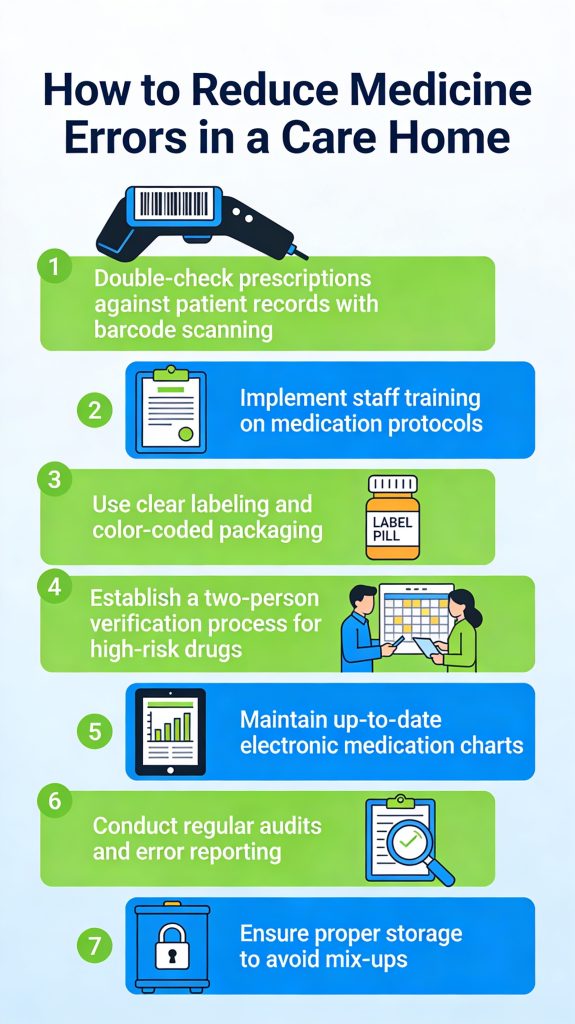
This matters because medicines incidents rarely sit in isolation. A missed signature may be linked to interruptions during the round. A stock discrepancy may point to a wider checking problem. A dose given at the wrong time may reflect unclear communication after a prescription change. If the home only looks at the final mistake, it may miss the conditions that allowed it to happen.
A proper investigation helps managers understand what occurred, protect the resident, support staff fairly and reduce the chance of the same issue happening again. It also shows that the home is treating medicines safety as an active part of governance rather than a reactive task completed only after serious harm.
Why medicines incident investigation matters
When a medicines incident happens, the first instinct is often to ask who made the mistake. That question has some value, but it is far too narrow on its own. Safer services look beyond the individual and examine the full chain around the incident.
A good investigation matters because it helps care homes:
- protect the resident quickly
- understand the level of risk
- identify what caused the incident
- check whether similar risks exist elsewhere
- improve training, systems or supervision
- support open reporting and learning
- show evidence of good governance
Without proper investigation, the same problems tend to repeat. Staff may become more cautious for a few days, but the underlying weakness remains in place.
Start with the resident’s safety
The first priority after any medicines incident is the resident. Before records are reviewed or causes are explored, the home needs to confirm whether urgent action is required.
That may include:
- checking the resident’s condition
- seeking clinical advice promptly
- monitoring for adverse effects
- informing the appropriate senior person
- following emergency procedures where needed
- recording what has happened clearly and factually
The level of response will depend on the incident. A missed signature may call for immediate clarification. A wrong dose may need urgent clinical advice. A fridge failure affecting temperature-sensitive medicines may require a wider stock review. The key point is that resident safety comes first.
Confirm the facts early
Once immediate safety has been addressed, gather the basic facts while they are still fresh. Early fact-finding helps avoid confusion later and makes the investigation more reliable.
Start by confirming:
- what medicine was involved
- which resident was affected
- what happened
- when it happened
- where it happened
- who discovered it
- who was involved
- what action was taken straight away
At this stage, keep the record factual. Avoid assumptions, blame or early conclusions. The aim is to establish the sequence clearly before moving into analysis.
Decide what type of incident occurred
Not every medicines incident is the same. Clear classification helps shape the investigation and makes trend review easier later.
The incident may involve:
- wrong medicine
- wrong dose
- wrong time
- omitted dose
- documentation error
- storage failure
- stock discrepancy
- controlled drugs issue
- fridge temperature issue
- refusal handled incorrectly
- poor disposal practice
- unauthorised access to medicines
Some incidents fit more than one category. For example, a missing controlled drug entry may also be a stock control issue. A clear classification helps the home spot repeated patterns across different reports.
Separate fact-finding from judgement
Investigation quality drops quickly when people rush to judgement. Staff may become defensive. Important details may be missed. The final record may focus too much on the last person in the chain rather than the wider problem.
A better approach is to separate two stages:
Fact-finding
Gather what happened in order, using records, observations and accounts.
Analysis
Examine why it happened, what contributed to it and what needs to change.
Keeping those stages distinct helps managers stay fairer and more accurate.
Review the relevant records
Medicines incidents often leave useful evidence in records. These should be checked carefully and in context.
Depending on the issue, review:
- MAR charts
- stock records
- controlled drugs registers
- fridge temperature logs
- handover notes
- care plans
- delivery records
- disposal logs
- local incident forms
- any recent audit findings linked to the same area
The aim is not simply to confirm that the incident happened. It is to see whether the records reveal a pattern, a mismatch or a wider control failure.
Speak to the staff involved promptly and fairly
Staff accounts matter, but the way they are gathered matters just as much. If a member of staff feels that the investigation is only trying to assign blame, the quality of the information may suffer.
A fair discussion should aim to understand:
- what the staff member believed was happening at the time
- what information they were using
- whether interruptions were involved
- whether anything was unclear
- whether workload or environment played a part
- whether they had concerns but felt unable to escalate
- whether this had happened before
The purpose is understanding, not accusation. That does not mean accountability is ignored. It means accountability is based on evidence rather than assumption.
Look for contributing factors, not just the final mistake
Most medicines incidents have more than one contributing factor. Focusing only on the final error can hide the real lesson.
Contributing factors may include:
- poor storage organisation
- unclear labels or MAR entries
- interruption during the round
- weak induction or refresher training
- poor competency assessment
- communication failure with pharmacy or prescriber
- unclear local policy
- excessive reliance on memory or habit
- staffing pressure
- weak supervision
- earlier near misses that were not acted on
A strong investigation asks not only, “What went wrong?” but also, “What conditions made this easier to happen?”
Check whether the issue is isolated or part of a pattern
One incident can sometimes reveal a bigger problem. For that reason, the investigation should ask whether similar issues have appeared before.
Useful questions include:
- Have there been recent MAR gaps?
- Have other stock discrepancies been found?
- Have fridge temperatures been unstable before?
- Have controlled drugs checks shown weaknesses?
- Have staff needed repeated reminders in the same area?
- Have recent audits highlighted the same problem?
- Have near misses already pointed to this risk?
Pattern-checking matters because repeated low-level concerns are often the clearest sign that the system needs change.
Investigate near misses with the same seriousness
Near misses are often more useful than people think. Because no harm occurred, staff may assume there is less to learn. In reality, a near miss often shows exactly where the system almost failed.
A strong investigation of a near miss should still ask:
- What nearly happened?
- What stopped it?
- Was the control reliable or just fortunate?
- Would a different staff member have noticed it?
- What should change now?
Treating near misses seriously helps the home improve before harm occurs rather than after it.
Review the level of harm and risk
Some medicines incidents cause no harm. Others may cause minor, moderate or serious harm. Even where no immediate harm is visible, the level of future risk may still be high.
The investigation should therefore consider:
- actual harm
- potential harm
- likelihood of recurrence
- number of residents potentially exposed to the same risk
- whether urgent system changes are required
This helps the home prioritise its response properly. A low-harm incident may still reveal a high-risk system weakness.
Decide what action is needed straight away
Some findings will need immediate action before the full investigation is complete. Waiting for the final write-up may leave residents exposed to avoidable risk.
Immediate actions may include:
- replacing or quarantining affected stock
- clarifying a MAR entry
- increasing supervision
- reviewing a staff member’s medicines duties
- repairing storage equipment
- checking other residents’ records
- repeating stock balances
- contacting the pharmacy or prescriber
- updating staff on an urgent learning point
These actions should be recorded clearly so the home can show how risk was controlled in the short term.
Identify longer-term improvements
The best investigations do more than close the incident. They strengthen the system. Once the causes and contributing factors are clearer, the home should decide what longer-term improvements are needed.
That may include:
- refresher training
- revised induction content
- competency reassessment
- improved MAR checking
- stronger stock control routines
- better key or access management
- changes to fridge monitoring
- clearer escalation guidance
- revised handover arrangements
- audit schedule changes
- policy updates
Actions should be specific. A vague note such as “staff reminded” is usually too weak on its own. The stronger question is, “What exactly will change, who is responsible, and when will it be checked?”
Record the investigation clearly
A medicines incident investigation should leave a clear written trail. That record helps with follow-up, governance review and future learning.
A good investigation record should include:
- the incident summary
- immediate actions taken
- key facts established
- records reviewed
- staff input gathered
- contributing factors identified
- risk level considered
- actions agreed
- who is responsible
- target dates for completion
- review date
The final record should be factual, readable and useful. It should help someone understand both what happened and what the home has done about it.
Share learning without creating fear
Investigation is not complete until the learning is shared properly. Staff should understand what changed and why, especially if the issue could affect other residents or other team members.
Good learning might be shared through:
- supervision
- team meetings
- short safety briefings
- refresher sessions
- one-to-one feedback
- updated procedures near medicines areas
The tone matters. If learning is shared in a blaming or humiliating way, staff may become less open next time. If it is shared clearly and constructively, reporting usually improves.
Common mistakes in medicines incident investigation
Some investigation approaches weaken learning instead of improving it. Common mistakes include:
- focusing only on who made the final error
- failing to review the records properly
- ignoring near misses
- assuming low harm means low importance
- using vague actions with no follow-up
- not checking for wider patterns
- failing to review whether actions worked
- treating the investigation as paperwork rather than improvement
Avoiding these mistakes helps the home get real value from the process.
Final thoughts
Investigating a medicines incident in a care home is about more than explaining a mistake. It is about understanding how the system performed under real conditions and what that means for resident safety. The strongest investigations are calm, factual and practical. They protect the resident first, separate evidence from assumption, look for contributing factors and turn findings into action.
When care homes investigate medicines incidents well, they do more than close reports. They improve storage, strengthen records, sharpen training, support staff more fairly and reduce the chance of the same problem happening again.
Discover more from Blog Total Locker Service
Subscribe to get the latest posts sent to your email.