How Care Homes Can Work with Pharmacies and GPs to Improve Medicines Safety
March 31, 2026

Safe medicines management depends on good teamwork. In a care home, staff handle medicines every day, but they do not work alone. Community pharmacies and GPs both play a key part in keeping residents safe, reducing errors and making sure treatment stays appropriate.
When communication is clear, medicines are more likely to be ordered on time, supplied correctly and reviewed properly. In contrast, gaps between the care home, the pharmacy and the GP can lead to missed doses, wasted stock, delays, unclear instructions and avoidable incidents.
This guide explains how care homes can work more effectively with pharmacies and GPs to improve medicines safety. It covers communication, ordering, reviews, record keeping, problem solving and practical steps that support a safer system.
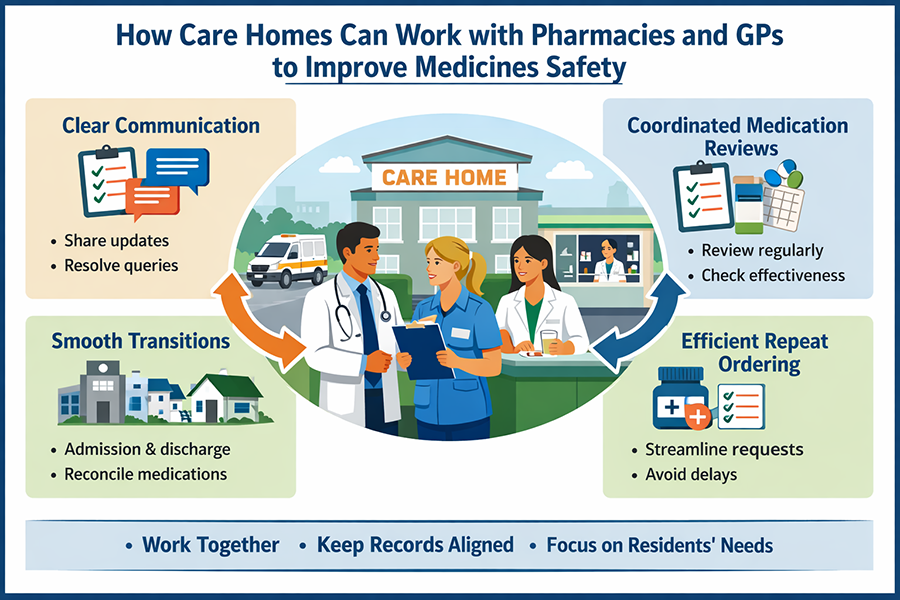
Why Joint Working Matters
Residents in care homes often take several medicines. Some may also have changing needs, long-term conditions, swallowing difficulties or medicines that need close monitoring.
That means medicines safety is rarely about one single task. It is about a whole process that includes:
- prescribing
- ordering
- supplying
- receiving
- storing
- administering
- recording
- reviewing
- stopping or changing treatment when needed
Each part affects the next. If one step breaks down, the risk can spread through the rest of the system.
For example, a GP may change a prescription after a review. When updated directions are not received clearly by the care home, staff may continue to follow the old instructions. A pharmacy dispensing against outdated information may then supply the wrong medicine or quantity. Delays in spotting the issue can also lead to missed doses while the problem is being resolved.
Stronger links between the care home, the pharmacy and the GP help prevent this. They also make it easier to deal with concerns quickly and consistently.
The Role of the Care Home
Care home staff are responsible for the day-to-day handling of medicines in the home. They are often the first to notice issues such as:
- missing items
- unclear labels
- changes in a resident’s condition
- side effects
- swallowing problems
- refusals
- stock discrepancies
- late prescriptions
- repeated administration difficulties
Because of that, care home teams need a reliable way to raise concerns and get timely support from both the pharmacy and the GP practice.
The home should also make sure that staff know who to contact, when to escalate, how to document concerns and what to do while waiting for advice.
The Role of the Pharmacy
The pharmacy supports the safe supply of medicines. This can include dispensing repeat medicines, providing labels and patient information, advising on formulations, identifying supply problems and helping with medicines queries.
Many pharmacies also support homes with monitored dosage systems, audits, returns processes or advice on storage and administration.
A good relationship with the supplying pharmacy helps the home resolve practical problems faster. It can also help reduce waste and improve the accuracy of orders.
The Role of the GP
The GP is responsible for prescribing and clinical review. GP input is especially important when a resident’s needs change, when medicines may no longer be appropriate or when staff notice possible side effects or poor symptom control.
GPs also help with:
- medication reviews
- dose adjustments
- stopping unnecessary medicines
- starting new treatment
- clarifying unclear directions
- changing formulations
- reviewing PRN use
- responding after hospital discharge
Close working between the care home and the GP practice helps make sure that prescribing decisions are communicated properly and acted on safely.
Start With Clear Points of Contact
One of the simplest ways to improve medicines safety is to make communication easier.
Every care home should know:
- which pharmacy supplies each resident’s medicines
- the main contact at that pharmacy
- the best route for urgent queries
- the GP practice for each resident
- who to contact at the practice for prescription and medicines issues
- when urgent clinical concerns must be escalated immediately
This should not be left to memory. Contact details and escalation routes should be easy for staff to find. New starters should also be shown how the system works.
When staff are unsure who to contact, delays become more likely. A clear structure reduces hesitation and helps problems get to the right person quickly.
Use Consistent Communication Methods
Safe systems rely on consistent communication, not informal messages passed from one person to another.
Care homes should use agreed methods for:
- repeat ordering
- urgent prescription requests
- reporting missing medicines
- requesting clarification
- reporting side effects or concerns
- confirming medication changes
- following up unresolved issues
Where possible, written communication should support verbal discussions. Phone calls are useful for urgent matters, but important details should still be recorded clearly afterwards.
A written record helps staff check what was requested, when it was sent and what response was received. It also makes handovers safer and supports accountability.
Share Complete and Accurate Information
Pharmacies and GPs can only act on the information they receive. If that information is incomplete, the risk of delay or error rises.
When contacting a pharmacy or GP, staff should provide enough detail to avoid confusion. This usually includes:
- resident’s full name
- date of birth
- medicine name, strength and form
- current dose and timing
- nature of the concern
- when the issue was identified
- what action has already been taken
- whether the issue is urgent
For example, saying “Mrs Smith needs her tablets” is far less helpful than stating that “Mrs Jane Smith, date of birth 12 May 1938, has only one dose left of amlodipine 5 mg tablets and the repeat was not included in the last delivery”.
Clear information saves time and reduces back-and-forth queries.
Improve Repeat Ordering Processes
Repeat medicines are a common area for error. Problems can include ordering too early, ordering too late, requesting items no longer needed or missing items off the request entirely.
A stronger process should include:
- set ordering dates
- named responsibility for checking repeat lists
- a stock check before ordering
- a review of recent changes before submitting requests
- a final check when medicines arrive
Pharmacies can often help homes improve this part of the system by identifying patterns such as repeated urgent requests, frequent over-ordering or regular omissions.
GP practices can also help when prescription requests are delayed because of review dates or missing authorisation.
A joined-up approach makes repeat management more predictable and reduces pressure on staff.
Involve the Pharmacy and GP in Medication Reviews
Medication reviews are a major safety tool. They help identify medicines that are no longer needed, doses that need changing and combinations that may be causing harm or confusion.
Care home staff should prepare for reviews by noting:
- changes in appetite, sleep, mood or mobility
- swallowing difficulties
- side effects
- frequent refusals
- PRN medicines used often
- medicines that seem ineffective
- administration difficulties
- concerns raised by residents or relatives
This practical information is valuable. It helps the GP and pharmacist review medicines based on how the resident is actually managing, not just what is written on the prescription.
Reviews are especially useful after:
- hospital discharge
- falls
- repeated infections
- weight loss
- changes in cognition
- increasing frailty
- frequent use of PRN medicines
A review should lead to clear follow-up. Any changes must be communicated promptly, recorded accurately and reflected in the medicines administration record.
Act Quickly After Hospital Discharge
Transitions of care are a common risk point. When a resident returns from hospital, medicines may have been started, stopped or changed.
If discharge information is delayed, incomplete or unclear, staff may be left trying to reconcile different instructions from existing records, the discharge letter and the medicines supplied.
This is where pharmacy and GP support is essential.
After discharge, the care home should:
- check the discharge information as soon as it arrives
- compare it with current medicines records
- identify any differences
- seek clarification without delay
- confirm which medicines should now be given
- make sure new supplies are arranged if needed
- update MAR records and internal documentation
Good links with the pharmacy and GP practice help the home resolve discrepancies before they reach the administration stage.
Raise Concerns About Side Effects and Formulation Problems
Medicines safety is not only about getting the right item in the box. It is also about making sure the resident can take it safely and that the treatment remains suitable.
Staff should feel confident raising concerns such as:
- drowsiness
- constipation
- dizziness
- poor pain control
- swallowing difficulty
- refusal linked to taste or size
- patch problems
- issues with liquids or thickened fluids
- concerns about covert administration processes
Pharmacies may be able to suggest alternative formulations. GPs can review whether the medicine, dose or timing still makes sense.
Prompt reporting prevents minor problems from becoming bigger ones.
Learn From Incidents and Near Misses Together
When a medicines error or near miss happens, the response should not stop at the care home door.
Some incidents may reveal wider problems, such as:
- unclear prescribing directions
- labelling issues
- repeated supply omissions
- confusing communication
- poor discharge information
- ordering system weaknesses
Where relevant, the pharmacy and GP should be involved in reviewing what happened and how recurrence can be prevented.
That does not mean shifting blame. It means improving the system.
A constructive review should ask:
- what happened
- what factors contributed
- what communication took place
- whether instructions were clear
- whether the process could be simplified
- what changes are needed now
Shared learning builds stronger routines over time.
Hold Regular Medicines Discussions
Formal and informal medicines discussions can improve safety. These do not need to be complex. Even a short structured review meeting can help identify recurring issues.
Topics might include:
- repeated missing items
- frequent urgent prescriptions
- stock control problems
- common administration difficulties
- recent incidents
- PRN monitoring
- cold chain concerns
- upcoming medication reviews
- changes in resident needs
A regular discussion between the care home and the pharmacy can improve supply and operational issues. Periodic input from the GP practice can then support clinical decisions and prescribing quality.
Keep Documentation Aligned
Good communication is only useful if records stay aligned afterwards.
Once advice is received or a change is made, the care home must update the relevant documents promptly. Depending on the issue, that may include:
- MAR charts
- internal communication records
- stock records
- handover notes
- care plans
- PRN protocols
- temperature or storage records
- incident logs
If records are not updated, staff may continue following outdated information even after the right decision has been made.
Support Staff Confidence and Escalation
A safe medicines culture depends on staff feeling able to speak up.
That means team members should know:
- what issues need escalation
- when to contact the pharmacy
- when to contact the GP
- when to seek urgent medical help
- how to record advice received
- how to challenge unclear or conflicting instructions
Training should cover not only administration tasks, but also communication and escalation. Staff need to understand that raising concerns early protects residents.
Use Storage and Organisation to Support Safer Working
Joint working is easier when the home has clear internal systems. Medicines should be stored securely, neatly and in a way that supports checking, stock control and safe access.
Well-organised medicines rooms and cabinets help staff:
- identify stock clearly
- separate discontinued items
- manage returns safely
- reduce picking errors
- keep records up to date
- spot shortages earlier
For many homes, secure and well-planned medical storage supports the wider medicines system by making day-to-day practice more controlled and consistent.
Practical Steps Care Homes Can Take Now
Care homes can strengthen pharmacy and GP working relationships by taking a few practical steps:
- review current contact and escalation routes
- standardise ordering and query forms
- keep a clear written record of requests and responses
- prepare properly for medication reviews
- follow a set discharge medicines checklist
- share incident learning where relevant
- schedule regular medicines discussions
- train staff to escalate concerns early
- keep records aligned after every change
Small improvements in communication often lead to large improvements in safety.
Final Thoughts
Medicines safety in a care home is a shared responsibility. The care home, the pharmacy and the GP each bring a different part of the system together.
When those links are strong, residents benefit from more accurate prescribing, smoother supply, clearer records and faster action when something goes wrong. Good joint working also reduces stress for staff and helps the whole process feel more controlled.
The safest homes do not wait for a serious incident before improving communication. They build reliable relationships, clear routines and consistent follow-up into everyday practice.
That is what turns medicines safety from a reactive task into a stronger and more dependable system.
Discover more from Blog Total Locker Service
Subscribe to get the latest posts sent to your email.