Self-Administration of Medicines in Care Homes: Storage, Risk Assessments and Resident Choice
March 25, 2026
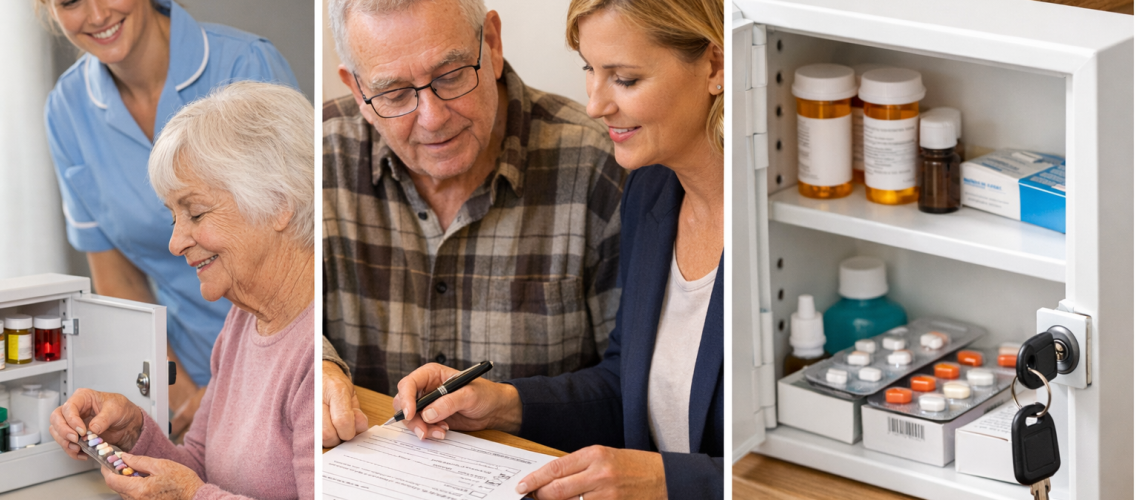
Self-administration of medicines in a care home should not be treated as an exception or an inconvenience. For many residents, it is an important part of independence, dignity and continuity. A person may have managed their own medicines safely for years before moving into a care setting. Entering a care home does not automatically mean that ability or choice disappears.
That principle matters in practical terms as well as ethical ones. A blanket rule that all medicines must be taken over by staff can reduce resident control and create unnecessary dependence. The better approach is person-centred. The home should ask what the resident wants, assess what they can do safely, decide what support may still be needed and make sure the storage arrangement is secure without being obstructive.
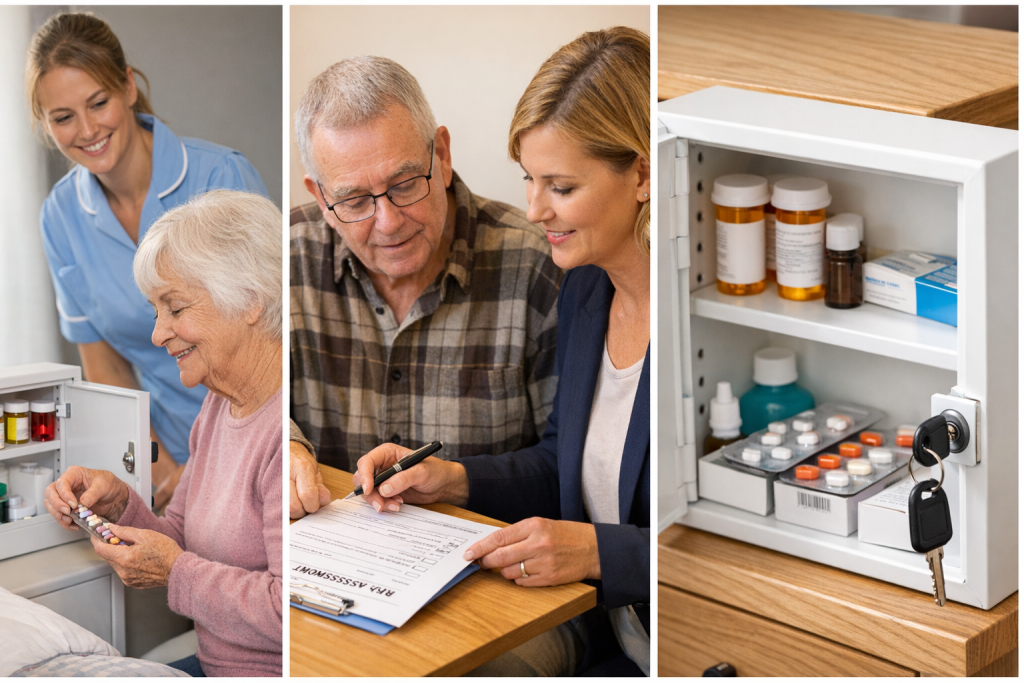
This guide explains how self-administration can work safely in a care home, how risk assessments should be structured, what storage arrangements make sense and how care providers can balance resident choice with medicines governance.
If you are reviewing your wider medicines storage system, see our comprehensive guide to medical cabinets and our medical cabinet security solutions.
Why self-administration matters in a care home
For some residents, self-administration is about maintaining a skill they do not want to lose. For others, it is about confidence, privacy or routine. A resident may be perfectly able to take tablets independently, but may need support with eye drops, creams, inhalers or time-specific medicines. Good care does not force an all-or-nothing model. It recognises that independence can vary by person and by medicine.
This is especially important in respite, intermediate and step-down care, where maintaining existing skills may support a person’s eventual return home. It also matters in long-term residential settings, where personal autonomy should not be narrowed without a clear and evidence-based reason.
Start from choice, not restriction
One of the most important shifts in current guidance is the starting position. The old habit in many settings was to assume that staff would take over medicines management unless a resident actively proved otherwise. The safer and more person-centred starting point is to assume that people can continue to take and look after their own medicines unless a risk assessment indicates that they cannot do so safely.
That does not mean providers ignore risk. It means they do not remove independence by default. The question is not, “Why should we allow this?” The question is, “What does this resident want, what can they safely manage, and what support or controls are needed to make that work?”
The individual risk assessment is the foundation
Self-administration should always be supported by an individual risk assessment. The assessment should be coordinated by the care home manager or delegated lead and should involve the resident, relevant staff and, where appropriate, family members, carers, the GP and the pharmacist.
A sound risk assessment should consider:
- the resident’s own choice
- whether self-administration creates a risk to the resident or to others
- whether the resident can take the correct dose at the right time and in the right way
- mental capacity where relevant
- manual dexterity and practical ability
- whether the person can manage some medicines but not others
- how medicines will be stored
- what responsibilities staff still retain
- how often the assessment should be reviewed
- what changes would trigger reassessment.
This point about variation by medicine is important. A resident may manage tablets independently but not insulin devices, eye drops or topical medicines. Another may manage routine medicines but need prompts for lunchtime doses. The risk assessment should capture those distinctions clearly.
Capacity, dexterity and practical ability
The most obvious part of the assessment is whether the resident understands what they are taking and can physically use it properly. That includes opening packets, reading labels, identifying the right medicine, measuring liquids and using devices correctly. Manual dexterity, grip strength, vision, hearing and memory can all affect whether self-administration is realistic.
The aim is not to fail the resident on a technicality. It is to understand the real-world task. Can they reach the storage place? Can they use the inhaler device? Can they draw up or measure the medicine safely? Can they tell when something has changed? These are the kinds of details that make a self-administration plan robust rather than theoretical.
Self-administration does not always mean no support
A common mistake is to treat self-administration as a pure independence model in which staff must do nothing at all. That is not the case. Support can still be part of the arrangement. Reminder charts, prompts, help opening containers, large-print labels, colour coding, help measuring liquids and devices that make inhalers easier to use can all support safe self-administration.
In care home practice, support may include:
- prompting the resident at the right time
- providing water
- helping with awkward packaging
- reading or explaining labels
- keeping a reminder chart
- checking that medicines have been taken where this is part of the agreed plan
- supporting only the medicines the resident cannot safely manage alone.
That flexibility is often what makes self-administration workable. It allows the home to support resident choice without pretending that every resident must manage every part of the process completely unaided.
Storage is central to safe self-administration
Storage is not a side issue. It is one of the core controls that determines whether self-administration is safe in practice. Providers should assess each person’s storage needs and provide storage that meets the person’s needs, choices and risk assessment. For self-administered medicines, this may be a lockable cupboard or drawer in the resident’s room. The resident must be able to access medicines when needed, while other people must not be able to access them.
This makes storage a balancing act. If medicines are locked away in a way the resident cannot access, self-administration becomes meaningless. If they are left openly accessible to visitors, confused co-residents or children, the arrangement becomes unsafe. The storage setup should therefore be tailored, not generic.
A good storage assessment will look at:
- the medicine type
- whether any item needs refrigeration
- who should have access
- how access will be restricted
- the room environment
- whether the resident shares space with anyone else
- whether the resident can reliably use the lock or access method
- whether there are safeguarding concerns
- whether exceptions are needed for medicines that must remain quickly accessible.
Lockable drawers, cupboards and room-based storage
For many care homes, the most practical option is a lockable drawer or small cupboard in the resident’s room. This can work well where the resident needs regular access and has the ability to use the storage safely. It also preserves privacy and can reduce delays around routine medicines.
The design of that storage matters more than it may first appear. The unit should be robust, easy to locate, easy for the authorised user to operate and large enough to prevent clutter. If medicines need to be separated by time of day, dosage form or risk level, the internal layout should support that. If the resident struggles with fine motor movement, the locking system must not make access impossible.
This is one reason medical cabinets and secure bedside storage need to be chosen carefully in care environments. The right unit can support both autonomy and control. The wrong one can frustrate the resident or encourage unsafe workarounds.
Some medicines may need special handling
Not every medicine fits the same storage model. Following risk assessment, some medicines may be exempted from secure storage where ease of access is important. Examples may include reliever inhalers, glyceryl trinitrate spray and insulin.
That does not mean these items become casual possessions. It means the risk assessment and local policy may justify faster access because of clinical need. In a care home setting, that decision should be explicit and documented. Staff should know which medicines are stored differently, why that exception exists and what monitoring still applies.
The care plan must match the arrangement
A self-administration decision should never live only in someone’s memory or on a single assessment sheet. It needs to flow into the resident’s medicines support care plan. These plans should be person-centred, co-produced, regularly reviewed and clear about the support the person needs, from reminders through to practical help.
For self-administration, the care plan should record:
- which medicines the resident self-administers
- which medicines staff still administer or supervise
- what storage method is used
- who holds the key or controls access
- what prompts or support are agreed
- what staff should monitor
- what signs would trigger reassessment
- when further clinical advice should be sought.
Plans should also be easy for staff to read and act on. If the plan is vague, the arrangement will drift. One staff member may prompt, another may administer, another may leave the resident unaided. That inconsistency creates avoidable risk.
Monitoring and review should be built in
Self-administration is not a one-off decision that lasts forever. The risk assessment should be reviewed periodically and whenever circumstances change. Unplanned review should happen promptly if concerns arise about physical health, mental health, compliance or access to medicines.
This matters because residents’ needs can change quickly. A person may be well one month and confused the next because of infection, delirium or a medicine change. Someone who managed blister packs easily may struggle after a stroke or deterioration in arthritis. A resident may begin missing doses, stockpiling medicines or allowing someone else access to them. All of those changes should trigger review.
A sensible review process helps providers intervene early rather than only after an incident.
Records still matter, even when the resident is independent
Self-administration does not remove the need for records. The home still needs an audit trail showing what the agreed arrangement is and how the provider is maintaining oversight.
In practice, record-keeping may include:
- the initial risk assessment
- the current care plan
- the storage arrangement
- review dates
- any incidents or concerns
- actions taken after reassessment
- records of discontinued or returned medicines
- documentation of any staff prompts or support where relevant.
The exact format may vary by provider, but the principle does not. A home should be able to show who is doing what, under what conditions and with what safeguards.
Common mistakes care homes should avoid
The most frequent failures in self-administration are not usually dramatic. They are small gaps in process that build into risk.
- assuming a resident either can or cannot manage all medicines without testing medicine-specific ability
- failing to update the care plan
- storing medicines in a room without proper access controls
- forgetting to review the arrangement after illness
- allowing informal practices to replace the written plan
- treating self-administration as purely resident-led while staff quietly continue to correct problems without recording them.
If staff are regularly stepping in, the arrangement may still be appropriate, but the care plan and risk assessment need to reflect that reality.
Staff training makes the difference
Even a strong policy will fail if staff do not understand it. Staff should know that self-administration is a supported and assessable option, not something to discourage automatically. They should know how to identify concerns, what the agreed support looks like, how to escalate changes and how to distinguish prompting from administering.
Managers should also ensure there is ownership. Someone needs to coordinate assessments, review incidents and make sure reassessments happen when circumstances change. Where that leadership is missing, self-administration arrangements tend to become inconsistent.
Storage equipment should support resident choice, not undermine it
From a practical care-home point of view, the physical storage solution often decides whether self-administration succeeds. If the drawer is flimsy, if the lock is unreliable, if the resident cannot use it, or if there is no clear separation between active medicines and other items, the arrangement becomes harder to defend. On the other hand, a well-chosen lockable storage unit in the resident’s room can make the plan clear, safe and workable.
This is where fit-for-purpose medical cabinets, lockable bedside cupboards and room-based medicines storage can add real value. The storage should suit the resident, the medicine profile and the level of support in the care plan.
Final thoughts
Self-administration of medicines in a care home is not about stepping back and hoping for the best. It is about supporting resident choice through a structured process. That means starting from the assumption that independence should be maintained where possible, then using individual risk assessment, suitable storage, clear records, practical support and regular review to keep the arrangement safe.
The strongest homes do not force every resident into the same model. They recognise that one person may need a prompt, another may need help with only one medicine, and another may safely manage their own treatment from a lockable drawer in their room. When the policy, care plan and storage setup all align, self-administration can support both resident dignity and good medicines governance.
To support a full review, see our medical cabinet security range and our comprehensive guide to medical cabinets.
Discover more from Blog Total Locker Service
Subscribe to get the latest posts sent to your email.