PRN Medicines in Care Homes: Protocols, Recording and Safe Storage
March 26, 2026

PRN medicines are medicines given when required rather than at fixed times. In care homes, they are commonly used for pain relief, constipation, nausea, anxiety, skin conditions and other symptoms that do not always need regular treatment. While PRN medicines can improve comfort and quality of life, they also need careful control. If instructions are vague, records are incomplete or storage is poorly organised, the risk of error rises quickly.
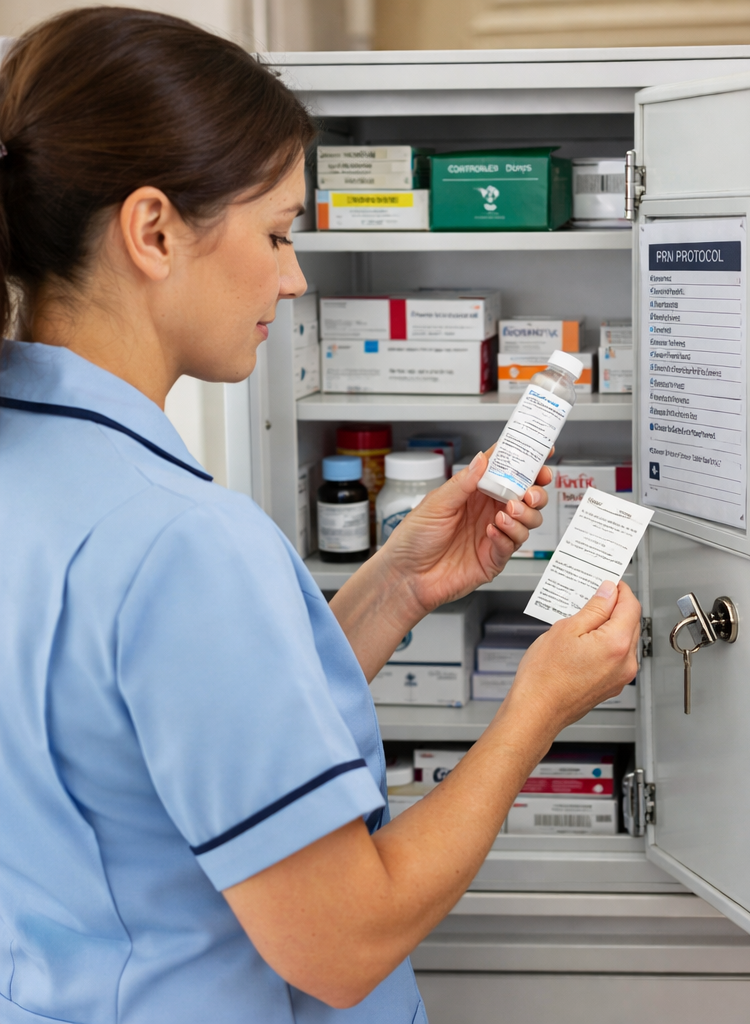
A strong PRN process helps staff decide when a medicine should be given, when it should not be given, and how to record the outcome properly. It also makes audits easier and supports safer communication between carers, nurses, pharmacies, GPs and inspectors.
For care homes, this is not only about medicines administration. It is also about secure storage, clear protocols, accurate MAR records and a consistent approach that protects both residents and staff.
What PRN medicines are
PRN stands for pro re nata, a term used to mean as required. These medicines are not administered automatically at set times. Instead, they are given when a resident has a particular symptom or clinical need.
Common examples include:
- pain relief such as paracetamol or prescribed analgesics
- laxatives for occasional constipation
- anti-sickness medicines
- creams or ointments used when symptoms flare up
- inhalers used when needed
- medicines for agitation or anxiety where specifically prescribed
- antacids for indigestion
- eye drops or other short-term symptomatic treatment
Because PRN medicines are not part of a fixed routine, they need clearer supporting guidance than many regular medicines. Staff should not be left to guess what counts as the right reason, the right gap between doses or the right point to escalate to a clinician.
Why PRN medicines carry extra risk
Regular medicines usually appear on the MAR with defined times and doses. PRN medicines are different. A staff member must recognise a need, check the instructions, confirm the medicine is appropriate, make sure the maximum dose is not exceeded, administer safely and then record the outcome. That means there are more judgement points in the process.
Risk increases when:
- the reason for use is not clearly written
- there is no minimum interval between doses
- the maximum daily dose is missing
- different staff interpret symptoms differently
- previous doses are not easy to see on the MAR
- stock is mixed with regular medicines in a confusing way
- a resident cannot explain symptoms clearly
- records do not show whether the medicine worked
These risks can be reduced significantly by having clear PRN protocols and organised storage.
When a PRN protocol is needed
A PRN protocol provides practical guidance for staff on how a medicine should be used for a specific resident. In many cases, it is one of the safest ways to support consistent administration, especially where several staff members may be involved over different shifts.
A good PRN protocol is particularly useful when:
- the resident cannot reliably describe their symptoms
- the medicine is for pain, distress, agitation or behaviour-related symptoms
- the medicine may cause sedation or other significant effects
- there is a risk of overuse
- staff need to use observation as well as verbal feedback
- there is a history of frequent PRN use
- different carers may interpret need in different ways
The protocol should be resident-specific where possible. A generic note such as take when needed is rarely enough on its own in a care home setting.
What a clear PRN protocol should include
A PRN protocol should give staff enough information to act safely without relying on memory or assumption. It should be easy to find, easy to read and kept up to date when prescriptions change.
Useful information includes:
- resident name and date of birth
- medicine name, strength and form
- the reason for giving the medicine
- signs or symptoms that indicate use
- the dose to administer
- the route of administration
- the minimum time gap between doses
- the maximum amount in 24 hours
- when the medicine should not be given
- possible side effects to watch for
- when staff should seek medical advice
- how and where to record administration and outcome
For some residents, the protocol may also need to include non-verbal indicators. For example, pain may be shown through facial expression, reduced appetite, guarding, calling out, withdrawal or disturbed sleep rather than a direct complaint.
The importance of accurate MAR recording
PRN medicines should always be recorded clearly on the MAR chart and in any supporting notes required by the home’s procedure. Good records allow the next staff member to see what was given, when it was given, why it was given and whether it had the desired effect.
Every PRN entry should make it easy to answer these questions:
- what medicine was given
- what dose was given
- what time it was administered
- why it was needed
- who gave it
- whether it worked
- whether any follow-up was needed
This matters for both safety and governance. If one staff member gives a PRN medicine at 10:00 and the record is incomplete, the next shift may not realise it has already been used. That can create a risk of repeated dosing too soon.
Recording effectiveness is just as important as recording administration. If a resident regularly receives a PRN medicine with little benefit, the care home may need to request a medication review rather than simply continuing the same pattern.
How to assess whether a PRN medicine is needed
Before giving a PRN medicine, staff should pause and assess the situation properly. The decision should be based on the resident’s current symptoms, the care plan, the protocol, the prescription instructions and the recent administration record.
That assessment may include:
- asking the resident about symptoms where possible
- observing behaviour, discomfort or physical signs
- checking when the medicine was last given
- confirming the minimum interval has passed
- checking the total amount already given in the past 24 hours
- considering whether a non-medicine approach may help first
- checking whether the symptom may need medical review instead
For example, if a resident is restless, staff should not assume pain relief or a sedative PRN is automatically appropriate. Restlessness may be linked to toileting, discomfort, temperature, hunger, confusion, noise, positioning or another unmet need. Good care means looking at the whole picture.
PRN medicines and non-medicinal alternatives
In some situations, a non-medicinal response may be worth trying before a PRN medicine is used, as long as that fits the care plan and does not delay necessary treatment. This is especially relevant for mild symptoms or where there are known triggers.
Examples may include:
- offering reassurance and a calm environment
- helping the resident change position
- offering fluids
- checking whether the resident needs the toilet
- adjusting lighting or room temperature
- using prescribed topical treatment before oral pain relief where appropriate
- supporting rest or quiet time
This does not replace medicine when medicine is needed. It simply supports good judgement and person-centred care.
Safe storage of PRN medicines in care homes
Safe storage is a key part of PRN medicines management. These medicines should be secure, easy to identify and stored in a way that reduces the chance of selection errors. A cluttered or poorly arranged medicines cabinet can make PRN use less safe, particularly during busy medication rounds.
Care homes should consider the following storage principles:
- keep medicines in locked cupboards, cabinets or trolleys with controlled access
- store each resident’s medicines separately where the system requires it
- make sure labels remain readable and attached
- avoid mixing discontinued stock with current medicines
- separate internal, external and refrigerated medicines as appropriate
- store controlled drugs in the correct controlled drug cabinet
- keep PRN protocols accessible to authorised staff
- check expiry dates regularly, especially on short-life products
Storage design matters. Internal shelves, clear compartments and logical organisation can make it much easier for staff to locate the correct medicine quickly while still maintaining control. This is one reason many care settings invest in dedicated medical cabinets rather than general-purpose cupboards.
Common storage mistakes to avoid
Even where medicines are technically locked away, poor organisation can still create risk. Common mistakes include:
- keeping old and current stock together
- placing similar medicine packs side by side without clear separation
- storing external creams with oral medicines
- failing to quarantine discontinued or returned medicines
- leaving handwritten instructions loose inside cupboards
- allowing cupboards to become overfilled and hard to navigate
- keeping PRN stock in different places without a clear system
These problems make administration slower and less reliable. They also make audits more difficult. Good cabinet organisation supports safer daily practice.
How frequent PRN use can highlight wider issues
PRN medicines should be reviewed when they are being used often. Regular repeated use may indicate that the resident’s needs have changed or that the existing care plan no longer reflects what is happening day to day.
Frequent PRN use may suggest:
- pain is not adequately controlled by regular treatment
- constipation management needs review
- a behaviour support plan needs updating
- the resident has a recurring trigger that is not being addressed
- an acute illness is developing
- the prescribed medicine is ineffective or unsuitable
Patterns should be spotted through MAR review, handover discussion and medication audits. A good recording system makes these patterns easier to identify early.
PRN medicines for residents who self-administer
Some residents may self-administer all or part of their medicines, including PRN items. In those cases, the home still needs a clear assessment and storage arrangement. The resident should have an agreed level of independence, suitable secure storage where required, and a documented process for monitoring safety.
This may involve:
- a self-administration risk assessment
- agreement on where PRN medicines will be stored
- regular stock checks where appropriate
- clear information on maximum dosing
- review of whether the arrangement remains safe
Supporting independence is important, but the arrangement needs to be safe, practical and clearly documented.
Training and consistency for staff
PRN medicines require a consistent approach across the whole team. Training should cover not just the mechanics of administration, but also observation, judgement, escalation and recording. New staff, agency staff and night staff should all be able to follow the same process.
Training points may include:
- understanding PRN instructions on the MAR
- using resident-specific protocols
- recognising when symptoms need escalation
- checking time gaps and daily limits
- recording both administration and outcome
- safe storage and stock handling
- what to do when instructions are unclear
Consistency protects residents and gives staff confidence. It also reduces variation between shifts.
Auditing PRN medicines in the care home
Regular audit helps care homes test whether PRN systems are working properly. This should include more than a simple stock count. A useful audit looks at the full process from protocol to administration to storage.
Questions to ask during audit include:
- does each PRN medicine have clear directions for use
- are resident-specific protocols available where needed
- are staff recording the reason for administration
- is effectiveness being documented
- are repeated doses properly spaced
- are expired or discontinued items removed promptly
- is storage orderly and secure
- are trends in frequent PRN use being identified
Audit findings can then be used to improve care plans, training, storage layout and liaison with prescribers.
Practical examples of PRN risk
Example 1: A resident receives PRN pain relief from two different staff members within a short period because the first dose was not clearly recorded. A complete MAR entry and handover note would have prevented the duplicate dose.
Example 2: A cream prescribed for flare-ups is stored with discontinued medicines and missed when symptoms appear. Better stock organisation and separation of active from old items would reduce delay.
Example 3: A resident regularly needs a PRN laxative several times each week, but the pattern is not reviewed. A proper audit may show that the bowel management plan needs updating.
Linking PRN safety to better medicines storage
PRN medicines management is stronger when the storage system supports the workflow. Secure medical cabinets, tidy internal organisation, clearly separated stock and easy access to records all make it simpler for staff to work safely. In care homes, that practical side matters just as much as written policy.
Where medicines are stored in a clear and organised way, staff can:
- find the correct medicine faster
- reduce selection errors
- see stock levels more easily
- separate active and discontinued items properly
- support safer audits and handovers
- maintain a cleaner and more controlled medicines area
That is why cabinet choice, layout and internal configuration should be part of the wider medicines management conversation.
Final thoughts
PRN medicines can play an important role in resident comfort and responsive care, but only when they are managed properly. Clear protocols, accurate MAR recording, safe assessment, organised storage and regular review all help reduce risk.
For care homes, the goal is simple. Staff should be able to see when a PRN medicine is appropriate, administer it safely, record it clearly and review its use over time. When those steps are supported by secure and well-planned medical storage, the whole system becomes easier to manage and safer for residents.
If you are reviewing how medicines are stored in your care home, choosing the right medical cabinet and setting up a more organised medicines area can support better day-to-day control, cleaner audits and safer administration procedures.
“`
Discover more from Blog Total Locker Service
Subscribe to get the latest posts sent to your email.