Assigned vs Shared Staff Lockers: Which Works Best for Hybrid Workplaces?
April 2, 2026
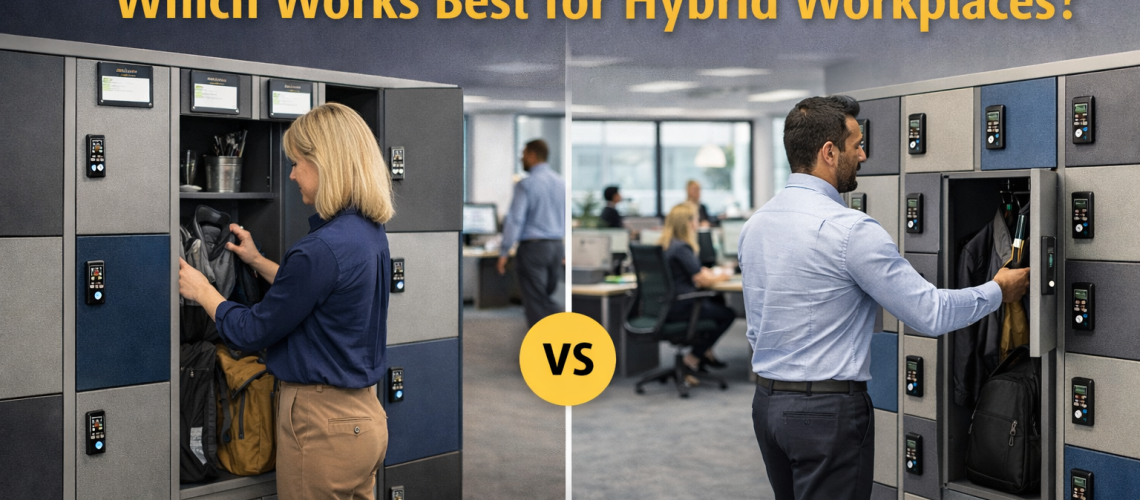
Hybrid working has changed how many offices think about personal storage. When staff are not all on site every day, the old assumption of one locker per person no longer fits every workplace. At the same time, shared desks and flexible attendance often make secure storage more important rather than less important.
That leaves many businesses with a practical question. Should lockers be assigned to specific employees, or should they be shared and used on a day-use basis? Both approaches can work well, but they suit different patterns of office use. The best answer depends on how people attend, what they need to store and how the workplace is managed from day to day.
This guide explains the strengths and limits of assigned vs shared staff lockers and helps hybrid workplaces decide which model is the better fit. For the main workplace lockers guide, visit the hub page. If your office project is still at the wider planning stage, see how to choose workplace lockers for a new office fit-out. For technology-led storage, visit smart lockers for hybrid workplaces. When you are ready to compare products, see our workplace lockers page for staff lockers and commercial staff storage.
Why this choice matters in hybrid offices
In a traditional office, assigned lockers often felt like the obvious answer. Staff came in every day, sat in the same area and stored similar belongings from one week to the next. Hybrid workplaces are different. Attendance changes through the week, teams rotate in and out, and the same person may not need storage every day.
That shift affects both space planning and user experience. Too many permanently assigned lockers can waste valuable floor area. Too few shared lockers can leave staff without a practical place to store coats, bags and laptops on busy office days. The right model helps the office feel organised. The wrong one can create frustration very quickly.
This is why the choice between assigned and shared storage should be treated as a planning decision, not just an admin detail.
What are assigned staff lockers?
Assigned lockers are allocated to one person on an ongoing basis. The same employee uses the same locker each time they attend the workplace. This model is simple to understand and often feels familiar because it mirrors the traditional one-desk-per-person approach.
Assigned storage works best where staff attend regularly, want a dependable place for personal belongings and may leave certain items on site between visits. It can also suit teams that carry more equipment or have a stronger preference for personal ownership of their storage space.
What are shared staff lockers?
Shared lockers are used by different people at different times rather than being tied to one named user. In many hybrid offices, these are managed as day-use lockers. A member of staff arrives, uses a locker for the day and then clears it at the end of their visit so it is ready for someone else.
This model is often more space-efficient because the total number of lockers can be based on peak attendance rather than on total headcount. It fits especially well where not everyone is in the office on the same days and where staff mainly need short-term personal storage rather than a permanent base.
Benefits of assigned staff lockers
The biggest benefit of assigned storage is consistency. Staff know exactly where their belongings go each time they arrive. That can make the office feel easier to use, especially for employees who attend often or prefer a more settled routine.
Assigned lockers can also reduce uncertainty on busy days. Nobody has to wonder whether a locker will be available. For some teams, that reassurance matters more than the space-saving benefit of shared use.
Another advantage is that staff may be able to leave lower-risk personal items on site between visits if policy allows it. That can be helpful where commuting patterns are long or where employees do not want to carry the same gear back and forth each day.
Assigned lockers often suit:
- staff who attend the office most days
- teams with a predictable routine
- workplaces with enough space for one-locker-per-user models
- employees who carry more personal equipment
- offices where stable storage is part of the staff experience
Limits of assigned staff lockers
The main weakness is efficiency. In a hybrid office, permanently assigned lockers can sit unused for large parts of the week while still taking up space. That is especially noticeable where attendance varies sharply from day to day.
This model can also make expansion harder. If every employee expects a dedicated locker, future growth may require more floor area than the office can comfortably provide. In addition, assigned storage can preserve old habits from fixed-desk workplaces even when the wider office has moved to a more flexible model.
In short, assigned lockers feel dependable, but they are not always the most efficient answer for a workplace built around variable attendance.
Benefits of shared staff lockers
Shared storage is usually stronger on efficiency. Lockers can be planned around the busiest realistic day rather than the total number of employees on the payroll. That often frees up space for other office needs or allows the storage zone to be more generous without becoming oversized.
This approach also fits naturally with hot-desking and flexible attendance. If the office already works on a shared-use basis for desks, meeting points and collaboration space, shared lockers can feel consistent with that wider model.
Another advantage is adaptability. If attendance patterns change, a shared system may cope better without needing a full reallocation exercise. It can also work well for offices that expect growth but do not want to commit to a one-locker-per-person layout too early.
Shared lockers often suit:
- hybrid offices with variable attendance
- hot-desking environments
- workplaces where most storage is day use
- offices that want better space efficiency
- teams that mainly store coats, bags and laptops during the day
Limits of shared staff lockers
The main challenge is availability. If demand is underestimated, staff can arrive on the busiest days and find that there are not enough lockers. That creates immediate frustration and undermines confidence in the system.
Shared storage also relies on behaviour. Users need to clear the locker properly after use, and the workplace needs a simple process for dealing with items left behind. If those rules are vague, the day-use model can become messy.
Some employees also prefer having their own dedicated space. In certain teams, a fully shared model may feel less settled, especially if people attend frequently or keep a more personal working routine.
What do staff actually need to store?
This is one of the biggest practical tests. If staff only need short-term storage for coats, bags, lunch items and a laptop, shared lockers often make strong sense. Where employees want to keep shoes, commuting gear, personal equipment or other regular items on site, assigned lockers may be more practical.
It helps to look at the real mix of belongings rather than assuming every user is the same. A hybrid office may still contain groups with different storage needs. Some teams may be comfortable with day-use lockers, while others need something more dependable.
That is why locker planning works best when based on user behaviour rather than on a broad office label alone.
Hybrid attendance should drive the locker model
Attendance patterns are often the deciding factor. If most employees are in on the same two or three days every week, the locker requirement may still be quite high even in a hybrid office. If attendance is spread more evenly, shared storage can be much more efficient.
The best way to plan is to look at peak attendance rather than total headcount. Once that number is clear, the office can decide whether a shared locker bank is enough or whether certain teams still need assigned units. Some workplaces use a mixed model, which can often be the strongest compromise.
For the wider capacity question, visit how many workplace lockers do you need.
A mixed model can work very well
Many hybrid workplaces do not need to choose one model for everyone. A mixed arrangement can give permanently assigned lockers to the teams who need them most while using shared day-use lockers for the rest of the office. This often provides a better balance between convenience and efficient use of space.
For example, regular office-based staff or teams carrying more equipment may benefit from assigned storage. Less frequent users, visitors or flexible workers may be better served by shared lockers. This kind of layered approach often reflects how the office really operates instead of forcing every user into the same system.
Do smart lockers change the answer?
In some workplaces, yes. Smart allocation can make shared storage much easier to manage because it supports temporary assignment, faster turnover and clearer control over use. That can remove some of the friction that would otherwise make day-use lockers harder to run.
However, technology does not automatically make shared storage the right choice. A simpler assigned or mechanical system may still be the better fit if the office pattern is stable and the admin burden is low. Smart lockers are most useful when they solve a genuine management problem rather than being added for their own sake.
For that side of the topic, see smart lockers for hybrid workplaces.
Location still matters
The choice between assigned and shared storage should also connect to where the lockers are placed. Shared day-use lockers often work best near arrival zones or edge-of-floor storage points where staff naturally pass at the start and end of the day. Assigned lockers can be a little more flexible in placement because users are more likely to develop a regular routine around them.
If placement is poor, even the right locker model can underperform. A shared locker bank hidden too far away may be ignored. An assigned locker area that clutters the open plan floor can weaken the office layout. Storage works best when the model and the location support each other.
For more on placement, visit should staff lockers be in open plan areas or separate storage zones.
Common mistakes in choosing between assigned and shared lockers
- assuming shared storage will work without checking peak attendance
- giving every employee an assigned locker in a strongly hybrid office
- ignoring the different storage needs of different teams
- using a shared model without a clear day-use process
- adding smart technology without a real operational reason
- treating locker choice as separate from locker location
- planning from headcount instead of from behaviour
Most of these problems come from applying one simple rule to a workplace that is more varied than it first appears.
How to decide which model fits your workplace
The best starting point is to answer four practical questions. How often are people on site? What do they need to store? Do certain teams have different needs from others? How much space can the office give to storage without weakening the wider fit-out?
If attendance is variable and the storage need is mostly day use, shared lockers often make more sense. Where teams attend regularly, keep more items on site or want consistent access, assigned storage may be the stronger answer. In many hybrid workplaces, a mixed model provides the most realistic balance.
Good planning starts with real office behaviour, then chooses the locker model that supports it.
Conclusion
Assigned and shared staff lockers can both work well in hybrid workplaces, but they solve different problems. Assigned storage offers consistency and a stronger sense of personal ownership. Shared storage improves efficiency and often fits better with flexible attendance and hot-desking.
The best choice depends on attendance patterns, storage needs, office space and day-to-day management. For the wider cluster, return to the workplace lockers guide. Office-specific planning is covered in how to choose workplace lockers for a new office fit-out. Product-led next steps can be found on our commercial staff storage page.
Frequently asked questions
Are shared staff lockers better for hybrid offices?
Often yes, especially where attendance varies and most storage is needed only for the day. The right answer still depends on peak demand and user behaviour.
Discover more from Blog Total Locker Service
Subscribe to get the latest posts sent to your email.