Are Office Lockers Worth It? ROI, Productivity and Space Use
April 8, 2026
Office lockers are often treated as a practical extra, but in many workplaces they do more than provide somewhere to put a coat or bag. They can help reduce desk clutter, support hybrid working, improve the arrival routine and make shared space easier to manage. The real question is not whether lockers are always worth it. It is whether they solve enough real problems in your office to justify the space and cost.
A simple row of lockers will not transform an office on its own. However, where staff are hot-desking, carrying laptops between home and office, or bringing coats, bags and personal items into shared areas, lockers can support a more organised workplace. For the wider context, see the main workplace lockers guide.
ROI is not only about direct cash return
The return on office lockers is rarely a single measurable figure. In most offices, the value comes through several smaller gains:
better use of floor space
less visual clutter
fewer belongings left around desks and shared areas
a smoother arrival experience for staff
A lot of inefficiency in offices comes from small friction points. Bags end up on spare chairs. Coats sit on desk backs. Personal items spread into meeting rooms and shared areas. Lockers can remove those issues by creating a defined storage point.
If you are planning from scratch, this ties closely into how to choose workplace lockers for a new office fit-out.
Lockers can support productivity indirectly
Clutter is not just a visual issue. It can affect how people use a workspace. A cleaner, more organised environment often makes it easier to focus and work efficiently.
Lockers help by separating personal belongings from the working area. When desks are clearer, the workspace tends to feel more controlled and easier to use. This is especially noticeable in shared or hybrid environments where multiple people use the same desks.
For practical implementation, see day-use office lockers.
Space use is often the strongest argument
In hybrid offices, desks are no longer the right place for personal storage. Staff may not have a fixed workstation, and businesses often want the main work areas to stay clean and flexible.
Lockers create a clear boundary between personal storage and work space. The biggest benefit usually appears when they are placed:
just beyond reception
along the arrival route
at the edge of the main work floor
In those positions, lockers act as a transition point. Staff arrive, store belongings and move into the workspace without carrying unnecessary items through the office.
For placement strategy, see where should office lockers go in a reception-to-desk journey.
They are usually worth it in hybrid and shared offices
Lockers tend to offer the clearest return in workplaces with:
hot-desking or shared desks
staff bringing laptops and personal items daily
a need to reduce desk clutter
limited under-desk storage
a focus on clean, organised shared areas
In these environments, lockers support both organisation and consistency.
You can also explore capacity planning here:
how to plan office locker capacity around peak attendance days
They may be less worth it in some offices
Lockers are not always necessary.
They tend to add less value in:
traditional offices with fixed desks
workplaces with built-in desk storage
environments with stable attendance and low carry-in items
In those cases, desk-level storage may already solve the problem effectively.
The real mistake is installing the wrong locker system
Lockers are only worth it when they are planned properly.
Common issues include:
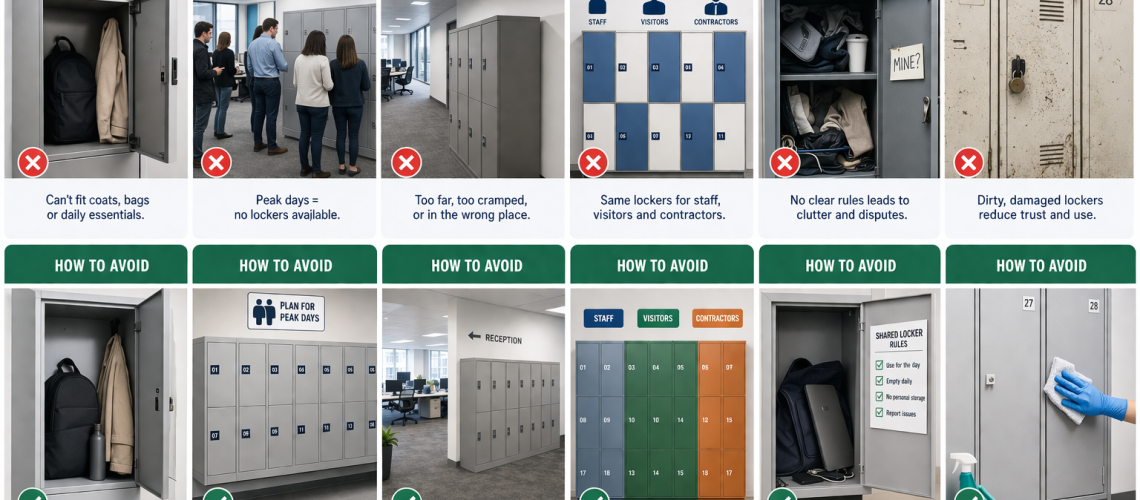
lockers that are too small for real use
too few lockers for peak days
poor placement that interrupts workflow
unclear rules for shared use
If lockers cannot handle coats, bags and daily items, staff will stop using them. If availability is inconsistent, trust in the system drops.
To avoid these issues, see:
common office locker mistakes and how to avoid them
The decision framework
Instead of asking “should we install lockers?”, it is more useful to ask:
what do staff actually need to store?
are lockers shared or assigned?
are peak attendance days covered?
where should lockers sit in the office flow?
do we need standard storage or charging lockers?
Material choice also plays a role:
what materials are best for office lockers
Verdict
Office lockers are often worth it, especially in hybrid workplaces, but the return is usually operational rather than dramatic.
They provide value through:
better organisation
clearer space use
reduced clutter
improved day-to-day experience
The strongest case is where the office needs to separate personal belongings from shared working space. The weaker case is where staff already have sufficient storage at fixed desks and the office is not struggling with clutter.
For the full cluster and planning approach, return to the
workplace lockers guide.
I
Discover more from Blog Total Locker Service
Subscribe to get the latest posts sent to your email.