How to Audit Medicines Management in a Care Home: Storage, Access and Record Accuracy
March 30, 2026
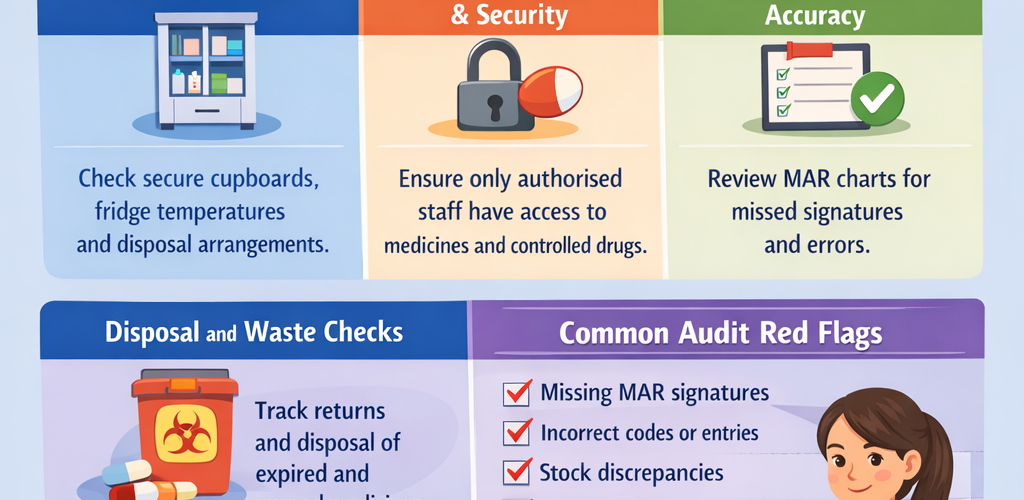
Medicines audits help care homes move from assumption to evidence. A service may feel organised day to day, but an audit shows whether medicines are actually being stored safely, accessed properly and recorded accurately. NICE says care homes should have clear policies for receiving, storing and disposing of medicines, while its care home medicines checklist says these processes should be monitored and audited. CQC also states that adult social care providers must maintain secure, accurate and up-to-date medicines records.

A good medicines audit is not just a paperwork exercise. Practical safety check. It helps you spot gaps before they become incidents, reduces the risk of missed doses or stock discrepancies, and gives managers clear evidence for training, supervision and service improvement. It also supports compliance with CQC expectations around safe care, treatment and governance.
Why medicines audits matter in care homes
Care homes handle medicines in a busy, real-world setting. Staff changes, hospital appointments, mid-cycle prescription amendments, variable dose medicines and medicines requiring refrigeration can all create pressure points. NICE recommends clear governance arrangements, accurate medicines records, and processes for reporting and reviewing medicines-related problems. That means an audit should not only ask whether a task was completed, but whether the full system around that task is working properly.
Regular audits also help managers see patterns. One missed signature may be human error. Repeated gaps on MAR charts, repeated temperature recording problems or recurring stock mismatches suggest a systems issue. NICE’s checklist specifically says care home medicines policies should explain how record-keeping and information-sharing processes will be monitored and audited, and how incidents and near misses will be reviewed.
What a medicines audit should cover
A strong medicines audit in a care home usually covers three core areas: storage, access and record accuracy. These three areas link together. When storage is weak, access control may also be weak. If access control is weak, record accuracy becomes harder to trust. If records are inaccurate, managers cannot be confident that medicines are being given, stored and disposed of safely.
The audit should also connect with related areas such as controlled drugs, medicines waiting for disposal, fridge management, self-administration arrangements and staff competence. NICE includes all of these within the wider process for safe and effective medicines management in care homes.
Auditing storage
Storage is one of the clearest places to start because it is visible and measurable. NICE says care homes should include in their safe storage process how and where medicines are stored, secure storage with only authorised staff having access, and the temperatures for storing medicines and how conditions should be monitored. It also says the storage provided should reflect the resident’s needs, choices, risk assessment and the type of medicines system being used.
During an audit, check whether medicines cupboards, trollies, rooms and fridges are locked when they should be. Confirm that internal medicines, external preparations and items requiring special handling are stored in the correct place. Review whether medicines awaiting disposal are separated appropriately and held securely. NICE says medicines for disposal should be kept in a tamper-proof container within a cupboard until collection or return to the pharmacy.
Fridge audits need special attention. CQC says medicines that require refrigeration must be kept between 2°C and 8°C, and that homes must manage cold-chain medicines appropriately from the point they are received. That means an audit should check not only the temperature log itself, but whether staff act when readings fall outside range, whether the thermometer system is reliable, and whether medicines are quarantined or reviewed when storage conditions may have been breached.
Storage audits should also cover resident-specific arrangements. Some people self-administer or keep selected medicines in their room. NICE says this should be based on a risk assessment and should be written into the resident’s care plan. So the question is not simply, “Is it locked away?” but, “Is it stored in the right way for this resident, this medicine and this level of risk?”
Auditing access and security
Only the right people should be able to access medicines. NICE explicitly refers to secure storage with access limited to authorised care home staff. In practice, an audit should examine who holds keys, who has codes, how access is handed over between shifts and whether there is a clear process when staff leave, move role or are suspended from medicines duties.
Controlled drugs need a tighter lens. CQC says care homes need to keep a running balance for each controlled drug preparation because this makes discrepancies easier to spot and track. It also says it is good practice for two trained and competent members of staff to witness and sign when controlled drugs are received, stock balances are checked, administered or disposed of. For homes with nursing, CQC also sets out how stocks may be held. Homes without nursing must not hold stock controlled drugs and may only hold controlled drugs prescribed and dispensed for an individual person.
An access audit should therefore ask practical questions. Controlled drug registers should be complete and up to date. Running balances need to be checked routinely and match the physical stock. Witness signatures should be present wherever required. Any unexplained variances, overwriting or retrospective entries must be identified and investigated.
Is access genuinely limited to trained staff, or is the system relying on habit and trust rather than control? These checks matter because weak access control can hide weak administration practice.
Auditing record accuracy
Records are where the audit becomes most revealing. CQC says medicines records must be secure, accurate and up to date. NICE adds detail by saying medicines administration records should be legible, signed, clear, accurate, factual, correctly dated and timed, completed as soon as possible after administration, and should avoid jargon and abbreviations. It also says staff must record administration only when the resident has actually taken the medicine and should complete the administration before moving on to the next resident.
That gives you a clear audit framework. Check MAR charts for missing signatures, unclear codes, late entries, inconsistent use of initials, transcribing errors, undocumented refusals and mismatches between the MAR, the care plan and the current prescription. Review whether allergies and intolerances are recorded accurately. NICE also says information should be recorded in the resident’s care plan, in the MAR, from correspondence and messages about medicines, and in transfer-of-care information when a resident is away from the home for a short time.
Another important audit point is handwritten MAR creation. NICE says a new handwritten MAR should be produced only in exceptional circumstances by a suitably trained and responsible member of staff, and that it should be checked and signed for accuracy by a second trained member of staff before first use. Where homes rely on handwritten amendments too often, the issue may be with ordering systems, communication with the pharmacy or local internal process.
Auditing returns, waste and disposal records
Even when the main audit focus is storage, access and record accuracy, disposal should not be left out. Disposal creates risk because medicines can accumulate, sit in the wrong place or remain on site after they are no longer required. NICE says care homes should have a process for the prompt disposal of medicines that exceed requirements, unwanted medicines including those belonging to a deceased resident, and expired medicines including controlled drugs. It also says records should be kept for medicines disposed of or awaiting disposal.
A disposal audit should therefore trace the full chain. Is the medicine still in current use? Has it been identified correctly as unwanted, expired or surplus? Is it logged? Is it stored in the disposal container? Has it been collected or returned promptly? Are controlled drugs handled with the extra witnessing and record controls expected by CQC? Disposal is often where drift appears, especially after hospital discharge, medication changes or end-of-life care.
How often should you audit?
NICE does not prescribe one universal timetable for every check, but it is clear that monitoring and auditing must happen, and that medicines incidents may mean review is needed more frequently. A sensible approach is to use layered auditing: frequent local checks for high-risk areas, a broader monthly manager audit, and a deeper periodic review of trends, training needs and policy effectiveness. That way, the home is not waiting for a full annual review before spotting a problem.
A practical routine might include daily operational checks, weekly spot checks on selected MARs and stock balances, monthly storage and records audits, and quarterly governance review. That schedule is a management choice rather than a fixed national rule, but it aligns well with the NICE expectation that homes actively monitor the quality of their medicines processes.
Turning audit findings into improvement
A medicines audit only adds value if findings lead to action. If you identify missing signatures, temperature gaps or stock discrepancies, record the issue clearly, assess the level of risk, decide what immediate action is needed and assign responsibility for follow-up. NICE’s checklist links medicines governance with incident reporting, safeguarding, investigation and shared learning, so the audit should feed back into supervision, training and policy review.
This is especially important when the same issue appears more than once. Repeated omissions may point to distractions during rounds, unclear roles, poor shift handovers or staff who have not been assessed as competent in practice. NICE says designated staff should administer medicines only when they have had the necessary training and been assessed as competent, and that staff without the required skills should not administer medicines.
Common red flags during a medicines audit
- Unsigned MAR entries
- Inconsistent use of codes for refusal or omission
- Medicines no longer required still sitting in stock
- Fridge temperatures recorded but not acted on
- Controlled drug balances not matching the register
- Keys or access arrangements that rely too heavily on informal staff habits
Each of these can look small in isolation, but together they suggest weak medicines governance.
Managers should also watch for mismatch between policy and practice. A home may have a detailed medicines policy, but the audit may show that staff are not following it consistently, or that the policy no longer reflects how the service actually works. NICE expects care homes to review policies, processes and governance arrangements so accountability is clear and medicines are managed safely and effectively.
Final thoughts
Auditing medicines management in a care home is about protecting residents, staff and the service as a whole. The strongest audits do not focus on forms alone. They test whether medicines are stored correctly, whether access is secure, whether records can be trusted and whether the home learns from what it finds. When the audit process is consistent, proportionate and tied to action, it becomes one of the most useful safety tools a care home has.
“`
Discover more from Blog Total Locker Service
Subscribe to get the latest posts sent to your email.