Engraved Locker Identification UK: Numbering, Records and Practical Use
April 9, 2026
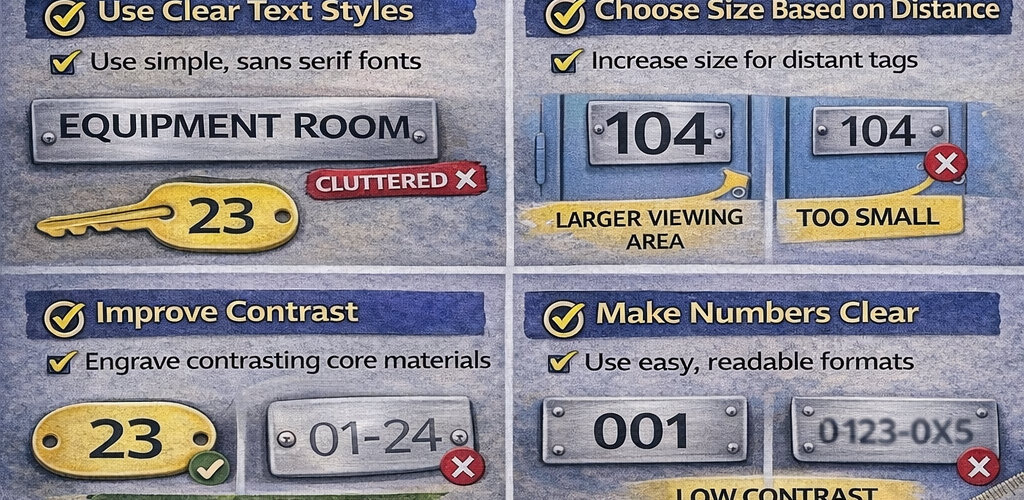
Engraved locker identification gives each locker or compartment a clear, durable physical reference that can be used consistently by users, facilities teams and administrators. The visible identifier on the locker can then correspond with allocation records, maintenance reports, key records, asset registers and refurbishment plans.
This guide focuses on how engraved identification is used operationally on lockers. It covers permanent locker references, visible locker IDs versus key codes and asset numbers, allocation, maintenance records, estate management and practical use across schools, workplaces, leisure facilities and healthcare settings.
If you need to design the numbering sequence itself, use our Locker Numbering & Labelling Guide UK. For physical plate shapes, dimensions, materials, colours, fixing methods and replacement matching, use the Engraved Locker Number Plates UK guide.
Quick Answer: What Is Engraved Locker Identification?
Engraved locker identification is a permanent or long-term visible reference attached to a locker door or compartment. It normally shows a locker number, letter or short alphanumeric code that identifies the physical locker rather than the person currently using it.
For example, a locker might be identified permanently as A027. That same reference can then appear in allocation records, maintenance tickets, key records and asset-management systems even when the person using the locker changes.
Why Give Every Locker a Stable Visible Identifier?
A visible locker number is useful for more than helping somebody find the correct door. It creates a shared reference that can be used across the life of the locker.
- Users can find the correct locker more easily.
- Staff can allocate lockers against a consistent reference.
- Lost keys can be associated with the correct locker record.
- Faults can be reported against a precise locker or compartment.
- Maintenance and lock changes can be recorded accurately.
- Replacement parts can be associated with the correct unit.
- Condition surveys can refer to individual lockers.
- Refurbishment work can retain the same established references.
- Asset registers can link physical lockers to estate records.
Across a larger locker estate, the engraved identifier becomes the physical link between the locker in front of the user and the information held about that locker elsewhere.
Locker ID, Key Code and Asset Number Are Not Necessarily the Same Thing
One of the most useful distinctions in locker management is between the visible locker identifier, the lock or key code and any internal asset reference.
| Reference | Purpose | Typical example |
|---|---|---|
| Visible locker ID | Helps users and staff identify the physical locker | A027 |
| Key or lock code | Identifies the key or lock series used for replacement and servicing | Manufacturer-specific code |
| Asset number | Internal facilities or estate-management reference | AST-004821 |
| Location reference | Identifies the locker bank, room or area | BLDG2-CHG-A |
These references can be linked in a management record without forcing all of them onto the locker door. The visible engraved identifier should remain simple enough for people to recognise quickly.
The Locker Number Should Identify the Locker, Not the Current User
A permanent locker identifier normally works best when it belongs to the physical locker rather than the person using it.
For example:
Locker: A027
Current user: recorded separately in the allocation system
If the member of staff, pupil or other user changes, locker A027 remains locker A027. The allocation record changes, but the physical locker reference does not.
This approach is particularly useful for:
- staff turnover;
- school-year changes;
- shared or shift-based lockers;
- contractor lockers;
- temporary allocations;
- day-use storage;
- locker refurbishment;
- long-term estate records.
Engraved Locker Identification and Allocation Records
A visible engraved reference makes locker allocation easier because the administrator, user and physical locker all use the same identifier.
A simple assigned-locker record might contain:
| Locker ID | Location | User or department | Key / access reference |
|---|---|---|---|
| A027 | Staff Changing Room A | Recorded authorised user | Relevant key or access record |
The engraved identifier does not need to contain all of this information. Its job is to provide the stable reference that connects the physical locker to the record.
Assigned, Shared and Day-Use Lockers
A permanent locker ID remains useful regardless of how the locker is allocated.
Assigned Lockers
Where one person is allocated a locker for a longer period, the locker reference can be linked to that user in the allocation record without engraving the user’s name permanently onto the door.
Shared Lockers
Where lockers are shared between shifts or groups, the same permanent locker ID can remain in place while the allocation changes according to the operating system.
Day-Use Lockers
For short-term lockers, the visible reference helps users relocate the correct compartment and allows staff to identify a specific locker when assistance is required.
For broader workplace allocation decisions, see our guide to assigned vs shared staff lockers.
Engraved Locker Identification and Key Records
The visible locker number can also provide a useful operational reference for keyed lockers, but it should not automatically be assumed to be the same as the manufacturer’s key code.
For example, staff may know a compartment as Locker A027 while the lock itself uses a separate manufacturer key number. A key register can associate those two references without displaying the technical key code prominently on the locker door.
For key-attached identification products, see our engraved key fobs and number discs. For managed key-cabinet workflows, see engraved key tags for key cabinets and asset control.
Using Locker IDs for Maintenance and Repairs
Maintenance teams need a precise way to identify the locker being reported.
Instead of a report such as:
the third locker from the left near the changing-room door
a visible locker reference allows the fault to be reported as:
Locker A027 – top hinge loose
The same identifier can then be used in:
- maintenance tickets;
- inspection records;
- service reports;
- replacement-part records;
- lock-change records;
- door or hinge repairs;
- condition surveys;
- refurbishment schedules.
If you need help identifying an existing component, use our locker lock, key and replacement part identification service.
Linking Locker Identification to an Asset Register
In a larger installation, the visible locker number can act as the user-facing reference while a more detailed asset record stores information that does not need to appear on the door.
A locker asset record might include:
- visible locker ID;
- site and building;
- room or changing area;
- locker bank;
- manufacturer;
- locker type and configuration;
- lock type;
- key or access reference;
- condition;
- maintenance history;
- refurbishment status;
- replacement priority.
For detailed estate-record planning, use our Locker Asset Register UK guide.
Consistent Locker Identification Across Several Rooms or Buildings
As an estate grows, locker numbers can become ambiguous if identical sequences are repeated in several locations without a clear location structure.
For example, a site might have a locker numbered 027 in more than one building. Facilities records therefore need enough location context to distinguish between them.
A practical estate reference could therefore combine:
- a building or site code;
- a room or area reference;
- a locker-bank reference;
- the visible locker number.
The visible door tag itself does not necessarily need to contain the complete estate reference. The aim is to keep the user-facing identification clear while maintaining unambiguous records behind it.
For sequence design, prefixes, zones and expansion planning, use our Locker Numbering & Labelling Guide UK.
Engraved Identification During Locker Refurbishment
Locker refurbishment often reveals identification that has become inconsistent over time. Some doors may have original engraved numbers, while others have handwritten labels, stickers or replacement plates from different periods.
Before changing the identification, check whether the existing references are already embedded in:
- allocation records;
- key schedules;
- maintenance systems;
- asset registers;
- departmental records;
- floor plans;
- other site documentation.
If the existing numbering structure still works, retaining the same locker references can avoid unnecessary changes to those records. The physical identification can then be renewed as part of the refurbishment programme.
If the numbering structure itself has become confusing or inconsistent, plan the renumbering first using the locker numbering guide.
For matching existing plates, choosing physical dimensions or deciding how replacement identification should be manufactured and attached, use the Engraved Locker Number Plates UK guide.
Replacing Missing Locker Identification
A missing locker tag does not necessarily require the numbering system to be redesigned. If the existing reference remains valid, the operational priority is usually to restore that same identifier so users and facilities records remain aligned.
Before replacing a missing identifier, confirm:
- the correct locker reference;
- whether that reference is still used in allocation or maintenance records;
- whether neighbouring lockers follow the same numbering pattern;
- whether the original number has accidentally been reused elsewhere;
- whether the locker is due to remain in service;
- whether a wider refurbishment programme is planned.
The physical specification of the replacement plate, including size, material, colour and fixing method, belongs in our locker number plate specification guide.
Engraved Locker Identification in Schools
School lockers need references that pupils, teaching staff and facilities teams can use consistently. A clear permanent locker ID can support allocation, lost-key enquiries, maintenance reporting and replacement planning without tying the physical locker permanently to one pupil.
- Keep the locker identifier clear and easy to recognise.
- Use the same reference in allocation and maintenance records.
- Avoid permanently engraving pupil names where allocations change.
- Keep equivalent locker banks internally consistent.
- Plan extensions so new lockers can fit the existing identification structure.
For broader education-sector planning, see our School Lockers UK guide.
Engraved Locker Identification in Workplaces
Workplace locker identification should remain useful even when employees change role, shift or department. The physical locker reference can stay fixed while the person or team assigned to it changes in the workplace record.
This is particularly useful where lockers are:
- assigned to permanent staff;
- shared between shifts;
- used by contractors;
- used by visitors;
- managed across several departments;
- distributed between multiple changing rooms.
For wider staff-storage planning, see our Workplace Lockers UK guide.
Engraved Locker Identification in Gyms and Leisure Centres
Leisure users often need to recognise a locker after only a short period away from it. A clear visible identifier gives the user a stable reference and also helps staff locate the correct locker when dealing with lost keys, forgotten codes or belongings left behind.
Where physical keys are issued, the locker number and key fob may use the same operational reference while remaining separate products. The locker tag identifies the fixed compartment; the key fob identifies the movable key.
For leisure-specific access methods, see our Leisure Locker Access Systems UK guide.
Engraved Locker Identification in Healthcare
Healthcare staff locker identification should provide a stable physical reference for allocation, facilities management and maintenance without requiring changeable staff information to be permanently displayed on the locker.
This is particularly useful where permanent staff, bank staff, agency workers and changing shift patterns mean locker allocation may change more frequently than the locker installation itself.
For healthcare-specific changing-room planning, see our NHS and Healthcare Changing Room Planning UK guide.
Locker Identification During Estate Audits
A consistent visible identifier is particularly useful when surveying an existing locker estate. Condition, utilisation and faults can be recorded against individual lockers rather than approximate positions.
An audit may record, for example:
| Locker ID | Condition | Lock | Action |
|---|---|---|---|
| A027 | Serviceable | Existing cam lock | No action |
| A028 | Door damaged | Working | Repair door |
| A029 | Serviceable | Faulty | Replace lock |
For the wider process, see our Locker Estate Audit UK guide.
When This Guide Is Not the Right One
This page is about the operational use of visible locker identification. Use the specialist guides below when the question is about something else.
- Planning locker numbers, prefixes, sequences or zones: use the Locker Numbering & Labelling Guide UK.
- Choosing plate dimensions, materials, colours, formats or fixing methods: use the Engraved Locker Number Plates UK guide.
- Choosing between a locker tag, key tag or equipment plate: use Engraved Tags for Lockers vs Key Tags vs Equipment.
- Choosing the size of an engraved tag: use What Size Should Engraved Tags Be?.
- Choosing how a plate should be attached: use How to Choose the Right Fixing Method for Engraved Tags and Nameplates.
- Identification attached to a key: view engraved key fobs, number discs and identification products.
- Key-cabinet and managed-key references: use Engraved Key Tags for Key Cabinets and Asset Control.
- Hotel room keys: view engraved hotel key fobs and room-number products.
- General engraved identification products: use the Engraved Products UK guide.
Common Locker Identification Mistakes
Using the Physical Tag to Invent the Numbering System
The engraved identifier should reproduce an agreed reference. Numbering sequences, prefixes, zones and future expansion should be decided before the tags are produced.
Engraving the Current User’s Name as the Permanent Locker ID
If locker users change, permanent personal names create unnecessary replacement work. Keep the locker identity stable and manage the current allocation separately.
Using Different References in Different Systems
If maintenance calls the locker A027 while the asset register calls it 0027 and the key register calls it Locker 27A, avoidable confusion can develop. Where different technical references are necessary, record the relationship between them clearly.
Reusing Locker Numbers Without Checking Records
During refurbishment or replacement, check whether an old locker number is still referenced in key schedules, maintenance history or asset records before reusing it elsewhere.
Putting Too Much Information on the Locker Door
The primary visible identifier should remain easy to understand. Detailed technical information belongs in the supporting records unless users genuinely need to see it.
Before Ordering Engraved Locker Identification
- Confirm that the locker numbering structure has been agreed.
- Prepare the complete list of locker identifiers.
- Check for duplicate or missing references.
- Confirm which identifier should be visible to users.
- Record any separate key, lock, asset or location references.
- Check that the same locker IDs are used consistently in allocation and maintenance records.
- Identify any lockers due for removal, refurbishment or replacement.
- Retain the final locker-reference schedule for future additions and replacement identification.
Once the operational identification structure is correct, use the Engraved Locker Number Plates UK guide for the physical plate specification.
Engraved Locker Identification from Total Locker Service
Total Locker Service supplies engraved identification for commercial locker installations, including locker-door numbers, engraved plates, key fobs and number discs. The locker identification guides on this page cover the operational use of the fixed locker reference, while product selection and manufacture are handled through the dedicated engraved-product pages.
For engraved products and ordering options, visit our engraved identification products page.
Related Locker Identification and Management Guides
- Locker Numbering & Labelling Guide UK — numbering structures, prefixes, zones, expansion and renumbering.
- Engraved Locker Number Plates UK — physical plate formats, dimensions, materials, fixing and replacement matching.
- Engraved Tags for Lockers vs Key Tags vs Equipment — choosing the appropriate identification product.
- Engraved Key Fobs, Number Discs & Identification Products — commercial options for identification attached to keys.
- Engraved Key Tags for Key Cabinets and Asset Control — managed key-control workflows.
- Locker Asset Register UK — linking physical lockers to estate records.
- Locker Estate Audit UK — condition, utilisation and replacement planning.
- Locker Refurbishment UK — repair, repainting and upgrade planning.
- Engraved Products UK — broad engraved-identification guide.
Engraved Locker Identification FAQs
What should an engraved locker identifier show?
It should normally show a clear permanent locker number, letter or short reference that identifies the physical locker or compartment. Changeable information such as the current user’s name is usually better stored separately.
Should the locker number be the same as the key code?
Not necessarily. The visible locker ID identifies the locker for users and facilities staff, while the key or lock code may be a separate manufacturer reference used for replacement keys or servicing. The two can be linked in a key or asset record.
Should an engraved locker tag show the user’s name?
Usually no. Where users change, the permanent identification should normally belong to the locker rather than the current user. User allocation can then be updated without changing the physical locker identification.
How does locker identification help maintenance teams?
A stable visible reference allows faults, inspections, lock changes, replacement parts and repairs to be recorded against a specific locker rather than an approximate location.
Can the same locker reference be used in an asset register?
Yes. The visible locker ID can be recorded alongside location, manufacturer, lock type, condition, maintenance history and other asset information so the physical locker can be matched reliably to its estate record.
Can engraved identification be used on shared or day-use lockers?
Yes. The engraved identifier can remain permanently attached to the locker while the person using it changes. Temporary allocation can be handled through keys, codes, booking systems or other management records.
Where should I choose locker plate size, material and fixing method?
Use the Engraved Locker Number Plates UK guide for physical plate dimensions, materials, colours, formats, fixing methods and replacement matching.
Where should I plan the locker numbering sequence?
Use the Locker Numbering & Labelling Guide UK to plan numbering sequences, prefixes, zones, duplicate prevention, future expansion and renumbering before engraved identification is produced.
Discover more from Blog Total Locker Service
Subscribe to get the latest posts sent to your email.
[…] For fixed locker numbering, see our guide to engraved locker tags and numbering. […]