Engraved Key Fobs & Number Discs UK: Locker, Workplace & Key Management Uses
September 30, 2026
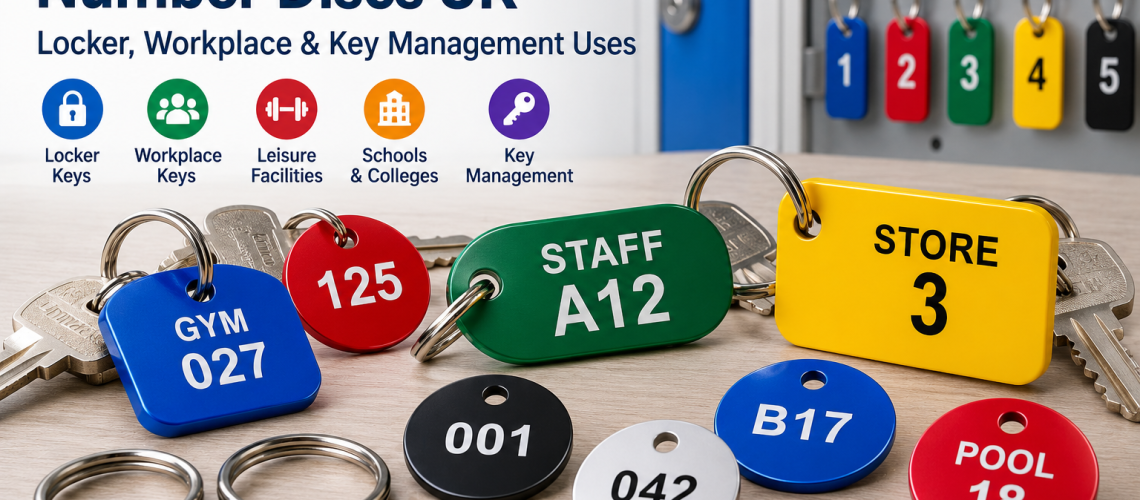
Engraved key fobs and number discs are simple identification products, but they play an important role in locker systems, workplaces, leisure facilities, hotels, key cabinets and commercial key-management processes.
A clearly engraved fob can identify a locker, key, department, room, floor, storage area or user group. A compact numbered disc can perform the same job where only a short reference is required. Both can make physical keys easier to organise, issue, return, replace and audit.
Total Locker Service supplies engraved key fobs and number discs for lockers, workplaces, leisure facilities and other commercial identification applications.
This guide explains the difference between key fobs and number discs, how they are used with locker keys and workplace keys, how to plan numbering and colour coding, how to match replacement items and when a fixed engraved plate may be more appropriate thn a mobile tag.
Quick Answer: What Are Engraved Key Fobs and Number Discs?
Engraved key fobs and number discs are portable identification products attached to keys, key rings or other items. The engraved information can include numbers, letters, short codes, department names or other references.
They are commonly used for:
- locker keys;
- staff keys;
- leisure-centre locker keys;
- school locker keys;
- workplace changing-room keys;
- key cabinet sets;
- room keys;
- equipment keys;
- departmental key sets;
- storage cupboards;
- maintenance keys;
- plant-room keys.
The main difference is normally physical format. A key fob generally provides more space for text or larger characters, while a number disc is compact and particularly useful where a short number or code is enough.
Why Engraved Identification Matters for Physical Keys
A physical key without a clear identifier quickly becomes difficult to manage once several similar keys are stored together.
Consider a facilities team managing 100 locker keys, 20 cupboard keys and a further set of maintenance keys. If each key is loose and visually similar, staff need another way to know what each one opens.
An engraved fob or disc can provide that reference directly at the key.
This can help with:
- issuing keys to users;
- returning keys to the correct place;
- matching keys to lockers;
- identifying spare keys;
- organising key cabinets;
- reporting missing keys;
- ordering replacements;
- separating departments or zones;
- reducing ambiguity between similar keys.
Engraved Locker Key Fobs
Locker key fobs are one of the most common uses for engraved identification because many lockers use small removable keys that are otherwise easy to confuse.
A locker key fob can carry:
- the locker number;
- a locker-bank reference;
- a room prefix;
- a department code;
- a floor reference;
- a short user-group code;
- another operational reference.
For example:
Locker A127 → key fob A127 → spare-key record A127
That consistency makes the physical key easier to manage and reduces the chance of a key being returned to the wrong locker record.
If replacement keys are required, see our replacement locker keys service.
Number Discs for Locker Keys
Number discs are particularly useful where the identifier is short and needs to remain visible without making the key assembly unnecessarily large.
A typical leisure locker key set might use:
locker key → split ring → engraved number disc → wristband or pin
The disc tells the user which locker they have used, while the split ring and carrying accessory help keep the key set together.
This is especially useful in:
- swimming pools;
- leisure centres;
- gyms;
- sports clubs;
- changing rooms;
- temporary-use locker areas.
For the wider leisure-key arrangement, see our guide to locker key pins for swimming pools, gyms and leisure centres.
Key Fob or Number Disc?
Both products can identify a key, but they suit slightly different requirements.
| Requirement | Key fob | Number disc |
|---|---|---|
| Short locker number | Suitable | Very suitable |
| Longer alphanumeric code | Usually better | May be too small |
| Department name | Better | Limited |
| Colour coding | Yes | Yes |
| Compact key set | Moderate | Very good |
| Large visible characters | Better | Limited by size |
| Simple leisure locker number | Suitable | Often ideal |
The best choice depends on how much information needs to be shown and how the key will be used.
Engraved Key Fobs for Workplaces
Workplaces often manage many different key types across one site.
These can include:
- staff locker keys;
- changing-room locker keys;
- store-room keys;
- office keys;
- cabinet keys;
- tool-store keys;
- plant-room keys;
- maintenance keys;
- vehicle keys;
- equipment keys.
Engraved key fobs can help distinguish those categories without relying on handwritten paper tags or temporary labels.
A simple workplace reference might be:
- ENG-01;
- WH-12;
- GF-05;
- STORE-3;
- LOCKER-217;
- PLANT-2.
Short, consistent codes are generally easier to use than overly detailed descriptions.
Engraved Key Fobs for Key Cabinets
Key cabinets are much easier to manage when the physical keys have clear identifiers that correspond with the cabinet positions or key register.
For example:
Cabinet position 42 → key fob 42 → key register 42
Alternatively, the fob can carry a functional code such as:
- STORE 1;
- SERVER;
- VEH-03;
- OFFICE 2;
- PLANT 4.
The identifier should match the organisation’s key-control process rather than being invented separately by each department.
For key storage, see our secure key cabinets range.
Using Engraved Fobs with Key Cabinets
A key cabinet and an engraved key fob solve different parts of the same problem.
The cabinet controls where the key is stored. The engraved fob tells staff which key it is.
A good system might therefore combine:
- numbered or labelled cabinet positions;
- matching engraved key fobs;
- a written or electronic key register;
- clear issue and return procedures;
- controlled access to spare or restricted keys.
The identification needs to be simple enough that staff can return the key to the correct position without interpretation.
Department and Zone Colour Coding
Colour can be used to organise key fobs and number discs visually.
Possible colour groups include:
- different departments;
- different floors;
- different buildings;
- locker banks;
- staff versus visitor keys;
- maintenance areas;
- different sports facilities;
- restricted and general-access keys.
Colour should support the engraved identifier rather than replace it. The system should still work for somebody who cannot reliably distinguish the colours.
Matching Fob Colours to Locker Areas
Locker installations can use the same colour logic as the locker bank or changing-room zone.
For example:
- blue fobs for pool lockers;
- red fobs for staff lockers;
- green fobs for first-floor lockers;
- yellow fobs for visitor lockers.
The visible locker number should still correspond with the key fob reference.
For fixed locker numbering, see our guide to engraved locker tags and numbering.
Sequential Numbering
Sequential numbering is often the simplest approach for large key sets.
Examples include:
- 001–100;
- 101–200;
- A001–A100;
- GF001–GF050;
- WH1-001–WH1-075.
Leading zeros can make large sets easier to scan because every identifier has the same visual length.
Whatever format is chosen, check the full sequence before manufacture for:
- duplicates;
- missing numbers;
- mistyped prefixes;
- inconsistent punctuation;
- unplanned changes in format.
Alphanumeric Key References
Alphanumeric references become useful when the number alone does not identify the location clearly enough.
A site with several changing rooms could use:
- MEN-001;
- WOM-001;
- STAFF-001;
- POOL-001;
- GYM-001.
A multi-building workplace might instead use:
- A-027;
- B-027;
- C-027.
The aim is to remove ambiguity, not to create the longest possible code.
Should the Fob Match the Key Number?
Not necessarily.
A lock manufacturer’s key code and an operational locker number are different things.
For example, locker 125 might use a key stamped with a manufacturer’s code that is completely unrelated to 125.
The engraved fob can still say:
125
while the facilities record privately maps locker 125 to the correct key code.
This keeps the user-facing identifier simple and avoids exposing unnecessary lock information.
Replacement Key Fobs
Engraved fobs are durable, but they can still be lost, damaged or removed from the key over time.
Replacement is easier when the original specification is recorded.
Useful details include:
- fob size;
- shape;
- material;
- colour;
- engraving colour;
- text format;
- font style;
- hole position;
- split-ring size;
- numbering sequence.
For a single missing item, matching the existing set is normally preferable to introducing a visibly different replacement.
Replacing a Complete Key-Fob Set
There are situations where replacing the entire fob set makes more sense than producing individual replacements.
Examples include:
- many fobs are missing;
- several different styles are in circulation;
- the numbering system has changed;
- the site has reorganised departments;
- the colour scheme is being standardised;
- new locker banks have been added;
- old fobs are heavily worn;
- the organisation wants a single consistent key-management system.
A replacement programme is also an opportunity to verify whether every retained key still corresponds to the correct lock.
Split Rings for Engraved Key Fobs
Most mobile engraved fobs need a reliable connection to the key.
Stainless steel split rings are commonly used because they provide a simple reusable connection between the key and fob.
A typical arrangement is:
key → split ring → engraved key fob
For locker and leisure applications, the same ring can sometimes also carry:
- a number disc;
- a wristband;
- a locker key pin;
- another small identification component.
See our stainless steel split rings for locker keys, key fobs and identification tags.
Using Locker Key Pins with Number Discs
In swimming pools, gyms and changing rooms, a number disc can form part of a larger temporary locker-key assembly.
For example:
locker key → split ring → numbered disc → stainless steel safety pin
The disc identifies the locker while the pin gives the user a way to attach the key set to a suitable item.
Total Locker Service supplies stainless steel locker key pins for this type of application.
Locker Wristbands and Engraved Number Discs
Where a leisure facility prefers the key to remain directly with the user, a wristband may be more appropriate than a pin.
The engraved disc still provides the locker reference, while the wristband provides the carrying method.
For swimming pools and gyms, see our locker key wristbands.
Engraved Key Fobs for Schools
Schools and colleges can use engraved fobs for:
- student locker keys;
- staff locker keys;
- department keys;
- sports changing-room keys;
- cupboard keys;
- maintenance keys;
- equipment keys.
Large school locker estates benefit from consistent numbering because the same visible reference can appear on the locker door, key fob and facilities record.
This can make lost-key handling and locker reassignment easier for site staff.
Engraved Key Fobs for Leisure Centres
Leisure centres may use engraved fobs or number discs for temporary locker keys, staff keys and operational keys.
Applications include:
- swimming-pool lockers;
- gym lockers;
- family changing areas;
- staff changing rooms;
- sports halls;
- equipment stores;
- plant rooms;
- cleaning cupboards.
For public-use lockers, large visible numbers and simple references are usually more practical than internal operational codes.
Engraved Key Fobs for Healthcare and Care Environments
Healthcare and care sites may use engraved fobs for staff lockers, cupboards, storage rooms and other controlled physical keys.
A clear identifier can help staff return keys to the correct storage point and distinguish different departments or locations.
Where the key relates to a restricted area or sensitive storage, the visible fob should not expose more information than the organisation’s security policy allows.
Engraved Key Fobs for Warehouses and Industrial Sites
Warehouses and industrial sites often manage many operational keys that look almost identical.
Engraved fobs can identify:
- tool stores;
- vehicle keys;
- locker areas;
- plant rooms;
- gates;
- maintenance cupboards;
- equipment cabinets;
- restricted storage areas.
A short site-specific code can keep the key set organised without using long descriptions.
When a Fixed Engraved Plate Is Better
A key fob or number disc identifies something that moves with the key. It is not always the right product if the identification needs to remain permanently attached to the object.
A fixed engraved plate is usually better for:
- locker doors;
- room doors;
- cabinets;
- equipment;
- cupboards;
- storage bays;
- plant and machinery.
For fixed identification, see our Engraved Products UK guide.
Key Fob Versus Fixed Locker Number Plate
In a locker installation, the fob and plate often work together rather than competing with each other.
For example:
locker door 214 → engraved locker plate 214 → key fob 214
The plate identifies the locker itself. The fob identifies the key that belongs to it.
Where the number is integrated around the cylinder, a numbered locker lock escutcheon can perform the fixed-door identification role.
Engraved Key Fob Size
The fob needs to be large enough for the required information but not so large that it becomes awkward to use.
Size should reflect:
- number of characters;
- character height;
- whether a prefix is required;
- how closely the fob will be read;
- how frequently it is handled;
- the size of the key itself;
- whether colour coding is important.
For a short number such as 42, a compact disc may be enough. For “WAREHOUSE 2” or “ENGINEERING 04”, a larger fob is more appropriate.
For further guidance, see What Size Should Engraved Tags Be?.
Avoiding Overloaded Key Fobs
Key fobs work best when the identifier is short and obvious.
Trying to include too much information can create a small plate full of tiny text that nobody wants to read.
Instead of engraving:
WAREHOUSE BUILDING ONE GROUND FLOOR CLEANING STORE CUPBOARD NUMBER THREE
use a controlled reference such as:
WH1-GF-C03
and keep the full description in the key register.
Matching Engraved Fobs to Existing Systems
Replacement fobs are easiest to match when the existing specification is known.
Record:
- material;
- colour;
- shape;
- dimensions;
- engraving colour;
- font style;
- hole position;
- numbering format;
- split-ring size.
If the existing set is many years old, perfect colour matching may not always be possible because the original material can change slightly through use, cleaning and light exposure.
Replacing Missing Number Discs
If the key remains serviceable but the original number disc has been lost, replacing only the identification component may be enough.
Before fitting the replacement:
- confirm which locker or asset the key operates;
- check the correct visible reference;
- inspect the split ring;
- check the key for wear;
- fit the replacement disc;
- test the complete key set before returning it to service.
This is particularly important in a large locker estate where a wrongly numbered key can create repeated confusion.
Lost Keys and Identification
An engraved fob can help identify a found key, but it does not remove the need for a lost-key procedure.
Facilities teams should still decide:
- how lost keys are recorded;
- whether a spare exists;
- whether the lock needs changing;
- whether the visible fob should expose the exact location;
- how the replacement key is ordered;
- how records are updated.
The visible identifier should therefore be useful without revealing more information than the operating environment requires.
Key Fobs and Security
Clear identification is operationally useful, but there are situations where an organisation may not want the exact purpose of a key printed on the fob.
For example, instead of engraving:
SERVER ROOM MASTER KEY
a controlled internal reference may be more appropriate.
The key register can then map the short code to its full description.
This is a policy decision for the organisation rather than an engraving limitation.
Managing Large Key-Fob Orders
For large sequential orders, prepare the required references in a structured list before production.
Useful columns include:
- reference number;
- text to engrave;
- colour;
- quantity;
- department;
- location;
- notes.
Check the list carefully for duplicate and missing entries before manufacture.
A numbering error repeated across 200 fobs is much more expensive to correct than an error found before engraving begins.
Planning for Future Replacement Fobs
A commercial identification system should be designed with replacement in mind.
Keep a record of:
- the fob specification;
- colour combination;
- numbering logic;
- file used for sequential references;
- hole position;
- ring type;
- date supplied.
This reduces the risk of later replacement orders gradually diverging from the original system.
Engraved Key Fobs Versus Printed Labels
Temporary printed labels can be useful for short-term identification, but they are often less suitable for frequently handled physical keys.
Engraved identification can provide:
- permanent characters;
- better resistance to routine handling;
- clear contrast;
- consistent sequential production;
- a more professional appearance;
- easier matching across larger key sets.
That makes engraved fobs particularly suitable for long-term commercial key systems.
Engraved Key Fobs and Hotel Keys
Hotels also use engraved physical key fobs, but hotel room fobs generally have different design requirements from compact locker or workplace tags.
Hotel fobs may need:
- a larger room number;
- hotel branding;
- a logo;
- contact details;
- a larger physical format.
For that application, use our dedicated guide to hotel key fobs and room identification.
The commercial hotel range is available at engraved hotel key fobs.
Engraved Identification as a Complete System
The strongest identification systems link the fixed asset, mobile key and facilities record together.
For example:
locker 327 → engraved door number 327 → key fob 327 → key cabinet position 327 → facilities record 327
Each component has a different role, but the shared reference keeps the system coherent.
The same principle can be applied to rooms, cupboards, stores, equipment and other physical keys.
Common Engraved Key Fob Mistakes
Using a Reference Nobody Understands
A code is only useful if the people handling the keys know what it means or can look it up quickly.
Putting Too Much Text on a Small Fob
Use a short reference and keep the detailed description in the key register.
Using Colour Without Text
Colour coding can help organisation, but it should not be the only identifier.
Mixing Number Formats
A set containing 1, 02, A003 and 0004 without a deliberate reason becomes harder to manage.
Confusing Locker Number with Key Code
The visible locker identifier and lock manufacturer’s key number are not necessarily the same thing.
Failing to Record the Original Specification
This makes matching replacement fobs harder later.
Before Ordering Engraved Key Fobs or Number Discs
Prepare the following information before ordering:
- Decide whether a fob or compact number disc is required.
- Choose the reference format.
- Prepare the complete list of numbers or codes.
- Check for duplicates and omissions.
- Select the colour or colour groups.
- Confirm the approximate size required.
- Decide how the fob will attach to the key.
- Confirm whether split rings are required.
- Record the final specification for future replacement orders.
Engraved Key Fobs and Number Discs from Total Locker Service
Total Locker Service supplies engraved key fobs, numbered discs and related identification products for locker keys, workplaces, schools, leisure facilities, key cabinets and commercial key-management systems.
Sequential numbers, short alphanumeric references, different colours and custom identification can be used to build a system that matches existing lockers, key cabinets or facilities records.
For the commercial range, visit our engraved key fobs and number discs page.
Related Engraved Identification Guides
- Engraved Products UK: Locker Numbers, Key Fobs, Signs & Identification
- Engraved Tags for Lockers: Numbering and Identification
- Engraved Tags for Lockers vs Key Tags vs Equipment
- What Size Should Engraved Tags Be?
- Locker Lock Number Plates & Escutcheons UK
- Hotel Key Fobs UK: Room Numbers, Logos, Colours & Replacement Fobs
- Engraved Identification Products
- Stainless Steel Split Rings
- Stainless Steel Locker Key Pins
Engraved Key Fob & Number Disc FAQs
What are engraved key fobs used for?
Engraved key fobs identify physical keys using a number, short code, department reference or other supplied text. They are commonly used for lockers, workplaces, key cabinets, rooms, cupboards and equipment.
What is an engraved number disc?
An engraved number disc is a compact identification tag carrying a short number or code. It is particularly useful for locker keys and other applications where a small, easy-to-read identifier is enough.
Should I choose a key fob or number disc?
Choose a number disc where a short number or code is sufficient and compact size is important. Choose a larger key fob where more characters, a department reference or larger visible text is required.
Can engraved key fobs be colour coded?
Yes. Different colours can be used to distinguish locker banks, departments, floors, buildings, key categories or user groups. The engraved number or code should remain the primary identifier.
Can locker key fobs use the same number as the locker?
Yes. Matching the visible locker number and key fob reference can make key issue, return and replacement easier. The visible locker number does not need to be the same as the manufacturer’s key code.
Can engraved key fobs be used in key cabinets?
Yes. Engraved fobs can correspond with numbered key-cabinet positions or a key register, making physical keys easier to identify and return to the correct storage location.
Can I replace one missing engraved key fob?
Usually, yes. Matching is easiest when the original size, material, colour, engraving format and attachment details are known.
Can engraved number discs be used for swimming-pool locker keys?
Yes. Number discs can identify temporary locker keys in swimming pools, gyms and leisure centres and can be used with split rings, wristbands or suitable locker key pins.
Can key fobs use letters as well as numbers?
Yes. Short alphanumeric references can identify departments, floors, buildings, locker banks and other locations where a simple number alone would be ambiguous.
Should a key fob show the lock manufacturer’s key code?
Not necessarily. The visible fob can use an operational locker or asset reference, while the facilities record privately maps that reference to the correct key code where required.
How should engraved key fobs be attached to keys?
Split rings are commonly used to connect engraved key fobs and number discs to physical keys. Leisure locker key sets may also include a wristband or stainless steel key pin.
Where can I buy engraved key fobs and number discs in the UK?
Total Locker Service supplies engraved key fobs, number discs and related identification products for commercial locker, workplace, leisure and key-management applications across the UK.
Discover more from Blog Total Locker Service
Subscribe to get the latest posts sent to your email.