Engraved Key Tags for Key Cabinets: Numbering, Records and Key Control
April 9, 2026
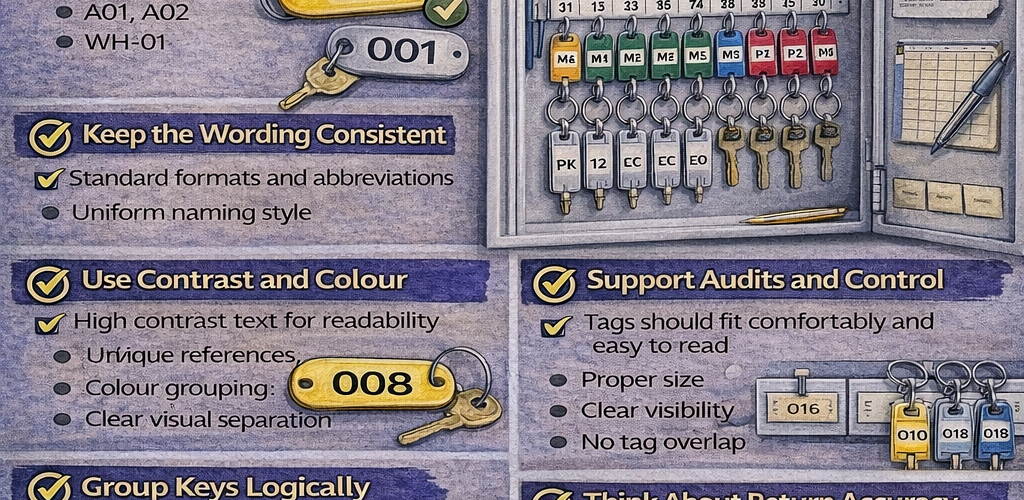
Engraved key tags help connect each physical key to the cabinet position, register and issue-and-return process used to control it. In a well-managed physical key system, the key, its engraved reference, its storage position and the associated record should all point to the same identity.
This guide focuses specifically on engraved key tags within physical key-control systems: matching keys to cabinet positions, issue and return, key registers and logs, department, room and asset references, spare and duplicate keys, lost-key identification, replacement-key continuity, audits and facilities-management records.
It does not cover general key-fob shapes, colours, decorative layouts, tag sizing or broad engraved-product selection. It also does not own key-cabinet capacity, cabinet buying decisions or mechanical-versus-digital cabinet comparisons. For engraved products, visit our engraved key tags, fobs and number discs range; for cabinet selection, use the dedicated key-cabinet guides.
For generic tag dimensions and character sizing, use What Size Should Engraved Tags Be?. For cabinet technology choice, use Mechanical vs Digital Key Cabinets.
What Is an Engraved Key Tag in a Key-Control System?
An engraved key tag is a durable identifier attached to a physical key or key ring. Within a managed key system, the tag normally carries a short reference that allows the key to be matched to its cabinet position, issue log, key register or associated access point.
The tag should not attempt to contain every detail about the key. Its main purpose is to give the physical key a stable reference that staff can use throughout the wider control process.
Why Consistent Key Identification Matters
Key control becomes unreliable when the key itself, its cabinet position and the management record all use different references. Consistent engraved identification helps keep those elements aligned.
- faster key selection;
- more accurate issue and return;
- easier checking against cabinet hooks or slots;
- clearer key logs and registers;
- simpler identification of spare and duplicate keys;
- better lost-key reporting;
- more consistent replacement-key handling;
- faster cabinet audits and stock checks.
The engraved tag is therefore not the whole key-control system. It is the physical identifier that allows the removable key to remain connected to that system.
Start with the Existing Key-Control Process
Before ordering engraved tags, establish how keys are currently stored, issued and recorded.
Confirm how the following relate to one another:
- the physical key;
- its cabinet position;
- the cabinet hook or slot reference;
- the key register;
- the issue-and-return log;
- the room, door, building, vehicle or asset served by the key;
- any spare or duplicate copies;
- the procedure used when a key is lost or replaced.
The most reliable systems normally use one recognisable core reference throughout.
For the wider operational process, see our Key Control Systems UK guide.
Match Engraved Tags to Key Cabinet Positions
Where a physical key cabinet uses numbered hooks, slots or positions, the engraved tag should make it easy to return the key to the correct place.
For example, a key stored at cabinet position 042 may also carry the engraved reference 042. The associated key register can then hold the fuller description of what that key operates.
| Cabinet position | Engraved reference | Register description |
|---|---|---|
| 042 | 042 | Plant Room 4 main access |
| 043 | 043 | Loading bay shutter |
| 044 | 044 | First-floor office access |
This direct relationship reduces search time and makes visual checks considerably easier.
Match Key Tags to Logs and Registers
The engraved reference should be usable within the site’s records. Those records may be held in a paper log, spreadsheet, asset register, facilities-management system or dedicated key-control database.
| Physical or operational element | Matching reference |
|---|---|
| Engraved key tag | Key reference |
| Cabinet hook or slot | Cabinet position |
| Issue log | Issued key reference |
| Key register | Full access-point description |
| Facilities record | Door, room, vehicle, asset or location served |
The same core identifier should ideally be recognisable in each place so staff do not have to translate between several unrelated numbering systems.
Use Engraved Tags for Key Issue and Return
Engraved identification is particularly useful where keys are issued temporarily to staff, contractors, maintenance teams or other authorised users.
- identify the key before it leaves the cabinet;
- record the same reference in the issue log;
- record who received the key;
- record when it was issued;
- use the same reference when it is returned;
- confirm that the key has gone back to the correct cabinet position.
A clear engraved reference reduces dependence on memory or visual recognition of the key itself.
For broader tracking methods, see our Key Tracking Methods UK guide.
Use Department and Location References Where Useful
A large key cabinet may contain keys for several buildings, departments, rooms or operational areas. A short location or departmental prefix can make the reference easier to understand.
- PLANT-04
- OFF-12
- WH-A07
- GATE-03
- FM-021
The objective is not to engrave the entire description onto the tag. The reference only needs to identify the key reliably and connect it to the management record.
Keep Long Descriptions in the Key Register
Detailed descriptions are normally better stored in the cabinet chart or key register than engraved onto the tag itself.
| Tag reference | Register description |
|---|---|
| PR-04 | Plant Room 4 main access door |
| WH-17 | Warehouse loading bay shutter key |
| OFF-08 | First-floor Office 8 |
This keeps the physical tag concise while preserving the detail required for facilities management.
Managing Spare and Duplicate Keys
Spare and duplicate keys should remain clearly connected to the main key record. Without a consistent relationship, duplicate keys can become detached from the wider control system.
- retain the same core reference;
- add a consistent suffix where individual copies must be distinguished;
- record where each duplicate is stored;
- identify which copies are routinely issued;
- avoid creating unrelated references for keys serving the same access point.
Examples might include 042-A and 042-B, or 042 and 042-SPARE, provided that the convention is documented and used consistently.
Master Keys and Higher-Access Keys
Master, sub-master and other high-access keys need especially careful identification because a single key may operate several doors, lockers or areas.
The physical tag does not necessarily need to advertise that level of access. A controlled internal reference linked to the key register may be more appropriate than a prominent description such as “MASTER KEY”.
For locker-specific management access, use our Locker Master Keys & Override Keys UK guide.
Use the Tag Reference When a Key Is Lost
Clear identification becomes particularly valuable when a key is lost. The engraved reference allows facilities staff to identify exactly which key is missing and which access point, room, vehicle or asset may be affected.
- record the missing key against its established reference;
- check who last signed it out;
- confirm what the key operates;
- assess whether the loss creates a security concern;
- arrange a replacement where appropriate;
- update the register and issue records;
- return the replacement to the correct cabinet position.
This is far more reliable than descriptions such as “small silver key” or “plant-room key”.
For wider lost-key management, see Lost Keys: Risk, Cost and Recovery.
Keep the Same Reference When a Key Is Replaced
When a lost, worn or damaged key is replaced, the replacement should normally return to the existing key-control structure if the underlying access point has not changed.
- retain the existing operational reference;
- replace the engraved tag if it was lost with the key;
- confirm the cabinet position remains correct;
- record that the physical key has been replaced;
- update issue or asset records where necessary;
- avoid introducing a new numbering format for a single replacement.
This keeps the key, cabinet position and management record aligned after replacement.
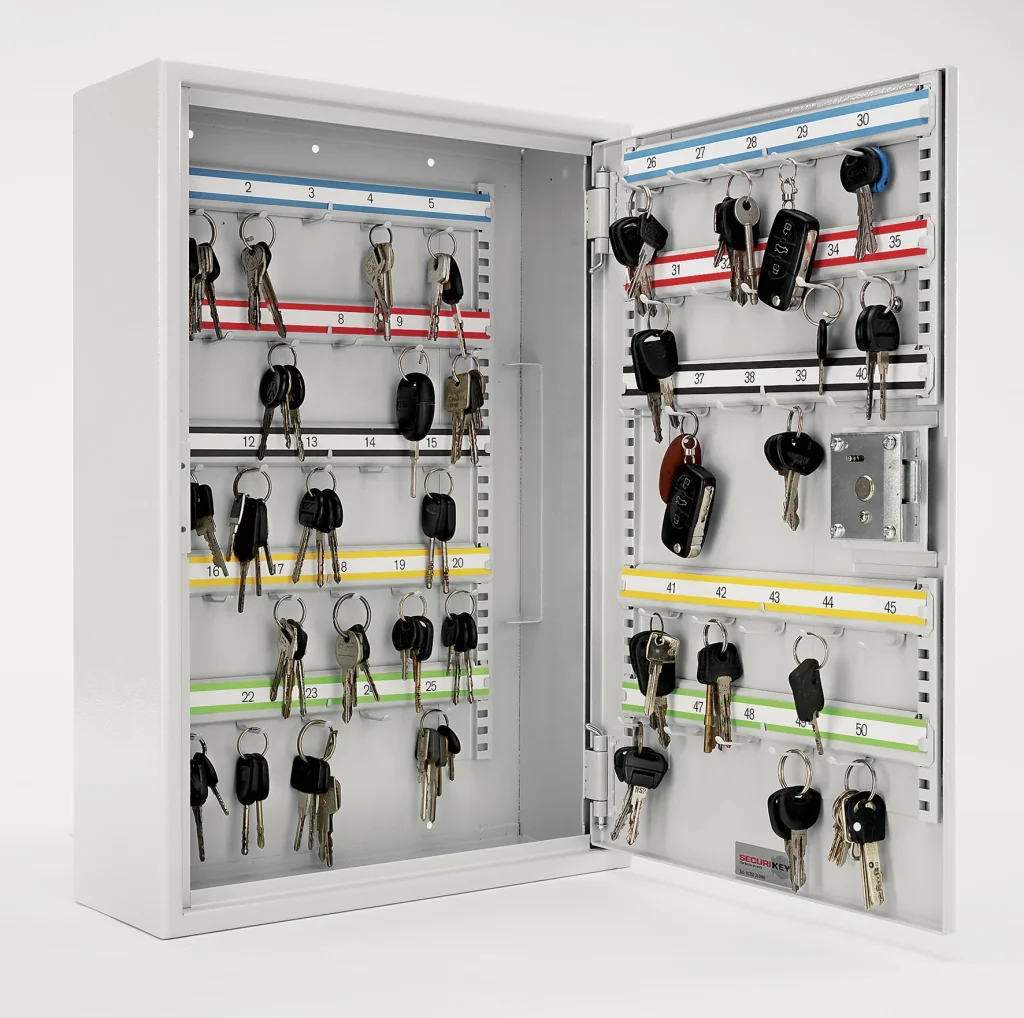
Using Engraved Tags with Physical Key Cabinets
Physical key cabinets are one of the clearest applications for engraved key tags because every removable key needs to correspond with a fixed storage position.
- numbered-hook cabinets;
- key boards;
- lockable wall-mounted key cabinets;
- departmental key stores;
- facilities-management key rooms;
- vehicle key cabinets;
- equipment-key storage systems.
This page does not own key-cabinet capacity, lock-type selection or cabinet buying decisions. For those topics, use our Key Cabinets Explained guide or browse our secure key cabinets.
Support Key Cabinet Audits and Stock Checks
A cabinet can be checked far more quickly when every physical key has an unambiguous reference.
- identify empty cabinet positions;
- confirm which key should occupy each position;
- compare cabinet contents with the register;
- identify duplicate or unexpected keys;
- check spare-key records;
- confirm replacement keys have been recorded;
- identify keys that have not been returned.
The engraved tag does not replace the audit record. It makes the physical key easier to reconcile with that record.
Adding New Keys to an Existing Cabinet
Key-control systems often expand as new rooms, vehicles, equipment or buildings are added. New keys should be incorporated into the existing reference structure rather than labelled independently.
- identify the next appropriate cabinet position;
- check that the reference has not already been used;
- create the corresponding register entry;
- record the location or access point served;
- identify spare or duplicate copies;
- use the established naming convention;
- update cabinet charts or schedules where applicable.
A structured system is easier to extend than one made up of unrelated labels added over time.
Practical Key-Control Examples
Facilities Department Key Cabinet
A facilities team manages 120 keys on numbered hooks. Each engraved tag carries the corresponding cabinet reference, while the register records the building, room, door and lock information associated with it.
Keys Issued to Contractors
A contractor signs out key PLANT-07. The same reference appears on the engraved tag, in the cabinet and in the issue log. When the key is returned, staff can immediately confirm where it belongs.
Duplicate Controlled Key
Two authorised copies of the same key are held. Both use the same core reference with a controlled suffix so staff can distinguish the physical copies without treating them as unrelated access points.
Replacement After a Lost Key
Key WH-14 is lost. The replacement receives the same operational reference and returns to the established cabinet position while the loss and replacement are recorded in the register.
Vehicle Key Cabinet
A fleet cabinet uses references such as VEH-01, VEH-02 and VEH-03. The key register holds the registration number and vehicle details while the engraved tag uses the shorter controlled reference.
Common Key-Control Mistakes
- using one reference on the key tag and another in the register;
- failing to match tags to cabinet positions;
- creating a new identifier whenever a key is replaced;
- engraving long descriptions where a short reference would work better;
- failing to record spare or duplicate keys;
- allowing temporary handwritten tags to become permanent;
- adding replacement keys without updating the register;
- using inconsistent department or building prefixes;
- failing to record where duplicate high-access keys are stored.
Before Ordering Engraved Tags for a Key Cabinet
- Confirm the key-cabinet layout.
- Confirm the hook or slot references.
- Review the existing key register.
- Identify missing or duplicate references.
- Confirm which key belongs to each position.
- Decide how spare and duplicate keys will be recorded.
- Confirm how keys are issued and returned.
- Check whether existing references already appear in facilities or asset records.
- Prepare the final key-reference schedule.
- Retain that schedule for replacement keys and future expansion.
Engraved Key Tags from Total Locker Service
Total Locker Service supplies engraved identification products for physical key-control systems, including engraved key tags, key fobs and number discs. This guide is concerned with how the engraved reference is used inside a managed key-control workflow; product shape, colour and general engraved-product selection remain with the engraved-products range, while cabinet specification remains with the key-cabinet guides.
Related Key-Control Guides
- Key Storage Systems UK — secure physical key storage, control and management.
- Key Cabinets Explained — cabinet types, capacities, lock options and uses; use this for cabinet selection rather than engraved-tag workflow.
- Key Control Systems UK — the wider manual and digital key-management process that the physical engraved reference supports.
- Key Tracking Methods UK — sign-out systems, logs and audit trails.
- How to Manage Keys in the Workplace UK — policies, responsibilities and everyday key management.
- Lost Keys: Risk, Cost and Recovery — responding to missing keys and assessing risk.
- Locker Master Keys & Override Keys UK — management access for compatible locker locking systems.
- Secure Key Cabinets — commercial physical key-storage products.
- Engraved Key Tags, Fobs and Number Discs — engraved identification products.
Engraved Key Tag FAQs
What should be engraved on a key tag for a key cabinet?
The tag should normally carry a concise reference that can be matched easily to the key’s cabinet position and key register. Detailed descriptions can remain in the register.
Should the key tag match the key cabinet position?
It often makes the system easier to manage if the engraved reference and cabinet position correspond directly, although the exact structure depends on the existing key-control system.
Should a key tag show the full room or door description?
Usually not. A short controlled reference is easier to read, while the key register can hold the full description of the door, room, building, vehicle or equipment served.
How should spare or duplicate keys be identified?
Spare and duplicate keys should normally retain the same core reference as the main key, with a consistent suffix where individual copies need to be distinguished. Their storage locations should also be recorded.
Should a replacement key receive a new reference?
Usually not if it still operates the same access point. Retaining the existing reference preserves continuity between the key, cabinet position and management records.
How do engraved key tags help with key cabinet audits?
They allow each physical key to be checked against its expected cabinet position and register entry, making missing, duplicate or incorrectly stored keys easier to identify.
Are engraved key tags a replacement for a key register?
No. The engraved tag identifies the physical key. The register stores the wider information about what the key operates, where it belongs, who has used it and any relevant management history.
Where can I buy engraved key tags and key cabinets?
Total Locker Service supplies engraved identification products and commercial key cabinets for physical key-storage and management systems.
Discover more from Blog Total Locker Service
Subscribe to get the latest posts sent to your email.