How to Fix Engraved Tags & Nameplates: Adhesive, Screws and Rivets
April 8, 2026
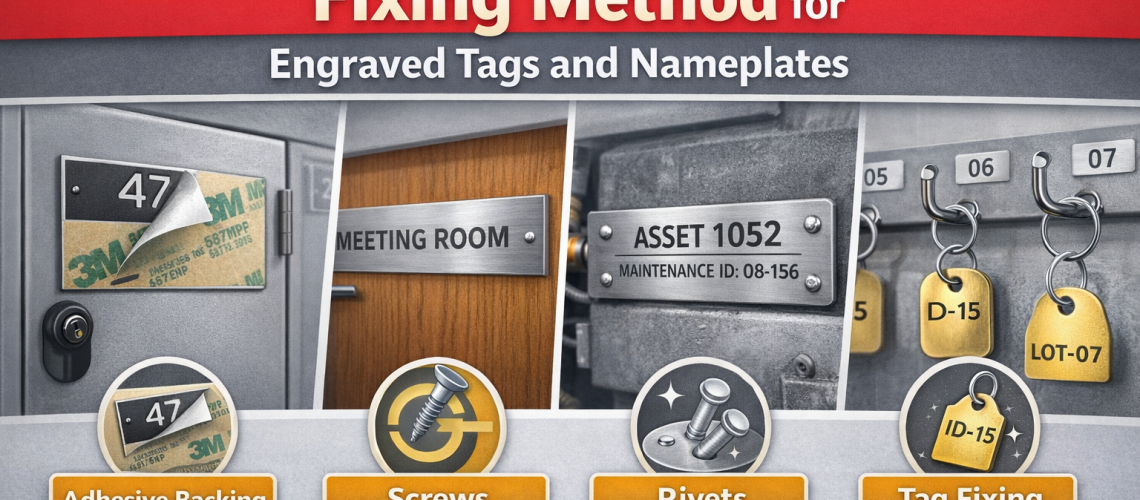
The fixing method used for an engraved tag or nameplate is just as important as the engraved information itself. A well-made plate can still fail if it is attached to the wrong surface, fitted without adequate preparation or exposed to conditions the fixing was not intended to handle.
This guide focuses specifically on how engraved tags and nameplates are attached. It is the fixing-method owner for the engraved-identification cluster, covering self-adhesive backing, screws, rivets, drilled holes, split rings and other hanging fittings, together with surface preparation, smooth and textured surfaces, moisture, cleaning, impact, interference risks and future removal.
For tag dimensions and character size, use our Engraved Tag Size Guide. For locker-specific plate shapes, materials and replacement matching, use the Engraved Locker Number Plates guide. For numbering structure, use the Locker Numbering & Labelling Guide UK. For lifecycle, cleaning and replacement decisions, use Maintain and Replace Engraved Tags.
Quick Answer: What Is the Best Fixing Method for an Engraved Tag?
The best fixing method depends on the surface, environment and whether the tag needs to remain permanently attached. Self-adhesive backing is often suitable for smooth, clean indoor surfaces. Screws and rivets provide more secure mechanical fixing where impact, moisture or heavier use are expected. Hanging tags normally use holes, split rings, chains or loops.
The Main Engraved Tag Fixing Methods
| Fixing method | Typical use | Main consideration |
|---|---|---|
| Self-adhesive backing | Lockers, cupboards, internal cabinets and smooth equipment | Surface must be clean, dry and suitable for adhesive |
| Screws | Doors, equipment, cabinets and heavier-duty plates | Requires suitable drilling and access behind the surface |
| Rivets | Metal equipment and more permanent installations | Strong, less easily removed fixing |
| Split rings or loops | Keys and movable identification | Tag needs a suitable drilled hole or slot |
| Chains, hooks or ties | Portable equipment and temporary or movable tags | Attachment method must suit handling and movement |
Self-Adhesive Engraved Tags
Self-adhesive backing is one of the simplest ways to install an engraved plate. It provides a clean appearance without visible screws or rivets and can make installation considerably quicker when many tags need to be fitted.
Typical uses include:
- locker number plates;
- cupboard labels;
- office-door identification;
- internal storage cabinets;
- smooth equipment housings;
- indoor workplace identification.
When Does Adhesive Fixing Work Best?
Adhesive fixing generally performs best where the mounting surface is smooth, clean, stable and dry.
- smooth painted metal;
- clean powder-coated surfaces;
- smooth laminate;
- smooth plastic;
- sealed indoor surfaces;
- areas with relatively low impact or tampering risk.
The condition of the actual fixing area matters more than the general material description. A clean smooth steel locker door may be suitable, while the same material covered in dirt, polish, grease or heavy texture may not be.
Prepare the Surface Before Applying an Adhesive Tag
Surface preparation is one of the most important parts of adhesive installation. Applying a plate directly over dust, grease, moisture or cleaning residue can reduce adhesion even when the underlying surface would otherwise be suitable.
- Identify the final fixing position.
- Check that the surface is stable and reasonably smooth.
- Remove dust and loose contamination.
- Remove grease, polish or other residues using a suitable cleaning method for the surface.
- Allow the area to dry fully.
- Position the tag carefully before applying pressure.
- Press the plate consistently across the adhesive area.
Where several plates are being installed, mark or measure the position first so the finished identification remains aligned across the installation.
When Adhesive Fixing May Not Be Suitable
Self-adhesive fixing is not automatically suitable for every surface or environment.
- rough or heavily textured surfaces;
- dirty or contaminated surfaces;
- areas exposed to repeated impact;
- locations where users may deliberately pull at the plate;
- very damp environments;
- external exposure;
- surfaces that flex significantly;
- areas exposed to intensive cleaning regimes;
- locations where the substrate itself is unstable or deteriorating.
Where these conditions apply, a mechanical fixing may provide a more reliable solution.
Screw-Fixed Engraved Tags and Nameplates
Screws provide a positive mechanical attachment and are useful where the plate needs to remain secure despite heavier use, impact or less favourable surface conditions.
They can be suitable for:
- doors;
- equipment housings;
- industrial cabinets;
- storage systems;
- walls or panels;
- larger engraved nameplates;
- locations where adhesive would be unreliable.
The plate needs correctly positioned fixing holes and the substrate must be suitable for the chosen screws.
Check Behind the Surface Before Drilling
Before drilling a locker, cabinet, door, machine housing or equipment panel, check what is behind the proposed fixing point.
Do not assume that an apparently clear section of surface is empty behind it. Depending on the product, there may be:
- lock mechanisms;
- linkages;
- electrical components;
- wiring;
- moving parts;
- reinforcing sections;
- internal shelves or liners.
Mechanical fixing should only be used where drilling is appropriate and can be carried out without damaging the underlying product or interfering with its operation. Pay particular attention to locks, hinges, handles, linkages, wiring and other moving or concealed components.
When Screw Fixing Is Preferable to Adhesive
- the surface is textured or unsuitable for adhesive;
- the plate is exposed to repeated knocks;
- the location experiences heavier handling;
- the plate is relatively large;
- mechanical security is preferred;
- the surface can be drilled safely;
- the installation needs a clearly removable mechanical fixing.
Screws can also be useful where a plate may need to be removed later, provided the fixing arrangement has been designed with future access in mind.
Rivet-Fixed Engraved Plates
Rivets provide a strong mechanical fixing and are commonly associated with metal panels, equipment, machinery and other applications where a more permanent attachment is required.
- industrial equipment;
- metal housings;
- plant-room identification;
- warehouse equipment;
- asset plates;
- heavy-use cabinets and storage products.
Compared with screws, rivets are generally less convenient where the plate needs to be removed regularly. They are therefore better suited to identification intended to remain in place for a long period.
Screws vs Rivets for Engraved Plates
| Requirement | Screws | Rivets |
|---|---|---|
| Strong mechanical fixing | Yes | Yes |
| Easy future removal | Generally easier | Generally more difficult |
| Visible hardware | Yes | Yes |
| Suitable for metal panels | Often | Often |
| Permanent installation | Suitable | Particularly suitable |
| Requires drilling | Usually | Usually |
Holes, Split Rings and Loops for Mobile Tags
Not every engraved product is fixed to a flat surface. Key tags, fobs and some equipment identifiers need to move with the item they identify.
Common attachment methods include:
- split rings;
- cable loops;
- chains;
- hooks;
- ties;
- other suitable loops or retainers.
The engraved tag needs a correctly positioned hole or slot that provides enough surrounding material to avoid unnecessary weakness at the attachment point.
For key-cabinet numbering and issue-and-return workflow, use our Engraved Key Tags for Key Cabinets guide. The physical engraved key-tag and number-disc range is available through our engraved identification products page.
Match the Fixing Method to the Surface
The same fixing method can perform differently on different surfaces. Always assess the actual mounting location rather than selecting a fixing method only from the type of engraved plate.
| Surface | Possible approach | Check first |
|---|---|---|
| Smooth painted metal | Adhesive or suitable mechanical fixing | Paint condition and cleanliness |
| Powder-coated steel | Often adhesive or mechanical | Surface texture and coating condition |
| Smooth laminate | Often adhesive | Cleanliness and finish |
| Plastic | Depends on surface and plastic type | Adhesive compatibility and flexibility |
| Wood | Adhesive or screws depending on finish | Surface coating and stability |
| Textured panel | Mechanical fixing may be preferable | Whether adhesive can achieve adequate contact |
| Metal equipment housing | Screws or rivets may be appropriate | Internal components behind drilling area |
Cleaning and Moisture Can Affect the Fixing Choice
Consider how the surrounding surface is cleaned and what conditions the plate will experience during normal use.
- frequent wiping;
- repeated wet cleaning;
- moisture in changing areas;
- condensation;
- cleaning products reaching the edges of adhesive-backed plates;
- industrial contamination;
- regular contact from users or equipment.
A fixing method that works well in a dry office may not be the best choice for an industrial, leisure, external or heavily cleaned environment. The fixing decision should reflect the actual exposure, cleaning regime, vibration, impact and likelihood of tampering rather than the appearance of the plate alone.
Existing Holes, Recesses and Previous Fixings
Existing holes, recesses, holders and adhesive residue can influence the fixing method for replacement identification. Where possible, use the existing installation intelligently rather than creating unnecessary new holes or leaving previous fixings exposed.
- check whether existing holes can be reused safely;
- measure recesses and holders before specifying a new plate;
- record hole centres where screws or rivets are already present;
- remove old adhesive residue without damaging the substrate;
- avoid placing a new fixing where it could interfere with locks, hinges, handles or moving parts;
- consider whether a replacement plate needs to cover marks left by the previous identification.
Fixing Engraved Tags to Lockers
Locker doors frequently provide a smooth painted or powder-coated surface, making self-adhesive plates practical in many installations. However, the condition of the door, expected impact and existing locker construction still need to be considered.
Mechanical fixing may be more appropriate where:
- plates are repeatedly being removed;
- the environment is particularly demanding;
- the existing identification already uses mechanical fixing;
- replacement plates need to match existing drilled positions;
- the surface is unsuitable for adhesive.
For locker-specific plate shapes, dimensions, materials, colours and replacement matching, use our Engraved Locker Number Plates guide. That page owns the physical locker-plate specification; this page owns the fixing decision itself.
Fixing Engraved Tags to Cabinets and Cupboards
Indoor cupboards and storage cabinets often suit self-adhesive identification when their surfaces are smooth and clean. This provides a neat appearance and avoids drilling where drilling is unnecessary.
Mechanical fixing may be preferable where the cabinet is exposed to heavier use, repeated impact or an unsuitable textured surface.
Fixing Engraved Plates to Equipment
Equipment identification often needs a more robust fixing because machinery and plant may experience vibration, impact, cleaning or environmental exposure that would be unusual for office furniture.
Screws or rivets may therefore be more appropriate, provided the equipment can be drilled safely and the fixing does not interfere with internal components or servicing access.
Consider Whether the Tag May Need Replacing Later
Some identification remains stable for many years. Other information changes as rooms are renamed, users change, equipment is replaced or locker systems are refurbished.
Before choosing a highly permanent fixing, consider whether the tag itself is likely to require future replacement.
- Long-term fixed identification: stronger permanent fixing may be appropriate.
- Information likely to change: consider how the plate can be removed without unnecessary damage.
- Matching existing identification: existing holes or fixing positions may determine the replacement method.
This page only considers future removal where it affects the fixing choice. For ongoing cleaning, replacement timing, matching and lifecycle consistency, use our Maintain and Replace Engraved Tags guide.
Consistent Positioning Matters
Choosing the correct fixing method is only part of a good installation. Plates also need to be positioned consistently.
- use a consistent height across locker doors or cabinets;
- align plates across rows where practical;
- maintain consistent distances from edges and handles;
- avoid positions where the plate interferes with operation;
- check the full installation before fixing large batches.
A simple positioning template can be useful where many identical plates need to be installed.
Common Engraved Tag Fixing Mistakes
Applying Adhesive to a Dirty Surface
Dust, grease, polish and moisture can prevent the adhesive from making proper contact with the underlying surface.
Using Adhesive on Heavy Texture
Adhesive backing needs sufficient contact area. Deep surface texture can significantly reduce that contact.
Drilling Without Checking Behind the Surface
Locker doors, cabinets and equipment may contain mechanisms, wiring or structural features immediately behind the proposed fixing position.
Choosing the Fixing Only for Appearance
A hidden adhesive fixing may look cleaner, but appearance should not override suitability for the surface and operating environment.
Ignoring Future Removal
A highly permanent fixing can make later replacement unnecessarily difficult if the identification is likely to change.
Inconsistent Plate Positioning
Even correctly fixed tags can make an installation appear poorly organised when each one is positioned at a different height or distance from the door edge.
A Simple Fixing-Method Selection Process
- Identify whether the tag is fixed or mobile.
- Inspect the mounting surface.
- Check whether the surface is smooth, textured, curved or flexible.
- Consider moisture, cleaning, impact and vibration.
- Decide whether the identification is intended to be permanent.
- Check whether drilling is permitted and safe.
- Check what lies behind the proposed mechanical fixing position.
- Consider whether the plate may need to be removed or replaced.
- Select adhesive, screws, rivets or a hanging attachment accordingly.
- Test the installation method before fitting a large quantity.
When This Guide Is Not the Right One
This page owns the method used to attach an engraved tag or nameplate. Its job is to answer whether the identification should use adhesive, screws, rivets, drilled holes, split rings or another suitable attachment, and what surface and environmental conditions affect that choice. It should not take over sizing, numbering, physical plate specification, key-control workflow, maintenance lifecycle or broad product selection.
- Choosing tag dimensions and character size: use What Size Should Engraved Tags Be?
- Choosing between a locker tag, key tag and equipment plate: use Engraved Tags for Lockers vs Key Tags vs Equipment.
- Locker number-plate formats, materials and replacement matching: use the Engraved Locker Number Plates guide.
- Locker numbering strategy: use the Locker Numbering & Labelling Guide UK.
- Operational locker identification: use Engraved Locker Identification UK.
- Key-cabinet identification and workflow: use Engraved Key Tags for Key Cabinets.
- Maintenance and replacement: use How to Maintain and Replace Engraved Tags.
- General engraved products: use the Engraved Products UK guide.
Engraved Tags and Nameplates from Total Locker Service
Total Locker Service supplies engraved identification products for lockers, keys, cabinets, equipment and workplace storage, with fixing options selected to suit different applications and surfaces. The appropriate attachment method should be chosen after the product type, size and physical specification are known.
Browse our engraved key fobs, number discs and identification products for available commercial options. The current product range includes drilled and adhesive-backed identification as well as other fixing formats.
Related Engraved Identification Guides
- What Size Should Engraved Tags Be? — viewing distance, character height and tag dimensions.
- Engraved Tags for Lockers vs Key Tags vs Equipment — choosing the appropriate identification product.
- Engraved Locker Number Plates — locker-specific plate formats and physical specification.
- Engraved Locker Identification UK — allocation, maintenance and record use.
- Engraved Key Tags for Key Cabinets — cabinet positions, registers and key control.
- How to Maintain and Replace Engraved Tags — cleaning, damaged tags and replacement consistency.
- Engraved Products UK — broad engraved-identification guide.
- Engraved Identification Products — commercial engraved fobs, number discs and plates.
Engraved Tag Fixing FAQs
What is the best way to fix an engraved tag?
The best fixing method depends on the surface and environment. Self-adhesive backing often suits smooth, clean indoor surfaces, while screws or rivets can provide stronger mechanical fixing for more demanding applications.
Can engraved tags be self-adhesive?
Yes. Self-adhesive backing can work well on suitable smooth, clean and dry surfaces such as many locker doors, cupboards and internal cabinets.
When should I use screws instead of adhesive?
Screws may be preferable where the surface is unsuitable for adhesive, the plate is exposed to heavier handling or impact, or a positive mechanical fixing is required and the surface can be drilled safely.
When should engraved plates be riveted?
Rivets can be useful for more permanent identification on suitable metal surfaces, including equipment and industrial applications where a strong mechanical fixing is preferred.
Do I need to clean the surface before fitting an adhesive plate?
Yes. The mounting area should be clean, dry and free from dust, grease, polish and other contamination that could prevent the adhesive from making proper contact.
Can adhesive engraved tags be used on textured surfaces?
Heavily textured or uneven surfaces may provide insufficient contact for adhesive backing. A suitable mechanical fixing may be more appropriate depending on the application.
Should I check behind a locker door before drilling it?
Yes. Check for lock mechanisms, linkages, wiring, structural sections or other components before drilling any locker, cabinet or equipment panel.
How are engraved key tags attached?
Engraved key tags normally use a drilled hole or slot with a split ring, cable loop, chain or another suitable attachment that allows the tag to move with the key.
Discover more from Blog Total Locker Service
Subscribe to get the latest posts sent to your email.