Bench seating, the ultimate seating for your work environment.
January 1, 2020
Changing room bench seating is available in several different forms, and the right choice depends on the environment, available space, cleaning requirements and whether users need simple seating, under-seat storage or integrated coat hooks.
This guide compares the main bench types used in UK schools, workplaces, gyms, leisure centres, factories and staff changing rooms, including standard timber-slat benches, mono benches, plastic benches and single-sided benches with hook boards.
This page focuses on bench type and construction. For detailed dimensions and seat-height planning, use our Changing Room Bench Sizes UK guide. For choosing benches as part of a complete changing-room project, see How to Choose Changing Room Benches UK.
Quick answer: which changing room bench type should you choose?
| Bench type | Best suited to | Main advantage |
|---|---|---|
| Standard timber-slat bench | Schools, workplaces, gyms and general changing rooms | Simple, robust seating with a familiar finish |
| Mono bench | Compact changing rooms and staff areas | Straightforward freestanding seating with a small footprint |
| Plastic bench | Wet, humid or demanding environments | Moisture-resistant, easy-clean construction |
| Single-sided bench with hook board | Changing rooms needing seating and garment hanging | Combines seating with coat-hook storage |
What this page owns
This page compares the main changing-room bench formats and the practical differences between them. It does not try to own detailed bench dimensions, locker-room aisle calculations or full room-layout planning.
- Bench construction and format.
- Timber-slat versus plastic seating.
- Freestanding bench options.
- Under-shelf storage.
- Integrated hook-board seating.
- Wet-area and dry-area suitability.
- Typical applications in schools, workplaces, leisure and industry.
Standard changing room bench seating
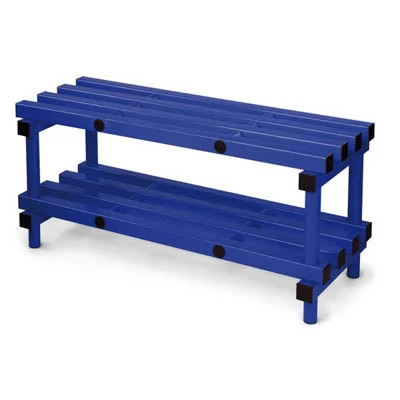
Standard changing-room benches are a versatile option for schools, workplaces, gyms and staff changing areas. A typical design combines a steel frame with timber seat slats to provide durable everyday seating without taking up unnecessary floor space.
Timber slats are commonly sanded, sealed and finished with a hard-wearing lacquer, while the frame is typically manufactured from steel and finished with a powder coating. Depending on the selected range, floor-fixing arrangements or adjustable feet may also be available.
The main advantage is simplicity. Standard benches are easy to position alongside locker runs and can work well where users need somewhere to sit while changing footwear or clothing.
Mono bench seating
Mono benches provide straightforward freestanding seating for changing rooms where the project does not require an integrated hook board or more complex structure.
They are particularly useful in staff changing rooms, schools, industrial facilities and compact spaces where a simple bench needs to sit between locker runs or against a wall.
- Steel-frame construction.
- Powder-coated finish.
- Timber-slat seating on suitable ranges.
- Suitable for freestanding changing-room use.
- Can be positioned independently of locker banks.
- Useful where seating needs to remain simple and modular.
Where exact length, depth or seat height is important, check the current manufacturer specification rather than relying on legacy dimensions. Our Changing Room Bench Sizes UK guide explains the main dimensional planning points.
Plastic changing room bench seating
Plastic changing-room benches are better suited to wet, humid or demanding environments where moisture resistance and easy cleaning are more important than a traditional timber finish.
Typical designs use PVC seating components with aluminium or corrosion-resistant structural elements. Some ranges also include an under-seat shelf for shoes, bags or other belongings.
Where plastic benches work well
- Swimming-pool changing rooms.
- Leisure centres.
- Washdown environments.
- Sports facilities.
- Industrial changing areas.
- Sites with frequent deep-cleaning routines.
Plastic benches can also be useful where the project needs low-maintenance seating that tolerates repeated cleaning. Suitability for chemicals, temperature extremes or corrosive conditions should always be checked against the current product specification.
Single-sided bench seating with hook board
A single-sided bench with hook board combines a seat with a vertical coat-hook rail or board. This makes it useful where users need to sit while changing and also hang coats, uniforms or workwear immediately above the bench.
This format is often used in schools, workplaces, factories, staff changing rooms and sports facilities where wall space is limited and it is useful to combine two functions in one installation.
- Provides seating and hanging storage in one unit.
- Reduces the need for a separate coat-hook rail.
- Works well against walls or along changing-room edges.
- Can support uniforms, coats and workwear.
- Needs sufficient clearance so hooks and seating do not obstruct circulation.
The complete bench-and-hook structure should be included in the room layout from the start. Treating the hooks or bench as an afterthought can reduce circulation and create conflicts with locker doors.
Timber vs plastic changing room benches
| Factor | Timber-slat bench | Plastic bench |
|---|---|---|
| Appearance | Traditional changing-room look | More utilitarian or contemporary |
| Moisture suitability | Best for dry or controlled environments unless specifically designed otherwise | Better suited to wet or humid conditions |
| Cleaning | Requires suitable cleaning for the finish | Usually easier to wash and wipe down |
| Typical use | Schools, workplaces, gyms and dry changing rooms | Pools, leisure, washdown and demanding environments |
| Under-shelf options | Available on some ranges | Common on some plastic bench systems |
How to choose the right bench type
Start with the environment and the way the room will be used. A dry staff changing room may only need a straightforward timber-slat mono bench. A poolside or washdown area may need a plastic or moisture-resistant bench. A changing room with uniforms and coats may benefit from an integrated hook-board bench.
| Project requirement | Bench type to consider |
|---|---|
| Simple seating in a dry changing room | Standard or mono bench |
| High moisture or frequent washdown | Plastic bench |
| Seating plus coat or uniform hanging | Single-sided bench with hook board |
| Compact room | Short mono bench or carefully positioned wall-side seating |
| Footwear or bag storage below the seat | Bench with under-shelf |
Bench layout and clearance
Bench selection cannot be separated completely from room layout. A bench may occupy a modest footprint on plan, but seated users, bags and footwear create a larger active-use zone around it.
- Keep benches clear of locker-door opening zones.
- Avoid blocking the main circulation route.
- Allow users to sit without preventing others from reaching lockers.
- Include hook-board projection and hanging garments in the layout.
- Allow access for cleaning beneath and around the bench.
- Check the finished position before locker and bench installation is finalised.
For detailed bench dimensions use Changing Room Bench Sizes UK. For wider locker-room layout problems, see Locker Room Layout Mistakes UK and Small Locker Room Design UK.
Bench construction and finish
Bench construction should suit the level of use and the environment. Steel frames are commonly powder coated, while timber seating normally uses sealed and finished slats. Plastic systems may use PVC and aluminium or other moisture-resistant components.
Do not assume that historic dimensions, colours or stock availability remain current. Before specifying a project, confirm the selected bench range, dimensions, finishes, fixing options and accessories against the current manufacturer information.
Changing room bench types by sector
| Sector | Typical bench considerations |
|---|---|
| Schools | Robust construction, suitable seat height, simple cleaning and efficient room use |
| Workplaces | Comfort, footwear changing, workwear storage and compatibility with locker banks |
| Factories and warehouses | Durability, workwear use, under-seat storage and easy cleaning |
| Gyms and leisure centres | High user turnover, moisture resistance and practical cleaning |
| Swimming pools | Wet-area suitability and corrosion-resistant construction |
| Sports clubs | Durable changing seating with enough space for kit and footwear |
Related changing room bench guides
- Changing Room Bench Sizes UK – bench length, depth and seat-height planning.
- How to Choose Changing Room Benches UK – choosing a bench for the complete changing-room project.
- Small Locker Room Design UK – fitting benches into constrained rooms.
- Locker Room Layout Mistakes UK – avoiding benches that obstruct locker doors and circulation.
- Locker Installation Planning UK – site preparation, positioning and installation.
- Changing Room Bench Seating – current commercial bench ranges.
Changing Room Bench Types UK FAQs
What type of bench is best for a changing room?
The best bench depends on the environment and use. Standard or mono benches suit many dry changing rooms, plastic benches are better suited to wet or demanding environments, and hook-board benches combine seating with garment hanging.
What is a mono changing room bench?
A mono bench is a simple freestanding changing-room bench without an integrated hook board. It is useful where straightforward seating is required alongside lockers or changing areas.
Are plastic benches suitable for wet changing rooms?
Plastic or moisture-resistant bench systems are often better suited to wet or humid changing rooms than conventional timber seating, but the selected product should still be checked against the actual environment and manufacturer specification.
What is a bench seat with a hook board?
It is a changing-room bench with an upright rail or board carrying coat hooks above the seat. It provides seating and hanging storage in one unit.
Should bench dimensions be included in locker-room planning?
Yes. Bench length, depth and position affect locker-door clearance, seated-use space and circulation, so the bench should be included before the room layout is finalised.
Should old bench dimensions and stock claims be reused?
Not without checking them. Product dimensions, finishes, colours, fixing options and stock availability can change, so current manufacturer information should be confirmed before a bench is specified or ordered.
Summary: choose the bench type before the size
The main bench types serve different environments. Standard and mono benches provide simple everyday seating, plastic benches suit wetter or more demanding areas, and hook-board benches combine seating with hanging storage.
Choose the bench format around the environment and user requirement first, then confirm the current dimensions, finish, fixing method and accessories for the selected range. The bench should be planned alongside the lockers so that seating does not compromise door opening, circulation or cleaning access.
Browse our changing room bench seating or contact Total Locker Service for help matching benches to a locker-room project.
Discover more from Blog Total Locker Service
Subscribe to get the latest posts sent to your email.
[…] Removable poolside bench seating at Hucknall pool […]
[…] Bench seating, how to select the most appropriate and cost effective. […]