Data Safe Fire Ratings Explained: What the Ratings Mean for Digital Media
October 2, 2026
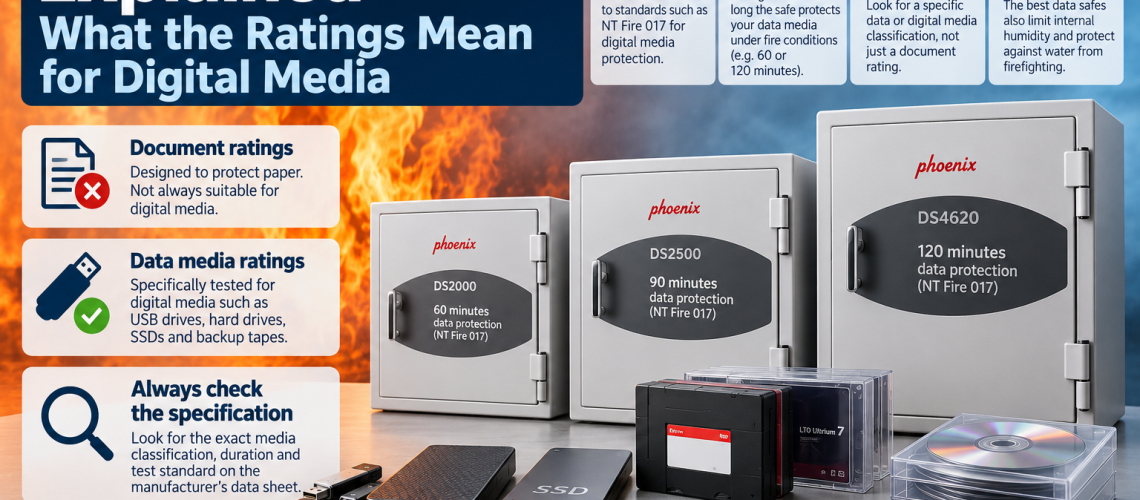
A data-safe fire rating tells you more than how long the cabinet has been tested. The important details are the test standard, the protection duration and the type of media the classification is intended to protect.
A 60-minute fire rating on its own is not enough information for digital media. Paper documents, backup tapes, USB drives, hard drives and other media can be covered by different classifications, so the complete product specification matters.
This guide focuses on how to read and compare data-safe fire ratings. For the broader difference between document and data protection, see Data Safes vs Fire Safes UK. For data-safe capacity, use What Size Data Safe Do I Need?.
Quick Answer: How Do Data Safe Fire Ratings Work?
Read a data-safe rating as a combination of duration and media classification. A rating such as 60, 90 or 120 minutes describes the tested fire-protection period, while the standard or suffix identifies the type of contents covered. Do not choose a data safe from the number of minutes alone.
| Specification element | What it tells you | Why it matters |
|---|---|---|
| Test standard | Which fire test the product has been assessed against | Different standards and classifications cover different contents |
| Duration | How long the tested protection applies | 60, 90 and 120 minutes are not interchangeable |
| Media classification | Whether the protection is intended for paper, data or digital media | A paper rating should not automatically be treated as a data-media rating |
| Water or humidity-related features | Additional protection characteristics where specified | Some media can be affected by moisture as well as heat |
Duration and Media Classification Are Separate Decisions
The fire-protection duration answers one question: how long was the safe tested for? The media classification answers another: what type of contents is that protection intended to cover?
This distinction is critical because two safes can both advertise 60 minutes of fire protection while being intended for different contents.
Duration
Common commercial data-safe specifications may state 60, 90 or 120 minutes of tested fire protection. Longer duration can be relevant where the risk assessment or storage requirement calls for it, but duration alone does not confirm media suitability.
Media classification
The classification identifies whether the test is for paper, data media, digital media or another defined content type. That is why the full line of the manufacturer’s specification should be read rather than only the headline number.
Why a 60-Minute Rating Alone Is Not Enough
“60-minute fire protection” sounds precise, but without the accompanying classification it does not tell you what the safe is protecting for those 60 minutes.
- Is the 60-minute rating for paper documents?
- Is it for computer data or backup tapes?
- Is there a separate digital-media classification for USB drives and hard drives?
- Does the specification include additional water-resistant or media-protection features?
A buyer should be able to answer those questions from the product specification before relying on the safe for important media.
Document Ratings vs Data and Digital-Media Ratings
Some safes carry more than one fire-protection classification because different parts of the safe or different tests may apply to different contents.
For example, the Phoenix DS2500 Data Combi range publishes separate fire-protection specifications for paper, data and digital media. That makes it a useful illustration of why one headline fire duration should not be treated as the whole specification.
| Content type | Typical specification wording | What the buyer should confirm |
|---|---|---|
| Paper documents | Paper fire-protection classification | The stated duration applies to paper |
| Computer data or backup tapes | Data or diskette classification | The test covers the relevant data-media type |
| USB drives, memory sticks and hard drives | Digital-media classification where stated | The product specification specifically includes those media types |
For the wider explanation of why paper and digital media need different protection, use Data Safes vs Fire Safes UK.
How to Read a Data Safe Specification
Read the specification in a fixed order rather than jumping straight to capacity or lock type.
1. Identify the test standard
Look for the named standard or classification used for the fire test. Do not rely on a generic marketing description where a tested standard is available.
2. Read the duration
Check whether the stated protection period is 60, 90, 120 minutes or another duration.
3. Identify the content type
Confirm whether the rating applies to paper, data, digital media or the specific media you intend to store.
4. Check whether multiple ratings apply
A combination safe may publish different durations for paper, data and digital media. Read each line separately.
5. Check additional media-protection features
Where the manufacturer specifies water resistance, sealed inner compartments or other media-related features, treat those as additional characteristics rather than substitutes for the fire classification.
Why Humidity and Water Resistance Can Matter
Digital and magnetic media can be affected by more than heat. Moisture, steam and water exposure can also damage stored media, so some specialist data safes include water-resistant seals or inner compartments.
That does not mean every water-resistant safe is suitable for data media. Fire classification and media suitability still need to be checked separately.
Phoenix DS2000 DataCare: Example of a Data Classification
The Phoenix DS2000 DataCare range is designed for computer backup tapes and digital media. Current Phoenix specifications for the DS2001 state testing to the Swedish NT Fire 017-60dis standard, providing 60 minutes of fire protection for computer backup tapes, together with twin water-resistant seals around the inner media compartment.
This is a good example of why the full wording matters. The useful information is not simply “60 minutes”; it is the combination of the NT Fire 017-60dis classification, the stated media use and the additional water-resistant inner compartment.
View Phoenix DS2000 DataCare data safes.
Phoenix DS2500 Data Combi: Example of Multiple Ratings
The Phoenix DS2500 Data Combi range demonstrates how one safe can publish separate protection figures for different content types.
- selected models are tested for 90 or 120 minutes of paper protection;
- the range includes data protection to the Swedish NT Fire 017 data classification;
- current Phoenix specifications also state 60 minutes of digital-media protection to the MTC DIP120-60DM standard for media including DVDs, USB memory sticks and hard drives.
The key lesson is that the paper, data and digital-media figures should be read separately. A buyer storing USB drives should not base the decision only on the longer paper rating.
View Phoenix DS2500 Data Combi safes.
Phoenix DS4620 Data Commander: Example of 120-Minute Data Protection
The Phoenix DS4620 Data Commander range is intended for higher-volume commercial data storage. Current Phoenix specifications state testing to Swedish NT Fire 017-120dis, providing 120 minutes of fire protection for computer backup tapes.
The range also uses twin water-resistant seals around the inner media compartment. This makes the DS4620 a useful example of a specification where duration, data classification and additional media-protection features are all stated together.
View Phoenix DS4620 Data Commander safes.
Phoenix Data Safe Rating Examples
| Range | Example classification | Practical interpretation |
|---|---|---|
| Phoenix DS2000 DataCare | NT Fire 017-60dis on DS2001 | 60-minute tested data protection for computer backup tapes |
| Phoenix DS2500 Data Combi | Separate paper, data and digital-media ratings | Read the rating that applies to the actual media being stored |
| Phoenix DS4620 Data Commander | NT Fire 017-120dis | 120-minute tested data protection for computer backup tapes |
What Should a Business Check Before Ordering?
- What media will actually be stored?
- Which fire-test standard is stated?
- What protection duration applies to that media type?
- Does the specification distinguish between paper, data and digital media?
- Are USB drives, hard drives, tapes or other required media explicitly covered?
- Are water-resistant seals or other media-protection features specified?
- Does the safe have enough usable capacity for the media collection?
- Does the physical size and weight suit the proposed installation location?
For capacity rather than fire classification, use the Data Safe Sizes UK guide. For the types of media that can be stored, see What Can You Store in a Data Safe?.
Common Mistakes When Reading Data Safe Fire Ratings
- Reading only the number of minutes: the content classification matters as well.
- Assuming a paper rating covers digital media: separate classifications may apply.
- Ignoring separate digital-media ratings: combination safes may publish different figures for USB drives and hard drives.
- Treating water resistance as a substitute for a data rating: it is an additional feature, not the fire classification itself.
- Comparing ranges by duration without checking the media: two 60-minute ratings may refer to different test classifications.
Data Safe Fire Rating FAQs
What does a 60-minute data safe rating mean?
It means the safe has a stated 60-minute fire-protection classification under the named test standard. You should also check what media type that classification covers rather than relying on the duration alone.
Is a 120-minute fire safe automatically better for digital media?
Not automatically. A longer duration is only useful if the relevant classification applies to the media being stored. A 120-minute paper rating should not be treated as the same thing as a 120-minute data-media rating.
Why can one safe have several fire ratings?
Some combination safes are tested or specified separately for paper, data and digital media. Each figure should be read against the content type it covers.
What does NT Fire 017-120dis mean on a data safe?
It is a Swedish NT Fire 017 data-media classification used on specialist data safes. On the Phoenix DS4620 Data Commander range, the manufacturer states 120 minutes of fire protection for computer backup tapes.
Do water-resistant seals change the fire rating?
No. Water-resistant seals are an additional protection feature. The fire-test standard, duration and media classification should still be checked separately.
Conclusion: Read the Complete Data Safe Rating
A data-safe fire rating should never be reduced to one number. Read the test standard, duration and media classification together, then check any separate digital-media or water-resistance specification that applies to the product.
The Phoenix DS2000, DS2500 and DS4620 ranges show the principle clearly: different models can provide different durations and classifications, and the correct choice depends on the media you actually need to protect.
Related Data Safe Guides
- Data Safes vs Fire Safes UK – compare document and digital-media fire protection.
- What Size Data Safe Do I Need? – plan capacity for USB drives, hard drives and backup media.
- What Can You Store in a Data Safe? – identify suitable digital and removable media.
- Can You Store USB Drives in a Fire Safe? – focused USB and removable-media guidance.
- Fire Safe vs Data Safe vs Filing Cabinet – compare the main protected-storage formats.
- View Data Safes – compare the current specialist data-safe ranges.
Discover more from Blog Total Locker Service
Subscribe to get the latest posts sent to your email.