Outdoor Lockers: Weatherproof Storage for External Locations
March 12, 2026
Outdoor lockers need to be chosen for the conditions they will actually face, not simply because they are described as suitable for external use. Rain exposure, shelter, drainage, material, lock type, stored contents and the length of time items remain inside all affect the specification.
This guide explains how to choose outdoor lockers in the UK for schools, workplaces, sports facilities, leisure sites and other commercial locations. It covers weather resistance, materials, siting, locker size, locks, ventilation, installation and maintenance.
An outdoor locker is not automatically completely waterproof. Where contents must remain dry, assess whether the proposed position is sheltered, partially exposed or fully exposed before selecting the locker. If you are ready to compare products, view our outdoor plastic lockers. For other specialist applications, use our specialist lockers guide.

Quick Answer: How Do You Choose Outdoor Lockers?
Start with exposure. A locker beneath a canopy is solving a different problem from one standing in an open playground or external yard. Once the exposure level is clear, choose a material and lock suitable for those conditions, size the compartments around the stored items, and plan the base, drainage, user access and maintenance.
- Classify the location as sheltered, partially exposed or fully exposed.
- Decide how important protection from direct rain is for the stored contents.
- Choose a locker material specifically suitable for the environment.
- Measure the largest items users will regularly store.
- Confirm the number of users and required compartments.
- Check the available footprint, door clearance and circulation space.
- Provide a stable, level base and assess local drainage.
- Select a lock that suits both the users and the exposure level.
- Confirm how locker banks will be joined, secured or stabilised.
- Plan inspection, cleaning and maintenance after installation.
Outdoor does not automatically mean waterproof. Match the locker to the actual exposure and use shelter where practical when keeping the contents dry is important.
Weather-Resistant vs Waterproof Lockers
The terms outdoor locker, weather-resistant locker, weatherproof locker and waterproof locker are often used interchangeably in searches, but they should not automatically be treated as equivalent specifications.
A weather-resistant locker uses materials and components suited to damp, humid or external environments. That does not necessarily mean that the locker forms a sealed enclosure capable of preventing water ingress during prolonged or wind-driven rain.
The eXtreme outdoor locker range supplied by Total Locker Service uses durable plastic construction and corrosion-resistant components, making it suitable for external storage applications. We describe these lockers as weather-resistant rather than fully waterproof. Where protection of the contents from water is particularly important, positioning beneath a canopy, shelter or other partially protected area is recommended.
| Requirement | What to establish | Why it matters |
|---|---|---|
| General external storage | Whether the locker is sheltered or exposed | Determines the level of weather resistance required |
| Contents must remain dry | Likelihood of direct or wind-driven rain | May require additional shelter rather than relying on the locker alone |
| Damp clothing or equipment | How long wet items remain inside | Ventilation and drying become part of the storage decision |
| High-security contents | Site supervision and lock suitability | Outdoor positioning can change the security risk |
| Long-term external installation | Material, fixings, base and drainage | Durability depends on the complete installation, not only the cabinet body |
Where Are Outdoor Lockers Used?
Outdoor lockers are useful where moving users back into a building simply to reach storage would be inconvenient or where external space is better suited to the activity.
- Schools and colleges: sports kit, bags and equipment near PE areas or external facilities.
- Sports clubs: personal belongings and equipment near pitches, courts and training areas.
- Leisure facilities: storage in sheltered external or semi-external areas.
- Workplaces: staff belongings, workwear or equipment near external work areas.
- Visitor attractions: temporary storage for users who need to leave bags or personal items securely.
- Cycle facilities: storage for smaller personal items, clothing or cycling equipment.
- Public facilities: secure storage where an indoor locker room is not practical.
The required compartment size should be determined by what will actually be stored. A small compartment may work for phones, wallets or personal items, while bags, coats, helmets and sports equipment require considerably more space.
For the wider process of choosing standard locker types and configurations, see our UK locker buying and selection guide. If the requirement is driven by a specialist environment rather than outdoor exposure alone, use the specialist lockers guide.
Assess How Exposed the Lockers Will Be
Outdoor installations vary considerably. A locker positioned beneath a deep canopy faces different conditions from a locker standing in an open playground or exposed courtyard.
| Location | Typical conditions | Planning priority |
|---|---|---|
| Sheltered external area | Outdoor temperature and humidity but limited direct rain | Material suitability, security and condensation |
| Partially exposed area | Occasional direct rain or wind-driven moisture | Weather-resistant construction, positioning and drainage |
| Open external area | Regular exposure to rain, sun and changing temperatures | Specialist outdoor material, stable base and careful siting |
| Coastal or demanding environment | Moisture plus potentially aggressive environmental conditions | Check all materials, fixings and lock components for suitability |
Where the proposed installation is highly exposed, assess the exact location before ordering. Small differences in shelter, orientation, local drainage, wind-driven rain and the items being stored can change the appropriate specification.
What Materials Are Best for Outdoor Lockers?
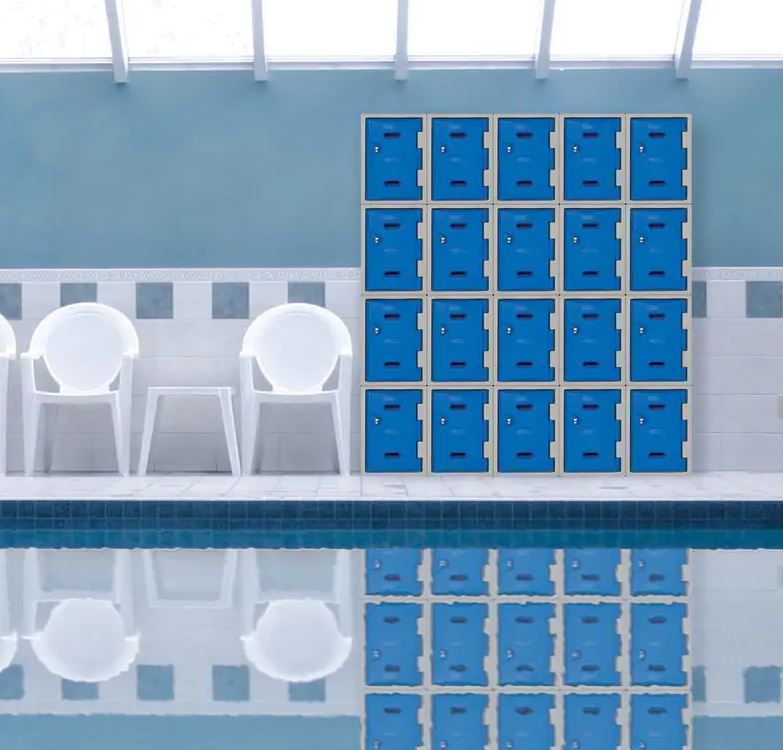
Locker material is one of the most important decisions for an external installation. Materials that perform well in a dry office, school corridor or staff room may not be suitable when exposed to moisture and changing outdoor conditions.
HDPE and Plastic Outdoor Lockers
Plastic locker construction avoids the conventional steel corrosion problem and is therefore particularly useful for damp, humid and external applications. The eXtreme outdoor locker range uses tough plastic construction with corrosion-resistant joining components.
- No conventional steel locker body to rust.
- Suitable for damp and weather-exposed environments when correctly positioned.
- Hard-wearing surfaces suited to frequent use.
- Modular units can be joined together.
- Different compartment heights can be selected around the items being stored.
- Key, hasp and coin-operated locking options are available within the current range.
See the current eXtreme outdoor plastic locker range for available configurations and current specifications.
Can Steel Lockers Be Used Outdoors?
Do not assume that a standard powder-coated steel locker is suitable for outdoor installation simply because steel is strong. Conventional commercial steel lockers are normally chosen for internal environments, and prolonged exposure to moisture can affect the cabinet, fixings and locking components if the product has not been designed for those conditions.
If a metal locker is being considered for a sheltered or unusual external application, confirm the manufacturer’s environmental specification first rather than relying on the material description alone.
For a wider comparison of steel, laminate and plastic construction, read our locker materials guide.
This page only considers materials in the context of external use. For a general comparison of locker materials across indoor applications, use the dedicated materials guide rather than treating outdoor suitability as a complete material comparison.
eXtreme Outdoor Plastic Lockers
The eXtreme range is the main purpose-specific outdoor locker range supplied by Total Locker Service. Its plastic construction provides a robust option for schools, leisure facilities, sports clubs, workplaces and public-facing sites where a conventional indoor steel locker may not be appropriate.
Current range features include:
- durable plastic locker construction;
- corrosion-resistant joining nuts and bolts;
- modular units that can be connected into locker banks;
- a profiled top and recessed base that allows compatible units to be stacked;
- 90-degree maximum door opening to help adjacent compartments remain accessible;
- a strong plastic hinge independently tested by FIRA to withstand 240 kg of force;
- key, hasp and coin-return lock options;
- different locker heights for different storage requirements; and
- optional sloping tops on suitable configurations.
Product specifications can change, so use the outdoor locker product page for current sizes, colours, lock choices, prices and availability.
Choosing Outdoor Locker Size
Do not choose an outdoor locker purely from the number of doors. Start with the largest item that users will regularly store and check whether the compartment provides enough usable height, width and depth.
| Items being stored | What to check |
|---|---|
| Small personal belongings | Compact compartment size and suitable lock |
| Bags and rucksacks | Internal depth and door opening |
| Sports clothing | Usable compartment volume and moisture management |
| Coats and workwear | Compartment height and internal fittings |
| Helmets or bulky equipment | Measure the actual equipment before ordering |
| Shared equipment | Opening size, access method and user responsibility |
External cabinet dimensions and usable compartment dimensions are not the same thing. If storage size is critical, check the actual product specification rather than estimating from overall locker height or door count. For general locker dimensions and configuration planning, use our locker sizes guide.
Choosing Locks for Outdoor Lockers
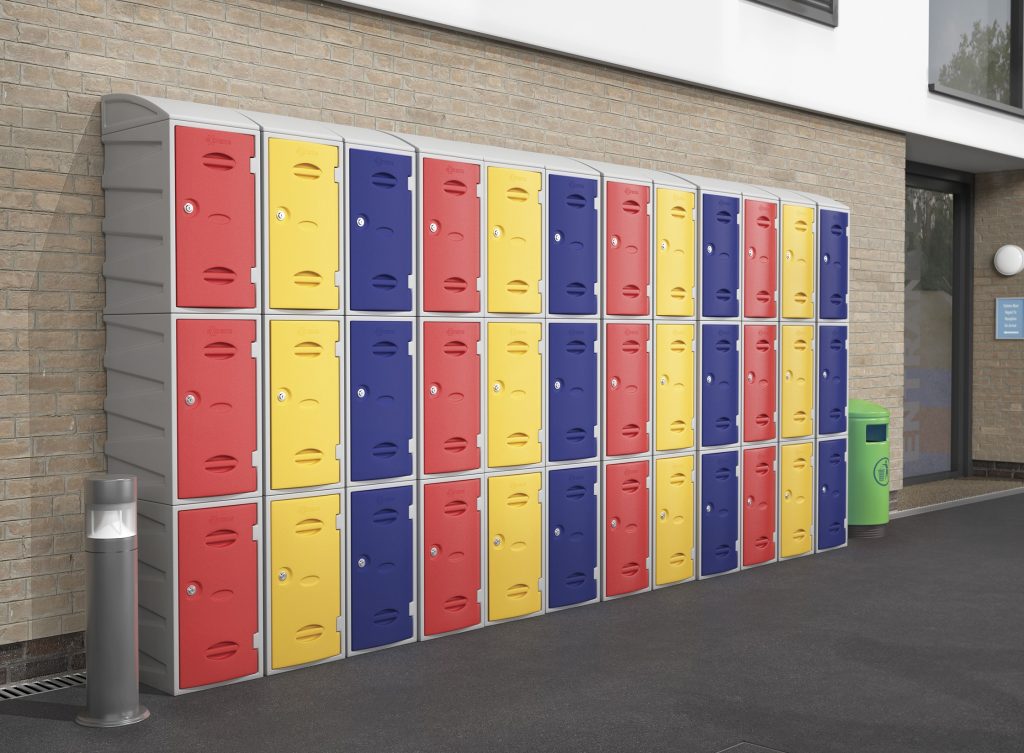
The appropriate lock depends on who will use the locker, how frequently users change and how the site intends to manage lost keys or forgotten access credentials.
- Key locks: straightforward for assigned lockers where individual users retain a key.
- Hasp locks: allow the user or site to provide a compatible padlock and can suit changing user populations.
- Coin-operated locks: useful for appropriate leisure and public-use applications where temporary access is required.
- Other locking systems: should only be selected after checking compatibility with the locker and environmental conditions.
Do not assume that an electronic or mechanical lock designed for an indoor locker is automatically suitable for direct external exposure. The environmental suitability of the complete lock assembly should be checked separately from the locker body.
For replacement and alternative locking systems, visit our locker locks section. For a general comparison of key, hasp, combination, coin and electronic access, see our locker locking systems guide. Outdoor suitability still needs to be checked for the specific lock and installation.
Planning an Outdoor Locker Installation
A suitable locker can still perform poorly if it is installed in the wrong position. The location should be assessed before the number and configuration of lockers are finalised.
Use a Stable, Level Base
Outdoor lockers should stand on a stable and level surface. Uneven ground can affect alignment, door operation and the way several lockers join together.
Also consider what happens to rainwater around the installation. Avoid positions where water regularly collects around the base of the lockers.
Do not assume that fixing or anchoring methods used indoors can be copied directly outside. The base material, locker design and manufacturer’s installation requirements should determine how the units are secured or stabilised.
Use Shelter Where Practical
Even where a locker is manufactured from weather-resistant materials, reducing direct exposure to rain can improve the environment around the locker and help protect the belongings stored inside. A canopy, covered walkway or recessed external area can therefore be preferable to a completely exposed position.
Check User Access
Users need enough room to stand in front of the lockers, open the doors and handle bags or equipment. The installation should not obstruct entrances, gates, circulation routes or other facilities.
Consider Supervision and Security
An outdoor locker bank may be less naturally supervised than lockers inside a staffed building. Consider visibility, lighting, user access and the surrounding site when choosing the location.
For the wider project process, including capacity, access, door clearance and installation, see our locker planning guide.
Ventilation, Moisture and Wet Items
Outdoor location does not remove the need to think about moisture inside the locker. Wet sports clothing, footwear, towels or workwear can introduce moisture even when no rain enters the compartment.
Where users regularly store damp items, consider:
- how long wet items will remain inside;
- whether the chosen locker design provides appropriate ventilation;
- whether equipment should be allowed to dry before storage;
- how frequently lockers will be cleaned;
- whether the locker is appropriate for the level of water exposure; and
- whether a specialist wet-area solution would be more suitable.
Do not confuse an outdoor storage requirement with a constantly wet changing-room requirement. Swimming pools, showers and other wet indoor environments may require a different locker construction and specification. For the broader principles of airflow, odour, moisture and drying, use our locker ventilation and airflow guide.
When an Outdoor Locker May Not Be the Right Solution
An outdoor locker solves an external-storage problem, but it is not automatically the right answer for every demanding environment.
- If users regularly place very wet clothing or equipment inside, ventilation or a heated/drying solution may matter more than weather resistance alone.
- If the location is continuously wet or wash-down intensive, check whether a specialist wet-area locker is more appropriate.
- If high-value items are being stored in an unsupervised external area, review the security requirement as well as the cabinet material.
- If the installation receives severe direct weather and the contents must remain dry, additional shelter may be necessary.
- If the requirement is powered device storage, use a dedicated charging-locker specification rather than adapting a general outdoor locker.
For other specialist requirements, including mesh, PPE, heated and charging lockers, see our specialist locker applications guide.
Outdoor Locker Maintenance
Weather-resistant construction reduces some maintenance problems but does not make an outdoor locker maintenance-free. Regular inspection helps identify damage before it affects security or usability.
- Check doors for correct alignment and free movement.
- Inspect hinges and joining points.
- Check locks, keys, hasps and coin mechanisms.
- Remove dirt and debris around the locker base.
- Make sure surrounding drainage remains clear.
- Check for signs of impact or vandalism.
- Replace damaged identification numbers or labels.
- Investigate water ingress rather than assuming it is normal for an outdoor installation.
Total Locker Service also supplies locker parts, repairs and service support for existing installations.
Outdoor Lockers vs Indoor Lockers
| Consideration | Outdoor locker | Typical indoor locker |
|---|---|---|
| Rain and moisture | Material selected for damp or external conditions | Normally intended for controlled indoor conditions |
| Corrosion | Plastic construction can avoid conventional body corrosion | Depends on material and environment |
| Installation surface | External base and drainage require consideration | Usually installed on an internal floor |
| Security environment | May require greater attention to location and supervision | Often within a controlled building |
| Water protection | Weather resistance and exposure must be checked carefully | Direct rain is normally outside the intended environment |
| Maintenance | Environment and fixings should be inspected regularly | Primarily wear, locks, doors and internal cleaning |
Questions to Answer Before Ordering
- Who will use the lockers?
- What exactly will they store?
- How many users need storage at the same time?
- Will lockers be assigned or used temporarily?
- Is the location sheltered, partially exposed or fully exposed?
- Could wind-driven rain reach the doors?
- Does water collect around the proposed location?
- What compartment size is required?
- Which locking method best suits the users?
- How will several lockers be joined or stabilised?
- Is sufficient space available for doors and users?
- How will the lockers be cleaned and inspected?
- Could additional locker capacity be required later?
If you are planning a larger installation, supplying photographs, measurements, expected user numbers and details of the proposed location makes it much easier to identify an appropriate locker configuration.
Outdoor Lockers from Total Locker Service
Total Locker Service supplies outdoor lockers for schools, workplaces, sports facilities, leisure sites and other commercial organisations throughout the UK.
Our eXtreme outdoor plastic lockers provide a weather-resistant option for external and demanding storage locations, with different compartment sizes and locking configurations available across the range. Check the product page for current specifications before ordering.
If outdoor storage is only one part of a larger project, browse our full commercial locker range. Use the locker buying guide for general selection, or the specialist locker applications guide where the environment or use case is the main driver.
For help with an external locker project, contact Total Locker Service on 01284 749211 or email sales@totallocker.co.uk.
Outdoor Locker FAQs
Are outdoor lockers completely waterproof?
Not necessarily. Outdoor lockers may be weather-resistant without forming a completely waterproof enclosure. The eXtreme outdoor lockers supplied by Total Locker Service are described as weather-resistant rather than fully waterproof. Where keeping contents dry is particularly important, a sheltered or partially protected installation is recommended.
What material is suitable for outdoor lockers?
Plastic and HDPE locker construction is useful for outdoor and damp environments because the locker body does not suffer from conventional steel corrosion. The complete product, including fixings and locks, should still be checked for the proposed environment.
Can ordinary steel lockers be installed outdoors?
Standard indoor steel lockers should not automatically be assumed to be suitable outdoors. Moisture and prolonged external exposure can affect the cabinet, fixings and lock components. Check the manufacturer’s environmental specification or choose a locker specifically designed for the proposed conditions.
Where should outdoor lockers be installed?
Install outdoor lockers on a stable, level base and avoid locations where water regularly collects. A canopy or other shelter is useful where practical, particularly when stored contents need protection from direct rain. Allow adequate space for users, open doors and safe access routes.
What locks can be fitted to outdoor lockers?
The current eXtreme outdoor locker range includes key, hasp and coin-return locking options on suitable configurations. Lock choice should reflect whether lockers are assigned or shared, user turnover, supervision and the environmental conditions at the installation site.
Do outdoor lockers need to be installed under a canopy?
Not in every case, but shelter can be beneficial. A canopy or partially protected position can reduce direct and wind-driven rain, improve the environment around the lockers and provide additional protection where keeping the contents dry is important.
Discover more from Blog Total Locker Service
Subscribe to get the latest posts sent to your email.