Locker Materials UK: Steel vs Laminate vs Plastic Lockers
March 9, 2026
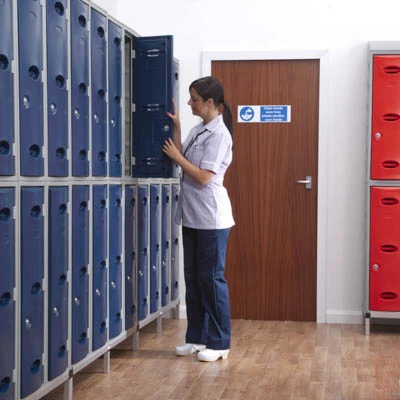
Locker material affects durability, appearance, moisture resistance, cleaning, maintenance and long-term cost. Choosing between steel, laminate and plastic lockers should therefore start with the environment in which the lockers will be used rather than colour or purchase price alone.
A dry school corridor, modern office, factory changing room and swimming-pool wet side all place different demands on a locker. The material that represents good value in one environment can be completely unsuitable in another.
Total Locker Service supplies locker ranges for different environments, including steel, plastic and specialist storage solutions for UK organisations.
This guide compares the main locker materials used in the UK, including powder-coated steel lockers, lockers with laminate doors and plastic lockers. It explains where each material works best, what to check before ordering and how moisture, cleaning, appearance, security and maintenance affect the final choice.
When you are ready to compare current products, sizes, configurations and lock options, browse our commercial locker range.
Quick Locker Material Comparison
| Locker material | Typical applications | Main strengths | Points to check |
|---|---|---|---|
| Powder-coated steel | Schools, workplaces, factories, warehouses and dry changing rooms | Durable, practical, cost-effective and widely available | Humidity, water exposure, finish and door construction |
| Steel carcase with laminate doors | Schools, offices, gyms, clubs and higher-finish interiors | Strong decorative doors and wide colour choice | Laminate grade, carcase construction and moisture exposure |
| Plastic | Pools, wet changing rooms, leisure, outdoor and moisture-prone areas | Corrosion-resistant body and easy-clean surfaces | Locks, hinges, drainage, weather exposure and exact specification |
The best locker material is the one that suits the environment, users and stored belongings over the working life of the installation.
Why Locker Material Matters
Locker material influences more than appearance. It can affect:
- resistance to everyday wear;
- performance in humid or wet conditions;
- cleaning requirements;
- impact resistance;
- appearance within the building;
- available colours and finishes;
- long-term maintenance;
- replacement-part requirements;
- and overall value.
The complete locker construction matters as well. Doors, carcase, hinges, locks, fasteners, shelves and internal fittings may use different materials, so a simple description such as “laminate locker” or “plastic locker” does not tell you everything about the finished product.
Steel Lockers
Powder-coated steel lockers are one of the most widely used commercial locker types in the UK. They provide a practical balance between durability, configuration choice, security and purchase cost.
Steel lockers are commonly used in:
- schools;
- colleges and universities;
- offices;
- factories;
- warehouses;
- staff changing rooms;
- healthcare staff areas;
- and other dry commercial interiors.
Advantages of steel lockers
- Strong and practical for general commercial use.
- Available in many heights, widths and depths.
- Available as single-tier and multi-tier lockers.
- Compatible with a wide range of locker locks.
- Powder-coated finishes provide useful colour choice.
- Replacement locks, keys and components are available for many ranges.
- Normally cost-effective for larger installations.
For current products, see our metal lockers.
Where steel lockers work best
Standard steel lockers generally work best in controlled dry internal environments. Schools, offices, warehouses and ordinary staff changing areas are common applications.
They are particularly useful where a project needs a large number of compartments and practical storage is more important than a premium furniture-style finish.
Where standard steel needs more consideration
Standard powder-coated steel should not automatically be selected for swimming-pool wet sides, shower areas, externally exposed locations or persistently humid environments.
If moisture is significant, confirm that the complete product is suitable for the environment rather than assuming a painted metal surface alone provides sufficient protection.
Laminate Door Lockers
The term laminate locker can describe several constructions. Many commercial systems combine a steel locker carcase with solid-grade or compact laminate doors.
This can provide a more decorative and furniture-like appearance while retaining a practical commercial locker body.
Laminate-door lockers are commonly considered for:
- modern offices;
- secondary schools;
- universities;
- gyms;
- health clubs;
- golf clubs;
- premium staff facilities;
- and customer-facing changing rooms.
Advantages of laminate doors
- Wide choice of colours and decorative finishes.
- Smart appearance for visible interiors.
- Strong door construction on suitable products.
- Useful where locker appearance forms part of the wider interior design.
- Available with different compartment and locking configurations.
Are laminate lockers waterproof?
Not necessarily. A laminate door does not automatically make the complete locker waterproof.
Check:
- the carcase material;
- the laminate grade;
- door edges;
- hinges;
- locks;
- fasteners;
- and the manufacturer’s environmental specification.
A steel-bodied locker with a laminate door still needs careful consideration before use in persistently wet or highly humid conditions.
Plastic Lockers
Plastic lockers are particularly useful where moisture, humidity or corrosion resistance are major considerations.
They are commonly used in:
- swimming pools;
- wet changing rooms;
- leisure centres;
- sports facilities;
- humid environments;
- selected food-industry applications;
- outdoor or semi-exposed locations;
- and other demanding environments.
Advantages of plastic lockers
- The plastic locker body will not rust.
- Good resistance to moisture on suitable products.
- Easy-clean surfaces.
- Useful for wet and humid environments.
- Available in different sizes, colours and configurations.
- Suitable products can be used in more demanding external environments.
Check the complete plastic locker
A corrosion-resistant plastic body does not mean every component is automatically suitable for every environment.
Check:
- hinges;
- locks;
- fasteners;
- internal fittings;
- drainage;
- ventilation;
- UV or external exposure where relevant;
- and installation instructions.
Weather-resistant should also not automatically be interpreted as completely waterproof in every installation.
Steel vs Laminate vs Plastic Lockers
| Factor | Steel | Laminate door | Plastic |
|---|---|---|---|
| General dry use | Excellent | Excellent | Good |
| Wet environments | Check product carefully | Depends on complete construction | Often strongest option |
| Appearance | Practical commercial finish | Strong premium/design choice | Functional, with colour options |
| Configuration choice | Very broad | Broad | Product dependent |
| Corrosion resistance | Environment dependent | Carcase dependent | Plastic body does not rust |
| Cleaning | Straightforward with suitable products | Check surface guidance | Generally straightforward |
| Typical price position | Often economical | Often higher than standard steel | Depends on specialist construction |
Which Locker Material Is Best for Schools?
Steel lockers are a practical starting point for many dry school corridors, classrooms and staff areas because they combine durability with a wide choice of sizes and configurations.
Laminate-door lockers may be appropriate where stronger decorative doors or a more premium appearance are required.
For external, swimming or unusually damp school locations, a suitable plastic locker may be more appropriate.
For the complete education specification, see our School Lockers UK guide.
Which Locker Material Is Best for Offices?
Both steel and laminate-door lockers can work well in offices.
Steel is often selected where the priority is practical, cost-effective staff storage. Laminate can be attractive where lockers form a visible part of a high-quality interior scheme.
Material choice should also consider whether lockers are positioned in back-of-house staff areas, open-plan workspaces, corridors or client-facing parts of the building.
For the specialist comparison, see our office locker materials guide.
Which Locker Material Is Best for Factories and Warehouses?
Steel lockers are widely used in factories and warehouses because they provide practical storage for personal belongings, uniforms and workwear.
The specification should account for:
- shift patterns;
- PPE;
- work boots;
- dirt and dust;
- humidity;
- cleaning;
- and whether clean and dirty clothing need to be separated.
Specialist garment or PPE locker layouts may be more important than the material alone.
Which Locker Material Is Best for Gyms?
The answer depends on whether the changing room is mainly dry or regularly exposed to significant moisture.
Steel or laminate-door lockers may work well in controlled dry gym changing areas. More humid or wet locations may require a purpose-designed plastic or other wet-area system.
Do not classify the whole building as wet simply because showers exist somewhere within it. Assess the actual location of each locker bank.
Which Locker Material Is Best for Swimming Pools?
Swimming-pool changing areas can combine persistent humidity, wet clothing and repeated cleaning. Product suitability should therefore be checked carefully.
Purpose-designed plastic lockers are often particularly useful where corrosion resistance is a principal requirement.
For a more detailed comparison, see our Wet Area Lockers UK guide.
Locker Material and Moisture
Moisture should be considered on a scale rather than simply classifying every room as wet or dry.
- Dry internal corridor.
- Ordinary staff changing room.
- Occasionally humid shower-adjacent area.
- Regularly wet changing area.
- Swimming-pool wet side.
- Wash-down environment.
- Externally exposed location.
The appropriate material can change substantially across these conditions.
Locker Material and Cleaning
Cleaning requirements should be considered before ordering rather than after the lockers are installed.
- How frequently will surfaces be cleaned?
- Which cleaning products are used on site?
- Will lockers be exposed to disinfectants or specialist cleaning chemicals?
- Can floors around the lockers be cleaned easily?
- Will water regularly contact the locker base?
- Can ventilation openings remain clean?
Always check manufacturer guidance where specific materials or finishes require particular cleaning products.
See our Locker Cleaning & Maintenance UK guide for routine care.
Locker Material and Ventilation
Material selection and ventilation are related but separate decisions.
A corrosion-resistant locker may still need ventilation where users store damp clothing, footwear, towels or PPE. Similarly, a ventilated locker is not automatically suitable for a wet environment if its materials and fittings are not designed for that exposure.
See our Locker Ventilation UK guide.
Locker Material and Security
Security should not be judged from the headline material alone.
Consider:
- door construction;
- carcase construction;
- hinges;
- lock type;
- cam or latch engagement;
- door frame;
- installation;
- and the expected risk level.
A premium-looking door does not automatically provide a higher security level, and fitting a sophisticated lock to a weak or damaged door does not solve the underlying problem.
For the wider subject, see our Locker Security UK guide.
Locker Material and Lock Compatibility
Different locker doors can require different lock fixings, spacers, cams or mounting arrangements.
Before specifying a lock, check:
- door thickness;
- door material;
- lock cut-out;
- fixing method;
- rear clearance;
- cam or latch requirements;
- and the environmental suitability of the lock.
For lock selection, see our Locker Locks UK guide.
Locker Material and Appearance
Appearance may be a relatively minor consideration in a back-of-house factory changing room but a major part of the specification in a modern workplace, leisure club or customer-facing facility.
Consider:
- colour;
- surface finish;
- door construction;
- numbering;
- end panels;
- sloping tops;
- surrounding furniture;
- and how visible the installation is within the building.
Do not pay for a premium appearance where it adds little value, but equally do not specify purely utilitarian storage where lockers form an important part of a high-quality interior.
Locker Material and Whole-Life Cost
The cheapest locker at the point of purchase is not necessarily the lowest-cost locker over its useful life.
Consider:
- purchase price;
- delivery;
- installation;
- cleaning;
- replacement locks and keys;
- hinges and doors;
- repairs;
- environmental suitability;
- refurbishment potential;
- and eventual replacement.
A standard steel locker may provide excellent value in a dry school or workplace. Paying more for a specialist wet-area product may be better value where ordinary steel would be exposed to unsuitable conditions.
For long-term ownership, see our Locker Lifespan & Lifecycle Cost Guide.
Locker Material Is Only Part of the Specification
Two lockers made from broadly similar materials can perform differently because of their design and construction.
Before ordering, also check:
- external and internal dimensions;
- compartment configuration;
- door construction;
- ventilation;
- drainage where relevant;
- lock type;
- management override;
- replacement-key availability;
- replacement parts;
- stands or plinths;
- sloping tops;
- end panels;
- numbering;
- delivery access;
- installation requirements;
- and warranty or product support.
How to Choose the Right Locker Material
- Classify the actual locker location as dry, humid, wet or externally exposed.
- Identify what users need to store.
- Determine how heavily the lockers will be used.
- Check how frequently they will be cleaned.
- Decide how important appearance is.
- Check moisture and corrosion requirements.
- Choose a suitable locker configuration.
- Select an appropriate locking system.
- Check maintenance and spare-part availability.
- Compare whole-life suitability rather than purchase price alone.
- Confirm the manufacturer’s environmental specification before ordering.
Common Locker Material Selection Mistakes
- Choosing by price alone.
- Assuming all metal lockers perform identically.
- Assuming laminate means waterproof.
- Assuming every plastic locker is suitable outdoors.
- Using ordinary dry-area lockers in persistent wet conditions.
- Ignoring locks and hinges when considering corrosion.
- Choosing a premium finish where practical durability matters more.
- Ignoring cleaning chemicals.
- Ignoring user behaviour and impact.
- Choosing by appearance without checking compartment size.
- Ignoring replacement parts and servicing.
- Failing to confirm the actual product specification.
Locker Material Checklist
- Is the location dry, humid, wet or outside?
- Will water regularly contact the lockers?
- What will users store?
- Will belongings be damp?
- How heavily will the lockers be used?
- How frequently will they be cleaned?
- Is appearance a major consideration?
- Does the complete carcase suit the environment?
- Do the doors suit the environment?
- Are hinges and locks suitable?
- Is ventilation required?
- Is drainage required?
- Are replacement parts available?
- Does the manufacturer approve the product for the proposed location?
Related Locker Guides
- Commercial Lockers – compare current locker ranges.
- Metal Lockers – steel locker products.
- Locker Sizes UK – dimensions and configurations.
- Wet Area Lockers UK – moisture and pool environments.
- Locker Ventilation UK – airflow, moisture and odour.
- Locker Cleaning & Maintenance UK – hygiene and routine care.
- Locker Locks UK – lock selection and management.
- Locker Lifespan UK – lifecycle and whole-life cost.
Locker Material FAQs
Which locker material is best?
There is no single best material. Steel is a practical choice for many dry commercial environments, laminate doors can provide a stronger decorative finish, and suitable plastic lockers are particularly useful where moisture and corrosion resistance are important.
Are steel lockers suitable for schools?
Yes. Powder-coated steel lockers are widely used in dry school corridors, classrooms and changing areas because they provide a practical balance of durability, configuration choice and cost.
Are steel lockers suitable for wet changing rooms?
Standard powder-coated steel lockers should not automatically be specified for persistently wet or highly humid environments. Check the exact product specification and consider purpose-designed wet-area lockers where corrosion resistance is important.
Are laminate lockers waterproof?
Not necessarily. Many laminate locker systems use laminate doors with a steel carcase. Environmental suitability depends on the complete construction, including the carcase, door grade, hinges, locks and exposed edges.
Do plastic lockers rust?
A plastic locker body does not rust. Locks, hinges, fasteners and other components should still be checked for suitability in the intended environment.
Are plastic lockers suitable outdoors?
Selected purpose-designed plastic lockers can be suitable for outdoor use, but weather resistance varies by product. Check exposure, drainage, fixings and the manufacturer’s installation requirements before ordering.
Are laminate lockers better than steel lockers?
Neither is universally better. Steel is often a practical and economical choice for general dry environments, while laminate-door lockers can provide a more decorative appearance and different door characteristics where those features are valuable.
Which locker material is best for swimming pools?
Swimming-pool environments normally need lockers specifically suitable for persistent humidity and wet use. Purpose-designed plastic lockers are often considered where corrosion resistance is a principal requirement.
Which locker material is cheapest?
Standard steel lockers are often among the more economical choices for general dry-area installations, but price varies with dimensions, door configuration, lock type, finish and accessories. Suitability over the working life should be considered alongside purchase price.
Choose Locker Material Around the Site
The material decision becomes much easier once the actual environment is understood. Steel works well across many dry commercial applications. Laminate doors can provide a more decorative and premium finish. Plastic lockers are particularly useful where moisture and corrosion resistance are central requirements.
Do not make the decision from material name alone. Check the complete locker construction, doors, hinges, locks, stored belongings, cleaning routine and environmental specification before ordering.
Browse our commercial locker range, or call 01284 749211 or email sales@totallocker.co.uk for help selecting the most suitable locker construction for your site.
Discover more from Blog Total Locker Service
Subscribe to get the latest posts sent to your email.