How to Maintain and Replace Engraved Tags: Cleaning, Damage & Matching Replacements
April 9, 2026
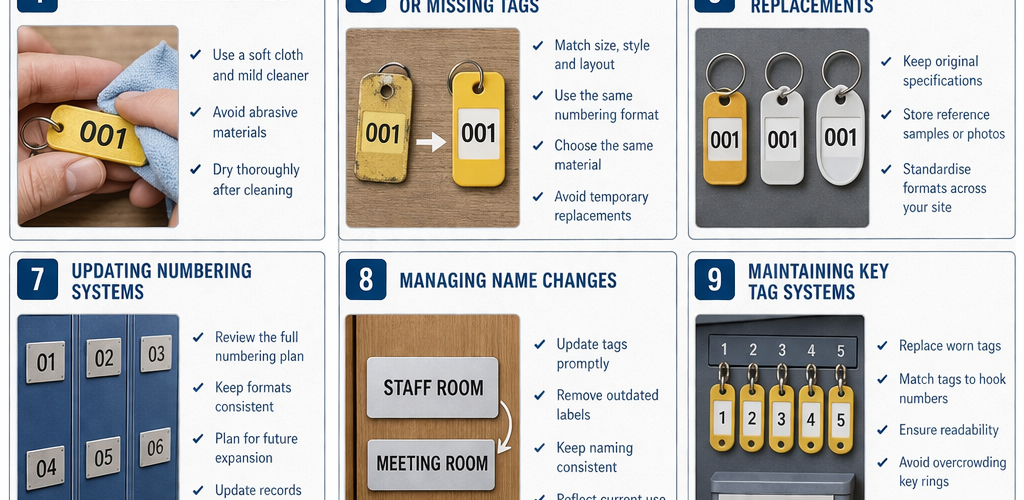
Engraved tags and identification plates are designed for long-term use, but they still need occasional cleaning, inspection and replacement. Dirt can reduce contrast, tags can become loose or damaged, and older installations can gradually become inconsistent as individual replacements are added over time.
This guide explains how to maintain and replace engraved tags while preserving a consistent identification system. It is the maintenance and replacement lifecycle owner for the engraved-identification cluster, covering routine cleaning, periodic inspection, damaged or missing tags, replacement criteria, matching replacements, retained specifications, refurbishment, phased replacement and deciding when an entire set or logical section should be refreshed.
For choosing the original tag size, use our Engraved Tag Size Guide. For adhesive, screw, rivet and hanging attachment methods, see How to Fix Engraved Tags & Nameplates. Locker numbering structure, locker-plate specification, key-control workflow and broad engraved-product selection are handled by their specialist guides rather than this lifecycle page.
Quick Answer: When Should an Engraved Tag Be Replaced?
An engraved tag should normally be replaced when it is missing, damaged, loose, difficult to read, obsolete or visibly inconsistent with the surrounding identification. Minor dirt or surface marks do not automatically justify replacement if the tag remains clear, secure and appropriate for its purpose.
What Does Engraved Tag Maintenance Involve?
A simple maintenance cycle is usually enough to keep an engraved identification system in good condition:
- clean tags and plates when necessary;
- inspect for wear, damage, looseness or loss;
- identify which tags can remain in service;
- replace missing, damaged or unreadable identification;
- match replacements to the established specification;
- decide whether isolated replacement or a wider refresh is more appropriate;
- retain the final specification for future replacement orders.
Cleaning Engraved Tags and Identification Plates
Many engraved tags do not need replacing simply because they look tired. Dust, grease, dirt and cleaning residue can reduce contrast and make otherwise serviceable identification harder to read.
Routine cleaning can often restore the appearance without disturbing the existing plate.
- remove loose dust and surface dirt;
- use a cleaning method suitable for the existing material and surface;
- avoid unnecessarily abrasive cleaning;
- do not scrape engraved surfaces with sharp tools;
- clean similar tags consistently across the same area;
- inspect readability again after cleaning.
If the engraving remains clear and the plate remains secure after cleaning, replacement may not be necessary.
Inspect Engraved Identification for Wear and Damage
Periodic inspection helps identify problems before a locker bank, key system or equipment area develops a visibly inconsistent mix of permanent and temporary identification. The appropriate interval depends on use, environment and maintenance routines; the important point is that identification is reviewed often enough to catch missing, loose or unreadable tags before temporary fixes become permanent.
Check for:
- missing tags;
- loose plates;
- cracks or chips;
- damaged edges;
- reduced engraving contrast;
- faded or difficult-to-read information;
- temporary labels replacing permanent identification;
- mismatched previous replacements;
- obsolete wording or references;
- plates that no longer sit securely in their original position.
One damaged tag may justify a straightforward individual replacement. Several problems within the same bank, room or department may indicate that a wider refresh is becoming more practical.
How Often Should Engraved Tags Be Inspected?
There is no single inspection interval that suits every site. A sensible frequency depends on how heavily the area is used, how often it is cleaned, whether tags are exposed to impact or tampering and whether identification forms part of a wider planned-maintenance routine.
- high-use changing rooms and workplaces may justify checks during routine locker or facilities inspections;
- industrial or heavily cleaned areas may need more frequent visual checks;
- low-use office or storage areas may only need inspection as part of periodic facilities reviews;
- refurbishment, relocation or repair work should trigger an identification check even if the normal inspection date has not arrived.
The aim is not to create an unnecessary standalone inspection regime. It is to make engraved identification part of the site’s existing maintenance cycle so missing, loose, damaged or unreadable tags are identified early.
When Should You Replace an Engraved Tag?
Replacement is usually justified when the plate no longer performs its identification role reliably or when damage is likely to cause further deterioration.
- the engraved information can no longer be read comfortably;
- the tag is missing;
- the plate is cracked or broken;
- the identification is obsolete;
- the plate no longer stays securely in position;
- a temporary substitute needs replacing properly;
- the replacement no longer matches an otherwise consistent installation.
The practical test is simple: does the tag remain clear, secure and appropriate for the identification system? If it does, cosmetic ageing alone may not require immediate replacement.
Replacing a Missing Engraved Tag
A missing tag should normally be replaced before handwritten stickers, marker pen or temporary printed labels become part of the permanent installation.
Before ordering a replacement:
- confirm the correct identification reference;
- photograph neighbouring tags;
- measure an existing matching plate;
- record the colour and visible layout;
- note the position of the tag on the locker, cabinet or equipment;
- check how the existing tag is attached;
- retain this information for future replacement orders.
Where locker numbering itself is uncertain, resolve that separately using the Locker Numbering & Labelling Guide UK before reproducing the missing plate.
Match Replacement Tags to the Existing Installation
A replacement tag should normally look as though it belongs with the identification already in place. Routine replacement is usually a restoration exercise, not an opportunity to redesign one individual plate.
Record and match, where practical:
- overall dimensions;
- shape;
- background colour;
- engraved colour or contrast;
- text position;
- number of lines;
- character style where known;
- general spacing;
- position on the locker, cabinet or equipment;
- existing fixing arrangement.
This page covers the lifecycle decision to match an existing tag, but not the detailed physical specification of locker number plates. For shapes, dimensions, materials, colours, locker-specific fixing positions and detailed replacement matching, use our Engraved Locker Number Plates guide.
What If the Original Engraved Tag Specification Is Unknown?
Older locker, cabinet and equipment installations often have no surviving specification or original order paperwork. In that situation, an undamaged existing tag can become the reference sample.
- measure the original carefully;
- photograph it straight-on;
- record the colour combination;
- record the general shape;
- record the engraved layout;
- note its position relative to neighbouring tags;
- retain an original sample if one is available.
Once the replacement has been reproduced successfully, create a simple retained specification so the same investigation does not need to be repeated next time.
Dealing with Faded or Inconsistent Older Tags
Older installations can become difficult to maintain because original tags age while newer replacements remain visually fresh. After several years of isolated repairs, the result can become a patchwork of slightly different colours, shapes and layouts.
There are two main approaches:
- match the existing installation as closely as practical when only a small number of replacements are required; or
- refresh a complete logical group when ageing and previous replacement work have already created obvious inconsistency.
The decision depends on the scale of the problem rather than the age of the tags alone.
Replace One Tag or Refresh the Whole Set?
Individual replacement is normally appropriate where the surrounding identification remains clear and internally consistent. A wider refresh becomes more attractive as mismatched, damaged or faded tags accumulate.
| Condition | Likely approach |
|---|---|
| One missing tag in an otherwise consistent bank | Replace the individual tag |
| One cracked or damaged plate | Replace the individual tag |
| Several previous replacements do not match | Consider refreshing the affected group |
| Most tags remain clear but show normal ageing | Continue individual replacement where practical |
| Widespread fading, damage or inconsistency | Refresh the whole set or logical section |
| Area undergoing refurbishment | Review the complete identification system |
Keep a Retained Specification for Future Replacements
One of the simplest ways to reduce future replacement problems is to retain a basic identification specification after the first order or reproduction exercise.
Keep a record of:
- tag dimensions;
- shape;
- colour combination;
- engraving layout;
- sample wording or numbering format;
- reference photographs;
- supplier or order reference where available;
- an unused sample or removed original where practical.
This gives facilities teams a reliable reference when another tag needs replacing months or years later.
Keep a Replacement Record
For larger estates, it can also be useful to record when identification has been replaced. This does not need to become a complex database, but it can help explain why one section looks newer than another and identify recurring problems.
A simple record might include:
| Reference | Location | Reason | Action |
|---|---|---|---|
| Locker A027 | Staff Changing Room | Tag missing | Matched replacement fitted |
| Cabinet 14 | Maintenance Store | Plate cracked | Individual replacement |
| Locker Bank B | Leisure Changing Room | Widespread fading | Complete set refreshed |
The replacement record here is intended only to support maintenance history and consistency. For wider locker-estate records, condition tracking and asset-management structure, see our Locker Asset Register UK guide.
Engraved Tag Replacement During Locker Refurbishment
Locker refurbishment provides a useful opportunity to inspect identification as a complete system rather than replacing tags only when individual failures occur.
If lockers, cabinets or changing-room equipment are being repaired, repainted, repositioned or replaced:
- record the existing identification before work begins;
- identify tags that can be retained;
- replace damaged or obsolete identification;
- check whether replacement plates still match the retained ones;
- review any temporary or handwritten labels;
- retain the updated specification for future work.
Where the locker references themselves remain valid, avoid renumbering simply because the physical tags are being replaced. If the numbering structure itself needs changing, that is a separate planning decision and belongs in the locker-numbering guide.
Maintaining Identification When an Installation Is Extended
Extensions can create replacement problems when new lockers, cabinets or equipment are added several years after the original installation.
If the new section is intended to appear as part of the existing installation, use the retained specification wherever practical:
- match the established visible dimensions;
- retain the same colour combination;
- follow the existing layout;
- position new identification consistently;
- compare a sample against the older tags before ordering a large quantity.
The detailed numbering of additional lockers belongs in the Locker Numbering & Labelling Guide UK. This page is concerned only with maintaining visual and physical continuity when an existing identification system is extended.
Managing Engraved Identification Through Phased Refurbishment
Large refurbishment projects are often completed in several phases. Without a retained specification, each phase can gradually introduce slightly different identification.
Establish the identification specification during the first phase and use the same reference for later work.
- keep reference photographs;
- retain approved samples;
- record dimensions and colours;
- retain the supplier or order reference;
- document deliberate specification changes;
- avoid allowing each phase to create its own interpretation.
Replacement Fixing Should Respect the Existing Installation
When replacing an existing plate, consider the original attachment before introducing a completely different fixing method. Existing holes, adhesive residue and mounting positions can all affect the finished appearance.
This page only considers the existing fixing where it affects maintenance, removal or replacement. It should not become a fixing-method comparison. For adhesive backing, screws, rivets, split rings, surface preparation and drilling considerations, use our Engraved Tag Fixing Guide.
Should You Keep Spare Engraved Tags?
For installations with predictable numbering or repeated standard plates, keeping a small quantity of suitable spare identification can make future maintenance easier.
This is most useful where:
- the same tags are used across a large installation;
- plates are occasionally damaged or removed;
- replacement consistency is important;
- the specification is unlikely to change;
- the site regularly refurbishes or relocates equipment.
Where every tag carries a unique locker or asset reference, retaining the specification may be more useful than holding unnecessary finished spares.
Temporary Identification While Replacements Are Produced
Temporary labels can be useful when a permanent engraved tag has been lost or damaged, particularly where the identifier is needed immediately for operational reasons.
The temporary label should remain exactly that: temporary.
- use the correct established reference;
- avoid inventing a new temporary numbering convention;
- record which permanent tag needs replacing;
- remove the temporary label when the engraved replacement is installed.
Practical Engraved Tag Replacement Examples
One Locker Number Is Missing
The surrounding locker tags remain in good condition. Measure and photograph an existing plate, reproduce the missing reference to the same visible specification and retain those details for future replacements.
Several Locker Tags Are Faded
If only one tag is affected, an individual replacement may be enough. If most of the bank has deteriorated visibly, replacing the complete set can produce a more consistent result than introducing a small number of obviously new plates.
An Older Cabinet Has Mismatched Replacement Plates
If several colours, shapes or layouts have accumulated over time, continuing isolated replacement may make the inconsistency worse. Refreshing the logical group and retaining a new standard specification gives future maintenance a clear baseline.
A Locker Room Is Being Refurbished in Phases
Create and retain the identification specification during the first phase. Later phases can then reproduce the same appearance instead of working from memory or photographs alone.
Common Engraved Tag Replacement Mistakes
- ordering a replacement without measuring an original;
- matching the wording but not the physical appearance;
- leaving temporary labels in place indefinitely;
- using visibly different colours within one installation;
- failing to retain a specification after reproducing an old tag;
- continuing isolated replacement after an entire group has become inconsistent;
- ordering each refurbishment phase independently;
- changing the locker reference unnecessarily during physical tag replacement;
- changing fixing methods without considering existing holes or residue.
When This Guide Is Not the Right One
This page owns the maintenance and replacement lifecycle of existing engraved identification: cleaning, inspection, deciding whether a tag can remain in service, deciding when replacement is justified, matching replacements, retaining specifications, refurbishment, phased replacement and maintaining consistency as installations evolve. It should not take over sizing, general fixing selection, numbering structure, locker-plate specification, key-control workflow or broad product choice.
- Choosing the correct identification product: use Engraved Tags for Lockers, Keys & Equipment.
- Choosing tag dimensions: use What Size Should Engraved Tags Be?
- Choosing adhesive, screws or rivets: use the Engraved Tag Fixing Guide.
- Planning locker numbering: use the Locker Numbering & Labelling Guide UK.
- Locker plate specification: use the Engraved Locker Number Plates guide.
- Locker allocation and operational identification: use Engraved Locker Identification UK.
- Key-cabinet tags and key-control workflow: use Engraved Key Tags for Key Cabinets.
- General engraved identification: use the Engraved Products UK guide.
Replacement Engraved Tags from Total Locker Service
Total Locker Service supplies engraved identification products for lockers, keys, cabinets and equipment, including replacement identification for existing installations.
Where an existing tag needs matching, photographs, measurements and an original sample can help establish the specification required for a consistent replacement.
Related Engraved Identification Guides
- Engraved Products UK — broad engraved-identification guide.
- Engraved Tags for Lockers, Keys & Equipment — choosing the appropriate identification type.
- What Size Should Engraved Tags Be? — viewing distance, character height and tag dimensions.
- How to Fix Engraved Tags & Nameplates — adhesive, screws, rivets and hanging attachments.
- Engraved Locker Number Plates — locker-specific plate specification and matching replacements.
- Engraved Locker Identification UK — allocation, maintenance and estate-record use.
- Engraved Key Tags for Key Cabinets — cabinet positions, registers and key-control workflow.
- Engraved Identification Products — commercial engraved tags and identification products.
Engraved Tag Maintenance and Replacement FAQs
When should an engraved tag be replaced?
An engraved tag should normally be replaced when it is missing, broken, loose, difficult to read, obsolete or no longer provides reliable identification.
Can engraved tags be cleaned instead of replaced?
Yes. Dirt, grease and cleaning residue can make an otherwise serviceable tag appear faded. Suitable cleaning may restore readability without requiring replacement.
How do I match a replacement engraved tag?
Measure and photograph an existing tag and record its size, shape, colour, engraving layout, position and fixing arrangement. An original physical sample can also be useful where available.
Should one damaged tag be replaced or should the whole set be changed?
Individual replacement is normally appropriate when the surrounding identification remains consistent. A complete or sectional refresh may be more practical where fading, damage or mismatched previous replacements are widespread.
What should be kept as an engraved tag specification?
Useful records include dimensions, shape, colour combination, engraving layout, reference photographs, supplier or order details and an original or unused sample where practical.
Should locker numbers change when number plates are replaced?
Not normally. If the existing locker references remain valid, replacement of the physical plates does not by itself require the lockers to be renumbered.
Can temporary labels be used while replacement tags are made?
Yes, where immediate identification is necessary. The temporary label should use the established reference and be removed when the permanent engraved replacement is fitted.
Can old engraved locker number plates be matched?
Often, yes. Measurements, photographs, colour information and an existing undamaged plate can be used to establish a replacement specification, although exact matching of aged materials may not always be possible.
Discover more from Blog Total Locker Service
Subscribe to get the latest posts sent to your email.