How Charging Lockers Work: Power, Ventilation and Safety Explained
April 16, 2026
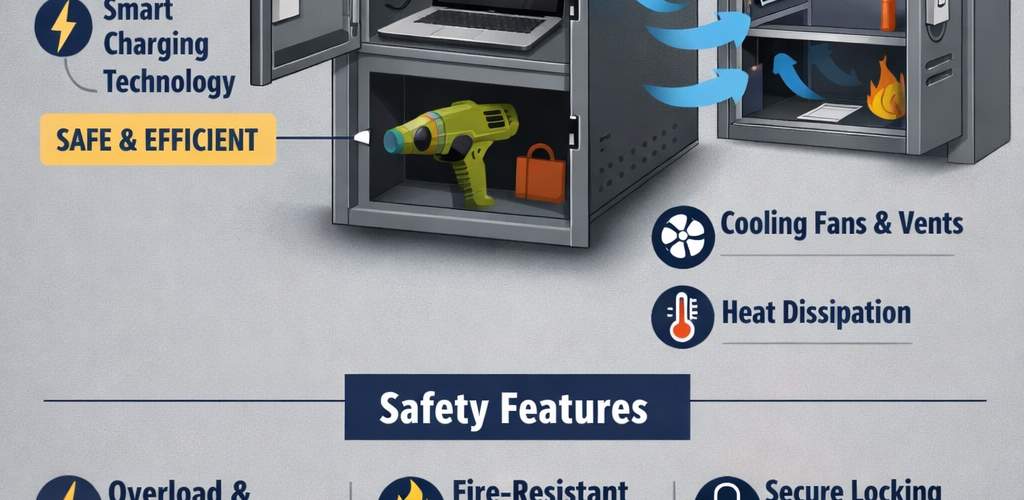
Charging lockers work by combining secure storage with an internal power supply so laptops, tablets, phones, radios, tools or rechargeable batteries can remain locked away while they charge. The basic process is simple: place the equipment inside, connect its charger to the powered compartment, secure the door and leave the equipment charging until it is needed again.
The important difference from an ordinary locker is that the power, charger, cable routing and secure storage are planned as one system. A charging locker is therefore not simply a standard cabinet with a loose extension lead placed inside.
This guide concentrates specifically on how charging lockers work: how power reaches the locker, how sockets and chargers are used, how cables are managed, how equipment remains secure while charging and what happens during normal day-to-day use. For the wider buying and specification process, start with our Charging Lockers UK guide.
Quick Answer: How Does a Charging Locker Work?
- The charging locker is connected to an appropriate power supply.
- Power is distributed to sockets, USB outlets or another charging arrangement inside the unit, depending on the model.
- The user places a device, tool or battery in the compartment.
- The equipment is connected using the appropriate charger.
- The charging cable and power supply remain inside the storage space.
- The locker door is closed and secured.
- Charging continues while the equipment remains stored and protected.
- The user later unlocks the compartment, disconnects the device and removes it ready for use.
The exact electrical arrangement varies between charging locker models, so product instructions and the requirements of the equipment being charged should always be followed.
What a Charging Locker Actually Does
A charging locker performs two jobs at the same time.
- Secure storage: equipment remains behind a lockable door rather than being left on a desk, bench or open shelf.
- Powered storage: the equipment has access to a suitable charging connection while it remains stored.
This combination allows organisations to create a repeatable return-and-charge process. Equipment can be returned to one known location, connected to power and secured ready for the next lesson, shift or task.
If you are deciding whether powered storage is necessary at all, use our separate Charging Lockers vs Standard Lockers guide. This page assumes you already need equipment to charge while securely stored.
How Power Reaches a Charging Locker
A charging locker needs an electrical supply because the cabinet itself has to provide powered charging positions. How the unit connects to the building supply depends on the particular product and installation.
At a high level, the power path is:
- Building electrical supply.
- Charging locker electrical connection.
- Internal power distribution.
- Socket, USB outlet or other charging point.
- Device charger or charging dock.
- Device or rechargeable battery.
This article intentionally keeps the building-electrical side brief. Cable loading, supply capacity, connection methods and other electrical specification questions belong in our dedicated Charging Locker Power Requirements Explained guide.
Internal UK Sockets and Charging Points
Many charging lockers provide internal UK 3-pin sockets. This lets the organisation use the original charger supplied with the laptop, tablet, radio, power tool or battery system.
This arrangement is useful because the locker does not have to reproduce the charging electronics for every possible device. Instead, it provides secure access to mains power while the manufacturer’s own charger performs the charging function.
Depending on the model and intended equipment, other charging arrangements may also be available, including USB charging or dedicated powered connections. Always check the specification of the actual locker rather than assuming every charging unit has the same socket arrangement.
Does the Locker Charge the Device or Does the Charger?
In many charging locker installations, the device’s normal charger still performs the charging. The locker provides the secure powered environment.
| Equipment | Typical charging arrangement |
|---|---|
| Laptop | Original laptop power supply connected to an internal socket |
| Tablet | Mains or USB charging arrangement suited to the device |
| Phone or handheld device | USB adapter, mains charger or charging cradle |
| Radio or scanner | Manufacturer charging dock or power supply |
| Tool battery | Original battery charger connected within the powered storage area |
The actual arrangement depends on the product and equipment. This is why charger dimensions and cable positions need to be considered when choosing the compartment.
For that dimensional decision, use our Charging Locker Sizes UK guide.
The Charging Cycle From Return to Collection
A well-planned charging locker creates a simple user routine.
- Return: the user brings the device or equipment back to the charging area.
- Open: the authorised user opens the appropriate locker or compartment.
- Connect: the equipment is connected to its charger or charging point.
- Store: the device, charger and cable are positioned inside the compartment.
- Secure: the door is closed and locked.
- Charge: the equipment charges while stored.
- Collect: the authorised user returns, unlocks the compartment and disconnects the equipment.
- Use: the charged device or tool returns to service.
The benefit is not only electrical charging. The organisation also gains a predictable place for equipment to be returned and collected.
How Equipment Stays Secure While Charging
The powered connection is located inside the lockable storage space, so the door can be secured after the equipment has been connected.
This means valuable equipment does not have to remain exposed simply because it needs power. Laptops can remain inside individual compartments, tools and batteries can remain inside powered storage and shared devices can be returned to a controlled location between users.
The precise security level depends on the cabinet construction, location and lock selected. Key locks, mechanical combinations, digital locks and RFID options can all suit different management models.
For the lock decision, use our Best Lock Types for Charging Lockers UK guide or browse our locker locks.
How Charging Cables Are Managed
Cable management is part of the normal operation of a charging locker. The cable needs to reach the device without being stretched across the compartment, crushed against the door or repeatedly bent into an awkward position.
A practical internal arrangement provides enough space for:
- the charger body;
- the device connection;
- the plug;
- the cable bend;
- any spare cable length;
- the equipment itself.
Keeping the charging equipment inside the compartment also helps keep the charger associated with the device rather than allowing power supplies to become separated across desks, classrooms or workshops.
Detailed cable and plug clearance belongs in the Charging Locker Sizes UK guide.
Individual Compartments vs Larger Powered Storage
Charging lockers are not all organised in the same way.
Some use individual lockable compartments, allowing each device or user to have a separate secure position. Others provide larger powered spaces designed for several devices, tool batteries or a complete working kit.
| Format | How it works in practice | Typical benefit |
|---|---|---|
| Individual charging compartment | One user or device is secured behind its own door | Clear individual access and separation |
| Multi-compartment charging locker | Several independent powered compartments share one cabinet | High number of secure charging positions |
| Larger powered compartment | More equipment or a larger charger sits within one secure space | Suitable for bulky devices, tools or batteries |
| Shared device storage | Devices are returned to managed powered positions for later issue | Supports pooled equipment |
How many positions you need is a separate capacity decision. See our Charging Locker Capacity Planning guide.
How Assigned and Shared Charging Lockers Work
The same charging principle can support different allocation models.
Assigned use gives a user, team or device a fixed compartment. The same equipment normally returns to the same charging position.
Shared or pooled use allows authorised users to place equipment into available compartments according to the site’s operating process.
The electrical charging process is broadly similar, but the locking and administration method may change. Shared systems often need more deliberate management of access, resets or electronic credentials.
Does the Operating Principle Change for Laptops, Tablets and Tools?
The underlying principle remains the same: secure the equipment, provide suitable power and allow it to charge while stored.
What changes is the physical charging arrangement.
- Laptops: typically need space for the laptop, charging connector and power supply.
- Tablets: can use smaller compartments but protective cases and charging-port positions still matter.
- Phones and handheld equipment: may use compact adapters, USB connections or charging cradles.
- Power tools and batteries: often use larger manufacturer charging docks and therefore need more internal volume.
For application-specific detail, see our laptop and tablet charging lockers and tool and battery charging lockers.
What Happens When Power Is Switched Off?
If the electrical supply to a conventional charging locker is isolated, the storage function remains but connected equipment will no longer receive charging power.
How isolation is provided and who is authorised to disconnect the supply depends on the installation. Electrical maintenance and isolation arrangements should be established as part of the site’s electrical system rather than improvised by locker users.
For electrical connection and supply planning, use our Charging Locker Power Requirements Explained UK guide.
Where Ventilation Fits Into the System
Chargers and rechargeable equipment can generate heat while operating. A charging locker therefore needs to be used with its designed ventilation paths unobstructed and in accordance with the manufacturer’s requirements.
This technical-operation guide does not repeat the airflow topic because it has its own dedicated page. For heat, vents, airflow paths and charging-environment considerations, read Do Charging Lockers Need Ventilation?
Where Installation Fits Into the System
The charging locker needs to be positioned where users can access it and where the intended power connection can be provided. Beyond that, location, room footprint, door opening and circulation are separate planning topics.
Use our Where to Install Charging Lockers UK guide for the siting decision.
Why a Charging Locker Is More Than a Standard Locker With Power Added
A purpose-built charging locker brings the electrical connection, secure compartment, charger space and cable arrangement together as one product concept.
By contrast, placing loose extension leads or chargers into furniture that was not specified for powered storage can create problems with:
- cable routing;
- plug and charger clearance;
- equipment fit;
- ventilation;
- electrical access;
- maintenance;
- consistent day-to-day use.
If your decision is still between powered and non-powered storage, see Charging Lockers vs Standard Lockers.
How to Make a Charging Locker Work Well Day to Day
The electrical system can work correctly while the operating process still fails. Users need a clear routine for returning and collecting equipment.
- Give devices a clear return location.
- Keep chargers associated with the correct equipment.
- Make sure cables are returned inside the compartment rather than trapped in doors.
- Define who can access each locker or bank.
- Keep unused equipment from blocking ventilation openings.
- Report damaged sockets, cables, locks or doors rather than continuing to use them.
- Remove equipment from service where its own charger or battery is damaged.
A charging locker is most useful when the storage and charging routine is simple enough that users follow it consistently.
Charging Locker Maintenance
Maintenance should cover both the locker hardware and the powered components.
Routine visual checks can include:
- damaged or loose doors;
- failed locks;
- damaged internal sockets or charging points;
- frayed or damaged user chargers;
- cables being trapped in doors;
- blocked ventilation openings;
- loose internal fittings;
- signs of impact or misuse.
Electrical inspection, testing and repair should be carried out by appropriately competent people in accordance with the product and site requirements.
Use the Right Charging Guide for the Next Question
This article owns the technical operating principle. The supporting charging canister separates the other specification questions deliberately:
| Question | Use this guide |
|---|---|
| What are charging lockers and which type should I buy? | Charging Lockers UK Guide |
| What size compartments do I need? | Charging Locker Sizes UK |
| How many charging positions do I need? | Charging Locker Capacity Planning |
| Do charging lockers need ventilation? | Charging Locker Ventilation Guide |
| Where should the charging locker be installed? | Charging Locker Placement Guide |
| What electrical supply is required? | Charging Locker Power Requirements |
| Which lock should the charging locker use? | Charging Locker Lock Types |
| Do I need powered storage at all? | Charging Lockers vs Standard Lockers |
Common Misunderstandings About How Charging Lockers Work
- “The locker replaces the device charger.” Often it provides power while the equipment still uses its normal charger.
- “Every charging locker has the same socket arrangement.” Power outlets vary by model and intended use.
- “The device only needs to fit by itself.” The charger, plug, connector and cable arrangement also occupy space.
- “A standard locker can always be converted by adding a plug.” Purpose-built charging storage should be specified around powered use.
- “All users need their own permanent compartment.” Some installations use assigned compartments while others manage shared equipment pools.
- “Charging lockers solve equipment management automatically.” Users still need a clear return, charging and collection process.
- “Ventilation, location and electrical supply are the same question as operation.” They are related, but each requires its own specification check.
How Charging Lockers Work FAQs
How does a charging locker work?
A charging locker provides secure storage with access to power inside the locker. The user places equipment inside, connects the appropriate charger, closes and locks the door, and the equipment continues charging while stored.
Does a charging locker replace the laptop or device charger?
Often no. Many charging lockers provide an internal UK socket so the original charger supplied with the laptop, tablet, tool or battery can be used inside the secure compartment.
Can equipment charge while the locker door is locked?
Yes, purpose-built charging lockers are designed so equipment can remain connected to the internal charging arrangement while secured behind the locker door, subject to the operating instructions for the particular model.
What powers a charging locker?
The charging locker connects to an electrical supply and distributes power internally to its charging positions. The exact connection and electrical requirements depend on the locker model and installation.
Do charging lockers have normal UK plug sockets?
Many UK charging lockers use internal 3-pin sockets so original device chargers can be connected inside the cabinet. Other models may use USB or different charging arrangements, so check the specification of the particular product.
How are cables kept inside a charging locker?
The compartment should provide enough usable space for the charger, plug, connector and cable routing so the lead can reach the equipment without being stretched or trapped by the door.
Can one charging locker charge different types of device?
Potentially, if the compartments, power outlets and charging arrangements suit those devices. Compatibility should be checked against the largest equipment, charger and accessories that need to use the locker.
What happens if the power to a charging locker is switched off?
The cabinet can continue to provide physical storage and security, but connected equipment will stop receiving charging power until the electrical supply is restored.
Do charging lockers need ventilation?
Charging equipment can generate heat, so designed ventilation openings and airflow paths should remain unobstructed. The exact ventilation requirement depends on the locker and equipment, so follow the relevant product instructions.
Are charging lockers only for laptops?
No. Charging lockers can be designed for laptops, tablets, phones, radios, scanners, tools, rechargeable batteries and other powered equipment, provided the storage and charging arrangement suits the application.
How Charging Lockers Work: Summary
Charging lockers work by bringing three things together: secure storage, internal access to power and an organised charging process. Equipment is placed inside, connected using the appropriate charger, secured behind the locker door and left charging until it is required again.
The locker normally provides the powered storage environment rather than replacing the device’s own charging electronics. Internal sockets or charging points supply power, while the charger, cables and device remain organised inside the compartment.
Once you understand that operating principle, the next specification questions should be handled separately: use the Charging Locker Sizes UK guide for physical fit, the capacity guide for compartment numbers, the ventilation guide for airflow and the placement guide for siting.
To compare current powered storage options, browse our charging lockers, laptop and tablet charging lockers and tool and battery charging lockers, or return to the main Charging Lockers UK guide.
Discover more from Blog Total Locker Service
Subscribe to get the latest posts sent to your email.