Office cash safe storing petty cash, company cards, keys and business valuables in a UK workplace
September 24, 2026
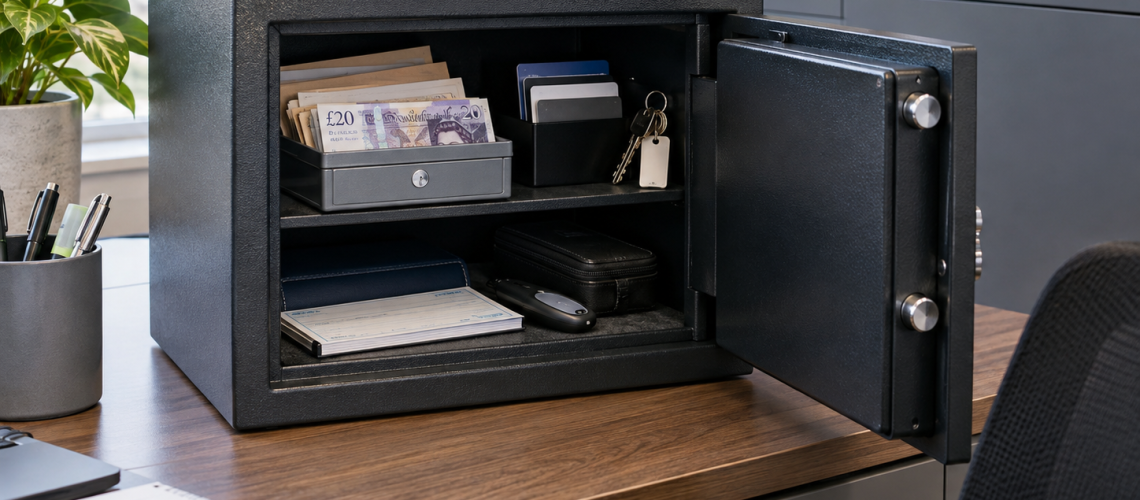
Office cash safes are often used for much more than banknotes. A business may need secure storage for petty cash, company cards, cheque books, spare keys, payment devices, stamps, confidential items and other small valuables. The correct safe should match the value being protected, the number of authorised users, the physical contents and the way access is managed day to day.
This guide explains how to choose a cash safe for a UK office, including petty-cash storage, company cards, business keys, small valuables, lock choice, internal capacity, staff access, installation and the difference between cash security, document fire protection and data-safe storage.
Quick Answer: What Safe Does an Office Need?
A small office may only need a compact security safe for petty cash, company cards, keys and small valuables. Larger businesses or offices holding more valuable contents should choose the safe around the maximum value stored, required cash or valuables rating, internal dimensions, authorised users and any insurer requirements. If the main risk is fire rather than theft, a fire safe may be more appropriate.
| Office storage requirement | Safe or storage type to consider |
|---|---|
| Petty cash | Compact security or cash safe |
| Company cards | Security safe with controlled access |
| Cheque books | Cash or valuables safe |
| Safe keys and restricted keys | Cash safe or separate secure key-storage system |
| Important paper records | Document fire safe where fire protection is required |
| Digital backup media | Data or media safe where fire protection is required |
| Higher-value cash and valuables | Appropriately rated high-security safe |
What Do Offices Store in Cash Safes?
An office cash safe may contain a mixture of money, credentials and small valuable items rather than large quantities of cash alone.
- petty cash;
- company debit or credit cards;
- cheque books;
- cash envelopes;
- banking documents;
- spare keys;
- vehicle keys;
- security tokens;
- payment terminals;
- stamps;
- small electronic devices;
- confidential items;
- valuable stock or samples.
The correct safe therefore depends on both the monetary value and the operational importance of the contents.
Petty Cash Safes for Offices
Petty cash is one of the most common office-safe applications. Even where the amount is modest, keeping it in an unlocked desk drawer creates unnecessary access and makes responsibility difficult to control.
A compact safe can provide a fixed storage location while limiting access to authorised employees.
Define the petty-cash process
The safe is only one part of the process. The business should also decide:
- who is responsible for petty cash;
- who may remove money;
- how transactions are recorded;
- how often the balance is checked;
- who replenishes the fund;
- what happens when the responsible employee is absent.
Restricting access to the safe helps make the financial procedure easier to manage.
Storing Company Cards in an Office Safe
Company payment cards may be physically small, but they can provide access to significant business funds.
Where cards are shared between authorised employees, secure storage can help prevent them being left in desk drawers, trays or open office areas.
The business should define:
- which cards exist;
- who may use them;
- where they are stored;
- how issue and return are recorded where required;
- who can access the safe;
- what happens if a card is missing.
If only a few cards and small valuables are stored, a compact office safe may provide adequate physical capacity.
Cheque Books and Banking Materials
Businesses that still use cheque books, paying-in books or physical banking materials may also choose to keep them in secure storage.
These items do not normally require a large safe, but they may need restricted access because they can be financially sensitive.
Measure folders, wallets and envelopes before selecting a compact safe so that documents can be stored flat rather than folded or forced into the available space.
Can Business Keys Be Stored in the Cash Safe?
Yes, where the number of keys is small and the authorised users overlap with the people permitted to access the safe.
Examples may include:
- spare building keys;
- vehicle keys;
- restricted cupboard keys;
- master keys;
- safe override keys;
- keys for valuable equipment.
However, a safe is not always the best solution for a large key estate. If many keys need identification, issue records or regular access, a dedicated key cabinet or key-management system may be more practical.
See How to Manage Keys in the Workplace UK for the wider key-control process.
Where Should Spare Safe Keys Be Stored?
A spare operating or override key should not normally be stored beside the safe it opens.
If an emergency key is kept in an unlocked drawer next to an electronic safe, unauthorised access to the drawer may undermine the safe’s access control.
Spare safe keys should be:
- restricted to authorised personnel;
- stored separately from the safe where practical;
- identified without making their purpose unnecessarily obvious;
- included in the business key-control procedure;
- accounted for when staff responsibilities change.
Small Business Valuables and Equipment
Office safes may also protect compact items whose replacement cost or operational importance is greater than their physical size suggests.
- security tokens;
- authentication devices;
- company phones;
- portable drives;
- small specialist tools;
- valuable samples;
- access cards;
- restricted stamps or seals.
List the maximum combination of items likely to be stored before choosing internal capacity.
How Much Security Does an Office Safe Need?
The required level depends on the maximum value stored and the consequences of loss.
A small petty-cash fund presents a different security requirement from a safe holding larger cash balances, valuable items or financially sensitive credentials.
Consider:
- maximum cash amount;
- value of other contents;
- how long contents remain unattended;
- whether the office is occupied outside normal hours;
- building access controls;
- alarm arrangements;
- safe fixing;
- any insurer requirements.
For cash ratings and higher-security safe grades, see Cash Safes UK and Insurance Rated Safe UK.
What Size Safe Does an Office Need?
Compact office safes can provide enough room for petty cash and cards, but requirements increase quickly when folders, keys, cash bags or devices are added.
Before ordering, gather the largest objects and measure:
- height;
- width;
- depth;
- maximum quantity stored;
- any envelopes or containers used.
Then compare the requirement with the safe’s internal dimensions and clear door opening.
See Cash Safe Size Guide UK for detailed sizing guidance.
Key or Electronic Safe for an Office?
Both locking methods can suit office use.
Key locking may suit:
- very small offices;
- owner-managed businesses;
- sites with one or two authorised users;
- businesses with strong key control.
Electronic locking may suit:
- offices with several authorised managers;
- businesses where staff responsibilities change;
- sites where changing a code is easier than recovering keys;
- applications requiring additional electronic lock functions.
See Key vs Electronic Cash Safes UK for a full comparison.
Who Should Have Access to an Office Safe?
Safe access should follow business responsibility rather than general office access.
Possible authorised users might include:
- business owners;
- finance staff;
- office managers;
- designated administrators;
- specific directors or senior managers.
Not every employee who works in the office needs safe access.
Review access when staff change roles
If a key holder leaves, recover the key. If a person who knows an electronic safe code no longer requires access, review whether the code should be changed.
Access control should remain current rather than reflecting who needed access several years ago.
Where Should an Office Safe Be Installed?
The safe should be accessible to authorised users while remaining discreet and securely installed.
Possible locations include:
- finance offices;
- restricted administration rooms;
- secure stockrooms;
- management offices;
- appropriate cupboards where structural fixing remains possible.
A safe should not be placed purely for concealment if the chosen position prevents correct anchoring or makes everyday access impractical.
See Cash Safe Installation & Fixing UK for floor anchoring, wall fixing and placement guidance.
Can an Office Safe Be Installed Inside a Cupboard?
Yes, where the safe remains usable and can be securely fixed to an appropriate building structure.
Check:
- the cupboard opening;
- safe external dimensions;
- safe door clearance;
- access to fixing points;
- cupboard base strength;
- the structural wall or floor behind the furniture;
- access for electronic lock battery replacement.
Do not rely on thin furniture panels as the sole security fixing where the safe is intended to be structurally anchored.
Office Cash Safe vs Fire Safe
An office cash safe and an office fire safe solve different primary problems.
| Primary requirement | Safe type to consider |
|---|---|
| Protect petty cash from theft | Security or cash safe |
| Protect company cards and valuables | Security safe |
| Protect paper documents from fire | Document fire safe |
| Protect digital backup media from fire | Data or media safe |
| Protect cash and paper | Safe providing appropriate security and fire protection |
For paper records and office fire protection, see What Fire Safe Do I Need for My Business?.
Should USB Drives and Backup Media Go in the Office Cash Safe?
A cash safe can physically store USB drives or portable hard drives, but that does not mean it provides appropriate fire protection for them.
Digital media can require lower internal temperatures than ordinary paper documents during a fire.
If local backup media needs physical fire protection, see Data Safes vs Fire Safes.
The Safe as Part of Wider Office Security
The safe should form one part of the office’s wider storage and access system.
An office may also require:
- staff lockers;
- key cabinets;
- filing cabinets;
- secure cupboards;
- data storage;
- device lockers;
- charging storage;
- restricted document storage.
Use each product for the storage job it handles best rather than forcing all valuables, documents and keys into one safe.
For the wider workplace picture, see Workplace Storage Systems UK.
Cash Safes for Small Businesses
A small business may have only modest cash holdings but still need secure storage for cards, keys and financially sensitive items.
A simple arrangement might include:
- one compact security safe;
- one or two authorised users;
- a recorded petty-cash balance;
- company cards returned after use;
- spare keys kept under controlled access;
- regular checks of safe contents.
The safe should still be fixed correctly and selected according to the maximum value stored.
Cash Safes for Larger Offices
Larger businesses may have more departments, authorised users and valuable items to control.
Rather than simply buying a larger safe, consider whether the contents should be divided between systems.
- Cash and financial items in the safe.
- Large key estates in a dedicated key cabinet.
- Paper records in secure filing or fire-resistant storage.
- Digital media in appropriate data protection.
- Staff possessions in lockers.
This can produce clearer access rules and more usable storage than one oversized safe containing unrelated items.
Example Office Safe Procedure
- Identify authorised safe users.
- Record the petty-cash opening balance where applicable.
- Store company cards and financial items when not in use.
- Record removals according to company procedure.
- Return cards, keys and unused cash promptly.
- Secure the safe when unattended.
- Check the contents periodically.
- Review access when staff roles change.
- Secure spare keys or override credentials separately.
- Review the safe capacity and security level if the stored value increases.
This is an example structure rather than a universal office policy. Each business should adapt its procedure to its own financial controls and staffing.
Common Office Cash-Safe Mistakes
- Keeping petty cash in an unlocked desk drawer: use controlled secure storage.
- Giving the entire office access: restrict safe access to staff who genuinely require it.
- Leaving company cards unsecured: return cards to controlled storage after use.
- Keeping the spare safe key beside the safe: backup access should also be protected.
- Using the safe as an unstructured key drawer: large key estates may need a dedicated key cabinet.
- Choosing by external size: check usable internal dimensions.
- Buying a fire safe when the main requirement is burglary protection: match the product to the risk.
- Assuming a cash safe protects digital media from fire: data protection requires separate consideration.
- Failing to review access when employees leave: recover keys or change codes as appropriate.
- Failing to anchor the safe: follow the manufacturer’s installation requirements.
Office Cash Safe Selection Checklist
- How much petty cash is normally held?
- What is the maximum cash amount?
- Will company cards be stored?
- Will cheque books or banking materials be stored?
- Will keys be stored inside?
- Are there other valuables or electronic devices?
- What internal dimensions are required?
- How many people need access?
- Would key or electronic locking suit the business better?
- How will spare keys or override credentials be controlled?
- What cash or valuables rating is required?
- Does an insurer specify a particular safe?
- Where will the safe be installed?
- Can it be securely anchored?
- Will the safe fit through the delivery route?
- Do documents also require fire protection?
- Does digital media require specialist protection?
- Would a separate key cabinet or filing system be more suitable for some contents?
Office Cash Safe FAQs
What safe does a small office need?
A compact security safe may be sufficient where the office only needs to protect petty cash, company cards, keys and small valuables. Choose the security level and capacity around the maximum contents.
Should petty cash be kept in a safe?
A secure safe provides better physical access control than leaving petty cash in an unlocked drawer or desk. Access should still be supported by an appropriate petty-cash procedure.
Can company credit cards be stored in a safe?
Yes. A safe can provide controlled physical storage for company payment cards when they are not being used.
Can office keys be stored in the safe?
Yes, particularly where only a small number of restricted keys need secure storage. Larger key estates may be easier to manage in a dedicated key cabinet.
Should an office safe use a key or electronic lock?
Either can be suitable. Key locks can work well with a small stable user group, while electronic locks can make credential changes easier where authorised personnel change.
Can an office safe be hidden in a cupboard?
Yes, where the safe can still be securely anchored, opened properly and accessed by authorised users. Do not rely solely on thin cupboard panels for structural fixing.
Does an office cash safe protect documents from fire?
Not automatically. Burglary resistance and fire resistance are separate specifications. Choose a suitable fire safe where document fire protection is required.
Can USB drives be kept in an office safe?
They can be stored physically, but a standard cash safe should not automatically be assumed to provide suitable fire protection for digital media.
Should an office safe be bolted down?
Where the safe is designed for anchoring, follow the manufacturer’s fixing instructions and any insurer requirements.
Who should know the safe code?
Only employees who genuinely require access should have the code. Review credentials whenever authorised staff leave or change responsibilities.
Choose an Office Safe Around What Actually Needs Protection
An office cash safe may protect a relatively small amount of money but still play an important role in controlling company cards, keys, banking materials and other valuables.
Start by listing the contents, maximum stored value and authorised users. Then choose the required safe size, security level and lock type before deciding where it will be installed.
Do not expect one safe to solve every office storage problem. Use dedicated fire protection for important paper records, data safes for sensitive media and key-management systems where a larger key estate needs structured control.
Related Cash Safe Guides and Products
- Cash Safes UK
- Deposit Safes UK
- Under-Counter Cash Safes UK
- Cash Safe Installation & Fixing UK
- Cash Safe Size Guide UK
- Key vs Electronic Cash Safes UK
- Cash Safes for Retail Shops UK
- Cash Safes for Hospitality UK
- Insurance Rated Safe UK
- Workplace Key Management UK
- What Fire Safe Do I Need for My Business?
- Safes UK
Discover more from Blog Total Locker Service
Subscribe to get the latest posts sent to your email.