Key vs Electronic Cash Safes UK
September 24, 2026
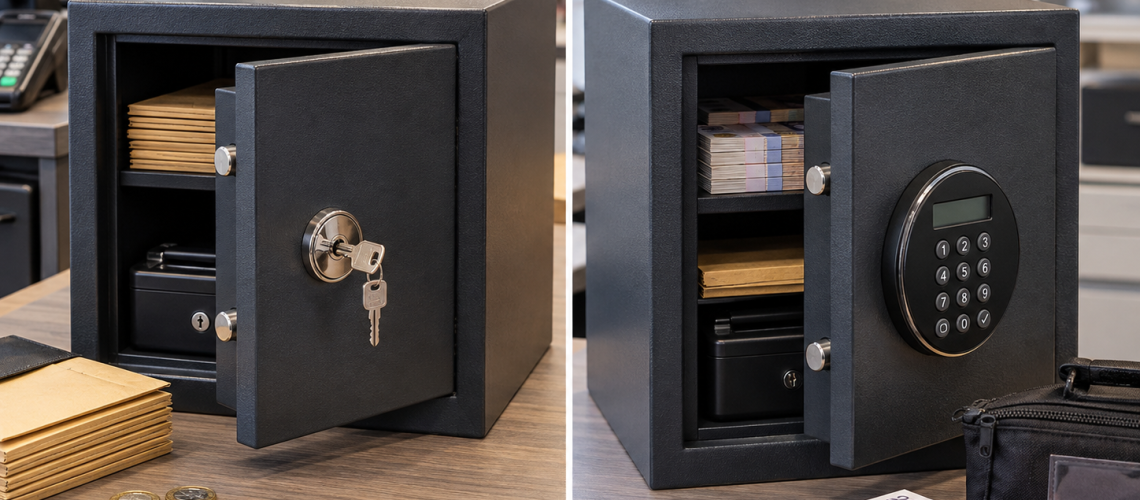
Choosing between a key lock and an electronic lock is one of the most important practical decisions when buying a cash safe. Both can provide appropriate security when fitted to a suitable safe, but they create very different day-to-day management requirements. A key lock depends on physical key control, while an electronic safe depends on code management, batteries and authorised-user procedures.
This guide compares key, electronic keypad and biometric locking for UK business cash safes. It covers access frequency, staff changes, lost keys, forgotten codes, battery management, dual control, time delay, override arrangements and how to choose the right locking method for retail, offices, hospitality and higher-security commercial storage.
Quick Answer: Key Lock or Electronic Safe?
A key-lock safe is usually the simpler choice where only one or two trusted people need access and physical key control is easy to manage. An electronic safe can be more practical where authorised staff change regularly, codes need to be updated or functions such as dual control, time delay or multiple users are required. The correct choice depends on the exact safe and lock specification, not simply whether the lock is mechanical or electronic.
| Requirement | Lock type to consider |
|---|---|
| Very small number of authorised users | Key lock |
| Regular staff changes | Electronic lock |
| No batteries wanted | Key lock |
| Codes need to be changed easily | Electronic lock |
| Dual-control access required | Suitable high-security electronic lock |
| Time-delay access required | Suitable electronic lock |
| Fingerprint access required | Biometric safe |
| Simple mechanical operation preferred | Key lock |
Start With the Safe Security Level, Not the Lock Type
A key lock does not automatically mean low security, and an electronic keypad does not automatically mean high security.
The burglary resistance of the complete safe depends on the safe body, door, locking system, certification, fixing and overall construction.
High-security safes may be available with either certified key locks or certified electronic locks. Lower-cost office safes may also offer both options.
Choose the required safe security level first. Then compare the lock options available within that safe range.
For the wider security decision, see Cash Safes UK: Security Ratings, Insurance Grades and Business Cash Protection.
How Does a Key-Lock Cash Safe Work?
A key-lock safe uses a physical key to operate the locking mechanism. Depending on the safe, this may be a conventional security key or a high-security double-bitted key.
The main advantages are simplicity and independence from batteries, programming and remembered codes.
Advantages of key-lock safes
- simple operation;
- no batteries;
- no PIN to remember;
- straightforward for a very small authorised-user group;
- high-security certified key locks are available on higher-grade safes;
- no electronic programming required.
Disadvantages of key-lock safes
- physical keys need secure control;
- lost keys can create a security and access problem;
- staff changes may require key recovery rather than simply changing a code;
- spare keys also need secure storage;
- keys can be copied or mishandled depending on the system;
- the key must be available when authorised access is required.
The main management question is therefore not whether the key lock itself is reliable, but whether the organisation can control the safe keys reliably.
Safe Key Management
A key-operated safe is only as well managed as its key-control procedure.
The organisation should know:
- how many keys exist;
- who holds each key;
- where spare keys are stored;
- whether keys may leave the premises;
- what happens if a key is lost;
- who is authorised to request replacements;
- whether former employees have returned their keys.
Do not store a spare safe key in an unlocked drawer beside the safe. That undermines the purpose of restricting access.
Who should hold the key?
For a small business, the owner or manager may hold the operating key. Larger organisations may nominate specific finance, cash-office or duty-management personnel.
The number of key holders should reflect operational need rather than convenience.
How Does an Electronic Cash Safe Work?
An electronic cash safe normally uses a keypad and programmed code instead of relying solely on a physical operating key.
Electronic locking ranges from simple user PIN systems to high-security locks with features such as master codes, dual control and time delay.
Advantages of electronic safes
- no day-to-day operating key required on many models;
- codes can often be changed when staff leave;
- multiple authorised users may be supported depending on the lock;
- some high-security locks provide dual control;
- some provide time delay;
- some provide master-code functions;
- credentials can be changed without replacing a physical key.
Disadvantages of electronic safes
- batteries need monitoring;
- codes can be forgotten;
- poorly managed shared codes reduce accountability;
- different locks have very different functionality;
- users need to understand the lock procedure;
- emergency access arrangements need to be understood.
The main benefit is administrative flexibility, but only when the code-management procedure is properly controlled.
Should Staff Share One Safe Code?
Where an electronic lock supports only a single user code, the organisation may have limited choice. However, sharing a code between many staff reduces the ability to associate access responsibility with a particular person.
Where the lock supports individual user credentials, separate codes may provide better control.
The exact number of users and available functions depend on the lock fitted to the safe. Do not assume every digital safe supports multiple individual codes.
Change codes when responsibilities change
If an employee with knowledge of the safe code leaves the organisation or no longer requires access, review whether the code should be changed.
This can be much simpler than recovering or replacing physical keys, provided the safe’s programming procedure is understood and controlled.
Battery Management for Electronic Safes
Electronic safe locks normally depend on batteries, so battery management becomes part of the maintenance process.
Businesses should know:
- what battery type the lock uses;
- how low-battery warnings are displayed;
- how batteries are replaced;
- whether the code is retained during battery replacement;
- what emergency access procedure applies if the battery fails.
Do not wait until the safe is needed urgently before learning how its low-battery procedure works.
What Happens if the Safe Code Is Forgotten?
The recovery process depends on the safe model and lock.
Some compact electronic safes include an emergency key override. Higher-security safes may instead use controlled management or service procedures.
Before buying an electronic safe, establish:
- what happens if the user code is forgotten;
- whether a master code exists;
- whether an override key is supplied;
- who should control any override facility;
- what happens if both normal and emergency access are unavailable.
An emergency override should itself be protected. Leaving an override key beside the safe removes much of the security benefit.
What Is Dual Control on a Cash Safe?
Dual control requires two authorised inputs or users before the safe can be opened, depending on the lock design.
This can be useful where an organisation does not want one person to have unilateral access to high-value cash or valuables.
Dual control may be appropriate for:
- cash offices;
- higher-value retail operations;
- finance departments;
- controlled commercial storage;
- sites with formal two-person access procedures.
Dual control is not a feature of every electronic lock. Check the exact safe specification.
What Is a Time-Delay Safe Lock?
A time-delay function prevents the safe from opening immediately after a valid code is entered. The user must wait for a programmed period before access becomes possible.
This can form part of a higher-security cash-management procedure, particularly where immediate access to large cash holdings is undesirable.
Some higher-security electronic safe locks include time-delay functions, while ordinary office-safe keypads may not.
Do not confuse an electronic keypad with a time-delay lock. The functionality must be stated for the particular lock.
What About Fingerprint and Biometric Safes?
Some commercial safes are available with fingerprint or combined touchscreen and biometric locking.
A biometric safe can allow an authorised user to access the lock using a registered fingerprint rather than relying only on a physical key or remembered PIN.
Potential advantages include:
- no physical operating key for normal use;
- reduced reliance on remembered codes;
- multiple registered users on suitable systems;
- rapid access for authorised personnel.
However, functionality varies significantly. Check user capacity, fallback access, programming, battery requirements and the actual security certification of the lock.
The Phoenix SS0990 Cashier Deposit Safe range, for example, includes key, electronic and touchscreen/fingerprint lock variants.
Key vs Electronic Locks for Small Office Safes
Small office and retail safes often provide the clearest choice between a simple key lock and a straightforward electronic keypad.
The Phoenix Vela SS0800 range, for example, is available with either key or electronic locking.
A small business with one owner and one spare authorised user may prefer the simplicity of keys. A business with changing managers may prefer the ability to change an electronic code.
The choice is primarily operational once the required security specification has been established.
Key vs Electronic Safes for Retail Businesses
Retail businesses often have changing shifts and several levels of responsibility, which can make access management particularly important.
Consider:
- how many managers require access;
- whether the same people work every day;
- how frequently staff change;
- whether access needs to be removed quickly;
- whether dual control is required;
- whether the safe is opened frequently during trading;
- who manages codes or keys.
For a deposit-safe workflow, front-line staff may not need access to the main lock at all. They can make deposits while retrieval remains restricted to nominated managers.
See Deposit Safes UK: Cash Handling, Till Drops and Staff Deposit Security.
Key vs Electronic Safes for Hospitality
Hotels, restaurants, bars and venues often combine long operating hours with changing duty managers and multiple shifts.
An electronic lock can make access changes easier where management responsibility changes regularly, while a key lock may still suit smaller owner-operated businesses.
The lock should support the site’s staffing model rather than forcing the staffing model to work around the lock.
Lock Choice on High-Security Safes
High-security safes may be available with certified key or electronic locks, and some configurations combine both.
The Phoenix Neptune HS1050 range, for example, is available with high-security key locking or electronic locking. Electronic variants include features such as dual control, master code and time delay on suitable models.
The Phoenix Planet HS6070 range provides higher-grade security and includes configurations combining high-security electronic and key locking.
At this level, lock selection should be considered alongside:
- safe grade;
- cash and valuables rating;
- insurer requirements;
- dual control;
- time delay;
- number of authorised users;
- site security procedures;
- installation and anchoring.
See Insurance Rated Safe UK: EN 14450 vs EN 1143 for the certification side of safe selection.
Lost Key vs Forgotten Safe Code
| Problem | Key-lock safe | Electronic safe |
|---|---|---|
| User loses access credential | Lost physical key | Forgotten or unavailable code |
| Staff member leaves | Recover key and review spares | Change or remove code where supported |
| Backup access | Controlled spare key | Depends on lock: master code, override or service procedure |
| Power requirement | None for normal mechanical operation | Usually battery-powered |
| Access changes | Physical key administration | Electronic programming |
Is a Key Safe More Secure Than an Electronic Safe?
Lock type alone does not answer this question.
A high-security certified electronic lock can provide a much higher level of protection than a basic mechanical lock. Equally, a certified high-security key lock can provide far greater protection than a low-cost domestic keypad.
Compare:
- the complete safe security standard;
- the certification of the lock;
- the safe construction;
- the fixing method;
- the way credentials are managed;
- the operational requirements of the business.
A badly managed high-security lock can also create operational weaknesses. Security depends on the complete system.
When Is a Key-Lock Cash Safe a Good Choice?
A key lock can be a sensible choice where:
- only one or two trusted people need access;
- the organisation already has strong physical key control;
- staff turnover is low;
- electronic features are unnecessary;
- the business wants to avoid battery management;
- simple operation is preferred.
The organisation must still decide how spare and replacement keys will be controlled.
When Is an Electronic Cash Safe a Good Choice?
An electronic safe can be particularly useful where:
- authorised personnel change regularly;
- codes need to be changed without replacing physical keys;
- several users require access;
- dual control is required;
- time delay is required;
- master-code management is needed;
- the business wants to reduce dependence on physical keys.
Check which of these functions are actually supported by the selected lock.
Cash Safe Lock Selection Checklist
- How many people need to open the safe?
- How often will it be opened?
- How frequently do authorised staff change?
- Can physical safe keys be controlled reliably?
- Would changing a code be easier than recovering keys?
- Does the organisation need individual user credentials?
- Is dual control required?
- Is time delay required?
- Is a master code required?
- Does the electronic lock have an override system?
- Who will control any override key?
- Who will manage battery replacement?
- Does the lock have the certification required for the safe grade?
- Does an insurer specify a particular locking arrangement?
- How will access be revoked when an employee leaves?
Common Cash Safe Locking Mistakes
- Assuming electronic automatically means more secure: compare the complete safe and lock specification.
- Leaving spare keys near the safe: backup access must also be secured.
- Giving too many people the same PIN: shared credentials reduce control.
- Failing to change codes after staff leave: access procedures need to follow staffing changes.
- Ignoring batteries: understand low-battery warnings and replacement procedures.
- Buying a keypad and assuming it has time delay: advanced functions are model-specific.
- Assuming every electronic safe has an override key: recovery methods vary.
- Choosing lock type before security grade: establish the safe requirement first.
- Ignoring key replacement: establish what happens if an operating key is lost.
- Failing to document authorised users: know who is permitted to open the safe.
Key vs Electronic Cash Safe FAQs
Is a key safe better than an electronic safe?
Neither is automatically better. A key lock can be simpler for a very small number of users, while electronic locking can make access changes easier where staff or codes change regularly.
Are electronic cash safes secure?
Electronic locks range from simple office-safe keypads to certified high-security systems. Security depends on the exact lock, safe construction and certification.
What happens if an electronic safe battery goes flat?
The procedure depends on the safe. Some models provide external battery access or emergency override arrangements, while others use different recovery procedures. Check the manufacturer’s instructions.
What happens if I lose a safe key?
The available options depend on the lock and key system. Keep spare keys securely controlled and establish the replacement or service procedure before an emergency occurs.
Can a safe code be changed?
Many electronic safe locks allow user codes to be changed. The exact programming procedure and number of available users depend on the model.
What is dual control on a safe?
Dual control requires two authorised inputs or users before access is permitted, depending on the lock design. It is commonly used where one person should not have sole access to higher-value contents.
What is time delay on a safe?
Time delay introduces a programmed waiting period between valid authorisation and the safe becoming available to open. It is a feature of some higher-security electronic locks.
Are fingerprint safes suitable for businesses?
They can be, depending on the required security level and product specification. Check user capacity, fallback access, battery requirements and certification before choosing biometric access.
Do electronic safes still have keys?
Some do and some do not. Compact electronic safes may include a mechanical emergency override, while high-security systems can use different arrangements. Check the exact model.
Which safe lock is best for several managers?
An electronic lock with suitable multi-user or management functions may be easier to administer where several managers need access, but the exact lock capabilities should be checked before purchase.
Choose the Lock Around the Business Process
The choice between a key and electronic cash safe should be based on how the safe will actually be managed.
Key locking can provide simple, dependable operation where a small number of trusted people control the keys. Electronic locking can make access administration easier where users change regularly or where features such as dual control, time delay or multiple credentials are required.
Neither lock type should be considered independently of the safe itself. Start with the required security level, cash rating, size and installation, then choose the locking system that best supports the organisation’s access procedure.
Related Cash Safe Guides and Products
- Cash Safes UK: Security Ratings, Insurance Grades and Business Cash Protection
- Deposit Safes UK: Cash Handling, Till Drops and Staff Deposit Security
- Under-Counter Cash Safes UK
- Cash Safe Installation & Fixing UK
- Cash Safe Size Guide UK
- Insurance Rated Safe UK: EN 14450 vs EN 1143
- Phoenix Vela Key and Electronic Safes
- Cashier Deposit Safes
- Phoenix Neptune High-Security Safes
- High-Security Safes
Discover more from Blog Total Locker Service
Subscribe to get the latest posts sent to your email.