Cash Safes for Hospitality UK: Hotels, Pubs, Restaurants and Shift Cash Management
September 24, 2026
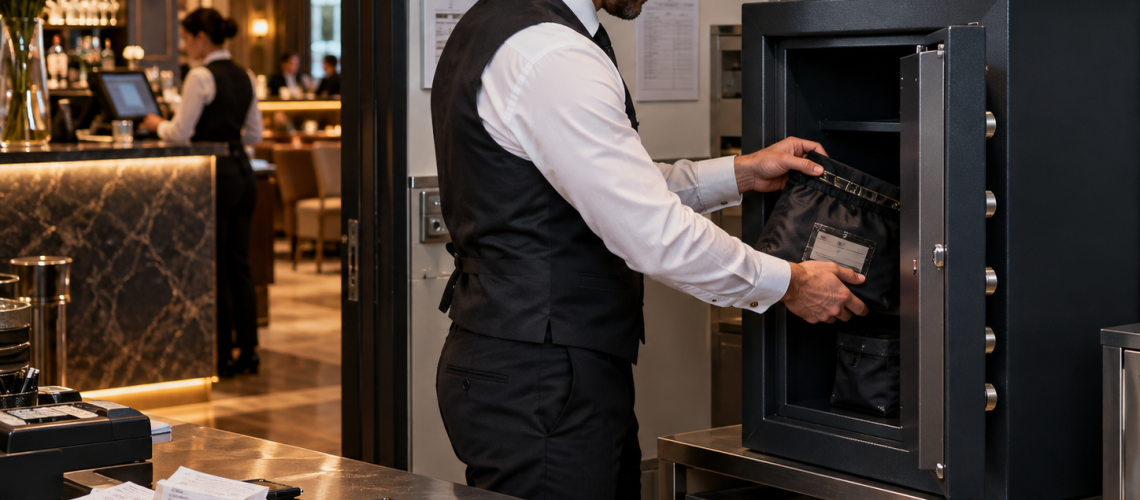
Hotels, pubs, restaurants, cafés and hospitality venues often handle cash across several tills, departments and staff shifts. A suitable cash-safe system should do more than provide somewhere to place takings at the end of the night. It should support controlled cash drops during trading, restrict access to accumulated money, simplify shift handovers and provide suitable overnight storage for the maximum amount likely to remain on site.
This guide explains how UK hospitality businesses can choose and use cash safes, including under-counter note safes, deposit safes, shift cash management, bar and restaurant tills, hotel reception cash, overnight holdings, locking options, staff access and safe installation.
Quick Answer: What Cash Safe Does a Hospitality Business Need?
A hospitality business should choose its safe around the maximum amount of cash held, the number of payment points, how often staff need to make deposits and who should be allowed to retrieve accumulated takings. Bars, restaurants and hotels with several tills or shifts may benefit from deposit safes for daytime or evening cash drops plus an appropriately rated safe for overnight storage.
| Hospitality requirement | Safe solution to consider |
|---|---|
| Small reception or petty-cash holding | Compact security safe |
| Remove excess notes from a bar or till | Under-counter note safe |
| Several staff need to make deposits | Cashier or day-deposit safe |
| Multiple bars or departments feed one cash point | Central deposit safe |
| Cash retained after closing | Appropriately rated cash safe |
| Higher-value overnight holdings | Certified high-security safe |
Why Hospitality Cash Security Is Different
Hospitality businesses often have more complicated cash flows than a single-counter shop.
Money may be collected at:
- main bars;
- secondary bars;
- restaurant tills;
- hotel reception desks;
- function rooms;
- event bars;
- cloakrooms;
- ticket points;
- food counters;
- leisure or spa reception areas.
These payment points may operate at different times and be staffed by different teams. One department may finish hours before another.
The cash-safe arrangement therefore needs to support movement between shifts and departments rather than assuming all money is counted at one time by one person.
The Hospitality Cash Journey
A typical hospitality cash process might include:
- A till or bar starts with an agreed float.
- Customers make cash payments during service.
- Cash builds up at the payment point.
- Excess notes are removed according to the site’s procedure.
- Staff make a secure deposit.
- The deposit remains inaccessible to ordinary till users.
- A supervisor or manager retrieves accumulated takings.
- Cash is reconciled against till records.
- Takings from different departments are combined where appropriate.
- Money moves to overnight secure storage.
- Cash is banked or collected according to the business schedule.
The safe should support these stages rather than becoming an obstacle staff work around.
Cash Safes for Pubs and Bars
Pubs and bars may experience intense periods of cash activity followed by quieter periods. A busy Friday or Saturday evening can produce a very different cash holding from a weekday afternoon.
Bar staff need enough cash to provide change, but accumulated notes do not necessarily need to remain in the till throughout the entire shift.
Cash drops during service
An under-counter note safe can allow authorised staff to remove excess notes without leaving the bar area.
Alternatively, a central deposit safe may serve several tills or bars where staff make periodic cash drops.
For compact till-drop applications, see Under-Counter Cash Safes UK.
Late-night closing
Late-night venues should consider who has authority to retrieve deposited cash after trading and where takings are stored before banking.
Do not assume that a small till-drop safe is automatically the correct overnight storage location for the combined takings of several bars.
Cash Safes for Restaurants
Restaurants may receive cash through one central till, several service stations or a combination of bar and restaurant payment points.
A suitable procedure should define:
- who issues till floats;
- when excess cash is removed;
- where staff make deposits;
- who reconciles the tills;
- who can open the main safe;
- how tips are handled separately where required;
- how final takings are stored overnight.
The safe arrangement should match that workflow rather than relying on unrestricted access by every member of the service team.
Cash Safes for Hotels
Hotels can have especially complex cash handling because several departments may operate independently while feeding into one final finance or night-management process.
Cash may come from:
- reception;
- bars;
- restaurants;
- room-service payments;
- spa or leisure facilities;
- events;
- conferences;
- parking;
- other guest services.
One department may close while others continue operating. That makes secure interim deposit especially useful.
Reception cash
Hotel reception may operate for long hours or continuously. A compact security safe can suit petty cash or small controlled holdings, while a deposit facility may be more appropriate where staff need to transfer cash without opening the main secure compartment.
Night management
Where a night manager receives cash from departments after they close, a central deposit safe can provide a controlled collection point before final reconciliation.
Retrieval access should remain limited to the people responsible for the site’s cash process.
Cash Safes for Cafés and Small Hospitality Businesses
A small café or owner-operated hospitality business may have only one till and one or two authorised safe users.
Its cash-security requirements can therefore be simpler.
- Maintain an agreed working float.
- Move excess notes into secure storage where appropriate.
- Restrict safe access to the owner or manager.
- Bank takings regularly.
- Avoid unnecessarily large overnight holdings.
A compact cash-rated safe may be sufficient where holdings are modest, provided the security rating and installation are suitable.
Cash Safes for Events and Function Venues
Hotels, clubs and event venues may occasionally operate temporary bars, ticket desks or function-room payment points.
These can produce short periods of concentrated cash activity.
Before an event, decide:
- where each float comes from;
- who is responsible for each till;
- where excess cash is deposited;
- how deposits are identified;
- who retrieves the deposits;
- where takings move after the event;
- whether the overnight safe has sufficient capacity.
Temporary tills should still feed into a defined permanent cash-security process.
Shift Handovers and Cash-Safe Control
Shift handover is one of the biggest differences between hospitality cash management and a simple office safe.
Where several teams use the same till or safe system, responsibility should be clear at the point of handover.
A shift procedure may record:
- opening float;
- cash drops made during the shift;
- closing till balance;
- deposits transferred to the safe;
- who completed the handover;
- who accepted responsibility for the next shift.
The safe secures the physical money, while the records establish accountability for how that money moved.
Why Deposit Safes Work Well in Hospitality
A deposit safe allows staff to place cash into secure storage without opening the main safe compartment.
This is particularly useful where many employees handle money but only managers or finance staff should be able to remove accumulated takings.
Deposit safes can support:
- bar cash drops;
- restaurant deposits;
- hotel reception deposits;
- shift handovers;
- event cash;
- departmental deposits;
- central night-management collection.
See the TLS deposit-safe range and Deposit Safes UK for the detailed product-selection questions.
One Central Safe or Several Department Safes?
Large hospitality sites may need to decide whether each department should have local secure storage or whether all cash should move to one central location.
Local deposit points
Local safes reduce the distance staff need to move with cash. This can suit separate bars, reception areas or function spaces.
Central safe
A central safe reduces the number of high-security storage points but requires a controlled process for transferring money from each department.
Some sites use both: local deposit storage during trading and a central higher-security safe for final overnight holdings.
Overnight Cash Storage in Hospitality
The overnight safe should be selected around the maximum realistic holding rather than an average quiet shift.
Consider:
- Friday and Saturday trading;
- bank holidays;
- Christmas and New Year;
- weddings and functions;
- major sporting events;
- seasonal tourism;
- multiple departments depositing before banking;
- delayed cash collections.
A busy hotel or venue may hold takings from several departments at once, which can significantly increase the maximum overnight value.
Where higher values are stored, see the high-security safes range.
Cash Ratings and Insurance for Hospitality Safes
A manufacturer-stated cash rating gives an indication of the security level associated with the safe, but it should not be treated as automatic confirmation of insurance cover.
Insurers may also consider:
- maximum cash held;
- safe grade;
- safe location;
- anchoring;
- alarm systems;
- building security;
- staff access arrangements.
Hospitality businesses with fluctuating cash volumes should consider the highest realistic holding, particularly around weekends and events.
For the technical standards, see Insurance Rated Safe UK: EN 14450 vs EN 1143.
What Size Safe Does a Hospitality Business Need?
Physical size should reflect the actual contents rather than cash value alone.
A hospitality safe may need to hold:
- banknotes;
- coin bags;
- cash envelopes;
- till cassettes;
- sealed banking bags;
- departmental deposits;
- keys;
- important documents;
- other small valuables.
A site with several tills may require much more internal capacity than a single-bar operation.
See Cash Safe Size Guide UK for detailed sizing guidance.
Key or Electronic Safe for Hospitality?
Hospitality sites often have changing managers and long opening hours, so access management can be as important as the lock itself.
Key locking may suit:
- small owner-operated businesses;
- sites with very few authorised users;
- businesses with established key-control procedures.
Electronic locking may suit:
- hotels with several duty managers;
- restaurants with changing management shifts;
- venues requiring regular code changes;
- sites needing multi-user access on suitable locks;
- applications requiring time delay or dual control.
See Key vs Electronic Cash Safes UK for the full comparison.
Which Hospitality Staff Should Have Safe Access?
Staff who handle cash do not necessarily need unrestricted access to accumulated takings.
Access can be separated into roles:
- till users who handle customer payments;
- deposit users who make cash drops;
- shift supervisors who manage handovers;
- duty managers who retrieve deposits;
- finance or cash-office staff who reconcile final holdings.
The fewer people who need retrieval access, the easier that access can be controlled.
Changing shifts and staff turnover
Hospitality can involve frequent staffing changes. Safe access should be reviewed whenever an authorised employee leaves or changes role.
Recover physical keys and change or remove electronic credentials where appropriate.
Where Should a Hospitality Cash Safe Be Installed?
Location should reflect how the safe is used.
An under-counter deposit unit needs to be close to the working till. A high-security overnight safe may be better located in a restricted office, cash room or management area.
- Avoid unnecessary visibility from guest or customer areas.
- Keep the route used to move cash practical.
- Use a suitable structural fixing point.
- Allow the safe door to open properly.
- Keep retrieval access restricted.
- Consider CCTV and wider site security where relevant.
- Check delivery access before ordering.
See Cash Safe Installation & Fixing UK for the installation side.
Safe Keys and Hospitality Key Management
Hospitality businesses often manage large numbers of keys for bars, stores, offices, guest facilities, plant rooms, cash areas and safes.
Safe keys should be treated differently from ordinary operational keys.
- Restrict safe-key holders.
- Do not leave safe keys behind bars or reception desks.
- Control spare keys separately.
- Record transfers between authorised managers where appropriate.
- Recover keys when staff leave.
Your existing key-storage guidance already identifies retail and hospitality as environments where shift working makes informal key control unreliable.
Cash, Documents and Other Hotel Valuables
Hospitality safes may also be used for documents, cards, keys or other valuables.
Where documents need fire protection, do not assume that a cash safe automatically provides an appropriate fire rating.
Similarly, digital backup media may require specialist data-safe protection.
Use:
- Fire Safe Ratings UK for document fire protection;
- Data Safes vs Fire Safes for digital media protection.
Example Hospitality Cash-Safe Procedure
- Issue each till or department with its approved opening float.
- Record responsibility for the till.
- Trade normally.
- Make cash drops at the agreed trigger points.
- Place deposits into secure storage.
- Record deposits where required.
- Complete shift handover records.
- Retrieve deposits only through authorised personnel.
- Reconcile each till or department.
- Combine final takings where appropriate.
- Move retained cash into overnight secure storage.
- Secure keys or electronic credentials.
- Bank or transfer the cash according to the next scheduled process.
This is a planning example rather than a universal cash-handling policy. Each business should adapt its process to its own site, staffing, risk and insurer requirements.
Common Hospitality Cash-Safe Mistakes
- Leaving all takings in tills until closing: consider controlled cash drops during trading.
- Giving every staff member retrieval access: deposit and withdrawal rights can be separated.
- Using one shared safe code indefinitely: review credentials when authorised staff change.
- Failing to record shift handovers: physical security and accountability should work together.
- Ignoring peak events: size and rate the overnight safe around busy weekends, functions and seasonal peaks.
- Using a small till-drop safe as the final overnight store: check the required security level separately.
- Leaving safe keys at reception or behind the bar: restrict and secure retrieval credentials.
- Choosing by average takings: consider the maximum realistic holding.
- Failing to anchor the safe correctly: follow manufacturer installation requirements.
- Assuming a cash safe also protects data or documents from fire: check each requirement separately.
Hospitality Cash Safe Selection Checklist
- How many tills or payment points operate?
- How many departments handle cash?
- How many shifts operate each day?
- What is the normal till float?
- When should cash drops occur?
- Who can make deposits?
- Who can retrieve deposits?
- Would under-counter safes help at busy bars or counters?
- Would a central deposit safe simplify shift handling?
- What is the maximum overnight cash holding?
- How much does that increase at weekends or events?
- Does an insurer specify a cash rating or security grade?
- Would key or electronic locking better suit the management structure?
- How will safe keys or codes be controlled?
- What internal capacity is required?
- Where will the safe be located?
- Can it be securely anchored?
- Can the safe be delivered to the intended location?
- Are documents, keys or valuables also being stored?
- Is separate fire or data protection required?
Hospitality Cash Safe FAQs
What safe does a pub or restaurant need?
The correct safe depends on the maximum cash held, number of tills, cash-drop procedure, overnight storage requirements and any insurer requirements.
Are deposit safes useful in pubs?
Yes. A deposit safe can allow bar staff to move excess cash into secure storage without giving them access to previously deposited takings.
What safe should a hotel use?
A hotel may need different safe arrangements for reception, departmental cash drops and final overnight storage. Larger sites often benefit from centralised deposit and management controls.
Should hospitality staff share a safe code?
Where a lock supports individual user credentials, separate authorised users can provide clearer access control than one code shared across many staff members.
Should safe access change between shifts?
Access should follow responsibility. Cashiers may only need deposit access, while duty managers or finance staff may need retrieval access.
How should hospitality businesses handle weekend cash?
Select overnight storage around the maximum realistic holding, including busy weekends, events and periods when banking or cash collection is delayed.
Should a hospitality cash safe be bolted down?
Where the manufacturer provides anchoring points, follow the specified fixing method and any insurer requirements.
Is an electronic safe better for a hotel?
Electronic locking can be useful where authorised managers change regularly, but the correct choice depends on the exact safe, lock functions and management procedure.
Can cash and important documents be kept in the same safe?
They can where capacity and security are suitable, but fire protection should be checked separately if important documents also need protection from heat and flame.
Do hotel guest-room safes replace the main business cash safe?
No. Guest-room safes serve a different purpose. Business takings, departmental cash and overnight commercial holdings should be managed through the hotel’s own secure cash-storage system.
Build Hospitality Cash Security Around Shifts and Departments
Hospitality cash security works best when the safe arrangement reflects the way the business actually operates. Bars, restaurants, hotels and event venues may have several tills, different closing times and frequent shift handovers, so one unrestricted safe is not always the most practical solution.
Use under-counter or deposit safes where staff need to make secure cash drops during service, restrict retrieval to authorised personnel and choose overnight storage around the maximum value likely to accumulate.
Finally, match the safe’s size, security rating, lock and installation to the business process rather than treating the safe as an isolated product.
Related Cash Safe Guides and Products
- Cash Safes UK: Security Ratings, Insurance Grades and Business Cash Protection
- Deposit Safes UK
- Under-Counter Cash Safes UK
- Cash Safe Installation & Fixing UK
- Cash Safe Size Guide UK
- Key vs Electronic Cash Safes UK
- Cash Safes for Retail Shops UK
- Insurance Rated Safe UK
- Deposit Safes
- High-Security Safes
- Safes UK
Discover more from Blog Total Locker Service
Subscribe to get the latest posts sent to your email.