Cash Safe Maintenance & Inspection UK: Locks, Batteries, Fixings and Security Checks
September 24, 2026
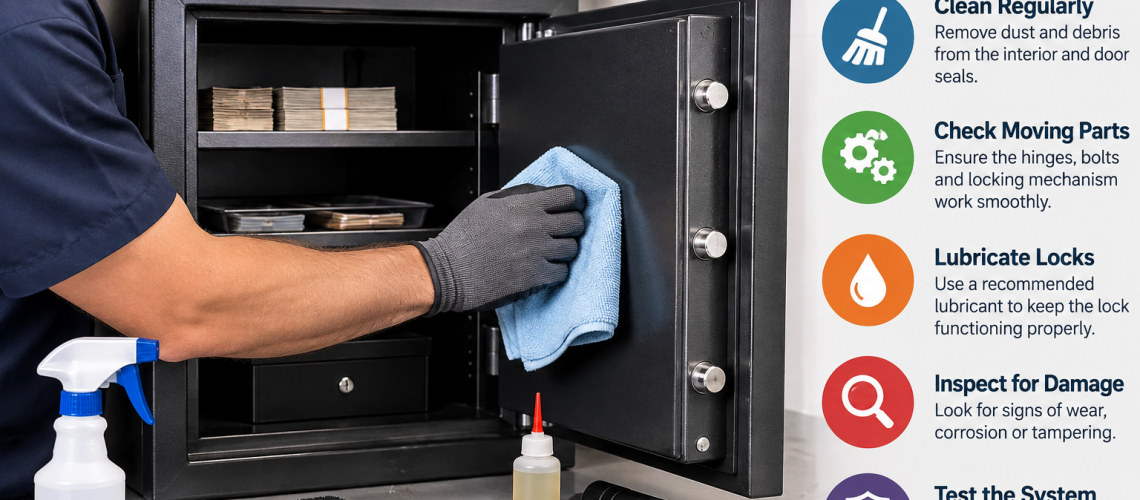
A cash safe should not be treated as a fit-and-forget security product. Keys can wear, electronic-lock batteries can become weak, handles and bolts can develop faults, anchoring can loosen and access procedures can become outdated as staff change. Regular inspection helps identify these problems before they prevent authorised access or reduce security.
This guide explains how UK businesses can inspect and maintain cash safes, including key locks, electronic locks, batteries, doors, hinges, bolts, handles, anchoring, internal fittings, access records and the warning signs that may require professional servicing.
Quick Answer: How Should a Cash Safe Be Maintained?
Inspect a cash safe regularly for reliable locking, smooth door movement, damaged keys, weak electronic-lock batteries, loose handles, unusual resistance, damaged hinges, loose anchoring and changes to authorised-user access. Follow the manufacturer’s instructions for battery replacement, lubrication and servicing, and do not dismantle or modify certified locking or security components unless authorised to do so.
| Area to inspect | What to check |
|---|---|
| Key lock | Key condition, smooth insertion and reliable operation |
| Electronic lock | Keypad response, battery warning and code operation |
| Door | Alignment, clearance and smooth closing |
| Handle and bolts | Smooth movement without unusual force |
| Hinges | Damage, looseness or abnormal movement |
| Anchoring | Movement, loose fixings or disturbed installation |
| Internal fittings | Loose shelves, drawers or coffers |
| Access control | Current key holders, codes and authorised users |
Why Cash Safe Maintenance Matters
A security safe may remain in service for many years. During that time it can be opened thousands of times, experience staff changes, be moved or loaded differently and receive little attention until something stops working.
Maintenance helps prevent two different problems:
- security problems, where the safe no longer provides the intended level of control; and
- access problems, where authorised users cannot open or operate the safe reliably.
Both matter. A safe that cannot be opened when required can disrupt business operations, while a safe with uncontrolled keys, weak fixings or an incorrectly closing door may not provide the security expected from it.
How Often Should a Cash Safe Be Checked?
There is no single inspection interval that suits every safe. Frequency should reflect how often the safe is used, its environment, its security importance and the manufacturer’s guidance.
A safe opened several times every day in a busy retail or hospitality environment is exposed to more operating cycles than a safe opened once a month in a small office.
A practical inspection programme may include:
- routine user checks during normal operation;
- periodic inspection of locks, keys and door movement;
- battery replacement when indicated or according to manufacturer guidance;
- inspection after relocation or attempted interference;
- access review whenever staff responsibilities change;
- professional attention where abnormal operation develops.
The aim is to identify change. A lock or door that suddenly feels different should not simply be forced until it fails.
Maintaining a Key-Lock Cash Safe
Mechanical safe locks are straightforward to use, but the keys and lock still need sensible inspection.
Check the safe key
Inspect operating keys for:
- bending;
- cracks;
- excessive wear;
- damaged edges;
- distortion;
- difficulty entering the keyway.
If one key operates smoothly and another requires unusual force, the problem may be the key rather than the safe.
Do not force a reluctant key
If a key stops turning normally, forcing it can make the problem worse and may result in a damaged or broken key.
Check that the correct key is being used and that the door and handle are in the correct operating position. If the problem remains, investigate before applying additional force.
Control spare keys
Maintenance also includes knowing where spare keys are and whether they still work.
- Record authorised key holders.
- Secure spare keys separately.
- Do not leave backup keys beside the safe.
- Recover keys when staff leave.
- Investigate missing keys promptly.
For the broader key versus electronic decision, see Key vs Electronic Cash Safes UK.
Maintaining an Electronic Cash Safe Lock
Electronic locks introduce additional maintenance considerations, particularly batteries and keypad operation.
Regular checks should include:
- keypad buttons responding correctly;
- display or indicator operation where fitted;
- reliable acceptance of valid codes;
- low-battery indications;
- damage to the keypad or housing;
- emergency-access arrangements;
- current authorised-user codes.
Do not assume all electronic safe locks operate in the same way. Battery location, low-battery warnings, code retention and emergency procedures vary between products.
Electronic Safe Battery Replacement
Battery replacement should be treated as planned maintenance rather than waiting for complete failure.
Before replacing batteries, check the manufacturer’s instructions for:
- correct battery type;
- battery location;
- replacement procedure;
- whether the safe should be open during replacement;
- whether codes are retained without battery power;
- how low-battery warnings are displayed.
Use appropriate new batteries of the specified type. Mixing old and new batteries or using unsuitable replacements can create unreliable operation.
Do not ignore intermittent symptoms
Slow response, inconsistent displays, repeated code-entry problems or low-battery warnings should be investigated before the safe becomes difficult to open.
Check the Safe Door and Alignment
The door should open and close consistently without scraping, dropping or requiring unusual lifting or pressure.
Look for:
- door rubbing;
- uneven gaps;
- changes in alignment;
- difficulty closing fully;
- unusual hinge movement;
- obstructions around the door or frame.
If the safe only locks when the door is pushed, lifted or forced into position, that should be investigated rather than treated as normal operation.
Inspect the Handle and Locking Bolts
The safe handle and internal locking boltwork should operate smoothly within the normal range specified for the safe.
Warning signs include:
- increasing resistance;
- grinding or scraping;
- loose handle movement;
- handle movement without normal bolt operation;
- difficulty retracting or extending the bolts;
- a sudden change in operating feel.
Do not repeatedly force a mechanism that has become unusually stiff. A developing alignment or lockwork problem may become a lockout if it is ignored.
Check Safe Hinges
Safe doors can be very heavy, so hinges carry substantial loads.
Check for:
- visible damage;
- loose components;
- door sag;
- unusual noise;
- unexpected movement;
- contact between door and frame.
Do not dismantle security hinges or internal door components without appropriate technical guidance.
Inspect Safe Anchoring and Fixings
A cash safe may have been securely anchored when installed, but the installation should still be checked if there are signs of movement or disturbance.
Look for:
- movement when the door is operated;
- gaps around the base;
- visible loose fixings;
- damage around fixing points;
- movement of mounting plates;
- signs that the safe has been struck or shifted.
If the safe has been relocated, treat the new position as a new installation and check that the correct fixing method has been used.
For installation guidance, see Cash Safe Installation & Fixing UK.
Inspect Shelves, Drawers and Internal Coffers
Internal fittings also need to remain secure and usable.
- Check shelves are correctly seated.
- Check adjustable shelf supports.
- Inspect drawers for smooth movement.
- Check internal coffer locks.
- Remove objects obstructing the door or boltwork.
- Avoid overloading shelves beyond their intended use.
A badly positioned cash bag, drawer or document pack can sometimes interfere with normal closing even when the main safe mechanism is working correctly.
Avoid Overfilling the Safe
A safe that is routinely packed to its limit can become difficult to operate and organise.
Overfilling can lead to:
- contents obstructing the door;
- bags or paperwork catching the bolts;
- difficulty retrieving individual deposits;
- poor internal organisation;
- pressure on shelves or fittings.
If the safe is regularly full, review whether the emptying frequency, contents or safe capacity need to change.
See Cash Safe Size Guide UK if capacity is becoming a recurring problem.
Cleaning a Cash Safe
Routine cleaning should focus on keeping the safe and surrounding area free from dust, debris and contamination without introducing liquids or chemicals into the locking mechanism.
General precautions include:
- follow the manufacturer’s cleaning instructions;
- avoid flooding keyways, keypads or electronic components;
- avoid abrasive treatment of displays and keypads;
- keep the door threshold clear;
- remove debris from internal shelves and corners;
- avoid unapproved chemicals on protective finishes.
If the safe is installed in a dusty workshop, industrial area or food-related environment, inspection frequency may need to reflect those conditions.
Should You Lubricate a Safe Lock?
Do not add oil, spray lubricant or graphite to a safe lock unless the manufacturer or qualified service guidance specifically requires it.
Different locks and mechanisms have different requirements. An unsuitable lubricant can attract contamination, migrate into components or create further problems.
If a lock has become stiff, identify the cause rather than automatically applying lubricant.
Review Safe Codes and Authorised Users
Safe maintenance is not limited to mechanical parts. Access permissions also need maintenance.
Review access when:
- an authorised employee leaves;
- a manager changes role;
- a safe key goes missing;
- an electronic code becomes too widely known;
- contractors or temporary staff no longer need access;
- responsibility for cash handling changes.
Where the lock supports multiple users, remove credentials that are no longer required. Where a shared code is used, consider changing it when authorised personnel change.
Maintaining Deposit Safes
Deposit safes require additional inspection because cash passes through a separate slot, drawer, chute or baffle before reaching the secure compartment.
Check:
- deposit opening condition;
- smooth operation of drawers or flaps;
- internal baffles;
- obstructions;
- damage caused by unsuitable deposits;
- mounting or fixing;
- secure retrieval operation.
Only deposit items the mechanism is designed to accept. Forcing coin bags or bulky objects through a note-only deposit system can cause damage or blockage.
For deposit-safe selection, see Deposit Safes UK.
Maintaining Under-Counter Cash Safes
Under-counter units should also be checked for secure attachment to their mounting system.
- Check the mounting plate remains secure.
- Check the safe locks firmly into the mounting arrangement.
- Check authorised release keys or controls.
- Inspect the note deposit opening.
- Remove any obstructions.
- Check the surrounding counter has not loosened or been damaged.
See Under-Counter Cash Safes UK for the broader till-drop application.
Check the Safe Environment
The surrounding environment can affect long-term condition.
Look for:
- water leaks;
- persistent condensation;
- high humidity;
- corrosive contamination;
- dust;
- impact from nearby equipment;
- changes to surrounding furniture or building works.
If corrosion appears around the safe body, hinges or fixings, investigate both the safe and the cause of the moisture.
Inspect a Safe After an Incident
A safe should be inspected after events that may have affected its security or operation.
- attempted break-in;
- forced or abnormal operation;
- impact damage;
- fire;
- flooding;
- building works around the safe;
- relocation;
- damage to the floor or wall fixing area.
Visible appearance alone may not reveal whether internal components or anchoring have been affected.
Safe Warning Signs That Need Attention
Arrange further investigation if you notice:
- a key becoming increasingly difficult to turn;
- intermittent electronic-lock operation;
- repeated low-battery warnings;
- a loose or unusually stiff handle;
- the door dropping or rubbing;
- unusual sounds from the locking mechanism;
- bolts not retracting normally;
- the safe moving on its anchors;
- a damaged keypad;
- missing or compromised keys;
- unexplained changes to access codes;
- evidence of attempted interference.
Early investigation is normally preferable to waiting until the safe cannot be opened or secured.
What Not to Do When a Safe Develops a Fault
- Do not repeatedly force a stiff key.
- Do not hit the keypad or handle.
- Do not drill the safe as a first response.
- Do not dismantle certified lock components without appropriate expertise.
- Do not add random lubricants to the lock.
- Do not modify the door or boltwork.
- Do not bypass an electronic lock using improvised wiring or power sources.
- Do not create additional holes through the safe body without manufacturer approval.
Incorrect intervention can turn a minor operational problem into a more expensive security or access failure.
When Does a Cash Safe Need Professional Service?
Professional attention may be appropriate where the problem involves the lock, boltwork, door alignment, security certification or repeated access failure.
Useful information to provide when requesting assistance includes:
- safe manufacturer;
- model;
- serial number where available;
- lock type;
- description of the fault;
- whether the safe is currently open or closed;
- whether a valid key or code is available;
- photographs of the safe and lock;
- any unusual event before the fault appeared.
Accurate information makes it easier to identify whether the problem is likely to involve the key, electronic lock, handle, door alignment or another component.
Keep a Safe Maintenance Record
Businesses with important cash-security requirements may benefit from keeping a simple record of safe maintenance and access changes.
| Record | Example information |
|---|---|
| Safe identification | Manufacturer, model and location |
| Lock type | Key, electronic or biometric |
| Inspection | Date and person completing check |
| Battery replacement | Date and battery type |
| Key changes | Lost, replaced or recovered keys |
| Code changes | Date access credentials were updated |
| Faults | Description and action taken |
| Service | Engineer visit and work completed |
Cash Safe Inspection Checklist
- Confirm the safe is securely anchored.
- Check the door opens smoothly.
- Check the door closes without rubbing.
- Inspect the handle for looseness or resistance.
- Check the locking bolts operate normally.
- Inspect key-operated locks and keys.
- Check electronic keypad operation where fitted.
- Review battery condition or warnings.
- Confirm authorised access codes are current.
- Confirm safe keys and spares are accounted for.
- Check hinges for damage or abnormal movement.
- Inspect shelves, drawers and internal coffers.
- Remove anything obstructing the door or boltwork.
- Check for corrosion or moisture.
- Inspect deposit mechanisms where fitted.
- Check under-counter mounting systems where applicable.
- Record any changes or faults.
- Arrange specialist attention where abnormal operation is found.
Cash Safe Maintenance FAQs
Do cash safes need maintenance?
Yes. Safe locks, keys, batteries, doors, hinges, handles, anchoring and access procedures should be checked periodically so developing faults can be identified before the safe becomes unreliable.
How often should I inspect a cash safe?
The appropriate frequency depends on usage, environment and manufacturer guidance. Frequently used commercial safes should normally be observed more closely than low-use storage.
When should I change an electronic safe battery?
Follow the manufacturer’s guidance and respond promptly to low-battery warnings. Do not wait for complete battery failure before understanding the replacement procedure.
Should I lubricate a stiff safe lock?
Do not apply lubricant unless it is recommended for the specific lock or mechanism. A stiff lock may have another underlying cause that should be identified first.
What should I do if a safe key becomes hard to turn?
Do not force it. Check the key for damage and make sure the safe door and handle are correctly positioned. If the problem continues, arrange appropriate inspection or service.
Should safe codes be changed when an employee leaves?
Review access whenever an authorised employee leaves or changes role. If they knew a shared code, changing that code may be appropriate.
Should spare safe keys be tested?
It is sensible to know that authorised spare keys remain available and serviceable, while keeping them securely controlled and separate from unauthorised access.
How do I know if a safe has become loose?
Movement when the door is operated, visible gaps around the base or disturbed fixing points may indicate that the installation needs checking.
Can I repair a safe lock myself?
Simple user tasks should follow the manufacturer’s instructions. Internal lock, boltwork or certified security-component repairs should not be improvised if they require specialist knowledge.
When should a safe be replaced rather than repaired?
Replacement may be worth considering where the safe is badly damaged, no longer provides the required security level, cannot be economically repaired or no longer matches the value and contents being protected.
Keep the Safe and the Access Procedure Working Together
Cash-safe maintenance is not only about fixing faults. It is about preserving reliable authorised access while keeping unauthorised access controlled.
Check keys, electronic locks, batteries, doors, handles, hinges, anchoring and internal fittings before small changes become major operational problems. At the same time, review who has keys, codes and permission to use the safe.
Where the safe develops abnormal resistance, lock faults, alignment problems or damage, investigate the cause rather than forcing the mechanism. A well-maintained safe should remain both secure and predictable to operate.
Related Cash Safe Guides and Products
Discover more from Blog Total Locker Service
Subscribe to get the latest posts sent to your email.