Adding Lockers to an Existing Installation UK: How to Extend a Locker Bank
September 25, 2026
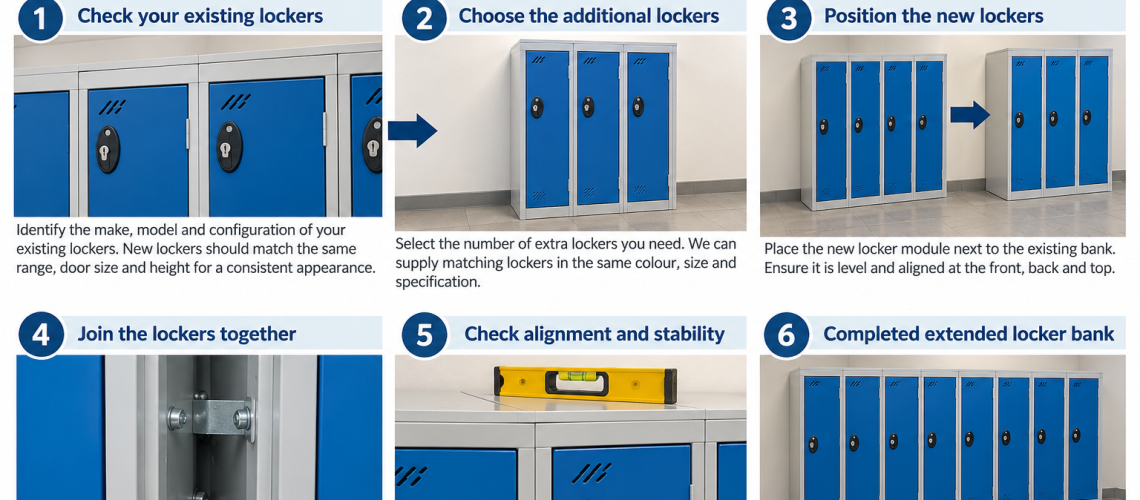
Adding lockers to an existing installation is not always as simple as ordering more units that look similar. Locker dimensions, manufacturer, compartment layout, colour, lock type, door numbering, floor space and installation details all affect whether the new lockers will work successfully alongside the existing bank.
This guide explains how UK schools, workplaces, factories, leisure centres and other organisations can extend an existing locker installation without unnecessarily replacing serviceable lockers.
If you are planning a completely new installation rather than extending an existing one, browse the full range of commercial lockers.
Quick Answer: Can You Add New Lockers to an Existing Locker Bank?
Yes. Existing locker installations can often be extended without replacing the original lockers, provided the new units are suitable for the room and user requirement. An exact visual or dimensional match is not always possible, especially where an older locker range has changed or been discontinued, so identify the existing lockers carefully before ordering additional units.
| Check | Why it matters |
|---|---|
| Manufacturer and range | Helps identify compatible sizes and finishes |
| Height, width and depth | Determines physical alignment |
| Door configuration | Affects user capacity and appearance |
| Colour and finish | Determines whether the new bank will visually match |
| Lock type | Affects keys and user management |
| Numbering | Needs to continue logically |
| Available space | Determines how many additional lockers fit |
| Installation method | New lockers still need suitable positioning and fixing |
When Does Extending an Existing Locker Bank Make Sense?
Adding new lockers can be more practical than replacing an entire installation where the existing lockers remain structurally sound and operationally suitable.
Typical reasons for extending a locker bank include:
- increased staff numbers;
- additional pupils or students;
- a new shift pattern;
- departmental expansion;
- new changing-room capacity;
- additional PPE requirements;
- business growth;
- new hybrid or shared-locker requirements;
- relocation of staff into an existing building.
Where the existing lockers are heavily damaged, unsuitable or approaching widespread replacement, use the separate Locker Replacement Planning UK guide instead.
Identify the Existing Lockers First
The best starting point is to identify the manufacturer and locker range already installed.
Look for:
- manufacturer labels;
- product stickers;
- old quotations or invoices;
- installation records;
- model numbers;
- lock manufacturer markings;
- distinctive ventilation patterns;
- door and handle designs.
Photographs are useful when the original paperwork is unavailable. Include full front views, side views, locks, vents and any labels or markings.
Measure the Existing Lockers
Do not rely on appearance alone. Two lockers that look almost identical can have different dimensions.
Record:
- overall height;
- overall width;
- overall depth;
- number of doors;
- individual compartment height;
- base or stand height;
- sloping-top dimensions where fitted;
- bench or seat dimensions where integrated.
Even a relatively small depth difference can make a new locker bank project further into the room than the existing installation.
For general locker dimensions, see Locker Sizes and Dimensions UK.
Do New Lockers Need to Match Exactly?
No. An exact match can be desirable, but it is not always necessary or possible.
An older locker range may have:
- changed dimensions;
- changed door designs;
- different ventilation patterns;
- updated colours;
- different locks;
- been replaced by a newer range;
- been discontinued completely.
The practical objective is usually to make the new lockers work successfully with the existing installation, rather than forcing an exact match where one is no longer available.
Matching Locker Height, Width and Depth
Dimensions have both visual and operational consequences.
Height
Different locker heights create an obvious step between old and new banks. This may be acceptable where the new lockers form a separate run or zone.
Width
Locker width affects how many additional units can fit along the available wall and the usable width of each compartment.
Depth
Depth is particularly important where new and existing lockers sit directly beside one another. A deeper new unit can project beyond the existing bank and affect aisle space or bench clearance.
Where exact dimensions cannot be matched, consider placing the new lockers as a clearly separate bank rather than creating an awkward near-match.
Matching the Door Configuration
The new lockers do not always need the same number of doors as the existing units.
For example, an organisation may already have full-height lockers but need additional smaller compartments for:
- bags;
- personal belongings;
- mobile devices;
- smaller PPE;
- temporary users.
In that situation, maintaining identical external appearance may be less important than selecting the correct compartment size for the new requirement.
The commercial range includes multiple door configurations, materials and specialist locker types. Browse commercial lockers to compare current options.
Matching New Locker Colours to Existing Lockers
Colour matching is often more difficult than expected because the original finish may have aged, faded or been discontinued.
Where a close match matters:
- identify the original manufacturer;
- find the original colour reference if possible;
- check whether the same finish remains available;
- request a current sample where necessary;
- compare the physical sample with the installed lockers.
If an exact match is impossible, an intentional contrasting colour can sometimes look better than a slightly different version of the original colour.
For detailed colour guidance, see Locker Colours and Finishes UK.
Should New Lockers Use the Same Lock Type?
Using the same lock system can simplify management, but it is not automatically the best decision.
Before copying the existing lock, ask:
- Does the existing system still work well?
- Are replacement keys readily available?
- Is a master-key system already in use?
- Are users assigned or changing?
- Is the organisation trying to reduce key management?
- Would a hasp, combination or electronic system suit the new users better?
Extending an installation creates an opportunity to review the existing lock strategy rather than automatically reproducing it.
If maintaining one lock type is important, record the manufacturer, lock model and any relevant key series before specifying the new lockers.
Locker Key and Master-Key Compatibility
A new key-operated locker does not automatically work with the master-key system already used on site.
If continuity is required, identify:
- existing lock manufacturer;
- lock series;
- key series;
- master-key arrangement;
- number range;
- any existing key schedule.
This information should be considered before the additional lockers are ordered.
Where the original lock system cannot be continued, the new locker bank can be managed as a separate key series or use another suitable locking method.
Continue the Locker Numbering System
Additional lockers should normally fit into a clear numbering system.
Before ordering number plates, record:
- the highest existing locker number;
- whether numbering is sequential;
- whether different rooms use separate ranges;
- whether prefixes identify departments or locations;
- whether duplicate numbers already exist.
A small extension is an opportunity to correct numbering problems before they become more difficult to manage.
See Locker Numbering and Labelling UK for detailed guidance.
Measure the Space Available for Additional Lockers
Do not calculate capacity from wall length alone.
Also account for:
- doorways;
- radiators;
- pipework;
- columns;
- skirting;
- electrical equipment;
- benches;
- locker door swing;
- aisle width;
- cleaning access;
- escape routes.
The remaining wall space may appear large enough while still being unsuitable once circulation and door operation are considered.
For the full layout process, see Locker Planning UK.
Extend the Existing Run or Create a Separate Locker Bank?
Additional lockers do not have to sit immediately beside the old installation.
Extending the existing run can work well where:
- matching dimensions are available;
- the finish is compatible;
- there is sufficient adjacent space;
- the same user group will use the new lockers.
A separate bank can be better where:
- the new product is visibly different;
- the locker depth has changed;
- a different department needs the lockers;
- a new lock system is being introduced;
- the extension would make the original wall overcrowded;
- an intentional new zone is easier to manage.
Separating old and new installations can make a specification difference look intentional rather than accidental.
Managing Mixed Old and New Locker Installations
There is nothing inherently wrong with operating different locker ranges on the same site.
However, mixed installations are easier to maintain if the differences are recorded.
Keep a simple record of:
- manufacturer;
- locker range;
- location;
- installation date;
- lock type;
- key series;
- colour;
- door configuration;
- replacement-part route.
This avoids future facilities teams assuming that visually similar lockers use interchangeable components.
Retain Serviceable Existing Lockers Where Appropriate
Expansion does not automatically justify replacing lockers that still perform their job.
Existing lockers may be worth retaining where:
- frames remain sound;
- doors operate correctly;
- corrosion is limited;
- locks remain serviceable;
- replacement parts are available;
- compartment sizes remain suitable;
- the existing bank does not obstruct the revised layout.
Damaged locks, keys, hinges or other components do not necessarily mean the complete locker bank needs replacing. TLS also supports existing installations with replacement keys, locks, parts and servicing.
Phased Locker Expansion
Large sites do not always need to add every future locker at once.
A phased approach can work where:
- headcount is increasing gradually;
- building works are happening in stages;
- departments are relocating at different times;
- budget is spread across financial periods;
- future capacity is uncertain.
If future expansion is likely, record the product range and complete specification from the first phase. This makes later matching easier, although product and colour availability can still change over time.
Installation Planning for Additional Lockers
Additional lockers still require the same installation planning as a new project.
Check:
- delivery route;
- door widths;
- stairs and lifts;
- final room position;
- floor condition;
- wall construction;
- required fixing;
- alignment with existing lockers;
- access for skirting or service runs;
- working hours and site restrictions.
If lockers are being installed directly beside an existing run, also check whether the original units are level and correctly positioned. Do not assume the old installation provides a perfect reference line for the new work.
What Information Helps When Requesting Additional Lockers?
Provide as much of the existing specification as possible.
- number of additional lockers required;
- photographs of existing lockers;
- manufacturer and range if known;
- overall height;
- width;
- depth;
- number of doors;
- colour or colour reference;
- lock type;
- key or master-key requirements;
- current numbering;
- available wall dimensions;
- delivery and installation requirements.
Photographs showing the whole locker bank and surrounding room are often more useful than close-up photographs alone because they show how the extension needs to fit into the existing space.
Common Mistakes When Adding Lockers to an Existing Installation
- Ordering by appearance alone: measure the existing units.
- Assuming the original product still exists: ranges and specifications change.
- Ignoring locker depth: a deeper unit can affect room circulation.
- Trying to force an imperfect colour match: an intentional contrast can look better.
- Assuming all key locks are compatible: identify the existing lock and key system.
- Restarting locker numbers at 1: integrate new units into the site’s numbering system.
- Using every available centimetre of wall: allow for door swing and circulation.
- Replacing sound lockers unnecessarily: repair or retain serviceable units where practical.
- Failing to record the new specification: keep details for future repairs and expansion.
Existing Locker Extension Checklist
- Confirm how many additional users need lockers.
- Identify the existing locker manufacturer.
- Identify the product range if possible.
- Measure height, width and depth.
- Record the existing compartment configuration.
- Record the current colour and finish.
- Identify the lock type.
- Check whether master-key compatibility is required.
- Record the current numbering system.
- Measure the available installation area.
- Check aisle and door clearance.
- Decide whether new lockers should continue the existing run.
- Consider a separate bank if exact matching is not practical.
- Retain serviceable old lockers where appropriate.
- Plan delivery and installation access.
- Record the final new specification for future additions.
Adding Lockers to an Existing Installation FAQs
Can I add more lockers to an existing locker bank?
Yes. Additional lockers can often be installed beside or near an existing locker bank, provided the available space, dimensions and installation requirements are checked first.
Do new lockers have to be the same brand?
No. Using the same range can make matching easier, but another suitable locker can be used where the original product is unavailable or a different specification better suits the new requirement.
Can new lockers match old locker colours?
Sometimes. The original colour may still be available, but ageing, fading and product changes can make an exact visual match difficult. Use physical samples where the match is important.
Can new lockers use the same master key?
Potentially, but only where the lock system and key series are compatible. Identify the existing lock manufacturer and master-key arrangement before ordering.
Should I replace the old lockers at the same time?
Not necessarily. Existing lockers that remain secure, serviceable and suitable can often continue in use alongside new units.
What if the original locker model has been discontinued?
Choose a current locker that meets the operational requirement and fits the available space. A separate or deliberately contrasting new bank can sometimes be preferable to an imperfect match.
What measurements are needed when adding lockers?
Record the existing locker height, width, depth, door configuration and any stand, plinth or sloping-top dimensions. Also measure the available room space.
Where can I buy additional commercial lockers?
Total Locker Service supplies commercial lockers for schools, workplaces, leisure centres, healthcare facilities, factories, warehouses and other UK organisations.
Extend the Locker Installation Around What Already Works
An expanding organisation does not automatically need to replace a complete locker installation. Where the existing units remain serviceable, additional lockers can be planned around them.
Start by identifying and measuring the existing lockers, then decide whether matching the original range is practical or whether a separate new locker bank provides a cleaner solution.
Dimensions, colours, locks, keys, numbering and installation all need to be considered, but exact visual duplication should not take priority over choosing lockers that actually meet the new storage requirement.
For current school, workplace, leisure, metal, plastic, charging, wire mesh and specialist options, browse the complete range of commercial lockers.
Related Locker Guides
Discover more from Blog Total Locker Service
Subscribe to get the latest posts sent to your email.