Wire Mesh Locker Sizes & Configurations UK: Single Door to Multi-Compartment
September 25, 2026
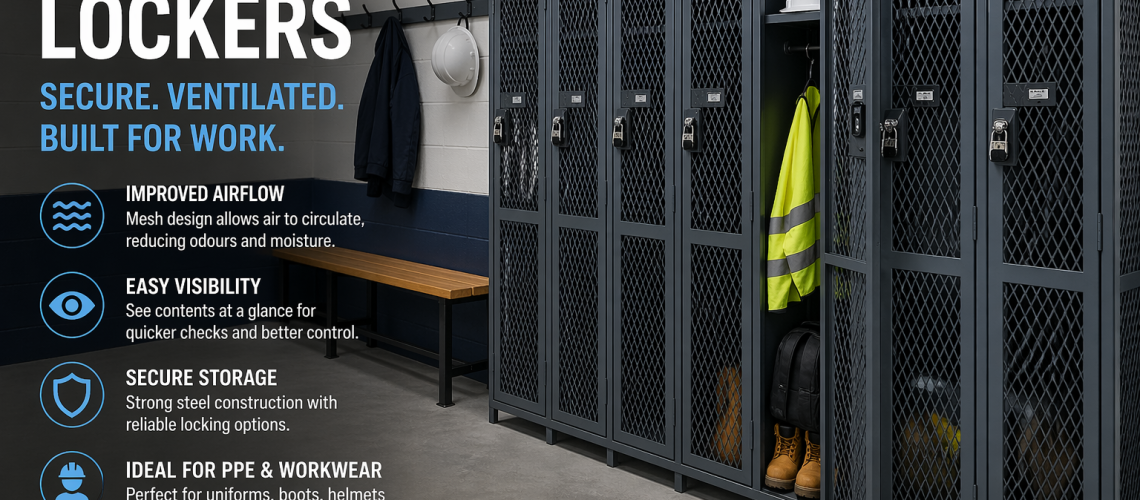
Choosing wire mesh lockers is mainly a question of what needs to be stored, how much compartment space each user requires and how many storage positions must fit into the available room. Full-height mesh lockers suit clothing, PPE and larger kit, while multi-compartment configurations can provide 12, 16 or 20 individual storage spaces within a single locker bank.
This guide compares wire mesh locker sizes and configurations for UK workplaces, warehouses, industrial sites, sports facilities and equipment-storage areas. It covers full-height versus multi-compartment lockers, 305 mm and 457 mm depths, compartment counts, visibility, ventilation, PPE storage, footwear and kit storage.
Quick Answer: Which Wire Mesh Locker Configuration Do You Need?
Choose a full-height wire mesh locker when users need space for clothing, coats, uniforms or larger PPE. Choose a multi-compartment mesh locker when the priority is providing a larger number of smaller storage spaces for footwear, helmets, bags, equipment or individually issued kit. A 305 mm depth suits many compact storage applications, while 457 mm provides additional space for bulkier items.
| Configuration | Best suited to | Main advantage |
|---|---|---|
| Full-height mesh locker | Workwear, coats, uniforms and larger PPE | Maximum vertical storage |
| Two-door mesh locker | Individual workwear and smaller personal storage | More users per locker column |
| 12 compartment | Footwear, bags, PPE and kit | Larger individual compartments |
| 16 compartment | General equipment and personal kit | Higher storage density |
| 20 compartment | Smaller kit and equipment | Maximum compartment count |
| Open compartment | Shoes, boots and supervised equipment | Immediate visibility and access |
| Compartment with door | Individually secured belongings | Controlled access |
Start With the Storage Requirement, Not the Locker
The most useful first question is not “How many lockers can fit here?” but “What does each person or department actually need to store?”
A warehouse employee storing a coat, high-visibility clothing and PPE may need a tall compartment. A site storing safety footwear may be better served by many smaller open compartments. A sports facility may need individual secure spaces for bags and kit.
That means the correct wire mesh locker configuration depends on:
- the largest item being stored;
- number of users;
- whether hanging space is required;
- whether footwear needs separate storage;
- whether contents need to be individually secured;
- required visibility;
- required ventilation;
- available wall and floor space.
For the broader question of when mesh construction is suitable, see Mesh Lockers UK.
Full-Height Wire Mesh Lockers
Full-height mesh lockers are generally the better configuration where employees need vertical storage for clothing and equipment.
Typical contents include:
- coats;
- overalls;
- uniforms;
- high-visibility clothing;
- helmets;
- bags;
- larger PPE;
- personal belongings.
The advantage is usable vertical space. Instead of dividing the locker into several small compartments, the user receives one larger storage area.
This makes full-height wire mesh lockers particularly useful in industrial changing rooms, warehouses, depots and operational workplaces where staff need to store clothing rather than just small personal items.
Multi-Compartment Wire Mesh Lockers
Multi-compartment mesh lockers divide the available cabinet space into multiple smaller storage positions.
Total Locker Service supplies configurations with:
- 12 compartments;
- 16 compartments;
- 20 compartments;
- doors or open fronts;
- 305 mm or 457 mm depth options.
These configurations work well where the items are relatively compact and the priority is providing a large number of individual storage positions within a limited footprint.
View the current wire mesh lockers for available multi-compartment configurations.
12 Compartment Wire Mesh Lockers
A 12-compartment unit provides fewer but larger storage positions than the 16 or 20-compartment alternatives.
This configuration can be useful when each user needs space for:
- footwear;
- small bags;
- helmets;
- folded clothing;
- issued PPE;
- tools or equipment;
- sports kit.
It provides a useful balance between storage density and individual compartment capacity.
Where the stored item is physically bulky, a 12-compartment layout can be preferable to increasing the number of compartments simply to maximise user count.
16 Compartment Wire Mesh Lockers
The 16-compartment configuration provides four compartments across and four down.
It offers a higher storage density while retaining useful individual compartments for smaller items.
Typical applications include:
- work footwear;
- small PPE sets;
- bags;
- equipment issue;
- staff personal items;
- sports equipment;
- warehouse kit.
The current 16-compartment design has a locker width of approximately 1220 mm and individual compartments approximately 305 mm high × 305 mm wide.
This makes it useful where the room has sufficient wall length but many users need individual storage positions.
20 Compartment Wire Mesh Lockers
A 20-compartment wire mesh locker prioritises storage density.
The current configuration provides five compartments across and four down, producing 20 individual storage positions within one bank.
The unit is approximately 1525 mm wide, with individual compartments approximately 305 mm high × 305 mm wide.
It is best suited to smaller equipment and items that do not require hanging space.
- safety footwear;
- small bags;
- compact PPE;
- issued equipment;
- sports kit;
- tools and accessories.
Do not choose 20 compartments purely because it offers the largest number of storage positions. Confirm that a 305 mm × 305 mm compartment is appropriate for the intended items first.
305 mm vs 457 mm Deep Wire Mesh Lockers
Locker depth changes usable storage volume without changing the basic compartment count.
| Depth | Typical use | Planning consideration |
|---|---|---|
| 305 mm | Footwear, compact PPE, small bags and equipment | Reduces room projection |
| 457 mm | Bulkier kit, larger bags and deeper equipment storage | Requires additional floor depth |
When 305 mm depth makes sense
The shallower option can work well where:
- stored items are compact;
- space in front of the locker bank is limited;
- the lockers primarily store shoes or smaller equipment;
- room projection needs to be minimised.
When 457 mm depth makes sense
The deeper option gives more usable storage volume and can suit:
- larger work boots;
- bags;
- bulkier PPE;
- sports equipment;
- deeper containers or issued kit.
The deeper locker also projects further into the room, so aisle and circulation space should be checked before ordering.
Wire Mesh Lockers With Doors or Without Doors?
Multi-compartment mesh storage is available both with individual doors and as open compartments.
With doors
Choose doors when each compartment needs controlled individual access.
This is useful for:
- personal belongings;
- issued PPE;
- individual staff equipment;
- sports kit;
- workplace storage where access needs to be restricted.
Without doors
Open compartments prioritise visibility and quick access.
They are particularly useful for:
- shoe storage;
- boot storage;
- supervised equipment areas;
- issue-and-return systems;
- kit that does not require individual locking.
The open format also makes it immediately obvious whether a compartment is occupied.
Visibility: A Major Reason to Choose Mesh
Visibility is one of the main functional differences between mesh lockers and conventional solid-sided lockers.
Depending on the application, being able to see through the locker can help staff:
- confirm whether a compartment is occupied;
- identify equipment quickly;
- check that issued kit has been returned;
- spot obvious misuse;
- manage footwear or PPE storage;
- reduce unnecessary opening during inspections.
This makes mesh storage particularly useful in operational environments where visibility is an advantage rather than a privacy concern.
If users require visual privacy for personal belongings, a standard solid locker may be more appropriate.
Ventilation for Workwear, Boots and Equipment
Wire mesh construction allows much greater natural air movement around stored items than a fully enclosed steel compartment.
This can be useful where lockers store:
- work boots;
- sports shoes;
- uniforms;
- workwear;
- helmets;
- gloves;
- PPE;
- frequently used equipment.
Mesh construction does not actively dry wet clothing in the same way as a heated locker, but it improves natural airflow around stored items.
Where active drying is required, see heated wire mesh lockers.
Wire Mesh Lockers for PPE Storage
PPE requirements vary considerably, so the configuration should follow the physical size and quantity of equipment being issued.
Smaller compartments may work well for:
- safety glasses;
- gloves;
- hearing protection;
- small respirator equipment where appropriate;
- compact issued kit.
Larger compartments or full-height lockers may be needed for:
- helmets;
- high-visibility clothing;
- overalls;
- larger protective garments;
- boots plus additional kit.
Do not assume that every employee needs the same compartment size. A mixed storage arrangement can sometimes use available space more efficiently.
Wire Mesh Lockers for Warehouses and Distribution Sites
Warehouses and distribution centres are strong applications for wire mesh lockers because storage often prioritises durability, ventilation and visibility over decorative appearance.
Typical requirements include:
- staff footwear;
- high-visibility clothing;
- helmets;
- bags;
- issued scanners or accessories where suitable;
- workwear;
- departmental equipment.
A warehouse may therefore use several mesh configurations within the same welfare area.
For example, full-height lockers can hold workwear while open multi-compartment mesh storage is used for boots or shared equipment.
Wire Mesh Lockers for Kit Storage
Mesh lockers are particularly useful for kit that needs to remain visible, ventilated and organised.
This can include:
- sports equipment;
- training kit;
- workplace issue equipment;
- protective clothing;
- site equipment;
- boots and footwear;
- bags and helmets.
Before choosing the compartment count, place the largest typical kit item into the proposed compartment dimensions or measure it carefully.
A higher compartment count provides little benefit if the equipment cannot fit comfortably inside.
Wire Mesh Shoe and Boot Storage
Open-front multi-compartment mesh lockers are particularly well suited to footwear storage.
Advantages include:
- good airflow around shoes and boots;
- easy visual identification;
- fast access;
- individual compartments;
- simple occupancy checking;
- reduced need for doors and locks where security is unnecessary.
Check boot height and depth carefully. Bulky safety boots may benefit from the deeper 457 mm configuration even where ordinary shoes fit comfortably within 305 mm.
Locker Depth and Room Footprint
Increasing locker depth increases storage capacity but also reduces the free space available in the room.
When comparing 305 mm and 457 mm deep lockers, also check:
- aisle width;
- door opening;
- bench position;
- opposing locker banks;
- cleaning access;
- staff circulation;
- emergency routes;
- delivery access.
A deeper locker may provide better storage but still be the wrong choice if it creates a congested changing or equipment room.
For broader room planning, see Locker Planning UK.
Calculate Compartments From Actual Users
The number of compartments required should come from the operational requirement rather than the physical capacity of a locker bank.
For example, a site may need storage for:
- 42 pairs of safety boots;
- 18 sets of issued PPE;
- 12 visitors;
- 30 sports-kit users;
- 80 warehouse employees across several shifts.
Once the user requirement is known, compare combinations of 12, 16 and 20-compartment units.
Do not forget spare capacity where user numbers are likely to increase or equipment allocation changes regularly.
Example Multi-Compartment Capacity Planning
| Required positions | Possible arrangement | Total compartments |
|---|---|---|
| 12 | 1 × 12 compartment unit | 12 |
| 24 | 2 × 12 compartment units | 24 |
| 32 | 2 × 16 compartment units | 32 |
| 40 | 2 × 20 compartment units | 40 |
| 48 | 3 × 16 compartment units | 48 |
| 60 | 3 × 20 compartment units | 60 |
Are Wire Mesh Lockers Secure?
Wire mesh lockers are designed to provide controlled storage while retaining visibility and airflow.
The required security level depends on:
- the value of stored items;
- whether the storage area is supervised;
- the lock fitted;
- whether compartments have doors;
- who can enter the room;
- whether visual privacy is required.
They are particularly appropriate for workwear, PPE, footwear and operational equipment where ventilation and visibility matter.
For high-value personal belongings or situations where complete visual privacy is required, another locker construction may be more appropriate.
Wire Mesh vs Solid Steel Lockers
| Requirement | Wire mesh | Solid steel |
|---|---|---|
| Visibility | High | Low |
| Natural ventilation | High | Lower |
| Visual privacy | Low | High |
| PPE and workwear | Strong application | Also suitable |
| Footwear storage | Strong application | Suitable |
| Operational inspection | Easy | Requires opening |
| Front-of-house appearance | Industrial appearance | Usually more conventional |
Common Wire Mesh Locker Specification Mistakes
- Choosing the maximum compartment count: more compartments are not useful if stored items do not fit.
- Ignoring locker depth: 305 mm may suit compact equipment while bulkier kit may require 457 mm.
- Not measuring safety boots: footwear can be larger than expected.
- Using small compartments for hanging garments: full-height storage may be more practical.
- Ignoring privacy requirements: mesh construction makes contents visible.
- Adding doors where they are unnecessary: open compartments can be better for supervised shoe storage.
- Using open compartments where security is required: choose individual doors where access needs controlling.
- Ignoring room projection: deeper lockers consume additional aisle space.
- Assuming ventilation equals active drying: mesh improves airflow but does not provide heat.
- Buying around current capacity only: allow for realistic growth where appropriate.
Wire Mesh Locker Configuration Checklist
- List everything that needs to be stored.
- Measure the largest regular item.
- Confirm the number of users or storage positions required.
- Decide whether hanging space is needed.
- Decide whether footwear needs separate storage.
- Choose between full-height and multi-compartment storage.
- Compare 12, 16 and 20-compartment configurations.
- Check whether 305 mm depth is sufficient.
- Consider 457 mm depth for bulkier items.
- Decide whether compartments need doors.
- Confirm whether visibility is desirable.
- Check whether visual privacy is required.
- Confirm the available wall width.
- Check locker depth against aisle space.
- Allow for benches and door clearance.
- Consider future capacity requirements.
- Select a suitable locking arrangement where required.
Wire Mesh Locker Size and Configuration FAQs
What sizes are wire mesh lockers available in?
Wire mesh lockers are available in several configurations. The current Total Locker Service multi-compartment range includes 12, 16 and 20-compartment units with 305 mm and 457 mm depth options.
What is the difference between 305 mm and 457 mm deep mesh lockers?
A 305 mm deep locker uses less room depth and suits many compact items. The 457 mm option provides additional storage volume for bulkier PPE, footwear, bags and equipment.
Are 20-compartment mesh lockers better than 12-compartment lockers?
Not necessarily. A 20-compartment unit provides more individual storage positions, while a 12-compartment configuration provides more space per compartment. Choose according to the stored items.
Can wire mesh lockers be supplied without doors?
Yes. Multi-compartment mesh units are available with or without doors. Open versions are particularly useful for footwear and supervised equipment storage.
Are wire mesh lockers suitable for PPE?
Yes. Mesh lockers can be suitable for PPE because they provide ventilation and visibility. The compartment size should be selected around the equipment being stored.
Are wire mesh lockers suitable for warehouses?
Yes. Warehouses, depots and industrial facilities are common applications because mesh lockers combine durable storage with ventilation and easy visual checking.
Are mesh lockers good for safety boots?
Yes. Open multi-compartment mesh lockers are particularly useful for boots and footwear because air can circulate around the stored items and users can identify them easily.
Do wire mesh lockers dry wet clothing?
Mesh construction improves natural airflow but does not actively heat clothing. Where active drying is required, consider heated lockers or heated wire mesh lockers.
Should I choose full-height or multi-compartment mesh lockers?
Choose full-height lockers for coats, uniforms and larger PPE. Choose multi-compartment lockers when you need more individual positions for smaller kit, footwear and equipment.
Where can I buy wire mesh lockers?
Total Locker Service supplies wire mesh lockers in multiple compartment counts and depth configurations for workplaces, warehouses, industrial sites and equipment-storage areas.
Choose Wire Mesh Locker Configuration Around the Contents
The best wire mesh locker is not automatically the one with the greatest number of compartments. The correct configuration depends on the number of users, dimensions of the stored items, required depth, need for hanging space and whether individual doors are necessary.
Full-height mesh lockers are better suited to clothing, uniforms and larger PPE. Multi-compartment units provide efficient storage for footwear, bags, smaller PPE, sports kit and operational equipment.
Measure the contents first, then choose the compartment count and depth. That approach avoids buying a high-capacity locker bank whose individual storage spaces are too small for the items it was intended to hold.
Related Wire Mesh and Workplace Locker Guides
Discover more from Blog Total Locker Service
Subscribe to get the latest posts sent to your email.