Locker Colours and Finishes UK: How to Choose and Match Locker Colours
September 22, 2026
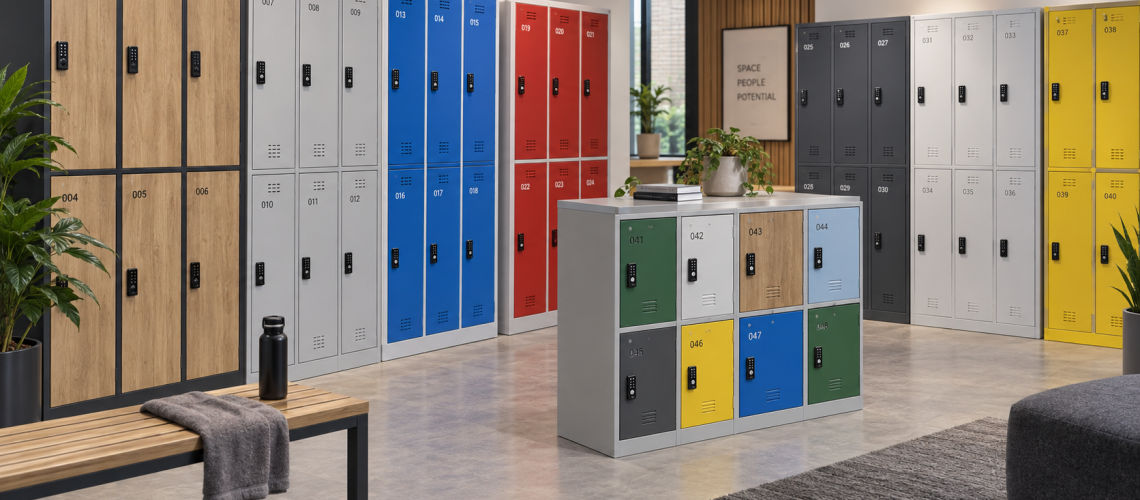
Locker colour can affect much more than appearance. In schools, it can help identify year groups or zones. In workplaces, it can coordinate storage with an interior scheme or company branding. In changing rooms, it can make a large locker installation feel more considered, while contrasting number plates and identification can make individual compartments easier to recognise.
Commercial locker ranges can be available with different door colours, body colours, powder-coated steel finishes, laminate colours, wood effects and decorative surfaces. The exact choice depends on the manufacturer and locker range, so a colour shown on one locker should never automatically be assumed to be available on another.
Colour and finish availability varies by manufacturer. Total Locker Service can help identify locker ranges with suitable specifications for your project.
Colour matching also needs care. A colour name such as blue, grey or white is not an exact specification, and photographs, printed brochures and computer screens can make finishes appear different from the physical product.
This guide explains how to choose locker colours and finishes, coordinate doors and carcases, use colour coding, specify laminate finishes, work with RAL references and match new lockers as closely as practical to an existing installation.
If you are still deciding which type of locker is required, start with the How to Choose Lockers UK guide. For current products and available specifications, browse the commercial locker range.
Quick Answer: How Should You Choose a Locker Colour?
Choose the locker product and material for the environment first, then select an available colour or finish that works with the room, organisation and way the lockers will be used.
- Confirm which colours are actually available for the chosen locker range.
- Check whether body and door colours can be specified separately.
- Use neutral colours where the lockers need to remain visually adaptable.
- Use contrasting colours where identification or zoning is useful.
- Consider laminate and decorative finishes where lockers form a prominent part of an interior.
- Check whether a quoted RAL reference is exact or approximate.
- Do not rely on a photograph or screen for critical colour matching.
- Request a physical colour sample or swatch where an accurate match matters.
- Record the manufacturer, product range and colour reference for future expansion.
Choose the locker for performance first and the colour second. A good-looking finish does not compensate for the wrong locker material, size or configuration.
Locker Colour and Locker Material Are Different Decisions
Colour and material are related, but they should not be treated as the same specification decision.
The material determines whether the locker is appropriate for its environment. The finish then determines much of its visible appearance.
| Locker construction | Typical finish approach | Colour consideration |
|---|---|---|
| Steel | Powder-coated surface | Body and doors may be available in standard colour ranges |
| Laminate-door locker | Decorative laminate door surface with supporting locker construction | Can provide solid colours, neutrals, wood effects and other decorative finishes depending on range |
| Plastic locker | Colour incorporated into the product or supplied finish | Colour choice depends on the specific plastic locker range |
| Specialist locker | Depends on construction and application | Available finishes should be confirmed for the exact product |
If you have not yet chosen between steel, laminate and plastic, use the separate Locker Materials Explained guide. This article assumes the basic locker material has already been selected and concentrates on colour and finish.
Powder-Coated Steel Locker Colours
Powder-coated steel lockers are widely used in schools, workplaces, factories and commercial facilities. The coating provides the visible colour of the locker while forming part of the finished steel surface.
Depending on the range, you may be able to choose:
- one colour for the complete locker;
- a neutral locker body with coloured doors;
- different door colours within one installation;
- or a limited selection of alternative body colours.
The exact options vary substantially between manufacturers. Do not build a project colour scheme around a colour used on one product page until availability has been confirmed for the exact locker range, size and configuration being ordered.
Locker Door Colour vs Locker Body Colour
A useful design decision is whether the locker doors and carcases should match or contrast.
Matching body and doors
Using the same or similar colour across the complete locker can create a quieter, more uniform appearance.
This can work well where:
- the lockers should blend into the room rather than dominate it;
- a neutral workplace appearance is preferred;
- the installation contains many cabinets;
- or future additions need to remain visually simple.
Contrasting locker doors
A neutral carcase combined with coloured doors creates more visual separation without making the complete cabinet highly coloured.
This approach can be useful for:
- school corridors;
- department identification;
- workplace zones;
- sports or leisure areas;
- different user groups;
- or simply breaking up a long run of lockers.
Using More Than One Locker Door Colour
Mixed door colours can be effective when they serve a clear purpose.
The most useful applications normally involve some form of organisation or visual structure rather than random colour variation.
Examples include:
- one colour for each school year group;
- different colours for different departments;
- floor-by-floor identification in a workplace;
- visitor lockers distinguished from staff lockers;
- different locker banks for separate teams;
- or alternating colours to break up a very large installation.
Before specifying mixed colours, confirm whether the selected manufacturer allows colours to be mixed within the same order, bank or cabinet configuration.
Locker Colours for Schools
School lockers are often installed in large numbers, so colour can have a strong effect on corridors, cloakrooms and changing areas.
Schools can use colour in several ways.
School or academy colours
Where a suitable available finish is sufficiently close to the school’s visual identity, locker doors can coordinate with the wider interior or branding scheme.
This does not necessarily require an exact corporate colour match. A complementary neutral or secondary colour may be easier to maintain across future additions.
Year-group colour coding
Where the chosen locker range permits mixed door colours, separate colours can support year-group or zone identification.
For example, one corridor or bank might use one door colour while another area uses a different finish.
Colour should support the management system rather than replace clear numbering, signage and allocation records.
Avoid making colour the only identifier
Important information should not depend solely on users distinguishing one colour from another. Locker numbers, labels and location references provide a more reliable identification system and can work alongside colour coding.
For the wider school specification, see the School Lockers UK guide.
Locker Colours for Offices and Corporate Workplaces
Workplace lockers are increasingly part of the visible office fit-out rather than equipment hidden in a back changing room.
In a modern office, locker colour may therefore need to coordinate with:
- walls;
- flooring;
- desk finishes;
- breakout furniture;
- reception areas;
- partition systems;
- signage;
- and the organisation’s wider interior design scheme.
Neutral finishes can make later refurbishment easier because they are less tied to a particular design trend or brand palette. Stronger colours can work well where lockers are intended to form a visible feature.
Where appearance is especially important, laminate-door lockers can provide a more furniture-like finish than a conventional all-steel installation.
For the wider office specification, see How to Choose Workplace Lockers for a New Office Fit-Out.
Locker Colours for Factories and Industrial Workplaces
In an industrial environment, colour is usually secondary to durability, locker size, ventilation, PPE requirements and practical maintenance.
However, colour can still be useful for:
- department identification;
- separating permanent staff and visitors;
- distinguishing locker banks;
- supporting a workplace colour scheme;
- or making locker numbers and labels easier to see.
A complex colour scheme should not make replacement or expansion unnecessarily difficult. Where a facility expects to add lockers over several years, retaining the exact product and colour references is particularly useful.
Locker Colours for Leisure and Changing Rooms
Leisure and changing-room lockers can form a large proportion of the visible room, so their colour has a strong effect on the finished appearance.
Possible approaches include:
- neutral locker banks that allow flooring and wall finishes to provide the main colour;
- contrasting locker doors used as a feature;
- wood-effect laminate finishes for a warmer appearance;
- strong colours for sports or youth environments;
- and restrained colours for premium changing rooms.
The environment still comes first. A finish should only be selected from locker products suitable for the actual moisture, cleaning and usage conditions.
Laminate Locker Colours and Decorative Finishes
Laminate doors expand the design possibilities beyond the standard appearance of powder-coated steel.
Depending on the locker system and laminate collection, options can include:
- solid colours;
- light and dark neutrals;
- wood-effect finishes;
- grey and stone-like tones;
- bright accent colours;
- and other decorative surfaces.
This can make laminate-door lockers particularly useful in offices, sixth-form areas, leisure facilities, reception-adjacent spaces and other locations where lockers form a visible part of the interior.
The exact laminate collection should be confirmed at the time of specification because manufacturers can revise colours, finishes and availability.
Wood-Effect Locker Finishes
Wood-effect laminate can soften the appearance of a large locker installation and help storage coordinate with furniture, doors or interior joinery.
When choosing a wood effect, consider more than whether the sample looks attractive in isolation.
- Does it coordinate with existing timber finishes?
- Are the surrounding finishes warm or cool in tone?
- Will several different wood effects compete with each other?
- Will the finish still work if the room is refurbished?
- Can the same finish be obtained later if additional lockers are required?
An approximate visual match can sometimes look worse than an intentional contrast. Where an existing wood effect cannot be matched reliably, a complementary neutral finish may provide a more coherent result.
What Is a RAL Colour Reference?
RAL references are widely used to identify colours in manufactured and architectural products.
A reference is much more useful than a broad colour description such as blue, silver or grey because it gives the project team a defined colour identifier.
However, do not assume every locker colour has an exact RAL reference.
A manufacturer’s literature may describe a finish as:
- an exact RAL colour;
- similar to a RAL colour;
- similar to another recognised colour standard;
- a manufacturer’s own named finish;
- or a decorative laminate without a direct RAL equivalent.
If an exact colour match matters, check how the manufacturer defines the selected finish rather than converting a colour name into a RAL reference yourself.
Exact RAL vs Similar to RAL
This distinction is important when matching existing lockers.
If a product is specified as RAL 9006, that provides a defined reference for the finish. If the product is described as similar to RAL a particular reference, the RAL number should be treated as a guide rather than an assurance of an exact match.
The same principle applies when an older locker installation was originally supplied under a manufacturer’s own colour name.
Keep the original order information where possible rather than relying on visual memory or a generic description such as light grey.
Why Locker Colours Look Different on Screens
A colour displayed on a website should be treated as a useful visual guide, not a guaranteed physical match.
The apparent colour can change because of:
- screen calibration;
- display brightness;
- ambient room lighting;
- photographic lighting;
- camera processing;
- image compression;
- and the surrounding colours on the page.
Printed brochures introduce their own reproduction limitations.
For this reason, manufacturer colour charts are useful for narrowing the selection, but a physical swatch or sample should be considered where matching is critical.
Request a Colour Swatch When the Match Matters
A physical colour swatch allows the finish to be assessed in the actual room rather than on a screen.
Check the sample:
- next to the existing lockers;
- against nearby walls;
- against flooring;
- beside benches or furniture;
- in daylight where available;
- and under the artificial lighting used in the room.
A colour that looks correct in one light source can appear different in another, particularly when comparing neutrals, greys and near-matching finishes.
How to Match New Lockers to Existing Lockers
Matching an existing locker installation is one of the most practical reasons for identifying the colour properly.
Start by identifying as much of the original specification as possible.
- Identify the locker manufacturer if possible.
- Identify the product range.
- Find the original order or quotation.
- Record the original colour name.
- Record any RAL, BS or manufacturer colour reference.
- Check whether body and door colours were specified separately.
- Confirm whether the current locker range still uses the same finish.
- Obtain a current sample if the match is important.
- Compare the sample physically with the existing lockers.
- Decide whether an exact match is realistically achievable before placing the order.
Photographs Are Useful for Identification, Not Exact Colour Matching
A photograph of an existing locker can still be very useful when requesting help.
It may help identify:
- manufacturer;
- door design;
- ventilation pattern;
- lock type;
- handle style;
- number plate;
- general construction;
- and approximate colour family.
It should not normally be treated as proof of an exact colour.
If requesting a quotation for lockers to match an existing installation, send photographs together with any labels, manufacturer details, old invoices or colour references you can find.
The commercial locker quote form allows photographs, plans and specifications to be supplied with an enquiry.
Why Existing Locker Colours Can Be Difficult to Match Exactly
Even when the original colour reference is known, an exact visual match may not always be practical.
Possible reasons include:
- the original product range has changed;
- the manufacturer has changed its standard colour collection;
- the original finish is no longer available;
- the old locker has faded or changed appearance with age;
- cleaning and wear have altered the surface;
- the replacement locker uses a different material or coating system;
- or the original colour was only approximately related to a standard colour reference.
This means the technically correct current colour can still look slightly different when installed next to an older cabinet.
When a Deliberate Contrast Is Better Than an Imperfect Match
If an exact finish is unavailable, deliberately contrasting the new lockers can sometimes produce a better result than attempting a near-match.
For example, an older blue locker bank may be difficult to reproduce exactly after many years. A clearly intentional neutral or contrasting door colour can make the extension look planned rather than accidentally mismatched.
This is particularly useful where:
- a new department is being added;
- a room is being refurbished in phases;
- old and new locker ranges need to coexist;
- or a different user group should be identifiable.
Matching Locker Colours Across a Phased Project
If lockers will be purchased in several phases, record the specification from the first order.
Keep:
- manufacturer;
- product range;
- cabinet dimensions;
- door configuration;
- body colour;
- door colour;
- RAL or manufacturer references;
- laminate manufacturer and finish code where applicable;
- lock specification;
- and the original quotation or order number.
This does not guarantee permanent availability, but it gives a future supplier much better information than “we need another 20 blue lockers like these”.
Should Lockers Match Corporate Brand Colours?
They can, but an exact brand-colour match should not automatically be the objective.
A company logo may use colours designed for print and digital applications that are not available as standard locker finishes.
A practical alternatives hierarchy is:
- Use an available exact or approved finish where suitable.
- Use the closest manufacturer-approved colour where a near-match is acceptable.
- Use a complementary neutral locker with brand-coloured signage or numbering.
- Use colour only in selected doors or zones rather than the complete installation.
This can protect the locker specification from becoming unnecessarily complex for a relatively small visual gain.
Standard Locker Colours vs Special Colours
Standard colours are normally the simplest specification because they form part of the manufacturer’s regular locker range.
Where non-standard colours or special finishes are available, they can potentially affect:
- price;
- minimum quantities;
- manufacturing requirements;
- lead time;
- replacement availability;
- and the ability to match future additions.
Confirm these points before designing an entire project around a non-standard finish.
Does Locker Colour Affect Lead Time?
It can.
A standard stock or production colour may follow the normal manufacturing route, while a less common finish may require different scheduling or may not be offered for the selected locker at all.
If completion date matters, confirm both colour availability and lead time before the specification is finalised.
How Locker Colour Can Affect Future Expansion
Colour decisions made today can become a practical maintenance issue later.
Schools, workplaces and leisure facilities frequently add storage as user numbers or room layouts change.
If future expansion is likely:
- consider established standard colours;
- retain the complete product specification;
- avoid relying solely on a descriptive colour name;
- record manufacturer colour codes;
- keep a physical sample where useful;
- and accept that future production can still vary if products change.
Light vs Dark Locker Colours
There is no universal rule that light or dark lockers are more practical.
The appearance of marks, dust, scratches and fingerprints depends on the surface, colour, lighting and type of use.
Instead of assuming one colour will always look cleaner, consider:
- the likely source of marks;
- the cleaning frequency;
- room lighting;
- surface texture;
- how heavily the lockers will be used;
- and whether individual damaged components can be replaced.
Locker Finish and Cleaning
The finish should be compatible with the site’s cleaning regime, but this article does not attempt to turn colour selection into a cleaning guide.
Always follow the manufacturer’s recommendations for cleaning the particular locker material and finish.
Abrasive products, unsuitable chemicals or aggressive cleaning methods can affect some surfaces and should not be selected simply because they work elsewhere in the building.
Contrasting Locker Numbers and Identification
Locker numbering is easier to read when there is sufficient contrast between the number plate, characters and locker door.
Identification does not have to match the locker colour exactly.
A deliberately contrasting number plate can make the locker easier to identify and can also become part of the overall design.
Total Locker Service supplies engraved laminate locker number plates in different colour combinations, allowing the identification to coordinate with or contrast against the locker finish.
Using Number Plates to Support Colour Coding
Colour coding does not need to be built into the entire locker door.
Where replacing the locker colour would be unnecessary, coloured number plates, labels or escutcheons can provide a smaller visual coding system.
This may be useful for:
- different departments;
- staff groups;
- visitor storage;
- school zones;
- changing-room sections;
- or sequential banks.
Where appropriate, numbered locker-door escutcheons can also combine lock identification with a contrasting laminate plate.
Should Locker Numbers Match the Door Colour?
Not necessarily. Identification normally benefits from contrast.
For example:
- light characters on a dark plate;
- dark characters on a light plate;
- a neutral plate on a strong-coloured door;
- or a coloured plate on a neutral locker.
The best combination is one that remains easy to identify while still fitting the overall appearance of the installation.
Do All Lockers in a Building Need to Match?
No.
A building may legitimately use different lockers for different purposes.
For example:
- office staff may use laminate-door lockers;
- warehouse staff may use steel garment lockers;
- wet changing areas may require a different material;
- visitors may use small compartment lockers;
- and device storage may use specialist charging lockers.
Trying to make every product visually identical can push the specification towards the wrong material or locker type.
A coordinated colour family can sometimes provide sufficient visual continuity without forcing unrelated storage requirements into one locker range.
Locker Colour Selection for Large Projects
For a large school, workplace or changing-room installation, treat colour as part of the formal specification.
Record:
- locker manufacturer;
- product range;
- body colour;
- door colour;
- finish reference;
- RAL or equivalent reference where applicable;
- whether that reference is exact or approximate;
- laminate collection and finish code where applicable;
- number plate colour;
- and any zoning or mixed-colour pattern.
This is especially important where different contractors, phases or buildings are involved.
Create a Locker Colour Schedule
A simple colour schedule can prevent ambiguity on larger orders.
| Location | Locker range | Body finish | Door finish | Identification |
|---|---|---|---|---|
| Example: Ground floor staff area | Selected range | Specified neutral | Specified colour | Number sequence and plate colour |
| Example: First floor staff area | Selected range | Specified neutral | Second specified colour | Number sequence and plate colour |
| Example: Visitors | Selected range | Specified finish | Contrasting finish | Visitor numbering |
The actual schedule can be expanded with quantities, cabinet sizes, locks and room references as required.
Test a Colour Scheme Before a Large Order
Where appearance is important and the project is large, confirm the finish before committing the entire installation.
Useful checks can include:
- reviewing manufacturer colour samples;
- placing samples against the actual room finishes;
- checking natural and artificial lighting;
- confirming body and door combinations;
- checking number-plate contrast;
- and confirming the selected finish is available across every required locker configuration.
Colour Availability Can Differ Between Locker Sizes and Ranges
Do not assume that because one manufacturer offers a colour somewhere in its catalogue, that colour is available on every locker.
Availability can differ according to:
- product family;
- door material;
- locker size;
- specialist construction;
- standard or non-standard production;
- and current manufacturer specification.
Confirm the complete combination of product, size, configuration and finish rather than specifying each item separately.
Locker Colour and Project Cost
Colour can affect cost where the selected finish falls outside the normal specification for the locker range.
Potential cost factors include:
- special colours;
- non-standard production;
- premium laminate finishes;
- small quantities of unusual finishes;
- custom identification;
- and future replacement requirements.
Do not assume that a visually similar alternative has the same cost or lead time. Obtain the final quotation against the actual colour specification.
Common Locker Colour and Finish Mistakes
- Choosing a colour before choosing the locker material.
- Assuming every colour is available on every product range.
- Specifying only “blue”, “grey” or another broad colour name.
- Assuming every manufacturer colour has an exact RAL equivalent.
- Treating “similar to RAL” as an exact match.
- Matching from a computer screen alone.
- Matching from a photograph alone.
- Ignoring the difference between door and body colours.
- Using too many colours without a practical reason.
- Using colour as the only identification system.
- Forgetting to coordinate locker number plates.
- Attempting an imperfect match when an intentional contrast would look better.
- Failing to record the original colour reference.
- Choosing a special finish without checking lead time.
- Assuming the same finish will remain available indefinitely.
- Ignoring how future locker additions will be matched.
Locker Colour and Finish Checklist
- Have we selected the correct locker material for the environment?
- Which colour options are available for the exact locker range?
- Can the body colour be selected separately?
- Can the door colour be selected separately?
- Do we want matching or contrasting doors?
- Will different areas use different colours?
- Does the colour have an exact reference?
- Is the RAL reference exact or approximate?
- Do we need a physical sample?
- Have we checked the colour in the actual room?
- Does it coordinate with walls, floors and furniture?
- Does it coordinate with benches where applicable?
- Will locker numbers be easy to read?
- Do number plates need a contrasting colour?
- Are we trying to match existing lockers?
- Do we know the existing manufacturer and product range?
- Do we have the old colour code or order details?
- Would an intentional contrast work better than a poor match?
- Is the colour a standard or special option?
- Does the finish affect cost or lead time?
- Could more lockers be required later?
- Have we recorded the complete colour specification?
Related Locker Selection Guides
- Commercial Locker Range – compare current locker types and product specifications.
- How to Choose Lockers – main UK buying and selection guide.
- Locker Materials Explained – compare steel, laminate and plastic lockers before selecting a finish.
- School Lockers UK – education-specific locker selection and specification.
- Workplace Lockers for Office Fit-Outs – plan lockers as part of a modern workplace interior.
- Locker Number Plates – engraved identification in contrasting colour combinations.
- Numbered Locker Escutcheons – combined locker numbering and lock surrounds.
Locker Colours and Finishes FAQs
What colours are commercial lockers available in?
Commercial locker colours vary by manufacturer and product range. Options can include neutral body colours, coloured steel doors, laminate finishes, wood effects and other decorative surfaces. Always confirm availability for the exact locker being specified.
Can locker doors and bodies be different colours?
Many locker ranges allow a neutral body to be combined with a choice of door colours, although the available combinations depend on the particular manufacturer and range. Confirm the exact specification before ordering.
Can different locker doors have different colours?
Some locker ranges allow mixed door colours. This can be useful for school year groups, workplace zones, departments or visual identification. Availability should be confirmed for the selected product and quantity.
Can lockers be matched to company colours?
Sometimes. If a suitable standard or special finish is available it may provide a close or exact match, but not every brand colour has a direct locker-finish equivalent. A complementary colour can sometimes be more practical than requiring an exact match.
What does a RAL locker colour mean?
A RAL reference provides a defined colour identifier. Some locker finishes use an exact RAL reference while others may only be described as similar to a particular RAL colour. Check the manufacturer’s wording where precise matching is important.
Can I match new lockers to existing lockers?
Often a close match can be identified if the original manufacturer, locker range and colour reference are known. Exact visual matching may not always be possible where the original finish has changed, aged or been discontinued.
Can you identify a locker colour from a photograph?
A photograph can help identify the locker type and approximate colour family, but it should not normally be used for exact colour matching because lighting, cameras and screens can change how the finish appears.
Should I request a locker colour sample?
Where the colour needs to coordinate closely with an existing installation or interior, a physical sample or swatch is preferable to relying only on a website or printed brochure.
Are laminate lockers available in wood finishes?
Some laminate locker ranges include wood-effect and decorative finishes as well as solid colours. Available designs depend on the selected locker and current laminate collection.
Can locker colours be used for school year groups?
Yes, where the selected locker range permits different door colours. Colour can help distinguish locker banks or zones, but clear locker numbering and signage should still be used rather than relying on colour alone.
Do special locker colours cost more?
They can. A non-standard colour or premium decorative finish may affect price, minimum quantities or manufacturing lead time. Obtain a quotation using the actual requested finish rather than assuming all colours cost the same.
Will I be able to buy exactly the same locker colour later?
Not necessarily. Manufacturers can change products and colour ranges over time. Retaining the manufacturer, product range, colour code and original order details gives the best chance of identifying a suitable match for future additions.
Choose Locker Colours Around the Complete Project
Locker colour should support the room rather than drive the entire locker specification.
First choose a locker that provides the correct size, material, configuration and locking system for the people and environment. Then use the available colour and finish options to coordinate the installation with the building, identify different user groups or create the required visual effect.
Where an existing installation needs to be matched, identify the manufacturer, product range and original colour reference before relying on photographs or broad colour names. For projects where the visual match is important, compare a current physical sample with the existing lockers and surrounding finishes before placing the full order.
Browse the commercial locker range to compare current products, or request a locker quotation and include photographs, drawings or details of an existing installation where matching is required.
For advice, call 01284 749211 or email sales@totallocker.co.uk.
Discover more from Blog Total Locker Service
Subscribe to get the latest posts sent to your email.