Locker Key Won’t Turn? Stuck, Bent and Snapped Locker Keys Explained
September 15, 2026
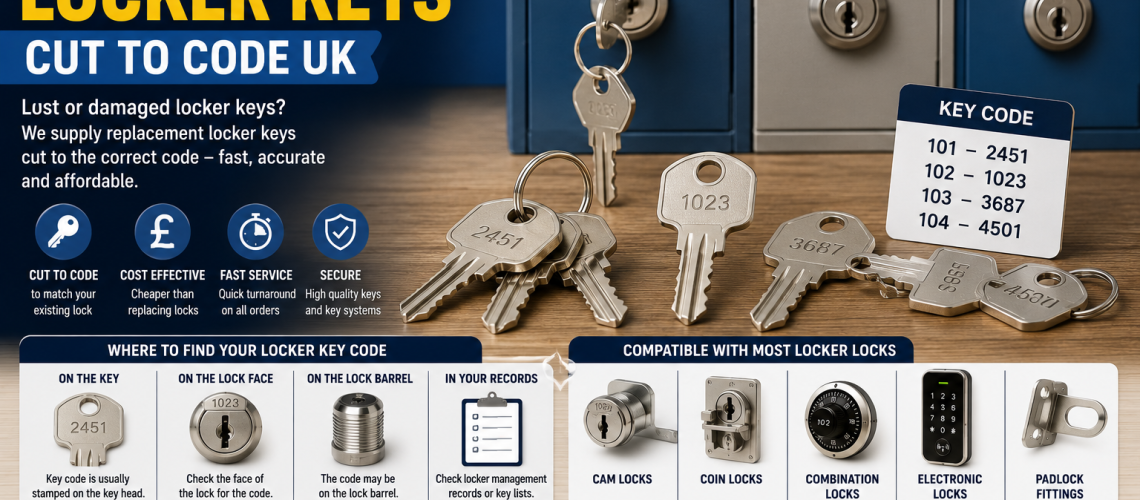
A locker key that will not turn is first a key-diagnosis problem, not automatically a locker-lock problem. The key may be wrong, bent, twisted, worn, cracked or damaged. A replacement key may also have been ordered from the wrong code or manufacturer series. The safest first step is to stop applying extra force and establish whether the fault follows the physical key or stays with the locker.
This guide focuses specifically on stuck, bent, worn and snapped locker keys: how to recognise key damage, how to compare a problem key with a known-good spare, what information to record before discarding a damaged key, when a cut-to-code replacement is appropriate and when the evidence says the problem has moved beyond the key itself.
If the key is simply missing, use our replacement locker keys UK service. If several correct keys fail in the same locker, move to the Common Locker Lock Problems and Fixes guide. This page deliberately stays on the key side of that boundary.
Quick Answer: Why Won’t My Locker Key Turn?
A locker key may not turn because the key is incorrect, bent, twisted, worn, cracked or damaged, because it has not entered the keyway fully, or because the replacement key does not match the correct manufacturer and code series. If a known-good spare works smoothly in the same locker, the evidence points strongly towards the problem key. If several correct keys show the same resistance, stop treating it as a key fault and investigate the lock, cam, door or frame instead.
| What you observe | What it suggests | Best next step |
|---|---|---|
| One key is stiff but a known-good spare works normally | Worn or damaged key | Replace the problem key |
| Key is visibly bent or twisted | Physical key damage | Stop using it and record the code |
| Key has a crack or weak point | High risk of snapping | Remove it from service immediately |
| Key only enters part way | Wrong profile, damaged key or obstructed keyway | Do not force it |
| New replacement key never worked | Code, manufacturer or series may be wrong | Recheck identification before re-ordering |
| Several correct keys are stiff in one locker | Probably not a key-only problem | Move to lock/door diagnosis |
| Key has snapped | Physical key failure | Keep the pieces, record the code and assess fragment access |
Do not keep increasing the turning force. A damaged key is normally simpler to replace while it is still intact than after part of the blade has broken inside the cylinder.
First Test: Does the Problem Follow the Key?
The most useful distinction is simple: does the fault follow one particular key, or does it remain with one particular locker?
- Confirm that the problem key is intended for that locker.
- Inspect the key for bending, twisting, cracks, worn cuts or a damaged tip.
- If an authorised known-good spare exists, test it normally.
- If the spare works smoothly, replace the problem key.
- If the spare behaves in exactly the same way, stop focusing on the key and investigate the locker.
This prevents a common facilities-management mistake: repeatedly ordering keys for a locker whose actual fault is mechanical.
Check That It Is the Correct Locker Key
A key that enters a locker lock is not necessarily the correct key. Large locker estates can contain many keys that look almost identical, and different cutting patterns can be used on the same blank profile.
Before treating resistance as a mechanical fault, check:
- the complete number stamped, engraved or printed on the key;
- any letter prefix or suffix;
- the number or code shown on the lock face where present;
- the locker allocation or key register;
- the lock or key manufacturer;
- whether the lock has previously been replaced.
Do not assume that a locker numbered 125 automatically uses key 125. Locker numbers identify compartments; key numbers identify a particular key or lock code.
If the code is unclear, use How to Find Your Locker Key Code UK and Locker Key Numbers Explained. If the manufacturer is known, use the locker key manufacturer selector.
Inspect the Physical Key Before Trying Again
Remove the key and look at it closely before making another attempt. A small amount of damage can be enough to change how the key enters or engages with the lock.
- visible bend along the blade;
- twist in the blade;
- hairline crack;
- damage where the blade meets the head;
- rounded or heavily worn cuts;
- damaged or shortened tip;
- corrosion or contamination;
- movement between the blade and a plastic head;
- marks showing that the key has previously been bent and straightened.
A damaged key should not be treated as something to “get one more use” from. Every additional attempt increases the chance of the key failing inside the cylinder.
Bent Locker Keys: Replace Rather Than Repeatedly Straighten
A locker key can bend because excessive turning force has been applied, because the key has been crushed while being carried, because the wrong key has been forced into the lock, or because the locker has become increasingly difficult to operate.
A visibly bent key is usually better replaced than straightened and returned to normal service. Metal that has already deformed can be weakened even if it appears straight afterwards.
This is particularly important where the bend is close to the shoulder or the point where the blade joins the key head. That area experiences substantial stress when the key is turned.
Before disposing of a bent key, record its complete code and manufacturer. If the correct code is known, the replacement can often be produced from the coded information rather than copied from the distorted key. See Replacement Locker Keys by Code UK.
Worn Locker Keys: Why a Key Can Look Fine but Stop Working Properly
Wear can be harder to identify than a visible bend. A key may still look broadly correct while its cuts or contact surfaces have worn enough to affect operation.
Warning signs include:
- the key used to work smoothly but now needs repeated attempts;
- it works only when moved slightly in or out;
- a newer spare works the same lock more smoothly;
- the cuts look rounded or polished;
- the blade is visibly thinner at wear points;
- the key needs more turning force than it previously did.
Where the manufacturer and correct code are known, a cut-to-code replacement avoids using the worn key itself as the physical cutting pattern. This is one of the strongest reasons to keep accurate key-code records across a locker estate.
Cracked Locker Keys: Remove Them from Service Before They Snap
A cracked key may continue to work for a short period, which makes it easy to ignore. It should instead be treated as a near-failure condition.
Remove the key from service if you can see a hairline crack, a split around the head, movement between the blade and head, or a weak point where the key has previously bent.
Record the code before the key fails. A readable damaged key can still contain all the information needed to order a replacement.
The Locker Key Goes In but Will Not Turn
If the key enters normally but will not rotate, keep the diagnosis key-focused at first:
- Confirm that it is the correct key.
- Inspect the blade for bending, twisting, cracking and wear.
- Check that it is inserted to its normal depth.
- Try a known-good spare if one is available and authorised.
- If the spare works, replace the original key.
- If the spare also fails, stop. The evidence now points away from the key alone.
At that point, use the Common Locker Lock Problems and Fixes guide. That page owns the lock-side diagnosis: cylinder faults, cams, door alignment, spinning locks and other mechanical problems.
The Locker Key Will Not Go Fully Into the Lock
Do not force a key that stops before reaching its normal insertion depth.
From the key side, check for:
- the wrong key or wrong key profile;
- a bent blade;
- a twisted blade;
- a damaged key tip;
- an incorrectly supplied replacement key.
If a correct, undamaged key also cannot enter normally, the problem is no longer adequately explained by the key itself. Do not push harder. Use the Locker Lock Identification Guide UK or arrange appropriate servicing.
A New Replacement Locker Key Will Not Turn
A new key failing does not automatically mean it was cut badly. Recheck the identification chain before ordering another replacement.
| Check | Why it matters |
|---|---|
| Manufacturer | The same number can belong to different manufacturer ranges. |
| Complete code | A missing prefix or suffix can identify the wrong key. |
| Ambiguous characters | 0/O, 1/I, 5/S and similar characters can be misread. |
| Locker number vs key number | The number on the locker door is not automatically the cutting code. |
| Lock replacement history | The current lock may no longer match old site records. |
| Known-good old key | If the old key still works, the replacement details need checking. |
If you know the manufacturer but are unsure which range applies, use Locker Keys by Brand. If the code itself is uncertain, use How to Find Your Locker Key Code UK.
Do Not Force a Stiff Locker Key
A key that suddenly needs more force is giving useful diagnostic information. Extra torque does not identify the problem; it only increases the chance of bending, twisting or snapping the blade.
Stop using the key if it begins to flex, if resistance has increased noticeably, or if you have to “work” the key repeatedly to make it operate. Compare it with a known-good spare and replace the key if the fault follows the key.
Warning Signs That a Locker Key Is About to Snap
- a visible bend or twist;
- a key that has previously been straightened;
- a hairline crack;
- movement between blade and head;
- heavy wear near the shoulder;
- a damaged tip;
- repeated flexing during use;
- rapidly increasing turning force.
If any of these appear, record the key details and replace it before failure.
Locker Key Snapped in the Lock: What to Do First
A snapped key is still primarily an information-preservation problem before it becomes a replacement-order problem.
- Stop trying to operate the lock.
- Keep the broken key head and every recovered piece.
- Record the complete key number and any manufacturer markings.
- Record the locker number separately.
- Photograph the lock face.
- Check whether another authorised key exists.
- Note whether the locker is currently open or closed.
- Assess whether the fragment is already projecting or is fully recessed.
The broken key may still provide the exact manufacturer and code needed to produce a replacement. Do not discard it until those details have been recorded.
Should You Try to Pull a Broken Locker Key Out?
If a substantial part of the key is already projecting and can be gripped without pushing it deeper, removal may be straightforward. If the fragment is fully recessed, repeated experiments can damage the keyway or push the fragment further into the cylinder.
Avoid adhesive, glue, screwdrivers, blades or improvised tools inserted into the keyway. If the fragment is not readily accessible, treat it as a servicing issue rather than escalating a simple broken-key problem into lock damage.
Total Locker Service provides locker servicing, repairs and maintenance for commercial locker installations.
Can You Order a Replacement From a Snapped Locker Key?
Often, yes. A broken physical key does not prevent a replacement being produced where the correct manufacturer and key code can still be identified.
The information may come from:
- the broken key head;
- another spare key;
- the lock face or barrel;
- an accurate site key register;
- a previous replacement-key order;
- a manufacturer-specific key schedule.
Use the Replacement Locker Keys by Code UK guide for the cut-to-code process, or go directly to Replacement Locker Keys UK when the manufacturer and code are already known.
Copying a Worn Key vs Cutting a Replacement by Code
If an old key is visibly worn, bent or distorted, copying the physical key may reproduce some of that deterioration. Where the correct manufacturer and key code are available, cutting from the coded information avoids deliberately using the damaged key as the cutting pattern.
| Situation | Better route |
|---|---|
| Key is intact and unworn | Confirm code and manufacturer before ordering |
| Key is badly worn | Prefer cut-to-code where the correct code is known |
| Key is bent | Record the code; do not rely on the bent blade as a reference |
| Key is snapped but code is readable | Order from the correct code |
| Code cannot be established | Identify the key/lock before ordering |
When a Replacement Locker Key Is the Right Solution
A replacement key is the logical route when the evidence follows the key rather than the locker.
- a known-good spare works normally;
- the user key is bent, twisted, cracked or badly worn;
- the key has snapped but the lock remains serviceable;
- the correct manufacturer and code are known;
- the current lock still meets the site’s access requirements;
- existing master-key compatibility needs to be retained.
Replacement keys can be ordered through Replacement Locker Keys UK. If the manufacturer is known, the Locker Key Manufacturer Selector routes to the correct supported key range.
When the Evidence Says It Is Not a Key Problem
This article should stop where the physical-key evidence stops. Move to lock or locker diagnosis when:
- several correct keys fail in the same locker;
- a known-good spare shows exactly the same resistance;
- the key turns only when the locker door is pushed or pulled;
- the lock has been forced;
- the barrel spins in the door;
- the keyway is visibly damaged;
- the locker repeatedly damages correctly supplied keys.
Use Common Locker Lock Problems and Fixes for mechanical diagnosis. If the lock itself must be identified, use the Locker Lock Identification Guide UK. For replacement-lock decisions, see the Locker Lock Replacement Guide UK.
What Information Should You Record From a Damaged Locker Key?
A damaged key can still be valuable identification evidence. Before throwing it away, record:
- the complete key number;
- every letter prefix or suffix;
- manufacturer name or logo;
- locker number;
- site or department;
- whether the key is user, master, service or override access;
- whether another known-good spare exists;
- whether the lock has previously been changed.
Photograph both sides of the key, the key number, the damaged area and the lock face. If the locker is already open and it is safe to do so, a photograph of visible lock markings can also help identification. Do not dismantle a locked mechanism merely to obtain a photograph.
Why a Known-Good Spare Is So Useful
A verified spare key is not only an emergency-access item. It is a diagnostic reference.
If the damaged or worn user key is stiff but the known-good spare operates smoothly, the evidence strongly supports key replacement. If both keys behave the same way, the fault is unlikely to be solved by supplying another user key.
Facilities teams managing larger locker estates should control spare and master keys appropriately rather than leave them in general circulation. For wider governance, see Locker Key Management Systems UK.
How to Prevent Bent, Worn and Snapped Locker Keys
- Do not force a key that has become unusually stiff.
- Remove visibly bent, twisted or cracked keys from service.
- Record the manufacturer and key code before keys become unreadable.
- Keep controlled known-good spares where appropriate.
- Use cut-to-code replacement where a badly worn key should not be copied.
- Investigate lockers that repeatedly damage keys.
- Update key records whenever a locker lock is changed.
- Keep locker numbers and key numbers as separate data fields.
- Use manufacturer-specific ordering routes when the brand is known.
Stuck, Bent or Snapped Locker Key: Final Decision Table
| Situation | Action | Best route |
|---|---|---|
| Bent key, spare works normally | Replace key | Replacement locker keys |
| Worn key, spare works normally | Replace key, preferably by code where known | Cut-to-code guide |
| New key never worked | Recheck manufacturer and code | Keys by brand |
| Key code unclear | Identify the correct code | Find locker key code |
| Snapped key, code readable | Retain pieces and order correct replacement | Replacement locker keys |
| Fragment recessed in lock | Do not improvise extraction | Locker servicing |
| Several correct keys fail | Stop treating it as a key-only fault | Lock problems guide |
| Lock identity unclear | Identify lock before ordering | Lock identification guide |
Relevant Locker Key Guides
- Replacement Locker Keys UK
- Locker Keys by Manufacturer and Brand
- Replacement Locker Keys by Code UK
- How to Find Your Locker Key Code UK
- Locker Key Numbers Explained
- Locker Key Management Systems UK
- Common Locker Lock Problems and How to Fix Them
- Locker Lock Identification Guide UK
- Locker Servicing, Repairs and Maintenance
Locker Key Won’t Turn FAQs
Why won’t my locker key turn?
The key may be incorrect, bent, twisted, worn or damaged, or it may not match the correct manufacturer and code series. Compare it with a known-good spare where available. If several correct keys fail in the same locker, investigate the lock or door rather than ordering more keys.
What should I do with a bent locker key?
Stop using it, record the complete key number and manufacturer, and replace it. Repeated straightening can leave the blade weakened and more likely to snap.
Can a worn locker key be replaced from its number?
Many locker keys can be replaced from the correct manufacturer key code. Where the code is known, cut-to-code replacement avoids using a badly worn physical key as the cutting pattern.
Why does a new replacement locker key not work?
Recheck the manufacturer, complete key code, letter prefixes or suffixes, and whether the locker lock has previously been changed. The number on the locker door is not automatically the key-cutting code.
Should I force a locker key that is difficult to turn?
No. Increasing the force can bend, twist or snap the key. Stop and determine whether the problem follows the key or remains with the locker.
What should I do if a locker key snaps in the lock?
Stop operating the lock, keep the broken pieces, record the key number and manufacturer, and photograph the lock face. If the fragment is fully recessed, avoid improvised extraction methods that could damage the cylinder.
Can I order a locker key if the original has snapped?
Often yes. Many replacement locker keys can be cut from the correct manufacturer code even if the original physical key is broken.
How can I tell whether the key or the locker is faulty?
Compare the problem key with a known-good spare. If the spare works smoothly, the original key is probably worn or damaged. If several correct keys fail in the same locker, the problem is unlikely to be the key alone.
Should I copy a badly worn locker key?
Where the correct manufacturer and key code are known, a cut-to-code replacement is preferable to deliberately using a badly worn or distorted key as the physical cutting reference.
Stop Before a Stiff Locker Key Becomes a Snapped Locker Key
A locker key should operate without excessive force. If it becomes stiff, start with the physical key: confirm that it is correct, inspect it for bending, wear and cracks, and compare it with a known-good spare where available.
If the fault follows the key, replace the key. If several correct keys behave badly in the same locker, hand the problem over to lock and door diagnosis rather than continuing to order replacement keys.
If the key has already snapped, retain the pieces and record the manufacturer and code. A broken key can still contain the information needed to produce an accurate replacement.
Total Locker Service cuts replacement locker keys for many common locker brands and provides locker servicing and repairs when the evidence shows that the problem is no longer the key itself.
Discover more from Blog Total Locker Service
Subscribe to get the latest posts sent to your email.