Engraved Tags for Lockers, Keys & Equipment: Which Type Do You Need?
April 9, 2026
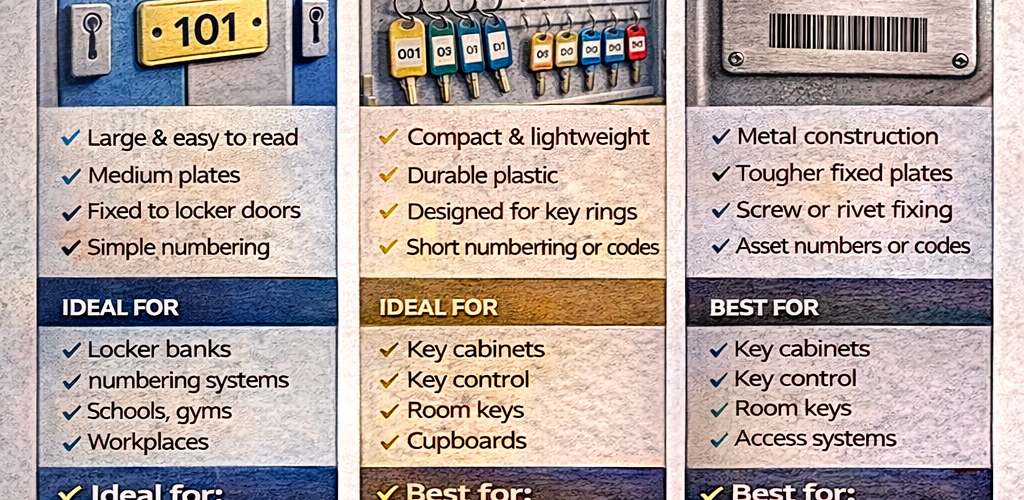
Engraved tags are used for many different types of identification, but the same product is not suitable for every job. A fixed locker number plate, a tag attached to a key and an equipment identification plate all perform different functions.
This guide helps you choose between engraved locker tags, key tags, equipment plates and nameplates. It owns the product-selection decision: what needs to be identified, whether the identification should remain fixed or move with the item, who needs to read it and which product type best suits that job. Detailed sizing, fixing, numbering, maintenance and key-control workflow decisions are handled in the specialist guides linked below.
For the wider engraved identification range, visit our engraved products page.
Quick Answer: Which Type of Engraved Tag Do You Need?
| Application | Best identification type | Main purpose |
|---|---|---|
| Locker door | Fixed engraved locker tag or number plate | Identify the physical locker or compartment |
| Key | Engraved key tag or fob | Identify the removable key |
| Equipment or asset | Engraved equipment plate | Identify machinery, equipment or an asset |
| Cupboard or room | Engraved nameplate | Identify a location or storage area |
Why Choosing the Correct Engraved Product Matters
The first decision is not size, colour or fixing method. It is what the identification is attached to and whether it should stay fixed or move. A locker tag remains fixed to a door, a key tag moves with the key, an equipment plate remains associated with an asset and a nameplate identifies a place or storage function.
Choosing the wrong product can create problems such as:
- poor readability;
- awkward handling;
- identification being attached to the wrong item;
- unnecessary information on small tags;
- inconsistent references;
- difficulty matching physical items to management records.
Engraved Locker Tags and Number Plates
Engraved locker tags are designed to identify a fixed locker door or compartment. They normally carry a clear number, letter or short reference that remains associated with the physical locker.
- fixed to the locker rather than carried by the user;
- designed for clear visual identification;
- suitable for locker banks and changing rooms;
- can link the physical locker to allocation and maintenance records;
- normally use a short permanent reference.
Typical applications include schools, workplaces, gyms, leisure centres, healthcare changing rooms and industrial locker installations.
For the operational use of locker identifiers in allocation, maintenance and estate records, see our Engraved Locker Identification UK guide.
For the physical specification of locker number plates, including shapes, dimensions, materials, colours, locker-specific fixing considerations and replacement matching, use the Engraved Locker Number Plates guide.
Engraved Key Tags and Key Fobs
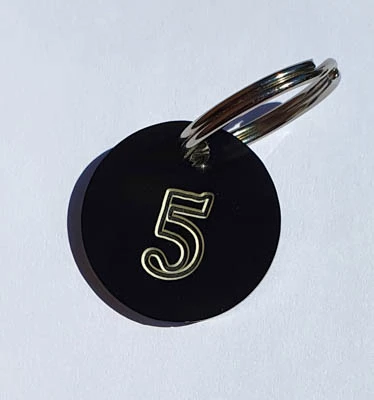
An engraved key tag identifies a removable key rather than a fixed locker, door or cabinet. It moves with the key and should therefore remain compact and easy to recognise when handled.
- attached to the key or key ring;
- read at close range;
- normally uses a short number or reference;
- can correspond with a key cabinet or register;
- helps distinguish similar-looking keys.
Key tags are commonly used for facilities keys, locker keys, room keys, vehicle keys, plant rooms and general workplace key control.
If the key tag forms part of a managed physical key-control system, hand the detail to our Engraved Key Tags for Key Cabinets guide, which owns cabinet positions, issue-and-return procedures, key registers, lost-key identification and replacement continuity.
For engraved key tags, key fobs and number-disc products, visit our engraved identification products page.
Engraved Equipment and Asset Plates
Equipment plates identify machinery, tools, plant, storage equipment or other workplace assets. Unlike a simple locker number, they may need to carry an asset code, equipment reference, department identifier or other operational information.
- fixed to the equipment or nearby surface;
- used for maintenance and asset identification;
- may carry longer references than locker or key tags;
- can support inspection and servicing records;
- useful where several similar assets need individual identification.
Equipment identification is particularly useful in warehouses, factories, plant rooms, workshops and facilities-management environments.
Engraved Nameplates for Cupboards, Doors and Storage Areas
An engraved nameplate identifies a location rather than an individual removable item. Typical examples include cupboards, rooms, storage areas, plant spaces and departmental facilities.
- identifies what a cupboard or area is used for;
- can display a department or room name;
- helps users locate storage or equipment;
- provides permanent workplace identification;
- can complement numbered locker, key and asset systems.
Fixed Identification vs Mobile Identification
One of the simplest ways to choose the correct product is to decide whether the identification should remain fixed in one location or move with the item.
| Identification type | Fixed or mobile? | Typical example |
|---|---|---|
| Locker tag | Fixed | Locker 126 |
| Key tag | Mobile | Key reference PLANT-04 |
| Equipment plate | Fixed | Asset 1847 |
| Door or cupboard nameplate | Fixed | Cleaning Store |
A common mistake is to confuse the fixed identifier with the movable one. A locker number plate identifies the locker. A key tag identifies the key. They may use the same reference, but they are still different products performing different jobs.
User-Facing vs Facilities-Facing Identification
Another useful distinction is whether the identification is mainly intended for the everyday user or for facilities and maintenance teams.
| Identification | Primary audience | Typical purpose |
|---|---|---|
| Locker number | User and facilities team | Find and identify a locker |
| Key tag | Staff or key-control user | Identify a physical key |
| Equipment plate | Facilities and maintenance | Identify an asset or machine |
| Room or cupboard nameplate | General users | Identify a location or storage function |
Should the Same Reference Appear on Different Products?
Sometimes yes. A locker and its key may share the same operational number, or an equipment plate may use the same reference as an asset register.
The important point is that each tag should identify the item to which it is attached.
- locker tag → identifies the locker;
- key tag → identifies the key;
- equipment plate → identifies the equipment or asset;
- nameplate → identifies a room, cupboard or location.
For locker numbering sequences, prefixes and expansion planning, use our Locker Numbering & Labelling Guide UK.
A Simple Order for Choosing the Right Engraved Identification
- Identify the physical item or location that needs a reference.
- Decide whether the identification must remain fixed or move with the item.
- Decide whether the main reader is the everyday user, key-control staff, facilities staff or maintenance staff.
- Choose the product type: locker tag, key tag, equipment plate or nameplate.
- Only then move to sizing, fixing, numbering structure, maintenance or workflow detail in the relevant specialist guide.
Choosing by Application
| Application | Recommended identification type |
|---|---|
| School locker | Fixed engraved locker number plate |
| Staff locker | Fixed engraved locker tag |
| Gym locker | Visible locker number plate |
| Locker key | Compact engraved key tag or fob |
| Key cabinet | Engraved key tags matched to cabinet records |
| Plant-room key | Engraved key tag |
| Machine | Fixed engraved equipment plate |
| Asset | Engraved asset identification plate |
| Storage cupboard | Engraved nameplate |
| Room | Engraved location or room nameplate |
Size Depends on How the Identification Is Used
The different product types naturally have different sizing priorities, but size is a second-stage decision. This article only identifies the sizing priorities that follow from the product choice and does not duplicate detailed size selection.
- locker tags usually prioritise visible numbers;
- key tags prioritise compact handling;
- equipment plates may need space for several pieces of information;
- nameplates may need room for words rather than short codes.
For viewing distance, character height, tag proportions and mounting space, use our dedicated guide: What Size Should Engraved Tags Be?
Choose the Fixing Method Separately
Once the correct identification product has been chosen, the attachment method can be selected separately. A locker plate may use adhesive or mechanical fixing, an equipment plate may be screwed or riveted and a key tag normally uses a ring or loop. This page should not turn that into a general fixing-method comparison.
For detailed advice on adhesive, screws, rivets and mobile attachments, use our Engraved Tag Fixing Guide.
Keep the Information Appropriate to the Product
The amount and type of information should reflect the job performed by the identification product.
| Product | Typical information |
|---|---|
| Locker tag | Number, letter or short locker reference |
| Key tag | Short key or cabinet reference |
| Equipment plate | Asset code, equipment name or location reference |
| Nameplate | Room, cupboard or storage-area description |
Avoid trying to make one small tag carry every piece of operational information. Detailed descriptions and records can be held separately where appropriate.
Practical Product-Choice Examples
School Locker Bank
A school installs lockers numbered 001–300. The identification needs to remain on each compartment and be visible to pupils and staff.
Best choice: fixed engraved locker number plates.
Facilities Key Cabinet
A facilities department manages keys stored on numbered hooks and records each issue and return.
Best choice: compact engraved key tags linked to the key-cabinet reference system.
Warehouse Equipment
A warehouse needs a permanent reference on each item of equipment so faults and inspections can be recorded accurately.
Best choice: fixed engraved equipment or asset plates.
Cleaning Cupboard
A cupboard needs to be clearly identified so staff can locate cleaning supplies.
Best choice: an engraved nameplate carrying the cupboard or storage-area description.
Common Engraved Tag Selection Mistakes
Using One Tag Type for Every Application
A small key tag and a fixed locker plate have different requirements. Standardising references can be useful, but standardising the physical product regardless of application is not always appropriate.
Confusing Locker Identification with Key Identification
The locker tag identifies the fixed compartment. The key tag identifies the movable key. They can share a reference without being the same product.
Choosing Only by Appearance
Appearance matters, but the product first needs to suit the item being identified and the way that identification is used.
Adding Too Much Information
Small tags become difficult to use when they are overloaded with information. Keep the physical identifier concise and move detailed information into the associated register or management record where appropriate.
Choosing the Fixing Method Before the Product
First decide what needs to be identified and whether the tag should remain fixed or move with the item. The fixing method can then be selected for that product and surface.
When This Guide Is Not the Right One
This article owns the decision between locker tags, key tags, equipment plates and nameplates. Its job is to answer which identification product should be used. It should not become the detailed guide for dimensions, fixing, numbering, maintenance, locker operations or key-control workflow. Use the specialist guides below for those decisions.
- Tag dimensions and character size: use What Size Should Engraved Tags Be?
- Adhesive, screw, rivet or hanging attachment: use the Engraved Tag Fixing Guide.
- Locker numbering sequences, prefixes and references: use the Locker Numbering & Labelling Guide UK.
- Locker number-plate specification: use the Engraved Locker Number Plates guide.
- Locker allocation, records and maintenance identification: use Engraved Locker Identification UK.
- Key-cabinet references and issue-and-return workflow: use Engraved Key Tags for Key Cabinets.
- Cleaning and replacing existing tags: use Maintain and Replace Engraved Tags.
- General engraved identification: use the Engraved Products UK guide.
Engraved Identification Products from Total Locker Service
Total Locker Service supplies engraved identification products for lockers, keys, equipment and workplace storage. Start by choosing the correct identification type according to what is being identified, whether the reference is fixed or mobile and whether it is primarily user-facing or facilities-facing. Product dimensions, fixing and detailed operational workflows can then be specified separately.
Related Engraved Identification Guides
- Engraved Products UK — broad engraved-identification guide.
- What Size Should Engraved Tags Be? — tag dimensions, viewing distance and character size.
- How to Fix Engraved Tags & Nameplates — adhesive, screws, rivets and hanging fittings.
- Engraved Locker Number Plates — locker-specific physical plate specification.
- Engraved Locker Identification UK — locker allocation, maintenance and records.
- Engraved Key Tags for Key Cabinets — key-cabinet positions, registers and issue-and-return workflow.
- Maintain and Replace Engraved Tags — cleaning, damage and replacement consistency.
- Engraved Identification Products — commercial engraved identification products.
Engraved Tag Selection FAQs
What is the difference between a locker tag and a key tag?
A locker tag remains fixed to the locker or compartment it identifies. A key tag is attached to a movable key. They can use the same operational reference but perform different identification jobs.
What type of engraved tag should I use on a locker?
A fixed engraved locker tag or number plate is normally suitable because it gives the physical locker a permanent visible reference.
What type of engraved tag should I use for keys?
A compact engraved key tag or fob is normally appropriate because it moves with the key and can carry a short key, room or cabinet reference.
What is an engraved equipment plate used for?
An engraved equipment plate identifies machinery, tools, plant or other workplace assets and can carry an asset code, equipment reference or location identifier.
Can a locker tag and key tag use the same number?
Yes. They may share the same operational reference, but the locker tag identifies the fixed locker while the key tag identifies the movable key.
Should I choose the tag size before choosing the product type?
No. First decide what needs to be identified and whether the identification is fixed or mobile. The required size can then be chosen according to viewing distance, text quantity and available space.
How should engraved tags be fixed?
The fixing method depends on the product, surface and environment. Options can include adhesive, screws, rivets, split rings and other suitable attachments.
Where can I buy engraved tags for lockers, keys and equipment?
Total Locker Service supplies engraved identification products for lockers, keys, cabinets, equipment and workplace storage applications.
Discover more from Blog Total Locker Service
Subscribe to get the latest posts sent to your email.