Fire Rated Cabinet Requirements UK: Compliance & Insurance Guide (2026)
February 26, 2026
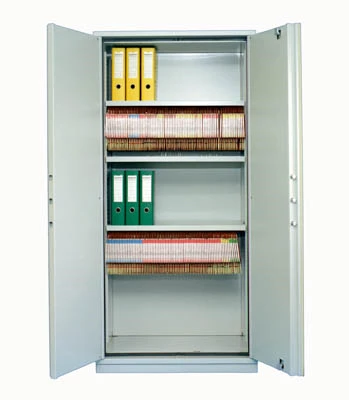
Fire-rated cabinet requirements in the UK depend on what you need to protect. Paper records, digital media, cash, valuables and hazardous substances do not share one universal cabinet standard, and a product described simply as “fire rated” is not enough information for a compliant specification.
For document and data storage, the important checks are the tested fire standard, protection class, duration, contents covered by the test, security requirement, capacity and installation conditions. UK law generally does not name a fire-resistant document cabinet as a universal requirement, but organisations may still need suitable physical protection because of fire-risk assessments, information-security duties, insurer conditions, contractual requirements or sector-specific rules.
This guide focuses on fire-resistant cabinets for documents and data. It does not treat COSHH, flammable-liquid or hazardous-material cabinets as the same product category, because those storage systems have different hazards and requirements.
Fire-Rated Cabinet Requirements UK: Quick Answer
There is no single UK rule that says every business must install a fire-rated document cabinet. Instead, specify the cabinet around the risk and the contents. For paper records, look for a recognised fire-resistance classification that applies to paper. For heat-sensitive digital media, use a data cabinet or data safe rated for that media type. If theft protection is also required, check the burglary-resistance rating separately because fire and burglary performance are different tests.
| Storage requirement | What to check | Relevant route |
|---|---|---|
| Paper documents | Tested paper fire classification and duration | Fire-resistant document cabinet or fire safe |
| Digital media | Data-media fire classification, temperature and humidity protection | Data cabinet or data safe |
| Cash or valuables | Fire protection plus separate burglary/security rating where needed | Fire and security safe |
| Large active filing systems | Paper fire protection, drawer capacity and access frequency | Fire-resistant filing cabinet |
| Hazardous substances | Substance-specific storage and fire-risk requirements | Specialist safety/COSHH/flammable storage, not a document cabinet |
What Is a Fire-Rated Cabinet?
A fire-rated or fire-resistant cabinet is a storage unit whose fire performance has been tested to a defined standard or test method. The test should identify what type of contents the cabinet is intended to protect and for how long under the specified test conditions.
This is different from an ordinary steel storage cabinet. Steel construction alone does not establish fire resistance. A normal cabinet can be durable and secure for general workplace storage without having a tested fire classification for documents or data.
It is also important to distinguish a document fire cabinet from a data cabinet. Paper can tolerate higher temperatures than many forms of digital media, so products designed for documents and products designed for data are not interchangeable.
Fire-Resistant Cabinet Standards Used in the UK
The relevant standard depends on the product and the contents. Do not treat every safe or cabinet standard as a fire standard.
BS EN 15659: Light Fire Storage Units
BS EN 15659 covers classification and fire-resistance testing for light fire storage units. It is relevant to products intended to protect paper documents and includes paper classifications such as LFS 30 P and LFS 60 P, depending on the tested product.
When a cabinet is sold with an EN 15659 classification, check the exact class shown in the manufacturer documentation rather than assuming every product under the standard has the same protection time.
BS EN 1047-1: Data Cabinets and Data Inserts
BS EN 1047-1 applies to fire-resisting data cabinets and data inserts. It uses fire-severity levels including S 60 and S 120 and different protection classes for contents with different temperature and humidity tolerances.
This is important where the contents include hard drives, backup media or other heat-sensitive data. A paper cabinet should not automatically be assumed suitable for digital media.
For the wider paper-versus-data distinction, see data safes vs fire safes.
BS EN 14450: Burglary Resistance, Not Fire Resistance
BS EN 14450 is often encountered when comparing secure safes and cabinets, but it is a burglary-resistance standard. It classifies secure cabinets for resistance to burglary and should not be presented as evidence of fire protection.
A product can have both fire protection and burglary resistance, but those characteristics should be checked separately. The same principle applies to higher-security safe standards such as EN 1143-1.
Other Fire Test Standards
You may also encounter products tested to standards or test methods such as NT Fire 017 or UL 72. These should not be treated as interchangeable simply because they quote the same number of minutes. Check the content class, test method, certificate and manufacturer specification for the exact product.
What Do 30, 60, 90 and 120-Minute Fire Ratings Mean?
A fire-protection duration tells you how long a particular product or design has been tested under the conditions of the relevant standard or test method. It is not a general promise that every 60-minute cabinet provides the same protection.
- 30 minutes: available on some light fire-storage products and document safes.
- 60 minutes: common across a range of paper-document and selected data-storage products.
- 90 minutes: available on some document cabinets and safes under particular test methods.
- 120 minutes: available on selected higher-duration document or data products.
The correct duration should follow the risk assessment, value and replaceability of the contents, building conditions and any insurer or contractual requirement. For a detailed comparison, use our fire safe ratings UK guide.
Are Fire-Rated Document Cabinets Legally Required in the UK?
There is no general UK law that requires every organisation to store important paperwork in a product specifically called a fire-rated cabinet.
For non-domestic premises in England and Wales, the Regulatory Reform (Fire Safety) Order 2005 places duties on the responsible person to carry out a suitable and sufficient fire-risk assessment and put appropriate fire-safety measures in place. The legislation is primarily concerned with fire safety and the protection of people; it does not prescribe a universal document-cabinet model.
Data-protection law also takes a risk-based approach. The UK GDPR requires appropriate technical and organisational measures to protect personal data against accidental loss, destruction or damage and to support availability and resilience. It does not state that every controller must use a fire-rated cabinet.
A fire-resistant cabinet can therefore form part of an organisation’s physical security, records management or business-continuity controls where the risk justifies it, but the legal duty should not be overstated as a specific cabinet mandate.
Fire-Rated Cabinets and Insurance Requirements
Insurance requirements vary by insurer, policy, premises and contents. Do not assume that a product described as “fireproof”, “fire rated” or “security rated” automatically satisfies your policy.
- Ask whether the insurer requires a particular fire test standard or duration.
- Confirm whether the requirement relates to paper documents, data media, cash or valuables.
- Check whether a separate burglary or cash rating is required.
- Confirm any fixing, anchoring or installation conditions.
- Keep the product certificate and specification where the policy requires evidence.
Where insurance acceptance matters, obtain the insurer’s requirement before purchase. Total Locker Service supplies fireproof safes and fire-resistant cabinets as well as a wider safe range for different security requirements.
Document Cabinets vs Data Cabinets
| Factor | Document fire cabinet | Data cabinet or data safe |
|---|---|---|
| Main contents | Paper files, contracts, certificates and records | Heat-sensitive digital or backup media |
| Main test concern | Limiting heat transfer to protect paper | Lower internal temperatures and, depending on class, humidity control |
| Relevant standard example | BS EN 15659 for light fire storage units | BS EN 1047-1 for data cabinets and data inserts |
| Typical storage format | Shelves, drawers or filing systems | Cabinet or safe designed for media protection |
| Can one replace the other? | No assumption should be made | No assumption should be made |
Do not use the often-repeated “paper ignites at 177°C” figure as the sole specification rule. A certified product should be selected from its tested classification and intended contents, not from a single ignition-temperature number.
When Is a Fire-Resistant Filing Cabinet the Right Choice?
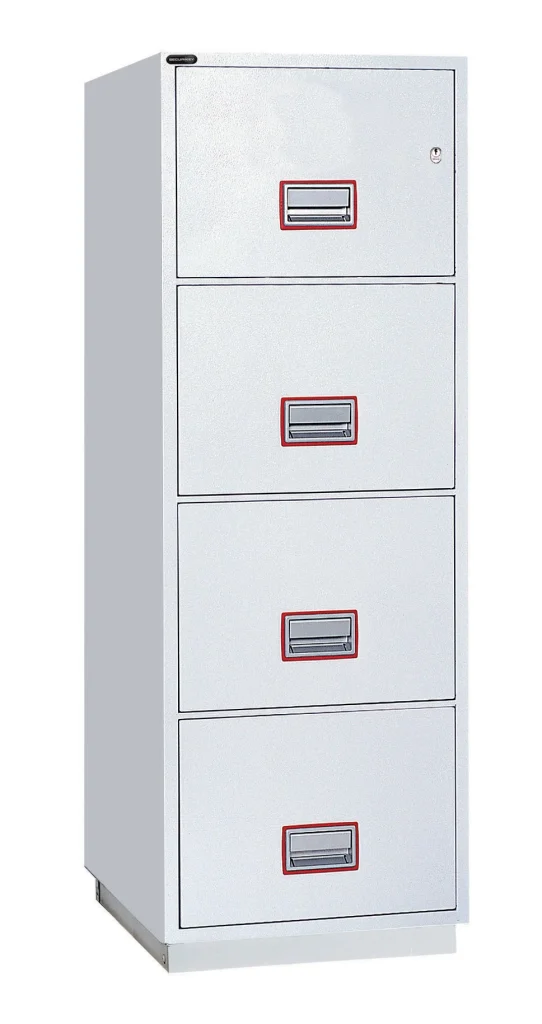
A fire-resistant filing cabinet is useful where the main requirement is protecting a large volume of organised paper records that staff need to access regularly. Drawer-based storage can be more practical than a conventional safe for HR files, accounts records, contracts, legal files and other active paperwork.
If the choice is between a conventional safe and a filing cabinet, use our fire safe vs fire-resistant filing cabinet guide. For current product options, see the fireproof safes and cabinets range.
Are Hazardous-Material Cabinets the Same as Fire-Rated Document Cabinets?
No. This is an important distinction. Cabinets for flammable liquids, chemicals, COSHH-controlled substances or other hazardous materials are specified around the hazards of those substances and the relevant workplace controls. They should not be grouped with document fire cabinets merely because both products may use the words “fire resistant”.
If the storage requirement involves hazardous substances, start with the substance-specific risk assessment, safety data sheets and relevant health-and-safety guidance rather than a document-safe standard.
Fire-Rated Cabinet Installation and Positioning
The exact installation requirements depend on the manufacturer and model. A heavy cabinet may also create delivery, floor-loading and access issues that should be checked before ordering.
- Check the manufacturer’s fixing or anchoring instructions.
- Confirm the cabinet weight and suitable floor loading.
- Measure doors, corridors, lifts, stairs and turning space on the delivery route.
- Allow enough clearance for doors or drawers to open fully.
- Avoid locations exposed to persistent damp or flooding unless the product is designed for them.
- Do not obstruct escape routes, fire doors or access to fire-safety equipment.
Fire-Rated Cabinet vs Standard Steel Cabinet
| Feature | Fire-resistant document cabinet | Standard steel cabinet |
|---|---|---|
| Primary purpose | Protect specified contents against fire for a tested period | General workplace storage and organisation |
| Fire test | Should have a stated fire test/classification where claimed | No fire resistance should be assumed |
| Construction | Designed to limit heat transfer | Steel construction for general storage |
| Typical contents | Documents, files or other stated fire-protected contents | Tools, supplies, equipment and general items |
| Security | Depends on the separate lock/security specification | Depends on the cabinet and lock |
How to Choose a Fire-Rated Cabinet in the UK
1. Identify the contents
Separate paper files, digital media, cash, valuables and hazardous materials. This determines the product category before you compare dimensions or prices.
2. Identify the required protection
Decide whether the risk is fire only, theft as well as fire, or specialist data protection. If an insurer, customer contract or internal standard specifies a classification, obtain that requirement first.
3. Check the exact test standard and class
Do not stop at “60-minute fire cabinet”. Check which standard was used, which contents the classification covers and whether the certificate applies to the exact model you are buying.
4. Check usable capacity
Compare internal dimensions with the real files, folders or media. Fire-resistant construction can reduce usable internal space, so external cabinet dimensions are not a reliable measure of capacity.
5. Plan delivery and installation
Check weight, route access, floor loading, final position and any anchoring requirements. Large fire-resistant cabinets can be substantially heavier than standard office storage.
Fire-Rated Cabinet Procurement Checklist
- What exactly will be stored?
- Is the product intended for paper or data?
- What fire standard and classification does the exact model carry?
- What fire duration is stated?
- Is burglary resistance also required?
- Does an insurer or contract specify a particular rating?
- Is the certificate or test documentation available?
- Will the internal dimensions accommodate the records?
- Can the floor and delivery route handle the cabinet weight?
- Are fixing and installation requirements understood?
Fire-Rated Cabinet Requirements UK FAQs
Are fire-rated document cabinets legally required in the UK?
There is no universal UK rule requiring every organisation to use a fire-rated document cabinet. The need should follow the fire-risk assessment, information-security requirements, sector rules, contractual obligations and any insurer conditions that apply.
Is BS EN 14450 a fire-resistance standard?
No. BS EN 14450 is a burglary-resistance standard for secure cabinets. A product may also have a separate fire classification, but BS EN 14450 itself should not be used as evidence of fire resistance.
What standard applies to fire-resistant document cabinets?
BS EN 15659 is one relevant standard for light fire storage units used for paper documents. Other products may be tested to different recognised standards or methods, so always check the exact classification and certificate for the model.
What standard applies to fire-resistant data cabinets?
BS EN 1047-1 applies to fire-resisting data cabinets and data inserts and includes classifications for different fire durations and content protection classes.
Can a normal steel cabinet protect documents from fire?
Do not assume that it can. Steel construction alone is not evidence of tested fire resistance. Where fire protection is required, use a cabinet or safe with a confirmed fire classification appropriate to the contents.
Are fire-rated document cabinets suitable for USB drives and hard drives?
Not automatically. Digital media can require lower internal temperatures and different protection from paper. Check a dedicated data cabinet or data safe specification where heat-sensitive media is being stored.
Related Fire-Safe and Cabinet Guides
- Fire Safe Ratings UK: 30, 60, 90 and 120 Minutes
- Data Safes vs Fire Safes
- Fire Safe vs Fire-Resistant Filing Cabinet
- What Fire Safe Do I Need for My Business?
- UK Secure Storage Compliance Guide 2026
Final Thoughts
Fire-rated cabinet requirements in the UK are not defined by one universal cabinet law or one certification. The correct specification starts with the contents and the risk. Paper documents, digital media, valuables and hazardous substances need different storage decisions.
For document storage, check the exact fire test standard, protection class and duration. For data, use a product classified for data-media protection. If theft protection also matters, verify the burglary rating separately. Where insurance or contractual compliance is important, obtain the required specification before ordering and retain the product certification as part of the procurement record.
Discover more from Blog Total Locker Service
Subscribe to get the latest posts sent to your email.